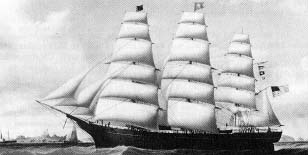
Click on a Ship Name/Year to find a description of the voyage
and possibly a narrative on the overland route.
Athena Voyage of 1862
Autobiography of Ola Nilsson Liljenquist
as contained in Tullidge’s Quarterly Magazine 4:1 (July 1881) pp.572-73.
April 21st, 1862, I left Copenhagen the second time, for Zion, in charge of a company of Saints, numbering four hundred and eighty-four souls. This was the fourth and last company that started from Copenhagen to Zion in the spring of 1862. I left, feeling exceedingly grateful for the power and graces that had been bestowed upon us while we had been bearing our testimonies to tens of thousands of people and felt that our garments would be unspotted from their blood in the great day of judgment. The Lord has blessed our feeble efforts with much fruit, but we felt that the harvest would be great though the laborers few. The company [p.572] arrived at Hamburg on the 22nd, and were taken by boat five miles up the Elbe, where we embarked on a German emigrant ship, a large sailing vessel, called the Athenia. We set sail on the morning of the 24th. We learned before we reached New York, to our sorrow, the difference of the German laws and the English in fitting out an emigrant ship for its long voyage. In the first place, the water for use on shipboard, taken in on the Hamburg Elbe, rotted long before we reached our destination; the provisions were of a very inferior kind, and the way it was cooked was still worse, and then not half enough of it as it was. The captain said he carried emigrants across the Atlantic twenty-six. He showed me the irons and hand-cuffs he used to put upon the emigrants when they were not servient of his will, and stated that he use to cut off the finest head of hair from the girls, and said he would treat us the same if we did not honor him as the sole chief, and quit finding fault with the treatment we had. One Sunday afternoon, after we had concluded our religious services, I suppose through jealousy and for not having any influence with the Saints, he threatened to throw me overboard, and I suppose would have carried out his purpose in a crazy fit, had he dared to. Measles broke out among us and thirty-five deaths occurred, as the result of bad water and food. Finally, after seven weeks at sea, we arrived at New York, where we took the car for St. Joseph, and from there by steamer to Florence. Horace S. Eldredge was the emigration agent at New York and he arranged everything well for us. At Florence we had a very long delay, and several deaths occurred. The four companies were made into two at Florence, C. A. Madsen was appointed captain of one, and myself of the other; and our great chief, John Van Cott, presided over both, as we traveled close together. We arrived safely at Salt Lake City, September 22nd, 1862. . . . [p.573]
------------------------------
Reminiscences and diary of Martin Peterson Kuhre
pp. 41-45,48.
At one o’clock we sailed with the steamer "Aurora. We had a pleasant voyage and arrived at Kiel the 18th in the morning at six o’clock. We came to the railroad and arrived at Altona. It took four hours, it is 14 miles. We stayed there seven hours. Was transported aboard in a little or coast [UNCLEAR] together with our baggage and was towed out to the large emigrant ship. We came aboard in the evening and got bunk together with Sister Karen and came to house. I was glad and happy because the Lord had [p.40] blessed me with a good wife to whom I could present my love and assistance. She was able to comfort and make sweet unto me life with her sincere heavenly love.
April 1862, 19th. We fixed our baggage
20th. The Sabbath. We had meeting aboard. District
Presidents were appointed and I was appointed as overseer over the lanterns.
My beloved wife and I rejoiced together.
21st. We were still in harbor at Gluckstad. We had meeting.
22nd. Changed a dollar and brought bread and some things.
23rd. We were still in harbor at Gluckstad on account of contrary winds.
24th. The same.
25th. Hoisted anchor in the morning with good wind and stood out. We were tugged out in the forenoon. My beloved wife was taken seasick and had to go to bed.
26th. Good wind. My beloved wife kept a bed all day and was sick.
27th. Sabbath. Calm all day. Meeting on the deck. My wife was up and enjoyed the sea.
28th. Good wind and rough.
29th. Good wind. Everything well aboard. We got in sight of Scotland in the afternoon. Passed [-] lighthouse in the evening and [-] islands at 12 o’clock at night.
30th. Heavy sea with contrary wind further on in the day. Pretty much all were seasick. My wife was very sick. Laid in bed all day.
May 1862. The first of May. The same kind of weather. My wife was very sick and had to keep in bed all day. Thanks to the Lord that I am strengthened and am able to help her.
2nd. Same wind, but could manage to steer over high seas. It blew terribly. We sailed with reef sails. My beloved wife was very sick. Between 4 and 5 in the afternoon she said that now she did not feel like she could live any longer. Her pulse beat fast and seemingly death was painted in her face. I pressed her to my bosom and pressed a kiss upon her ice cold lips and my heart bled with the thought of losing her, the dearest I had in the world. She expressed what was the desire of her heart. "My Father let me live to remain with him. I love him dearly." I sprang out of bed. Her pulse was stopped. I took some wine and water and got her to drink it and it seemed she felt a little easier about the heart. The Lord heard the silent prayers of our hearts and spared her life, thanks to His name eternally. She is all the time very weak and cannot retain anything on her stomach. The most of the Saints are very sick.
3rd. We are steering the course. It is blowing almost a
storm. We are sailing with bram sail. We have seen other
ships with reefed sails. My wife is yet very sick. Oh, Lord,
assist her and spare her life and bring us to Zion.
4th. Sabbath. Good wind and we are steering our course. My beloved wife had to keep her bed.
5th. My wife was up and was on half deck. Found herself pretty well. It was almost a storm but we went with [-]. In the afternoon we went with a side wind and we came very far towards the north. [p.41]
6th. Wind full towards the north till pretty near the evening. It blew hard and we made pretty good speed. My wife better, thanks to the Lord.
7th. About the same kind of wind and the ship went with the waves at a good speed. It blew hard.
8th. It blew hard. We went along and several ships were passed that sailed with reefed sails. My wife was lying all day. In the evening we reefed sail.
9th. Almost a storm. Meeting aboard. Hans Anderson and I administered and blessed a child who died half an hour after meeting. It was Jens Mats child, a boy. My wife well. I got a pair of dried bacon for Trine. It tasted splendid. Thanks be to the Lord for it. Rain and sharp wind from the west.
10th. My wife was up. Wind was west/southwest.
11th. Splendid weather. We were steering and we had a good meeting of the Saints on deck on quilts and blankets. I preached, requested by our President Brother Liljenquist. I felt blessed. Brother Anderson, H. P. Moller and Liljenquist preached. We did not get the meeting dismissed as the wind increased and as waves grew high and frightened some of the weakest of the Saints into gathering their clothes together. I talked with Trine and was lying on the bed clothes on deck and we talked over where we should ship in the evening. I went up to the brethren and thence down to my bed. They had to set out bram sail and store sail. The kaiver sail was broken during the night. We continued and sailed south/southwesterly. My wife kept in bed. Oh, my Lord, strengthen her both spiritually and bodily.
13th. Calm. My wife was up and better. I got a pan and fried bacon again. The steward of the ship gave it to me, God bless him for it. It tasted splendidly in the circumstances in which we were in.
14th. Easterly wind. Tail sail out. My wife was better and up, the Lord be thanked.
15th. Contrary wind. Good weather. My wife on deck in bed clothes. Considerable sickness on board. One man died. 17 (or 27) years old. A child also, 7 years old. In the evening I was up to see them sink in their watery grave.
16th. My wife also up. I was washing. The steward gave me peas for dinner. They tasted splendidly. Otherwise we should have had rotten cabbage. He gave me also some potatoes for evening and a big piece of pork of which I fried some for supper. A child died.
17th. Contrary winds and sharp. Almost a storm. My beloved wife well. I got some cod fish from the cook in the evening. The Lord bless him for his goodness towards us.
18th. The Sabbath. An old lady died during the night. Westerly wind and foggy air. Two children [-].
19th. One child died during the night. A man died. Calm and warm and many sick. My beloved wife well.
20th. Calm and warm. The guard was angry with Brother Halmstead. Brother Halmstead asked his pardon. In the evening there was music and dancing on the half deck. Most of them participated in the dance even though their wives and everything that would keep them there was about dead. I and my wife were lookers on to all this.
21st. Still calm and warm. A child died. [p.42]
22nd. A sharp wind. A woman and a boy 16 years old dies and a child. My beloved wife was seasick. Oh Lord, assist her.
23rd. A child died last night. Calm in the forenoon. Storm in the afternoon and good wind. This man has lost three children, Carl John Mork. [POSSIBLY, Mark]
24th. Four children died last night. Jens Poulson's [Poulsen] two sisters and wife and a child died. My beloved wife is not well today. Oh Lord, restore her I ask Thee in the name of thy beloved son, Jesus Christ, and bring us to Zion for thy mercy's sake. The wind calm today. Last night, rain, thunder and lightning. My beloved wife very sick of diarrhea. We got some wine soup from the captain. It strengthened her very much.
25th. My dear wife has been very sick during the night. Brother Moller's boy brought us a sugar dipped in opium from the captain to ease it. The wind northeast and sharp breeze. One child died during the night. My wife got a cup full of something that Brother Nielsen called liquor. Something unpleasant to drink but I hope it will help her. My beloved wife is still very sick. I got some pancakes for her from the cook. She ate a little of them.
26th. Two children died. The wind calm. My wife better. She got some warm wine and it did her good. In the afternoon she was worse. We brought the midwife and asked her assistance.
27th. My wife was very sick. Oh, Lord, assist her. The midwife counseled to bleed her which was done twice on one arm but did not get any blood. Niels Johansen brought blood from the other arm. The wind easterly and a slow breeze.
28th. My dear wife very sick. I am downcast, but my hope is to the Lord that He will raise her and turn her sufferings into joy in the coming days. She cannot retain food and is all the time writhing and in pain. A woman died today. Good wind, the Lord be thanked, but almost a storm. Four bram sail blown to pieces. The ship is going at the rate of 11 1/2 miles in four hours. The wind went west and the mar sails reefed for the first time on the voyage. High seas and the ship working heavily.
29th. My beloved wife a little better but she can still take nothing of such as I can get her to strengthen the weak body. I fried a few potatoes for her. She ate a few of them. Oh, my God, spare her life. Hear or hear thy humble servant's prayer for the dearest which thou hast given me on earth. The wind blew considerably, but we had lots of sail up.
30th. My beloved wife was a little better; a little. The wind was westerly. Four children died today.
31st. Calm. My dear wife was a little better today, thanks
to the name of the Lord eternally.
June 1862. The first of June, the Sabbath. The wind
south and calm. Was together with a ship from Bremmen by the name
of "Helena. Our captain visited them and they visited us.
My beloved wife better today but must all the time keep in bed. I
cooked a little chicken broth for her today from the table of the captain.
She had wished it so long and she enjoyed it so well, thanks to the Lord
as we have to acknowledge His hand in all things. Meeting on
deck. Brother Liljenquist preached and we had a blessed day and fine
weather. A child died during the night.
2nd. Foggy weather. A girl died today. My dear wife is better day by day. I got a little food for her from the captain's table. It strengthened her bodily. [p.43]
3rd. The same foggy weather and calm. Everything well aboard except a little sickness but not so bad as has been. There happened a little between my dear wife and myself on account that we did not always deal as wisely as we ought. We got it settled but not without tears on both sides. The Lord give us mercy to deal more according to wisdom as we do love one another so sincerely.
4th. Foggy. We passed two steamers. We had good wind all the time but foggy weather. My dear wife better every day. Two children died today.
5th. My dear wife very sick. The ship rocked very much and is sailing with a good wind and all of us waiting to see land. I got a little chicken soup from the Captain's table to my beloved Trine. About 3 o'clock in the afternoon we got land in sight. Blessed feelings passed through my soul when I saw the land which is the object of my desires and future hopes. The land where I was to pass through sorrow and joy and whatever comes in life together with this beloved woman the Lord has given me. Oh my hope is for time and eternity in this land where thousands are flocking to prepare for the millennial morning. Oh, Lord, hear Thy humble servant's prayer and strengthen and raise my beloved wife.
6th. [-] and cast anchor at 8 o’clock. We heaved anchor again
and sailed up a splendid river and enjoyed ourselves seeing the beautiful
forests and landscapes. My beloved wife was up and rejoiced in union
with me. We passed the doctor and got permission to go right up to
New York. We arrived in the city at
5 in the afternoon. One child died. We soon got a little
to eat and refreshed ourselves. In the evening a dance on deck.
7th. Two children died today; in all 39. We arrived at Castle Garden and was glad and rejoiced. We went up and had warm beef. It did us good after a long voyage. We went to a hotel and took a nights lodging there.
8th. Day of Pentecost. We went around and got us something to eat and looked around a little.
9th. We came to Castle Garden from the hotel. Two women had two births during the night in Castle Garden. We drove from Castle Garden at six in the afternoon to the station in wagons. We traveled from New York at half past eight in the evening and arrived at Albany at 6:30 in the morning.
10th. After we had rejoiced very much in seeing this pleasant land, these romantic rocky mountains, the green splendid forests and the fruitful fields; my beloved wife was pretty well satisfied. We traveled from Albany at 12:30 noon and arrived at Niagara at 11:30 noon on the llth, and rode over the bridge under which the great Niagara water fall is running. We camped in a green space and ate and drank and looked at this so much spoken of waterfall with great interest. We left Niagara at 2:30 afternoon and arrived the 12th in the morning at 7:00 at Windsor where we were set over to Detroit by a steamer. Traveled further at 2 in the afternoon. A child died in the car where I was.
13th. A boy of ten years fell out of the car and got his toes of one foot crushed. We arrived at Chicago at one in the afternoon. Everything well. We had splendid cars to ride in. We left Chicago at 5 in the afternoon and arrived the 14th at Quincy at 2 in the afternoon. Went aboard in the steamer and sailed along the Mississippi River 20 miles to Hannibal where we lodged in the cars over night. [p.44]
15th. Sabbath. We remain in Hannibal. Bought meat and made soup in the fields.
16th. We left Hannibal at 5 in the morning and arrived at St. Joseph at 6 in the afternoon. Camped on a green plain. A little after midnight we went aboard on a steamer and left St. Joseph the same night.
17th. We sailed up the Missouri River. Sister Sophis [Sophie] Olsen died today aboard the steamer about 6 in the afternoon.
18th. A child died today. We landed in Florence at 12 midnight.
19th. We hauled our baggage to the camping place and camped there.
20th. Attended to necessaries together with my dear wife.
21st. I made out a note to Brother Niels Johansen calling for 132 dollars American money at 4% interest annually until the same shall be paid.
22nd. Sabbath. Meeting under open heaven. I was not there on account of not feeling well. I built a bower to protect us from the heat of sun.
23rd. Very damp. My beloved wife not well. I bought an oxen for thirteen dollars.
24th. Heavy thunder during the night. The day passed attending to the necessities.
25th. The same.
26th. I went out in country a little together with brethren in order to buy cows. We went 9 ½ (or 4 ½) miles to town by name Gallawan. We were lying there overnight but went further again in the morning of the 27th without getting any cows. I bought a good cow on my road home for 20 dollars. I came home about noon. This day was my dear wife’s birthday, 24 years old.
28th. I was looking out for the cow and was looking after the necessities together with my dear wife.
29th. Sabbath.
30th. We received our oxen.
July 1862. The first of July. I herded our oxen and
our cow. I was not satisfied with our oxen and gave the brethren
to understand it and they thence told me I could have my money back if
I desired it. I concluded that I myself would get my wagon.
2nd. I went to Omaha in the morning and looked at some wagons but returned without buying any.
3rd. I bought the one pair of oxen from the brethren and had to give $69.75 for them. I went out and looked at a cow but went back again without buying it.
4th. The jubilee of the Americans.
5th. I and my wife went out and got a cow and gave $15 for it.
6th. Sabbath. We wrote some in a letter home to Denmark and herded our stock.
7th. Nothing remarkable.
8th. Very strong thunder and two English brethren were killed by the lightning.
9th. Rain and we almost swam in water in the tents. I bought a wagon for $50.
10th. I set [-] on the wagon and sent the wagon to the smith’s and brought provisions.
11th. I bought some provisions and fixed for the journey . . .
. [p.45]
. . . [Sept.] 26th. We reached Salt Lake City....[p.48]
------------------------------
Autobiographical Sketch of Jens Hansen
Autobiographical Sketch (Ms 7550), pp. 6, 8.
LDS Historical Department Archives
We left Denmark and arrived at Liverpool. Here
our son Lars Christian Hansen died the sixteenth of January 1854.
My wife gave birth to another son, who was named Joseph Christian Hansen,
born January sixteenth 1854 in Liverpool. After about two weeks stay,
we departed in the sailing vessel Benjamin Adams on which seven or eight
hundred Latter-day Saints were passengers. On this voyage my wife
suffered much with sickness which was a great trial for me, as it was difficult
to find a woman who nursed, so our little son could be breast fed.
After seven weeks we landed at New Orleans, in the blessed land of America,
after having crossed the Atlantic Ocean and up the lovely Mississippi River;
on the banks of which beautiful gardens were planted with trees that only
can be grown in countries with climates like here. I felt an inexpressible
joy and happiness on entering this beautiful country about which I had
read so much. This country where so many great things had been done.
We sailed up the river to St. Louis. Here my wife regained her
health which was a great joy to me as well as a relief, for now she was
able to nurse our baby. The river banks here were as before, very
beautiful. Orange trees and other fruit trees were growing in the
beautiful landscaped gardens. We now went aboard another steamboat,
which sailed up the river to Kansas, where we camped in a forest.
Here my wife received a child whose mother died during childbirth, who
with our own child had sufficient breast feeding. This child's father
was Jens Pedersen who had emigrated from Sjaelland. The child lived
however lived [UNCLEAR] only a couple of weeks. Cholera had just
started up the river and the child caught it and died. Due to this
communicative disease my half brother, Jorgen Jacobsen and several of his
children, died and was buried in this forest. A daughter of my brother,
Peder Hansen and his wife Karen also died here. Karen was also very
sick, so we naturally thought she would die too. My brother Peder,
her husband, and I even selected a place for her body when we buried their
daughter Anne Kirstine, but soon she was better and lived.
Our camp was soon moved to another forest by the
name of Westpole, thinking that it would be more healthy, and the health
of the camp seemed to improve now.
I was appointed captain of the camp, which assignment I had until
our arrival at the Great Salt Lake Valley. . . [p.6]
. . . I feel and understand by all of this, partly the greatness and power of the Lord by viewing his handy work. We crossed the large and smaller mountains and entered in through Emigration Canyon, where my father came to meet us. We were very happy to see each other in the camp of Zion, the gathering place of God’s children. My father had now another wife by the name of Dorthea. My mother had died aboard the ship that took them from England To America, but because they were so close to land she was buried in America. October fifth 1854 we came into the Great Salt Lake Valley and the beautiful laid out city. It was a joy to see and to realize all of the work had already been done in so short a time they had lived in the valley. I felt very thankful to the Lord for his protection and for the comfortable trip we had with the exception of the trial I went through when he called my wife and little son home and the difficulties with my brother Jorgen P. Hansen. But the joy and satisfaction of arriving here to Zion healed these wounds. . . . [p.8]
------------------------------
Rasmus Neilsen Journal, pp. 1-9
Ms 6006 (Typescript), pp. 109 in the LDS Church Historical Department
Archives
translated from Danish by his son C. E. Neilsen on March 21, 1902
From Fredericia, journeyed we Dec. 19, 1853, by ferry from Fredericia to Strib, from there with two wagons, to Odense, 2 o’clock p.m.
Dec. 20 We lay in the hotel till 8 o’clock, then to Nyborg on two wagons, arrived 1 o’clock. On the road visited we our son Hans. We took steamboat Nyborg to Korsor, 8 o’clock, then with two wagons to Roskilde, arrived 2 o’clock a.m.
Dec. 22 8 o’clock took train for Copenhagen.
Dec. 24 Christmas day we took steamer to Travemunde, took 26 hours.
Same evening we rode to Lubeck. Travemunde is a small city, but Lubeck
is about like Copenhagen. [p.1]
We traveled on the morning, Dec. 26, with ry. [UNCLEAR] 14 miles
to Altona. We lay there three days. We had our bills paid and
had a good time, saw many wonderful buildings and ships. We came
through one end of Hamburg. It is curious to see people living 7
or 8 stories up in the air. We get tired of looking up at them.
Do not know how large Hamburg is; we went through but one end, but Altona
is about the size of Copenhagen. We bought many little things here
that were cheap.
Dec. 30 From there by train to Gluckstad. There we found our company
who left Copenhagen the day after us by steamship by way of Kiel and train
to Gluckstadt. We were 400 quartered in a large hall and lay in straw
on the floor. We got dinner four times; the rest we provided ourselves
with food.
We lay there to the 7th of February [January] for the ice was
covering the harbor and drifting in the strand. We can see over the
strand 1 mile to Hanover. Here many things were cheap, such as factory
shoes. Living was dear. We bought many things here, and if
we had known we could have saved half by buying here instead of home.
Jan. 7 6 o’clock a.m. We went on the steamship "Tounsit with our things. It was wonderful to see the ship breaking through the ice. Nearly all were seasick. The bad smell from the machinery, and the stormy weather, and the North Sea that is always rough . . . [TYPESCRIPT NOTES HERE THAT THE REST OF THIS LINE IS NOT LEGIBLE] We were on the water 58 hours and arrived at Hull, England, 4 o’clock after having sailed 150 miles.
I will here give my recollection of that trip from Germany to England. The ship was a merchant vessel with no accommodation for passengers, and they were stored away in the hole, and when the storm come, they had to shut down the hatches, and that nearly smothered them. I and two other boys, one I learned was Peter Christensen from Nephi, was hid on deck near the boiler under some canvas and stayed there all night. In the morning when they took the hatches [off] of the steam, [it] came up as from a manure pit, and the refuse and liquid was six inches in the bottom of the ship and the sailors drew it up in buckets next morning. I think a child died that night. I wonder [why] father passed over that night so lightly and I recollect it so distinctively, that I got but little of it.
It was wonderful to see so many ships in the English Channel. In Hull we were but three hours. We went the same evening by train to Liverpool. I think Hull is about the size of Copenhagen. There are ships here in the harbor by the 1,000. It was bad, we went through England in the night, as we passed many trains and cities and through tunnels and over rivers and lakes. We rode 44 miles in 7 hours and arrived in Liverpool 3 o’clock a.m., 10th of January. Here we got beds; the first we have had since we left Copenhagen. We have had to lay on straw, on boards and boxes, and have had many trials. Many are sick, but my wife and children are well. We are furnished here, our food, coffee and white bread for breakfast, soup with beef and potatoes [p.2] for dinner, cakes and coffee and white bread for supper; as much as we want and good grub. Here cotton goods are cheap, so is lemons and citrons, porcelain and glassware, but eating is dear. We bought much factory and little things, thread in all colors. There is no end to see in Liverpool. It has 500,000 inhabitants and is several miles in circumference. It has many large stores and factories and buildings not equaled in Denmark, but the most wonderful is the shipping. I think there are 100 harbors and 1000 ships in each. I cannot describe all there is to see; great butcher shops, beef 7 cents, pork 8 cents. We We [SIC] do not see rye bread at all, but wheat bread everywhere. They mix oat and cornmeal together. We lay in Liverpool 15 days.
The 22nd, which is Sunday, we went aboard 10 a.m. the large three mastered ship, Benjamin Adams. We have good accommodations and good beds. We got our provisions;2 ½ pounds white bread, oat meal, wheat meal, tea, sugar, salt--more than we need--and 3 gallons water. We can go ashore each day if we want to. People bring things to sell. We can now have meetings, sing, and pray as we will.
Friday the 27th was we towed out of harbor by a tug about two miles and lay there. Was visited with the Rector and 4 families. Sixteen persons had to go to land and remain till the next company. The English missionaries visited us, but the worst was we could not converse with them--Brother Richards, President of the English Mission, and Brother Kahn. And, we have been in meeting with the Saints in England. Brother Wancot from Copenhagen is here. We here bought canvas for $1000 for tents in America. It is cheaper here than in America. Now that we have rested we have had conference and been laid off in 5 districts with a president for each--Anderson Jargensen [Jorgenson] from Jutland, Lasstroni Windberg from Sweden, and Kalply from Norway. Many spoke and much good instruction given from time to time. We are 400 Saints and about 150 Irish Catholics and some first cabin passengers; I don't know how many. It is beautiful to lay here on the sea between Liverpool and Brunswig. The water is as broad as Little Belt, 2 English miles. Brunswig is a city like Copenhagen. The ships cruise between there by the hundred. In the evening it is beautiful to see the gaslights on both sides of the channel. Children and grown people go barefooted. The weather is like the last of May in Denmark. We are waiting here to sail and hope the wind will soon blow from the east. Myself and wife and all five children are all well. Thank the Lord there is no sickness on board.
The 28th we got 10 pounds bread extra provisions.
It is rye bred that we brought with us from Altona.
The 31st we got 5 pounds beef, very good food. A
ship left Liverpool for Amsterdam on the 17th with 600 passengers.
2 days after it was lost and 450 perished and 150 were saved. One
of them that was saved I have talked with. He said they drifted one
whole day then struck a rock close to shore, and the ship went to pieces
by the waves in one hour. He lost all he had except the clothes he
had on. He is going again. Such [p.3] accounts we hear often in England.
Feb. 1, 1854: We had fast day and prayed that we might soon have good wind and the Lord heard our prayers.
For Thursday, which is Kidamas Day (or Hidamas), 2. Feb., came a steamer and towed us from England, 7 o'clock a.m. Beautiful, clear weather as in Denmark midsummer. Now, may our Heavenly Father give us a safe journey, good wind, luck, and health to get to America. The boat towed us 76 English miles and left us at 9 o'clock p.m. Then all sails were set but little wind. We sailed all night and at noon the 3rd we went by Shetland's large mountains and sand banks. The weather is calm and the 16 big sails can not move the ship but lays as still as in a wood.
Friday at 10 o'clock began to blow.
Saturday we got a head wind. We cruised but did not gain any. On Saturday night and on the 5th which is Sunday we had gone back to where we saw the large banks we had passed. May God protect us that we do not come to harm. Most of us are a little seasick as the sea is rough. We hope it will soon be better. The wind is not so strong today. I, my wife, and children are nearly well, and I think the wind will soon be favorable.
On Sunday morning we passed a large cutter drifting without men or sails. It had been lost in the storm Saturday night. It looked awful to see the water washing over it, and the sails and rigging hanging in the water. Who went down with it, the Lord only knows. Sunday evening we had a large meeting and wedding of 7 couples; Va Andersen, N. Larsen, and N. Neilsen from Jutland, August Neilsen and Rapsel Wingberg [Windberg] from Sweden, and C. Krupe from Copenhagen.
On Monday was the wind strong and against us. In the afternoon a son was born to a sister from Holland.
Tuesday had good wind, and Wednesday we had good wind. We are now in the Spanish Sea.
Thursday we sailed before a good wind. Nearby a storm; the sea is rough, and the ship rolls much. The waves go over the deck sometime. Thursday the weather was nearly still, and we did not come far. We got extra provisions--1 3/4 pounds rye bread each.
Friday the 10th died an old lady from Holland. We had good wind Friday 10th and sailed 12 miles in the watch with east wind; the best wind we have had.
Saturday, 11th of February, we had a right good wind form the south. One died from Holland.
Sunday the 12th Wind southeast--the best wind we could [p.4] have. The ship travels fast with 19 sails. This evening it is a pleasure to be out. We had two meetings today with large attendance.
Monday the 13th Right good wind.
Tuesday the 14th Wind good but easterly, right in our face. We got canvas for tents.
Wednesday, 15 Wind westerly, large waves. A sister from Saland had daughter.
Thursday, 16 The wind southwest. The ship is very uneasy. The weather is mild. Wednesday morning saw we a large white mountain south of us. It belongs to the Portuguese Islands. We saw a ship like ours, but we sailed past it. So, we can see that our ship is a good sailor. We have not seen many ships lately.
Friday, 17 A strong wind from southwest. Many got seasick again. The waves went over the deck.
Saturday, 18 Wind southerly. We sailed south westerly. Wind not so strong. Good sailing.
Sunday, 19 Had good wind from the south. We had good meeting and administered the sacrament.
Monday, 20 Wind was still, and it was so warm that we must lay off our clothes. We got extra provisions, 5 pounds beef. We saw a large steamship today, and ships like ours we seldom see.
Tuesday, 21 Wind easterly and but little wind, the we sailed well. We got extra beef, 1 pound each. We have mild wind. We are sewing our tents for the plains.
Wednesday, 22 Wind southwest and poor wind. One died. We sailed good northwest.
Thursday, 23 Wind southwest, we sailed southeast. We saw a steamship. One died. Hard rain.
Friday, 24 Wind light in southwest. Much rain. We did not come far.
Saturday, 25 Light wind from the east. Afternoon wind in the north. Heavy rain, better wind. We sailed this evening at good speed.
Sunday, 26 Wind in north and good sailing. We had a good meeting and two weddings--Soren Larsen from [-] and Neils Clemmensen.
Monday, 27 Wind light. Did not go far.
Tuesday, 28 Light wind from the east, but so warm we could [p.5] not go on the deck barefooted. One died.
Wednesday, March 1 Hardly any wind. Come very little way. Have our tents ready.
Thursday, March 2 Wind still in the forenoon. In the afternoon blew from the north and rained, and we sailed beautifully. The sailors have been smoking the cabins on account of health in the [-][UNCLEAR]. Wind northeast, right in our backs. We saw many kinds of fish--shark, whale, flying fish.
Friday, 3 Wind in the east, right on our back.
Saturday, 4 Wind the same. We are sailing as good as we can, about 60 miles a day. We saw one ship like ours. One died.
Sunday, 5 Wind east and good. We saw 3 ships. We had good meeting. My wife lost five twenty dollar gold pieces which we were sorry for.
Monday, 6 Morning saw we land. It is one of the West Indian Islands. We saw 4 ships. My wife found the lost money for which we are pleased and thank the Lord. The three islands we saw were St. Domingo, St. Thomas, and St. Cuba; they belong to our fatherland and are 200 Danish miles from America. They are south of us. Wind is east and we are sailing good.
Tuesday, 7 Morning, saw we land again and a very high mountain a couple of miles south of us. Wind easterly, and we are sailing well. Last evening had a dance from 8 to 10 o'clock.
Wednesday, March 8 Morning we saw Cuba to the north of us with very high hills. We were but 1 mile from land. The air was not clear so we could see but sand banks. Wind east. Good sailing.
Thursday, March 9 Was we again Cuba's high mountains that went above the clouds. Such sight have we never seen before. The air is not clear so we can see if the land is fruitful, but they are way above the clouds so they are hardly inhabited. Wind easterly and we are sailing good. We see ships now everyday. This afternoon we had council meeting. The presidents reported their districts. Some are weak in the faith, and some have not means to take them through. Hans Jensen from Jutland don't know where he is going, and J. Jespersen the same. Some lack a little and some have none at all. President Olsen gave much good counsel. We must keep each other spiritual as well as temporal. Want no one to stop at New Orleans as it was a robber town but go as far as St. Louis where there were 4,000 Saints. Meeting adjourned till Saturday.
Friday, March 10 We saw Cuba again. Wind easterly, but light. Air is heavy with rain. We are sailing very well but slow.
Saturday, March 11 Northeast wind and sail northwest very [p.6] well. An outgoing ship reached us today at noon with Dutch aboard. We was so near that the captains spoke to each other. They were about half as many as we. It had three masts was much less than our ship. We saw a brig, two masts, no passengers, but in ballast. Five o'clock was council meeting. The Saints felt better spiritually, but several were short temporally. President Olsen said that all should try to come up the river from New Orleans to St. Louis, and wanted the Saints in meeting tomorrow to see about the needy and help them.
Sunday, March 12 We sailed well today. Tonight we are a long way from that two masted ship that followed us yesterday. The wind today is northeast. We sail north northeast. We had good meeting.
Monday, March 13 A child died. Monday morning we saw the last of Cuba. It was low and flat and many . . . [UNCLEAR]. We have now 200 Danish miles to America. The wind is north and as much wind as the sails can carry. We sailed good speed north northeast.
Tuesday, March 14 Wind same as yesterday. We sailed past several ships smaller than ours. The birds are beginning to visit us.
Wednesday, March 15 Morning wind was still. Along in the day began to fresh up, toward evening was still again. An old sister died. Brother Swen Ladsen from Norway went wrong in his head that we had to watch him.
Thursday, March 16 Light wind form southwest. If it would clear up we could see land this evening. We are sailing north little the last 24 hours. We drifted back 20 miles. We have yet 200 miles to America.
Friday, March 17 Today the wind is favorable. Are making good time with northwest wind. A child died.
Saturday, March 18 Tonight the wind was so strong that we had to take in all the sails. The wind is not so heavy, but a head wind, so we have to cruise. Yesterday little Christine's eyes were so poorly that she was quite sick. She is today a little better. Thank the Lord the rest are all well. Many of the Saints are not well. Some are so weak they can not walk. Some have their feet swelled that looks like dropsy. Many are much tired over many things that transpires among us. The wind is again still, so we are drifting back.
Sunday, March 19 We have a good wind from southwest, but so foggy we can't see far. Water is as muddy as at Liverpool. We keep on sailing back and forward. The Lord knows why he will not allow us to land. We sail now south then north then east and west. Today we are fasting and praying for the unclean spirits that many among us are in possession of that the Lord will soon allow us to land. For 8 days we have not come any nearer. Our prayer is that the Lord will have mercy and compassion on us. Four o'clock came a war vessel loaded and went ahead of us to [p.7] America's land. Five and one half o'clock we first saw the mouth of the Mississippi. We cast anchor and lay there till morning.
Monday, March 20 We have splendid weather,
a little foggy. Saw many birds and fish, especially untold seal and
many ships. Seven thirty o'clock came a beautiful steamship like
a three story building and took us in tow. Great relief to our hearts.
It is six weeks and three days since we were towed out of Liverpool Harbor.
We have been about 8 weeks on the ship. We rejoice now to see the
end of the long sea voyage. Ten o'clock it left us and another with
three other ships and took us along. The beautiful steamship took
us and three others and towed us up the Mississippi River. It was
grand to see land on both sides. We were but a gunshot from land
with both sides. It is like a large swamp full of trees. Some
large and some small trees are floating in the water. Several lighthouses
and a town we passed. It is still weather and very warm. Here
is many mosquitos. We travel easterly higher up the river.
We came to small houses and cattle and beautiful green trees. Eight
thirty o'clock all five ships tied up till morning.
Tuesday, March 21 Six o'clock sailed the steamship with
all 4 ships. We saw today many nice residences and plantations, 2
forts right across from each other, several good harbors, and trees full
of oranges, great many wild turkeys. We saw many wolves and ducks
and many birds we did not know. The land is very flat but little
improved. The water is fresh in the river and runs constantly out
in the Spanish Sea. A great many trees float out with the stream
A good deal of it is taken to land. After 10 o'clock we passed a
large grove on fire. It looked like a great illumination in the night.
Wednesday, March 22 Six o'clock we began to
sail. Last night we had the hardest thunder, lightning, and rain
that I ever saw. We saw today many beautiful gardens and sugar plantations.
Horses were small. We saw cows and sheep. It is a beautiful
sight, so level and flat, so green and fruitful it looks with pretty groves
on the plantations. Saw we the black slaves at work, 30 to 50 in
a gang. On the steamship are 6 blacks. They do the heaviest
work. They buy them here for $25 each. Half that we have seen
yet are black. We ran aground but after a couple of hours hard work
came off again. We see . . . [UNCLEAR] yet, but the farther the prettier
buildings. We landed in the harbor of New Orleans 3:30 o'clock.
Two agents from Zion, Brother Brown and one other, came aboard to help
for us, and brought word from Zion that all was well. They took us
to a store where we could buy things. A Brother Olsen together with
the agent found soon a steamboat that we will take tomorrow. Great
many came aboard to us.
Thursday, March 23 We sent in the city and bought things
for the journey. Powdered sugar is cheap--4 cents [a] pound, rice
cent [a] pound, butter 12 ½ cents [a] pound. Two o'clock we
went aboard the new steam- [p.8] boat. The black carried our baggage
from one ship to the other. The sailors on the new ship are better
to us than the old. The black are polite and the folks in the city
are accommodating.
Friday, March 24 We got our provisions aboard and enjoyed
ourselves in the nice weather about the city to see the many black people
and especially in the harbor we saw many wonderful . . . . [UNCLEAR] on
the ships, especially steamers. The city and streets are not so pretty,
but the harbor and the shipping is a delightful sight. It is quite
warm here to go about the city. Potatoes are not to buy. They
cost $7 a barrel. Fish we can hardly get with money. Dress
goods are dear. A pair of boots for myself cost $16, but groceries
are cheap, such as sugar and . . . . [UNCLEAR] Ironware is dear.
Grain is dear.
Saturday, March 25 It is raining so we must stay aboard. The marshal have hard work to get all aboard to get ready to sail. Five o'clock we sailed with the new ship. It was nice to see beautiful meadows on both sides of the Mississippi River with woods and buildings. But both land and water are cursed and for that reason it is very unhealthy. We ran aground tonight and had to have help of another steamship as before. That and ours worked all night and got off at daylight. My wife took sick, 11 o'clock this evening with cramps in hands and feet, and so hard taken with diarrhea and vomiting, and at 2 the 26 of March, which is Sunday, she could not talk, but went quite dark on her hands and feet, likewise eyes and mouth and cold all over her body. She soon got medicine but did no good. She could not stand to have the clothes on her which we dearly wanted her to have on to keep her warm, but she held her hands in the air as if pointing toward heaven, but now she could not speak. I gave have her a little wine, sugar, and water as long as she could swallow. Sunday, March 26th, 2 o'clock p.m. she died peacefully. The ship carpenter made soon coffin for her. And in the evening 9 o'clock the ship came to land and we carried her a distance in the woods, 10 men, and dug there a grave for her, and buried her there in all quietness where she can rest in peace till we see each other again in the resurrection.
Monday, March 27 Quite early, we ran aground but came loose again with our own help. There are already three dead this morning. The Lord have mercy on me and my children.
-----------------------
Reminiscences of Anders Wilhem Winberg
Ms 1513 2-3 (Typescript),fd. 3, pp. 3-4. LDS Church Historical
Archives
The company left Copenhagen, Dec. 26, 1853. There was a
great many people to see us off. When a little distance from the
land we all sang. We were delayed a great many times on the way.
It was a sailing vessel called Benjamin Adams. I was married on this
steamer with some of the others. The Saints were divided into wards.
We held prayer and meeting every day on our journey. It was not all
pleasure as we had sickness and many deaths. This is near the last
of March and we have had 36 deaths all being buried in the sea. We
reached St. Louis on the 3 of April. Here we met another company
of emigrants who had left before us. My sister Nora Elizabeth was
among these. She also had married on the way a man by the name of
Anders Bertleson. Many more of the Saints died and many were sick.
On the 9th of May the company was ready to cross the plains.
There were sixty wagons, which we made into companies, each company having
a captain. I was one of the captains. Ten wagons to a company.
. . . [p.3]
On the 5th the other wagons drove up and we continued this day,
the 5th of October to the city. [MEANING, Salt Lake City] We camped on
the then called 17th Ward square where is now the City High School grounds
and our journey was at an end. . . . [p.4]
----------
Summary of Letter
Millennial Star 16:17 (April 29, 1854), p. 272
Arrival of the Benjamin Adams at New Orleans. By letter
from Elder H. P. Olsen, dated New Orleans, March 25, we learn that the
Benjamin Adams, with the second company of Danish and German Saints, arrived
at New Orleans, March 22, after a prosperous voyage of forty-five days
from Liverpool. The company generally were in good health, and felt
well. Eight deaths--two of adults and six of children, nine marriages
and two births, occurred during the voyage. Elder Brown, at New Orleans,
was rendering the company every assistance in his power. They expected
to leave New Orleans for St. Louis, the day Elder Olsen wrote. Elder
Curtis and company left New Orleans, March 21, all well and in good spirits.
Autobiography of Christine M. Larsen Warnick
"History of Christine Marie Larsen Warnick by herself." In Merrill
N. Warnick, Warnick Family History, vol. 1 (Provo, Utah: J. Grant
Stevenson, [1967]) p. 253.
We went next to Hamburg, from which place our company, consisting of Scandinavian Saints, sailed for England, landing at Grimsby on April 18, 1863. They left Liverpool on 8 May 1863 on the vessel B. S. Kimball and landed in New York on June 15th. We were eight weeks at sea; our food rations not very appetizing--consisting of sea biscuit, salt meat and dried peas. It was cooked in the general kitchen and came to us so salty that it could hardly be eaten. Mother had brought quite a lot of bread and butter and such food as would best carry on such a journey, but it ran short and then, those sea biscuits! One morning I slept extra long. When I climbed down from the bunk and told Mother I was hungry she spread a sea biscuit thick with butter and gave it to me. It looked good but when I bit into it, it was a different story. I asked if I might have a little piece of our own bread, but it was gone. I began to cry and wished we would soon be in Zion where we could get some bread.
From New York we went to Florence and from this place we began the long trip across the plains. . .
------------------------------
Autobiography of Lars P. Oveson
(formerly in Msd 2050) (typescript), pp. 2-3.
In the Spring of 1863 Father sold his home, and made preparation to emigrate to Utah. In the early part of April, bade farewell to dear old Denmark, the land of our birth, and after a stormy voyage over the North Sea, landed in Grimsby, England, and by rail from there to Liverpool, where we went on board the old sailing vessel, B.S. Kimball, together with 654 Saints from Scandinavia and Great Britain. After a voyage of nearly six weeks, we landed in New York on the 15th of June, all well. We only had three deaths on the voyage, which was considered very fortunate, and we were all glad to set foot on land again. We left New York the same evening, by rail, for St. Joseph, Missouri, where we was crowded onto a river flatboat, without any railing around the sides. The engine was fired with wood, and one night they laid to, to take on wood. We were aroused from our sleep, to clear the way, for the sailors to carry on the wood. A boy about twelve got up, I suppose half asleep, and walked right into the river and was lost. The current was so swift that he was swept away in an instant and every effort made to find him was without avail. This was on the Missouri River from St. Joseph to Florence, Nebraska. Here we were met by teams, that had been sent from Utah for over a thousand miles, to bring the Saints to Utah. That year (1863), there was sent from Utah after emigrants 384 wagons, 488 men, 3,604 oxen, bringing 235,969 pounds of flour. At Florence we stopped a couple of weeks to clean up and rest for the long overland journey ahead. On the 6th of July, we started from Florence, with Captain John F. Sanders train of about 50 wagons. Our teamster's name was Louris Jacobson, of Moroni, his home was later in Pleasant Grove, Utah. He was a very kind man, and as my mother was not very strong and could not walk much, he was always willing for her to ride. You can imagine that it was pretty crowded, as there was three [p.2] families in our wagon and as I now remember we were fifteen persons besides the teamsters, with all our belongings. To me this was a regular pleasure trip. We hadn't been many days on the road before I had learned the language that it took to drive oxen, and in two or three weeks, I was ready for graduation as a full fledged Bullwhacker. After long and wearisome journey, we arrived in Salt Lake City on the 5th of Sept.. . .[p.3]
------------------------------
Journals of Hans Peter Lund
Journals (Ms 8941), typescript translation, pp. 79-81, 84.
LDS Church Historical Department Archives
Wednesday 6 at 5 a.m. we left for Liverpool by train. Str. Else Petersen died at the station. 140 emigrants arrived at went aboard a big ship B. S. Kimball with captain Dearbom. [Dearborn] May 7 we arranged our things and was piloted out, we arranged us in the best way. Cannon, Jesse Smith and come more were aboard. May 8 the officials came and surveyed everybody. Ole Madsen's child was sick and parents and 2 children had to stay, the rest of the family left. We had a nice meeting where Cannon and Jesse Smith talked and I was appointed to preside over the Saints to New York, with P. Beck [Beckstrom] and C. Winge as counselors. J. N. Smith blessed us.
After they had committed us in the hands of the Lord they left us. A steamboat took us to Holyhead. We had a meeting in the evening and we organized the company in 7 wards with each a president. A. Jorgensen Vogt as captain and he arranged several things. The Saints were happy and by good health.
May 7, 4 couples were married: Christoffer Winge and Ane Marie Salvesen, Norway; Johannes Naess and Christine Larsen, Jylland; Jorgen Dinesen and Christine Christensen, Jylland; Soren Petersen and Ane Nielsen, Jylland.
May 8 Severin Poulsen and Rasmine Vaibel, Jylland; J. H. Hendriksen and Maren Rasmussen, Fyen; R. Nielsen and Maren B. Sorensen, Aarohus Jylland; S. G. Baerenstrom and Johanne Engstrom, Goteborg; P. C. Steffesen and Mariane Bertelsen, Aarhus Jylland; Soren P. Christensen and Ane M. Nielsen, Aarhus Jylland. We had a nice weather, and we gave out the provisions which was really good, Cannon had bought it, we had meetings every night.
May 11 it began to get windy. Sister Wetterlin, Goteborg, had a son, Joseph Kimball.
May 12 Sister Mikkelsen, Vensyssel, had a daughter.
May 13 still windy, seasick, unfavorable wind.
May 14 the weather a little better, not so many seasick.
Sunday May 17 N. M. Skougaards little son from Fredericia died, Daniel
Skougaard, he was 6 month old, we had a gathering in the afternoon, nice
wind, we went fast. We get our provisions twice a [p.79] [-]
The wind is still fine and people are happy.
Wednesday May 20 Hans Simonsen from Lolland died. He was 65 years old, he was buried same day. A seaman stole a coat from Brother H. P. Eriksen.
May 22 it was found and P. E. got his coat back. They put a note on the seaman's back with the word THIEF on, and he had to keep it there so everybody could see him. We did our laundry and cleaned up, we still get provisions twice a week.
May 24, Whitsun. [PROBABLY MEANING, Whitsunday, THE WEEK BEGINNING WITH PENTECOST] I was sick. The wind was unfavorable, during the week the wind got better.
Sunday 31 we reached the banks. Heavy fog that lasted for several days, we were sick to our stomachs. We had gatherings, the districts during Sundays, we felt really strong, we had the best feelings for each other. The members threw many boxes away to save weight. We collected something for 4 English brethren, so when they came to America they could go to Florence.
June 2 David Stuart, 2 years old, from Scotland died. We still had fog and we saw many ships where people were fishing. A little bird came and sat on the ship. People were not seasick any more except for some few, they had an upset stomach.
Sunday, Jun 7 we had heavy rain, we had a meeting and the Spirit of the Lord was poured over us. Niels Larsen and Wilhelmine Hyvinghoff, Lolland got married, 3 children were blessed, a sister died and so did August Nybergs son, 2 years old, from Goteborg and Carl F. Helding. We took care of our things because we are near America, but the wind was not good.
Many people threw away their big iron-studded boxes and packed their clothes in bags.
Jun 10 the fire in the kitchen was too big and the skirting-board burned and a piece of the cook's featherbed burned, but they stopped it and everything went well. We all got soap and extra water so the Saints could be washed before they left the ship.
Jun 9 Bekstrom [P. Beckstrom] and several brethren and the doctor found out how much provisions we had left. At noon we were 320 miles from New York.
Jun 11 we saw 2 very big ships. We came so close, that the captains could talk together. I gave the carpenter 8 and the steward 6 skilling, the wind was not good.
Jun 13 we came to New York and Sunday I wrote to Jesse N. Smith. We were happy and the weather was nice. In the afternoon Brother Stainer came aboard and we were happy.
Monday Jun 15 a ship came and took us to the fortress. Some of the brethren took the luggage and went to the railroad. Anders Eliasens son, 3, and Jens Hansens daughter, 1 ½ died. P. V. Poulsen stayed in New York with the family. I had a lot to do. None of my company stayed. At 9 we went by train and came to Albany.
Jun 16 at 10, H. Westenskous wife had a son. We send greetings and thanks to the captain and his crew to a newspaper and I signed it. Peer Hansen's son, 4, from Goteborg died. [p.80]
June 17 we came over Niagara, the biggest waterfall
in the world, and we arrived in Canada and asked a man to bury the child
and paid $10. At 2 we left and June 18 in the morning at 5 we arrived
in Windsor.
We crossed the river to Detroit. At 9 a.m. we left again.
Ane Marie Larsdatters son, 7, died. We had him buried in Chicago
and paid $5. At 1 p.m. we drove to Qaneqe (Kankakee?)
June 20 Rasmus Hansen from Lolland died, 63 years old, he was
buried in Kankakee S 12.
We crossed Mississippi and at 6 we took off and arrived in St. Joseph at 11. We came aboard a steamship "Denver" at once and came to Florence at 5 June 23. We met many members from Cluff's company. Sister Elonora Petersens son fell overboard and we did not see him more, he was 9 years old. A. Jonasens daughter, 3, went ashore with us. It was really nice to get some peace after 2 months journey. The wagons from the Church had arrived and I got letters from Maria and H. L. Dastrup and I was pleased. New York-Albany 160, S.B [UNCLEAR] 200, to Detroit 229, to Chicago 284, to Kankakee 268, St. Joseph 200, to Florence 270. Letter from Maria, I wrote her a letter. I was in Omaha and I bought some things for Dasstrup. I got sick and was in bed for several days. I was really sick from vomiting and diarrhea. I got some medicine from a brother. . . [p.81]
. . . I have not had time to write my journal
so I will give a short resume about the journey.
1863 Apr 30 I left Copenhagen with a company of the Saints,
we went via Kiel, Grimsby, Hull, New York, Florence. We arrived here
Jun 23, everybody was happy and we had a nice spirit among us. We
stayed here some days, then we drove 3 miles from Florence. I got
really sick. I was in Captain Sanders' company. Jul 5
I was called as curate in Captain John Young's company. We left Florence
Jun 7 with 240 persons in 47 wagons and arrived in Salt Lake Valley Sep
12. [1863] [p.84]
Journal of Charles P. Anderson
Anderson, Charles P., Journal of Charles P. Anderson, (Gilbert
Publishing Co., 1975), pp. 1-2.
On the 12 of May 1866 Mother, Claus, Carl, (myself), and Hilda, bid adieu to our native land. First day we went to Skofde where we remained ten days. While we were waiting there Father and August went to Gotenberg to get work, but failed, had to return to Skofde walking nearly also the way a distance of 84 miles.
In the meantime we left for Gotenberg arriving thee in the evening by rail. Eleven o’clock p.m. same evening we embarked
Everything being ready we left Hamburg June 1st 1866 the Saints were under the direction of Niels Nielson. We started out along the northern shores of Germany and Holland, then through the Strait of Dover into the English Channel. After that we saw nothing but the rolling billows, and the blue canopy of heaven for two months, with the exception of an endless variety of fishes sporting in the great deep. The only hope that we cherished was to look to that omnipotent being, that controls the elements and the destinies of mankind; for his watch care to be over us during our perilous voyage across the Atlantic. One stormy day the ship was going at a fast rate, a sailor fell over board, in front of the vessel, it going over him; when first seen behind the vessel he was bloody. Everything within the power of man was done to rescue him from a watery grave, but all in vain, he was left to the monster of the deep.
We sailed along for several weeks on our monotonous voyage; until one day we were aroused by the distant firing of cannon. The captain informed us that a vessel was firing to attract the attention of a pilot and that we was not far from New York. As we was on deck reconnoitering the distant shore a small schooner came in view, and in a short time it arrived at our vessel with a pilot, to pilot us into the New York harbor in safety. I gazed upon these men with great curiosity, as they were dressed in red and blue costumes. In one and a half days we reached the harbor, then we were compelled to stay on deck for two days while the quarantine officers were fumigating the ship. On the 31 of July 1866 a small steamer came out in the harbor and relieved Cavour (the vessel) of her burden. After being on the water for 61 days, three having died naturally and one fallen overboard, we were all glad to once more be on land, and we were soon walking up the streets of New York as happy as Columbus when he landed at San Salvador. We were all taken to Castle Garden, furnished our names for publication. We remained there until late in the [p.1] evening, then we all marched down the streets and embarked on a steamer. Next morning we landed and continued our journey westward, by rail, until we arrived at St. Louis. There we left many sick behind, after laying over one day and two nights on account of the cholera we continued our journey to St. Joseph by rail. There we embarked on a steamer, while we were going up the Missouri River first evening we buried four and the next (day) five. We arrived at Wyoming Nebraska August eleventh. I could not help but feel sad, in seeing suffering humanity excruciating in the most horrible manner until death relieved them of their suffering. It was daily sweeping young and old into a premature grave.
We left Wyoming August 13th 1866 traveling with ox teams; the dreadful cholera continues its ravages, until the cool weather, then it ceases . . . .
. . . As we approached the boundary of Utah, it was late in fall, and nature began clothing the everlasting hills with its white robes. We finally reached Parley’s Canyon, which we passed through and camped at its mouth. Nest morning we arose very early, to gratify our enthusiasm by getting the first look at Salt Lake City and the surrounding country . . . . [p.2]
------------------------------
Autobiography of Charles P. Warnick
Warnick, Charles Peter, [Autobiography], in Warnick Family History,
vol. 1, pp. 233-35.
I, together with my parents, my two brothers, John August and Anders Gustave, my sister Anne Christine, two sisters in law and three children, left our native land in the latter part of April, 1866 for America. We were thankful that we had thus been blessed of the Lord that we were able to go to Zion where we might live and worship with those of our faith without fear of mob or ridicule. But alas! How short-sighted are we human beings! How little we know what is before us.
We boarded the sailing vessel Cavour at Hamburg June 1st, 1866, for our trip across the great Atlantic. The supply of water was very limited for such a long journey which lasted nine weeks. We were allotted one quart of water per family each day. The water itself was terribly bad. Other rations were likewise limited and of very poor quality. Sickness broke out among the passengers. I was so sick my mother worried much as to whether I would be allowed to land. But that part went all right and we were glad once more to set foot on mother earth and to enjoy the luxury of good cold water, as the weather was warm.
When we landed in New York July 31st, we [p.233] went directly to Castle Garden and from there to Montreal, Canada. We went on a flat steamer that was fired by wood up the St. Lawrence River, and then continued by rail to Chicago and on to Omaha. When we saw the string of cars into which we were being herded, our hearts almost failed us. But what could be done about it? We were on the road and must follow it through, even though we were treated like cattle. For that was the kind of cars the train was made of. But those awful hard and dirty cars proved to be a blessing in disguise, for we had not been long on the train when cholera broke out in a very serious form among the people. The poor stricken souls couldn't have sat up, so with room to spread their bedding down, it was better for them. But oh how they suffered with the jarring and bumping of the cars.
When we had traveled three days, on the fifth of August my dear mother passed away, she being one of the first to go. Her body was left on the station platform at Marcella.
Conditions continued to get worse and when we reached
St. Joseph a few days later, my father and sister Christine were left dying
on the platform. When I now look back and think of that awful scene,
I wonder how we could do it, and I can only think that we saw so much suffering
and death that our sense of feeling and sympathy must have been paralyzed.
We thought nothing mattered - - the sooner the better.
We met ox teams in eastern Wyoming and started for Salt Lake
City on August 13th . . . [p.234]
. . . The company we traveled with was made
up of teams and men from Sanpete County. Our captain’s name was Ebnar
Lowry and he was from Manti. We arrived in Salt Lake on October 27,
1866. Our family was John August and his wife Mary Bengston Warnick,
their little girl Caroline and myself. Their baby, born on the way,
was numbered among the dead . . . . [p.235]
Letter Concerning the Consignment Voyage
Millennial Star 25:31 (August 1, 1863), p. 491.
EMIGRATION.--We have received a long letter from Elder A. [Anders]
[C.] Christensen, who went out in charge of the Saints on board the packetship
Consignment, which we have not space to publish entire, but from which
we learn they had a safe and pleasant passage and no accident, with the
exception of running into a French fishing smack. The Consignment
sustained no serious injury, however, from this collision, and the fog
was so thick that it was impossible to ascertain whether the smack was
materially injured, as she disappeared almost instantly from sight.
Elder C. [Christensen] speaks very highly of Captain Tukey, who, with his
officers, did all in their power to make the Saints comfortable and the
passage an agreeable one. As our readers are already advised, this
ship arrived at New York on the 20th ultimo. . . .
Electric
Autobiography and Journal of John Hansen Hougaard
Hougaard, John Hansen. Autobiography and journal (Ms 8178), pp.
14-20.
LDS Historical Department Archives
We left Nykjobing in Falster Apr. 5th 1862 with the steamship "Zambia". At 8 o’clock a.m., several of our friends and relations had come there in the morning to see us once more and to bid us "goodbye". After a pleasant voyage, we arrived in Kjobenhavn at 4 p.m. the same day where we remained till Apr. 14th when we left with the steamship "Albion" for Keil where we arrived Apr. 15. at 8 a.m. Left the same morning with railroad for Hamburg where we arrived the same evening and came on board the sailship Electric [p.14] which brought us directly from there to New York where we arrived on the 3rd of June. We had quite a pleasant and agreeable voyage across the Atlantic Ocean. We had no storm of any consequence and but little sickness on board the ship. We had but 7 or 8 deaths, while other ships that went with emigrants the same season had out of the same number of people, nearly between 4 or 5 hundred , had from 20 to 30 deaths. The main cause of this difference in mortality was said to be that we went in a higher latitude on account of going north of Scotland while the other ships went south of England [p.15] and through the Channel. Knud Brokker’s, daughter Else Meagrethe died in the Ocean on the 5th [of] May. Elder S. [Soren] Christofferson being the leader of the Saints on board the Electric exhorted them to diligence and faithfulness in keeping the commandments of the Lord. To be patient while in the ship, and how to conduct ourselves when we got to America. The Saints generally feel well and spend the time while on the ship singing praises to the Lord, playing, dancing &c. .
On the 6th of June we were landed in New York. Before however we were permitted to go ashore, a doctor [p.16] came on board to inspect the emigrants to see that no contagious diseases were among them, but that not being the case we were permitted to land.
We remained in New York for 3 days when we could not but admire the greatness, grandeur and magnificence of that far famed City.
On June 9th we left New York with the railroad wherewith we continued till we reached St. Joseph when we arrived June 16th. We had to change cars several times, but in the whole we had a very pleasant and agreeable ride, but we could not but see the contrast between [p.17] American Railroads and those of Europe, the latter being in our opinion much superior to the former, but all went well.
At St. Joseph we came on board a large river steamboat, which took us to Florence when we arrived June 19th and remained till July 13th, when we set out for the journey across the plains. During our stay in Florence we had it quite comfortable and convenient living in a house which we [lived] in per section with [which] a few more families had resisted. The most of the Saints while there lived in tents which they also used while crossing the Plains [p.18]
We had some considerable trouble getting started from Florence with those kind of horses, I mean oxen which there [was] provided for us . . . [p.19]
. . . finally after a somewhat tiresome and tedious trip of about 10 weeks we arrived in Salt Lake City, Utah, September 23rd, 1862. . . . [p.20]
------------------------------
Autobiography of Oluf Christian Larsen
Larsen, Oluf Christian. Autobiography, (microfilm of typescript)
pp. 31-36.
LDS Church Historical Department Archives
In the fall of 1861, a semi-annual conference was held in Christiania where I first had the privilege of looking upon a living apostle. Amasa Lyman and Charles C. Rich, apostles of Jesus Christ. The president of the European Mission and Charles W. Wediberg of the Scandinavian Mission were present. We had a glorious time together such as never before had been known in Christiania. During the conference I spoke to the authorities about becoming engaged to Emelia. Taking in consideration that I had the opportunity to emigrate in the near future they consented.
After this conference Norway seemed less homelike to me. I now started to work and plan to get money with which I could emigrate in the spring. This was no easy matter as few people were expected to emigrate that spring. I was too proud to ask Emelia’s father for the amount necessary for my own emigration. At this time I had not yet asked Emelia’s father for her, but I now wrote him a letter asking his consent to our marriage which he never answered. I took his favorable disposition and silence on the subject as his consent. It seemed that every avenue to get money was closed against me as the spring emigration drew near.
When Emelia’s father found I had not gotten money he felt very sorry because I had not told him before as I could have all the money I wanted if he had known my condition only a week before. Emelia kept preparing as though everything was sure. A few days before the appointed time for emigrating I was promised money by a good sister from Frederikstad. I immediately wrote President Dorius and informed him. I got answer to prepare myself and come to Christiania at once to help arrange for the Saints who expected to emigrate. The morning of April 12, 1862, the ship expected to leave for Copenhagen where we were to meet the Danish and Swedish emigrants.
The day I parted with the Saints was a day of mingled joy and sorrow as I had become very much attached to the people as they also were to me. We were all inspired with the hope of meeting again as they expected to follow. When I left, arrangements were made for Emelia to meet me at Moss the 12th of April.
The steamer left Christiania 8 a.m. and arrived at Moss about 10 a.m. A lot of boats came out filled with passengers. I stood with an anxious eye in search of the object that almost interested me. It was a happy moment when she and her luggage were safely on deck. I was thankful to God that our time for emigrating had come. The father, brother and Emelia had stayed at Wilberg’s overnight and all came out to the steamer to bid us goodbye.
The evening of the 13th arrived in Copenhagen where we remained for two days. I was placed as the head of the Norwegian emigrants and was expected to look after the changing of their money and other business affairs. When all the emigrants arrived we took steamer to Keil via Hamburg by railroad where we went aboard the sailing vessel which carried us across the ocean. It took the ship one day to get ready for sailing during which time we were locating and organizing. The ship was divided into two decks with a row of single bunks on each side and a double row along the center. There were between three and four hundred passengers, mostly Scandinavians. The ship was divided into wards with a president over each. The young unmarried men were in the forepart and the unmarried ladies in the hind part of the ship. I was chosen as captain of the guard [p.31] as we found it necessary to have a certain number of men on guard at night in the various parts of the ship.
This was a hard job as all the able bodied men were enrolled and each should have an equal share of the time to stand guard. The guard was divided into four shifts of two hours each. Some of their duties were to prevent stealing and immorality and to look after the kerosine lights to prevent fire, to help the sick and disabled, bury the dead and to awaken their successors. My duty was to see that the guards attended to their duties and to keep strict account of what was done.
The 19th we were towed down the Elbe River and anchored at the mouth awaiting a favorable wind. A returning missionary, Soren Christopherson [Christoffersen] from Manti, was appointed president over the Saints. We found there were several couples in the company who were engaged and it was deemed advisable that they marry considering the long journey before them. Accordingly on the 20th of April, 1862 there were twelve couples presented themselves for marriage among whom Emelia and myself were one. The same day President J. Vancott who had been among to attend to the organization went ashore to return to Copenhagen. The pilot was taken on board and sails were set for seven weeks cruise across the Atlantic Ocean.
Many varied incident happened on such a journey and the character of men and women were brought the light of day. Some were satisfied under all conditions while others were never satisfied. Some with large families of small children were to be pitied, especially in case of sickness, as there was no dainty food to be had but the sailor’s provisions was all. We had quite a spell of sickness on board and I was necessitated to superintend the burial of seventeen person before we reached New York. As there was no rain we were unable to get fresh water and our supply became very foul before reaching shore. At last, seven weeks after we left the Elbe, we sighted shore, the tops of the mountains of the promised land, which made our heart rejoice exceedingly.
When we landed in New York City we were all ushered into Castle Garden, a large amphitheater building down near the battery. Here the doctor’s examination took place and we were pronounced free from contagion. The nest day we boarded the train and rolled westward. This was during the Civil War and the railroad companies were not very particular what kind of cars they furnished. All kind of rolling stock was used for passengers. Here was another trial for grumblers and fault-finders because there were no upholstered seats for our use. When they came into a car they were obliged to stay. Now there were no warm breakfasts nor dinners to be had and there was very little chance to buy anything on the road. We at last reached Quincy, Illinois where we took steamers down the Mississippi to Hannibal where we stopped a day and had a rest. Those who had money could also get a good meal. There a train was patched up to take us to St. Joseph, Missouri, where we agin took a steamer up to Florence, Nebraska. From here we were to begin our tramp across the plains.
The church agent who had been working all summer preparing for the emigrants, had not been able to get tents to accommodate all the emigrants as they came in such great number. Some, consequently, had to camp with nothing but heaven as a canopy until tents were made. This was soon accomplished as hundreds of young ladies were set [p.32] to work sewing. This also gave a good opportunity for grumblers. It was very uncomfortable to be out in the hot sun. Then at times drenched in rains as if the heavens opened. Women, men, children, trunks, bedding and clothing were all moved about in the muddy, dirty water. Some were drying, some laughing and others were cursing. The sun would them come out with its extreme heat sending steam and fog heavenward. A general washday then generally followed including also drying and brushing. It seemed that God sent the people something to do to keep their minds occupied.
Our companies were soon furnished with tents but as other companies came they had the same things to endure that we had. There never before had been such a large company of emigrants on the prairies and we had to stay for several weeks. Living on the open prairie under such circumstances was something unknown to the people coming from Europe. It was connected with a great deal of inconvenience for all and suffering for others and was a use for discontent and fault-finding by the faint hearted. The provisions were chiefly flour and bacon with very little sugar. Beef was almost out of the question. We got a very little once a week. Having nothing to do people got restless and some ventured over to Omaha, five miles distance, to seek work although warned and advised not to do so. When they returned to camp they often brought a plug of tobacco or bottle of liquor with them.
Omaha seemed to be, at that time, a resting place for the weary and discontented coming from Europe and the east as well as the apostates who left Utah with the emigration teamsters. These apostles [PROBABLY MEANING, Apostates] were generally loaded with untruths and rumors about Utah and her people. The fain-hearted were easily deceived and captured by them. Several of this class left the camp and stayed behind. The faithful people enjoyed themselves by playing games, singing, holding meetings, etc. In this way kept up a good spirit. The teamsters from Utah then finally came.
Among the emigrants were several who had money so they could buy oxen and wagons of their own. These parties were supplied and organized into companies with guides and guards and pulled off toward the prairies. They had a great many difficult experiences in store which they had not dreamed of. They were entirely unacquainted with driving oxen and most of the oxen bought were unbroken. As young cattle essential for the journey it was a wonder they could make any headway at all. Ropes and men were a requisite and there was more leading than driving. Every day, however, gave both men and teams more experience and made them better acquainted with one another thus making better headway.
High water was the cause of the train not coming from Utah before. A great deal of snow had fallen during the winter and rain in the spring causing the rivers to be too high for the teams to cross. For weeks they had to wait for the water to lower. At last they came which caused rejoicing by both teamsters and Saints. The teamsters being you men they all gave vent to their feeling of joy by yelling, jumping, swinging their hats, capering around and with an occasional pistol shot. This was an unusual sight for the Europeans to look upon. There was a string of sixty or seventy wagons, each drawn by three of four yoke of oxen. The teamsters were ragged and dirty with broad brimmed slouchy hats, many wearing one shoe and one boot of which were often ragged. They had a brace of two or three pistols and a large bowie knife strapped to their waist and carried a 15 or 20 foot [p.33] whip in their hands. Thus they came in a cloud of dust. This was a terrorizing sight for those who never before had seen such a thing. Many different comments were made some favorable, but most unfavorable. Some thought, if this was a sample of the Mormon in Zion the evil reports about them must be true and "God pity the emigrants. Others were more sensible and held forth correct ideal of the condition and said we could not expect a different appearance of men and boys who had to be prepared to fight savages and who had traveled thousands of miles through dust, rain and mud. In this way their appearance was argued in every direction. The young girls especially who had figured on meeting some nice young men from Zion were disappointed very much.
As the company drove up and formed a circle with their wagons and the people were amused and astonished to see the teamster taking their stand and causing by command these long strings of brutes to take their exact places in the circle. It was as good a circus performance for us to watch. In a few moments the oxen were all unyoked and the guards on horseback drove them off to feed. The teamsters then hurried to the creek and washed themselves and some took time to put on a better suit of clothes while the others more anxious hurried to shake hands with the emigrants. They were soon scattered over the camp inquiring for relatives and friends among the company and emigrants inquiring for friends and relatives in Utah. Thus there was talk and chatter in every direction mingled with joy and laughter. Friendship and brotherly love was soon exhibited by all parties. The emigrants soon began to realize that these rough looking men were our deliverers and guardians and expected to carry us through seen and unseen danger across the wilderness to out destination among the mountains. The more we realized this they more they became a subject in our petitions to God. In this way our hearts were filled with love and respect for them so that even their shortcomings were overlooked.
The companies from the west now began to arrive fast, one after another and everybody was busy and especially the leaders. There was no time to stay longer than necessary. The wagons should be loaded and a certain number of person assigned to each. The number was generally 15 with one tent to each wagon. Two or three baking kettles went with each wagon as well as bedding and luggage allowing a certain number of pounds for each person. Those who brought more than their allotment had to pay extra for overweight. New trouble came that emigrants had not anticipated for the luggage generally outweighed the allotment. Everything should be done in a hurry and it was sometimes hard to decide what to throw away. Such things as mattresses, feather beds, trunks, boxes and unnecessary utensils had to be discarded. As many of the Danish people had supplied themselves with many pairs of fine new wooden shoes they had also, to be sacrificed although it was quite a trial to some.
One woman in our company had a spinning wheel along. The neighbor told her to throw it away as there was plenty wood in Utah. The woman cried very bitterly and said if her wheel could not be taken along she also would stay. The woman, however, came along but the wheel had to remain. The day of loading and packing was a busy one. It passed with little friction as the mind of all were filled with anxiety about getting on the road leading toward the mountains. There were near seventy-five wagons in our company. Our captain, Joseph Horn, was an experienced hand on the plains. The day we left [p.34] camp was one of rejoicing as the slowness with no progress for several weeks was very tiring. . . .
. . . We were all eager to get into [p.35] the open
Valley and when there on the bench all eyes were directed toward Great
Salt Lake City which at that time was hardly visible from that distance.
With light, yet tired and faint steps we passed by the penitentiary through
Sugarhouse into town where streets everywhere were lined with people to
see the emigrants. In the afternoon about 4 o’clock, September 29th,
1862, we arrived on the Eighth Ward Squared, it being nearly six months
since we started on our journey from Norway. [p.36]
Diaries of Ola Nelson Stohl
Stohl, Ola Nelson. Diaries, Book D, English translation from
Swedish (Ms 1420), pp.8- 14.
LDS Historical Department Archives
[NOTE: SWEDISH ORIGINAL OF BOOKS D AND E (Ms 1426), pp.146-182.]
The trip to Utah seemed to be well organized. On the 26th Grandfather sent out 10 letters all containing final instructions.
On Sunday March 20, Grandfather’s successor Lars Nilsson from Skåne arrived. A young man not quite 20 years old - a good man and a fine preacher.
Grandfather is getting some fine business experience since the accounting for his district must be settled and turned over to his successor. Also all the fares, etc. - for the emigrants must be collected by him.
On Thursday, April 3, they are busy packing. Grandfather is overjoyed with the gifts he is receiving. That evening a farewell meeting is held with the Saints only. About 70 were present. He says: "They were very moved when I bade them farewell. The brethren and Saints were very thankful to me and I went with their blessings. Little Sister Charlotta Carlsson gave me a silver spoon. She cried most of the night. Brother Carlsson gave me [p.8] $15.00. The sisters fixed up my things very well. O Lord God of Israel bless them one thousand fold!"
The trip to Copenhagen began early Friday April 4th by coach. He says: "We had three horses from the Coach Company and 4 hired horses that should go all the way to Töreboda. They arrived in Töreboda, April 6 after traveling 125 miles. "We were well preserved in body and spirit. The Lord had guided everything to our good. During the night the Libeck’s [Hendrik and Christine C. Lieback] arrived at the inn." On Monday two more elders came with the luggage which must be taken as passenger goods. They were charged extra for this. They next traveled to Gothenburg and on Tuesday the 8th, boarded the steamship "Najaden" arriving at Halmstad in the evening. Grandfather and Libeck [Lieback] slept on the ship.
On Wednesday 9th, they arrived in Copenhagen at 3 p.m. after a pleasant voyage. They had to pay "8 dollars for one room for three persons for 6 days and nights."
On Thursday, the 10th, Grandfather visits the mission office and "settled the money affairs for the emigrants." They traded for gold with the exception for the price across the sea to America. Grandfather had the joy of staying with his brother Nilsson.
On Saturday, April 12th, he purchased a coat for 14 dollars. Had his picture taken and sent it with a letter to his father. He had a fine visit with several old missionary companions.
Sunday, April 13th, he attended services at Wingardsstradde(Vingaardsstraede). More emigrants from Nörrkoping arrived. Their certificates must be made out also money exchanged for gold. His business is all finished, and a farewell is held with his two brothers Nils and Magnus.
Monday the 14th, after having everything in order including another letter and picture to his father the party board the ship "Albion" at 1 p.m. Sailed on the Baltic Sea to Kiel in Germany where we arrived the 15th in the morning. Took the railroad to Altona arriving that afternoon. The Saints from Norrköping Conference, 35 persons, were to board the ship "Athenia" but this was changed and we went aboard the big sailboat Electric that was anchored outside of Hamburg.
On Wednesday April 16, President Van Cott comes on board to organize the Saints into districts. I was appointed to preside over district 7, consisting of 40 people.
Thursday - Grandfather accompanies Brothers Liljenquist and Peterson into Hamburg which was a very elegant city. They visited President Van Cott at an English Hotel and telegraphed to Copenhagen for some lost baggage.
Friday April 18, held meeting on deck. Very early in the morning we sailed from Hamburg to Glückstadt Harbor at noon, anchored not far from the ship "Athenia" where the other Saints were.
On the 20th Grandfather goes over to the "Athenia" to see the [p.9] ship with Elder [Ola Nilsson] Liljenquist. They hope to get lost baggage which is not there. The ship was very elegant. There were 486 Saints aboard the Athenia and 335 on the Electric.
On Monday 21st, letters were written etc. They
sailed some but very little so they anchored again.
On the 22nd - Again they tried to sail then anchored at Hanover.
A meeting was held on ship for districts 5, 6, and 7. Every morning
prayer was held for all on ship at 7 o’clock. Also evening prayers
at 8 p.m.
On Friday, the 25th We lifted our anchors and had a good sail wind on Nordsjön (North Sea). I was assigned to make a list of all the emigrants on our ship, to be submitted to the captain. I wrote it even though the sea was rough and many were seasick. In the evening we held prayer as usual and I was mouth. We sailed all night.
On Monday the wind is still good but sickness breaks out among us. Measles had broken out. Grandfather was keeping well.
Tuesday - April 29 - The first death at sea - a little
daughter of Brother H. [Haukan] Andersen. Grandfather was there when
she died. He lifted her into another bed.
On Wednesday - the little child was put into the sea in her little
casket. Grandfather was to assist but was too ill.
On May 1st we were now out on the Atlantic.
Had good wind.
On the 2nd and 3rd two women died - one left her husband and
children, the other, a 15 year old girl had a throat disease.
Sunday, May 4 - Grandfather is asked to make a list
of all the priesthood on board. Usual services are held. After
evening prayer, Brother Christofferson spoke about the sickness that
was among the Saints and that we had no doctor on the ship and that he
felt that someone should be appointed to look after the sick Saints and
really be a spiritual doctor to them. He nominated Grandfather for
the position. He was put in by unanimous vote to be a spiritual
doctor and look after the cleanliness among the Saints.
That night he helped with a woman and her daughter from Lolland.
The woman died in the night and the daughter in the morning. There
are now between 20 and 30 sick. Grandfather is very busy. All
are administered to.
Tuesday, May 6th - He is in the captain’s dining room making a list of those who have died on the ship, been married on ship, and the children blessed. Sophie Marie Sorenson a 2 year old child from Jylland dies that day.
On Saturday, May 10 - A wedding is attended.
On the 11th the regular church worship. Some of the sick people are improving. The wind is picking up - more work with the sick.
Tuesday, May 13 - A special meeting on the ship was interesting to me. The Saints were instructed to walk a lot on deck, wash and comb [p.10] themselves there and do everything to prevent uncleanliness down in the ship. Admonished the night watchmen to look after this very carefully and to look after the sick, who could not help themselves. Every district president should appoint a brother to see that the Saints were up at 5 a.m. The Saints were admonished to behave in everything, that the hypocrites might be revealed. The brethren preferred that these stay in the States.
On the 14th, he is keeping books in the saloon of the ship. He is to account for the income of the ship. He is to account for the income and expenses of the company. Another death. That evening they are informed that a thief is among them. His comment, "Verily a sad thing that such would exist among the children of Zion".
Thursday and Friday - working on the lists of the Saints as I had done many times before, one to the captain, one to be brought to Zion.
Saturday, the 17th - A father from Jylland dies also a brother from Westerplana. He wanted me after he died to send his money to his foster parents in Sweden. A one year old baby girl dies also.
Lists of the belongings of some of the dead were made by Grandfather. The belongings were sold at auction.
Thursday and Friday (22 and 23) - After looking after the sick, instructions are given as to things to be purchased for the trip to Florence, Nebraska. Goods could be freighted for 15 cents per pound.
Saturday, May 24. - The captain asked me to write the lists because of his sickness - that he would write and show in New York. I had supper with the captain.
On Sunday the 25th - After services an auction is again held and a third member of the Fredrik Mårtensen [PROBABLY, Carl Fred Mortenson] family, a little girl is buried at sea.
Monday, 26th - Continued to write the captain’s lists. Had dinner and supper with him. He continues to work with the captain through June 1st. Is fortunate in having all his meals at the captain’s table.
On Saturday, May 31, a baby girl is born.
June 1 - The weather is delightful. The Saints are happy.
June 1, 2, 3. He is still working with the captain and still enjoys his hospitality. He says "Finished all three lists to his (the captain’s) satisfaction. However fog is coming in and more measles are showing up."
Wednesday, June 4 - A good wind.
Thursday, June 5. - In the morning American pilots came on board. Then we must dress us well as the doctors came on board too. Four persons were sick. We began to behold the wonderland of Joseph’s inheritance and holy feelings pierced my soul. ‘O Father, thanks be to Thee for the great grace and luck we have had over the big waters, and our arrival in the promised land be to an eternal blessing for me and all sincere.’ [p.11]
Friday June 6 We arrived at Castle Garden in New York. (The voyage was from April 18 until June 6 - seven weeks and two days.) Tipping was in vogue in 1862. He says "We gave the police officers some tips that they would not look into our things." Two brethren from Utah came to us. They were sent to help us. They had arranged the trip to Florence for us - 12 dollars for everybody over 13, 6 dollars for those over 5 and under 5 free. I was in the office and fixed the lists.
Saturday 7 - "Weighed all our belongings. The Saints from the ship "Athenia" also arrived. They had a lot of bad luck. About 38 dead.
Sunday, June 8 - A couple from Norway are married.
Monday, June 9 - Still could not find the lost baggage. "Boarded the train and traveled all night.
Tuesday, June 10 - Arrived in Albany. Ferried over a river and put to another train. Went over Canada. - More train changing. Arrived in Chicago, Friday, June 13 - Saturday, June 14, lost several brethren.
On June 14, they reach Hannibal, Missouri, a town
that one year ago was destroyed by war.
Sunday - June 15 - Stood still, very warm.
____________________
End of Book D
BOOK E
June 16, 1862 - July 17, 1864
Monday June 16 - The emigrants left Hannibal at 5 a.m. by train. Many soldiers came up to them at whistle stops but did them no harm. Stayed a few hours in St. Joseph then boarded a big steamer and sailed up the Missouri River.
Wednesday 18th - Arrived in Omaha and then to Florence at 2 a.m. The church wagons carried us over to the camp. There were already two companies from Scandinavia there.
Friday June 20 - For those who could afford it the church wagons would take them to Utah for $40.00 and provide everything. Other purchased their own outfits. Some were taken by the church for the small means they had with a promise to pay later. Grandfather is offered a job as teamster with the privilege of taking 80 pounds of belongings. He must buy his own food. He had to submit the lists of his company.
Saturday June 21 - Another death - A Norrköping sister that had been sick all the way. She made Grandfather her administrator. He took charge of her burial, purchasing a casket, etc., paid ten dollars of her money to the church. She said that I would have after her two [p.12] pillows and a pair of sheets. Three more deaths are recorded.
Sunday June 22 - We had a meeting at the camp at 5 p.m. Thousands of people were gathered. President Joseph W. Young, Brother Blackburn and J. Van Cott preached, all in English except Van Cott. A very good meeting even though our ignorance of the English language caused that we could neither understand nor benefit from it.
Tuesday June 24 - Midsummer day. Bought a hat and glasses for protection from the sun.
Wednesday - Helped to organize 12 to each tent. During the next week the business of organizing, making a list to be sent to Zion, recording several more deaths and a marriage and administrations to the sick kept our Grandfather busy.
Sunday July 6 - The Libeck’s [Lieback’s] decide to stay in Omaha for a year. He commissioned me to collect all the money he had lent to several people for the journey. I wanted to sign a note for 77 dollars that I owed him, but he said no, he trusted me completely.
Monday July 7 - A terrible hurricane followed by thunder and lightning surprised us. Brother Hakon Andersson and I were down at the river to look after a wagon. An American was first hit in the face. His hat flew away. Anderson and I ran for it. I caught it over in a corn field, where I hid while some of the hurricane passed over me. When I came back I saw our dear Brother Young had nearly his whole head crushed when some wagon parts nearly buried him. Nearly unconscious he was carried in. I ran for Van Cott and Blackburn. Some Americans were hit to death and others hurt. Anderson and I were in a marvelous way led away from the wagons, praise the Lord. This day I had the joy to meet Apostle [Charles C.] Rich of Utah.
Friday July 11 - In the evening I baptized 3 people. Carline Gren [Caroline Gran] bore a child which died.
Sunday July 13 - Grandfather is asked to be a teamster for a Danish family with all expenses paid. Brother Christofferson releases him from the other job.
Monday July 14 - 1862 - The journey to Zion begins. Things seemed to be uneventful until the last of July when I became sick with Constipation. I took in some American oil [could it be castor?]. Then I was sick for three weeks with diarrhoea. I was very weak but did not suffer anything in my head that I lost my senses.
Sunday August 17 - After being well for a couple of days, but not yet regained all my strength, I drove one of our wagons loaded with more than 2000 pounds. The road was very hilly. At one occasion we drove down a steep hill with banks high as the wheels. The stopper was sitting over the front wheel. When I should stop the wagon I slid down the high bank and I could not come forward but one of the back wheels drove over both my legs below the knee of the one and up on the thigh of the other. As soon as the wheel was over I stood up without help of hands or men - I walked and drive my oxen to the next camp. In the evening I felt some pain in my thigh but in the leg that the wheel passed over first I never felt any pain or knew the spot that was passed over. I anointed my thigh [p.13] with consecrated oil and during the night the pain left me. I rode on the wagon the first half of the next day, but thereafter I walked by the side and drove my oxen. For this Thy great mercy, O my Father in Heaven, I wish I could always be thankful and live to glorify Thy name. O Lord help me to do this.
Monday, September 22 - After two months and eight days they reach Emigration Canyon and that same evening I was surprised by the very pleasant meeting with my mother and her husband Pehr Brodersson. This was wonderful to meet mother for the first time in six years. I was very gracefully invited to stay with them.
Tuesday, September 23 - We drove over the large
mountain range which in its bosom protects Israel, gathered from all parts
of the world. We camped at the big campground of the city.
There I met my dear sister Johanna and her husband C. P. Willingbeck who
very gracefully asked me to stay with them which I accepted because my
mother lived 4 miles from the city. At this place I had the joy to
meet many old friends. The honor be thine, O Lord, who spared my
life that I am now happily gathered with the Saints in the valley of the
mountains. . . . [p.14].
Diary of Annie E. Bertelsen
Bertelsen, Annie E., Diary, (Typescript) Utah Pioneer Biographies
vol.
5, pp. 31-32
We started with 630 emigrants and left for Copenhagen by the steamer "Hansia on June 13, 1868, crossed the North Sea and arrived in Hull, England, on June 16 same year. In the evening we went on board the train to Liverpool.
On the 19th we went on board the ship Emerald Isle, and on the 20th the ship started sail from Liverpool, with a company of 877 souls.
On June 26th the ship sailed into the harbor of Queenstown to take fresh water, as the machine that distilled the water had broken. Loaded up with all the barrels and cans with fresh water that they could find and set sail on the 29th day of June, same year. The water soon became stagnant and a lot of sickness became on board. We were eight weeks crossing the ocean, and there were 37 deaths occurred on the voyage. I remember very well the first death on board the ship, which was a two year old little girl, she was a very pretty child, and they built a large casket for her, twice her size, and the partitioned [UNCLEAR] it off in the middle placing coal in the one end so that it would be sure and sink when she was lowered in the ocean. When they placed her down into the water, it did not sink, it just floated away, and as we sailed along, we could still see this casket still floating in the ocean. Our ship sailing one way and the casket still floating in another. The parents were almost grief stricken. After this the dead were placed on long boards with weights on each end so that it was sure that they sunk and went to the bottom. It was a wonder that any of us lived to tell the tale. I later heard that the ship on its return voyage back [p.31] sank with all its crew.
On August (of this year) 11th we arrived at the harbor of New York.
On the 17th we went from New York via Niagara, Detroit, and Chicago to Council Bluffs. Then by steamboat and railway to Benton, 700 miles west of Omaha.
On August 31st we started to cross the plains by ox team which was lead by Captain John G. Holman. We walked most all the way even if we were so tired and sick we could hardly go. There were 30 who died in crossing the plains, and in that number was my mother, who had hoped she would live to be buried on land, which she did. She was buried in a grave without any casket, just wrapped up in a cloth, laid in the grave, placed brush over her before covering her with dirt. We arrived in Salt Lake City September 25, 1868, of a long and tiresome journey. [p.32]
------------------------------
Departures
"Departures, Latter-day Saints’ Millennial Star 30:27 (July
4, 1868) p. 426.
The magnificent packet-ship Emerald Isle sailed from this port for New York on the 20th June, with a company of Saints numbering in all 876 souls. Of these 627 were from Scandinavia, and the rest from the British Isles. The following named returning missionaries were in the company: --Elders Hans Jensen Hals, John Fagerberg, and Peter Hansen, from the Scandinavian Mission; and James Smith and Henry Barlow, from the British Mission; also Samuel Southwick, James Stuart, Andrew Simmons, and Elisha Peck, native elders, who have been traveling in the ministry. Elder Hans Jensen Hals was appointed president of the company, and Elders James Smith and John Fagerberg his counselors. Previous to sailing, a meeting was held on deck, when the Saints were addressed by Elder Carl Widerborg in Danish, and Elder Charles W. Penrose in English. Everyone was in good spirits, and was thankful to the God of Israel for deliverance from Babylon. . . . [p.426]
------------------------------
Reminiscences and Journal of Hans Jorgenson
The Journey to America
Jorgenson, Hans. Reminiscences and journal (Ms 7330), pp. 79-82,
84.
LDS Church Historical Department Archives
The 13th of June, 1868, President C. Widerborg came up to [--] and emigrants called to order, whereupon he gave suitable instructions for our journey. 5 o'clock in the afternoon we all went on board the steamer [-] (Captain Beck of Hamburg) and after the Saints from Malmo, Sweden led by John Faferburg, had come on board, we started for England 7 ½ o'clock in the evening in a beautiful weather.
On the 14th I saw old [-] for the last time. We had a good passage across the North Sea, but I was nevertheless very seasick.
On the 16th, 2 ½ o'clock in the afternoon we landed in Hull, England and started off by rail same afternoon and arrived in Liverpool 1 ½ o'clock in the night. Next day we were all quartered at Hotel Columbia [p.78] owned by David Full, a Jew.
On the 19th we were all sent on board the packet ship Emerald Isle, Captain Gillespie of New York. While in Liverpool, I saw the greatest steamer in the world, "The Great Eastern which laid outside of Liverpool.
On the 20th of June, 1868, we started our long and weary journey to America, being pulled out by a tug steamer. Same evening a seaman belonging to the crew fell overboard but was rescued by a good swimmer. Then a safety boat fell from the ship and all on board was called for help [to] pull it up. The company of emigrants consisted of 876 souls of which six hundred and twenty seven were from Scandinavia and we had for [our] leader Hans Jensen Hals of Manti, San Pete County; John Faferburg of Fort Ephraim; and James Smith from Provo, his counselors. Henry Barlow also returning elder from Utah.
The following ships and steamers left Liverpool with emigrants belonging to the Latter-day Saints in the summer of 1868: "John Bright sailing vessel on the 4 of June; Emerald Isle sailing vessel on the 20 of June; "Constitution sailing vessel on the 24 of June; "Minnesota steamer vessel on the 30 of June; "Colorado steamer on the 14 of July. A total number of emigrants 3232. [----] We continued our journey. On the night of the 30th of June - died the first person namely Nicolay Christensen’s daughter, Albertine. [p.79]
On the 1st of July I received a letter from my mother off Queenstown, date June 11th. On the 7th of July a child died belonging to a Brother [-] of Sweden.
An English sister gave birth to a child on the 10th of July.
On the 11th a child belonging to a brother from Sjalland died. Same day I in company with Brother C. [Carl] B. [Burnhard] Olsen administered to Brother G. [Gustav] W. Siderberg [Soderberg], who fainted.
On the 12th, Brother [-] Nielsens' wife from Copenhagen was buried. On the night of the 18th I stood guard. An English brother buried on the 17th.
On the 18th 2 Danish children was buried.
On the 19th a Danish child died, and buried.
On the 23rd of July saw me an [-]. A boy belonging to Nicolay Christensen buried on the 21st and a child belonging to J. [Jorgan] Carlson buried on the 22nd. A severe storm occurred on the 25th of July and one Christen Petersen [Peter Christiansen] got his leg broke. A severe and terrible storm on the 26th and many sails blew off the ship. 2 Danish children buried in the evening.
On the 29th a child buried belonging to Johannes Olsen of Vendsyssel.
On the 30th 2 children buried. One was J. [Jens] C. A. Lind’s of Aalborg.
On the 1st of August a child belonging to Knud Christian [Christensen] of Hjorring buried.
On the 2nd three children buried.
On the 3rd an English adult and child buried.
On the 4th were 4 children buried; I stood guard.
On the 5th 2 children buried.
On the 6th 1 child.
On the 7th 6 children buried.
On the 9th Peter Nielsen of Copenhagen was married
to [-] Larsen of [-]. A child buried the 10th. I minded to
keep track of all those who died but I was sick and lay in the hospital
myself. However I was told that less than 37 babies was sunk into
the ocean. [p.80] The dead list of those buried in the ocean:
1 child, Danish, buried on the 30th June
1 child, Swedish, buried on the 7 July
1 child Sjallouidsk, buried on the 11 July
1 adult, Danish, buried on the 12 July
1 adult, English, buried on the 17 July
2 children, Danish, buried on the 18 July
1 child, Danish, buried on the 19 July
1 child, Danish, buried on the 21 July
1 child, Danish, buried on the 22 July
2 children, Danish buried on the 26 July
1 child,----- , buried on the 27 July
1 child, Danish, buried on the 29 July
2 children, Danish, buried on the 30 July
1 child, Danish, buried on the 1 August
3 children, Danish, buried on the 2 August
1 adult & 1 child, Danish, buried on the 3 August
4 children, ------, buried on the 4 August
2 children, -------, buried on the 5 August
1 child, -------, buried on the 6 August
6 children, -------, buried on the 7 August
1 child,-------, buried on the 10 August
2 adults, -------, buried on the 11th August
The treatment we had on board said vessel was anything but human. The captain and crew showed themselves as rough and mean towards us (especially Danish) as they could and the provisions did not by any means come up to the bargain. The shortest I can say about it is that this treatment was something like the Danish prisoners received in the 1807-1814. I for my part can [p.81] never think on the deadly Emerald Isle but with the greatest disgust and hatred.
About daybreak on the 11th of August, 1868, we to our great joy saw the land for which we so long a time had been longing. Having now been on the deadly ship 7 weeks and 3 days, we all felt to thank God our deliverer that he had spared our lives and permitted us to see the land of which we had so great hopes and anticipations. We were quarantined 3 days outside of New York and on the 14th we were permitted to put our feet on American soil.
On the 15th 10 o'clock in the evening, we left New York per rail via Albany & Niagara. The train stopped there and we had a splendid view of the great waterfall and I walked over the great suspension bridge on the 17th.
On the 25th we arrived at the terminus of the railroad and we were met at Stanton Benton by the church teams and 68 ox teams under leadership of John Hullman of Pleasant Grove. Our journey now became of an entirely different character. . . [p.82]
. . . We ended our journey and on the evening
of the 22 we arrived at [-] City where our lives and journey came to a
close for which I feel very thankful indeed. . . . [p.84]
------------------------------
Journal of Hans Jensen Hals
Journal History, September 25, 1868, pp. 7-19,21
Saturday, June 13, 1868--The emigrating Saints, 630 in number, went on board the steamship "Hansia at Copenhagen, Denmark, which sailed for England. Previous to sailing President Carl Widerborg came on board and named me as leader for the company. I was accepted by unanimous vote. A number of police officers, the emigration agent, and several of the brethren accompanied us to Elsinore. Owing to the large company on board we were very much crowded for room.
Sunday, 14--We passed Laeso and Skagen and the last we saw of Denmark [p.7] was the Hanstholm Lighthouse.
Monday, 15--We arrived safely at Hull, landed and went by train to Liverpool, where we arrived about midnight and were taken to several hotels by the brethren from the mission office in Liverpool.
Tuesday, 16--Accompanied President Widerborg to the mission office at 42 Islington and attended to business for the emigrating Saints.
Wednesday, 17--Visited the emigrating Saints who were stopping at seven different hotels. Some were comfortably located, while others were dissatisfied because they had had next to nothing to eat. I assisted in making them more comfortable, and then visited the ship Emerald Isle which is to take us across the Atlantic Ocean, and had a conversation with the captain.
Thursday, 18--Assisted the other brethren to change money and otherwise prepare for the voyage.
Friday, 19--The emigrating Saints went to the wharf where the Emerald Isle was lying, in the morning, but as the carpenters had not completed their labors in making temporary berths for the passengers, these were compelled to wait until past noon, when they were ushered on board in great haste. It was a most unpleasant sight to witness the poor emigrants treated like brutes by the sailors and others, and it certainly was a wonder that none was hurt. About 250 emigrating Saints from the British Isles also boarded the same ship. A tug boat towed us out into the river, where we cast anchor for the night.
Saturday, 20--President Franklin D. Richards and
Elders William B. Preston and Charles W. Penrose, from the Liverpool office,
came on board and a meeting was held, on which occasion the vessel was
blessed and dedicated to bring the Saints safely across the mighty deep.
President Richards gave me instructions as the leader of the company, and
James Smith was chosen as my first and John Fagerberg as my second counselors.
Elders Peter Hansen of Hyrum, and a Brother Parks were called to act as
stewards and Hans Petersen [Hans Pederson] appointed clerk of the company.
The visiting brethren then addressed the Saints under the influence of
the Spirit of God and every heart was touched by the words uttered and
the pleasant influence which pervaded the assembly. As the brethren
left us to go ashore, we gave them several ringing cheers. Soon afterwards
the anchor was weighed and a small steamer tugged us out into the open
sea. I was very busy assisting the Saints in finding their baggage,
which was scattered all over the ship, and showing the Saints their berths
and getting [p.8] them settled down. Thus I succeeded in bringing
some little order out of chaos. I also appointed guards to protect
the Saints against the sailors, who seemed to take delight in annoying
and insulting us in every way possible. . . .
Elder Jensen continues his journal as follows:
Sunday, June 21--We held three meetings during the day in different parts of the ship (Emerald Isle) and divided the company into 13 wards, each with a presiding elder. A sailor fell overboard, but as he was a good swimmer he was rescued by a passing steamer. In the evening I performed the marriage ceremony for two couples.
Monday, 22--Beating against a contrary wind, we saw the hills of Wales and Ireland. Together with the brethren, who assisted me, I was very busy in perfecting the organization of the company and getting the Saints satisfactorily divided into their respective wards. We gave numbers for drawing water, provisions and cooking, administered to the sick and supplied them with medicine and little wine.
Tuesday, 23--We commenced to distribute provisions among the people, but as this was something new and novel in the experience of the emigrating Saints, it took us nearly all day to complete the distribution. I held a meeting with the teachers, giving them instructions about the cooking and divided the kitchen between the English and Scandinavians. [p.9]
Wednesday, 24--I settled up financial matters with the people and conversed considerably with the captain, the doctor and the mate.
Thursday, 25--The experiment was made with the distilling machine which should change the salt sea water into fresh water, but the trial proved unsuccessful, as the man who had been assigned the task of running the machine was incapable. Consequently, Elder Smith consulted with the captain, and it was decided that the ship should touch at Queenstown, Ireland, to take fresh water on board.
Friday, 26--We anchored in the outer harbor of Queenstown and the captain went ashore. A large number of traders came out to us from ashore in boats from whom we bought bread and other things that we needed. In the afternoon both the English and Scandinavians danced on the deck.
Saturday, 27--The emigration inspector came on board to examine both ship and passengers; they subjected the captain and myself to considerable interrogation. When they returned, the captain, the doctor, Brother Smith, and I accompanied them; while ashore we also made a quick visit to Cork. Returning to Queenstown we dined in a large hotel, bought several articles for the emigrants and went on board in the evening, bringing with us a large quantity of water.
Sunday, 28--More water was brought on board, and we held a meeting on the after deck, at which Elder Smith spoke English, Elder Fagerberg Swedish, and I both Danish and English. Later we held four meetings on the lower decks and administered the sacrament. Soon after that, anchor was weighed and a tug boat hauled us out into the open sea; this gave me an opportunity to write a few lines to President Franklin D. Richards, informing him that the English steward had left us, and also three of the crew, namely, the third mate, the boatswain and a sailor.
Monday 29--I accompanied the doctor visiting the sick, who were given medicine. We administered to a number of sick persons, and commenced to organize choirs, both among the English and Scandinavians. We also started schools in which the English were to teach the Scandinavians to read and speak the English language.
Tuesday, 30--We again distributed provisions among the emigrants, which this time was more expeditiously done than before. Quite a number of the passengers suffered with stomach disorders, and about a dozen children were down with the measles. [p.10]
Wednesday, July 1--A child belonging to Brother Jens N. Christensen from Aalborg, Denmark, died with brain fever. We made a rude coffin, held a large meeting, at which we spoke both English and Danish, and then slid the body of the little child into the sea. This was the first death on board.
Thursday, 2--we made arrangements with the mate to have washing done twice a week and to have the clothes hung up to dry, after which I visited the sick, accompanied by the doctor.
Friday, 3--Conversed freely with captain about the rights and privileges of the passengers, as both the sailors and officers treated the emigrants roughly and uncivil. It came to harsh words between us, as I stood up for the rights of the people, exhibited my papers, and demanded that our people should be humanely treated and also have the portion of the water due them. I succeeded in getting some concessions, though the captain was hard to move.
Saturday, 4--Met in council with brethren of the presidency and the Steward, at which we discussed the best methods for cleanliness and the general comfort of the people, after which I accompanied the doctor in his visits among the sick. We counted 51, who were sick with the measles. In the afternoon the English Saints gave a concert in commemoration of the American independence.
Sunday, 5--We held meeting on the deck and preached on the first principles of the gospel. I appointed two men to keep order on the deck and two to look after lost property and restore it to the proper owners.
Monday, 6--A Swedish child died with measles early in the morning; the parents were overcome with grief, as it was their only child. We had three barrels of English beer brought up from the hold, which was distributed among the sick. A number of the bottles were broken, owing to the fomentation and strength of the beer.
Tuesday, 7--We held funeral services over the remains of the dead child, Elder Fagerberg officiated and preached the funeral sermon. The wind blew heavily from the northwest and many of the Saints were seasick. We met a large frigate from New York and exchanged signals with her.
Wednesday, 8--We again distributed provisions to the people, and I visited the sick. The measles are spreading rapidly; I secured medicine for the sick and we administered to a number of them. [p.11]
Thursday, 9--The weather was good, and it rained part of the day. The measles among the children seemed to abate some; we administered to several who got better. We passed a vessel from London, bound for new York, with passengers.
Friday, 10--Calm weather and rain prevailed this day. We hunted in the hold and found the soup cans, intended for the sick, and condensed milk for the children, which we immediately distributed. This gladdened the hearts of the sufferers. During the night another child died with the measles; the parents were from Slagelse, on Sjaelland, Denmark.
Saturday, 11--We held funeral services on the deck over the remains of the dead child. The mate acted in a very ungallant manner, and disturbed our peace without cause. It rained, but the wind was light. A sister by the name of Nielsen, from Sjaelland, Denmark, died in the afternoon with lung disease. We laid her on a board and brought her up in the machine room.
Sunday, 12--We sang and prayed on the deck, then committed the body of our dead sister to the waves, after which we held meetings at four places on the ship, two on each deck. Elder Smith and I preached in two and Elders Gaferberg [Fagerberg] and Peter Hansen in the other two. I spoke both English and Danish. We also administered the sacrament. After the meetings we sang hymns and visited the sick, many of whom seemed to be improving.
Monday, 13--This was our washday, and the first mate acted ugly and brutal towards our people. He cut the strings and threw the clothes down on the deck. And just as I was passing with the doctor he (the mate) grabbed Sister Sanders (from Grenaa, Denmark,) in the breast which caused her to scream. I seized him and pulled him away from her with main force and upbraided him for his brutality. While held the mate a number of the sailors and many of our people gathered around; also the captain. I reminded the captain of his promises to me in Liverpool to the effect that he would permit me to settle any difficulty that might arise between the crew and the emigrants and that the sailors should not be permitted to abuse the Saints. Incidentally I also remarked that if the ship’s officers and crew did not treat the emigrants right and humanely there were experienced sailors enough among them to manipulated the ship and bring it [p.12] safely to New York. The captain then called the mate into the cabin and gave him a tongue lashing; he afterwards kept him three days in confinement. It rained hard during the day.
Tuesday, 14--We again distributed provisions. Our effects were successful, but it took most of the day to complete our task. We also visited the sick. The wind was favorable and we made eight knots an hour.
Wednesday, 15--We had a contrary wind. There was dancing on the deck, and the mate, who was at liberty again was angry, especially with the captain, and sent a lot of water out on the deck, in order to annoy the Saints.
Thursday, 16--We held a meeting on the deck, in which Brother Barlow spoke in English and I translated; afterwards I spoke both Danish and English, endeavoring to teach the people about proper deportment and sociability. Later in the evening I went up and had a conversation with the first mate. I succeeded in softening his feelings towards us, but he was angry with the captain and put the blame on him. I then went on the middle deck, where one of the English brethren died with erysipelas. We laid him out and brought him into the machine room.
Friday, 17--We held funeral services on the deck over the remains of our dead brother before they were consigned to the deep; the old brother left a wife to mourn his death. We had contrary wind and saw a large vessel en route for New York.
Saturday, 18--Two children died with measles; we held a meeting and then buried the little ones in the sea. The wind was good. I compared tickets with the captain’s list, and found that there were 24 more tickets than names in the book.
Sunday, 19--The weather was stormy and many of the passengers were sick. A child form Randers, Denmark, died; we held meeting on deck; the English sang, and I spoke both in English and Danish, and then the body of the dead child was entrusted to the waves. Contrary wind. The sailors now behaved a little better toward our people than they had done before.
Monday, 20--We secured from the hold some bullion soup, wine and brandy for the sick and weak, and distributed the same among those who needed it; and as we began to fear scarcity of water, we made out a list by which we could distribute the water sparingly.
Tuesday, 21--We again distributed provisions to all the passengers visited the sick and gave some of them wine. A child died with measles, [p.13] and we buried it in the evening, after holding a little meeting or funeral exercises. During the day we saw a number of vessels.
Wednesday, 22--We had contrary wind, and our course in consequence was northward. Owing to icebergs in our immediate vicinity, the weather was also cold. A child belonging to Jorgen Karlsen, of Valdsted, Jutland, Denmark, died with measles. Prior to its burial in a water grave we held a meeting on deck. In the afternoon we held another meeting on deck with the English Saints. We also held three meetings on the lower decks for the Danish Saints; all the meetings were good and gave encouragement to the Saints. A Danish woman gave birth to a large and beautiful child, and everything connected with the event came off successfully; a Swedish sister fell in a fit and another sister fell down the stairs and fainted; we administered to her and she recovered.
Thursday, 23--We had good wind, and saw a large iceberg; also several vessels. The captain gave us chicken soup for the sick, and we held a meeting with Scandinavians, at which Elder Fagerberg and I preached.
Friday, 24--A number of sick persons were moved from the lower deck to better places in the fore part of the vessel; I administered to a number of them. The English Saints entertained us with singing and telling anecdotes. We were now on the banks of Newfoundland with 35 fathoms of water. The weather was fine.
Saturday, 25--Good wind. We saw eight fishing smacks and three larger vessels, at anchor. We encountered a tempest and rain, during which one of our sails was torn and Brother Peter Christiansen, from Vendsyssel, Denmark, broke his leg through the ship’s anchor sliding on to him. Others of the Saints had narrow escapes from being hurt.
Sunday, 26--The storm continued, though scarcely so severe as on the first day, but the sea was very rough; the wind tore one of the larger sails, blowing portions of it into the sea. We buried two Danish children who had died the previous night; one belonged to Brother Jens [Carl] Osterman [Ostermann], from Grenaa, and the other to a widow from Sjaelland, Denmark. Still another Danish child died the same day.
Monday, 27--Rain and contrary wind. We buried the dead child. The doctor and captain insisted on amputating Brother Christiansen’s broken limb, but I objected, and so it was bandaged instead. We distributed special food and drink among the people, in order to alleviate their [p.14] sufferings and cheer them, but a great number of the Saints felt downhearted and discouraged, and some fainted through weakness. During the violent heaving of the vessel a number of beds or berths fell down with people, boxes and valises that were in them, and everything of a moveable nature that could possibly get loose, was tossed about in the ship.
Tuesday, 28--I was taken sick with fever, diarrhea, and severe pains in the stomach. The doctor and captain made another attempt to amputate Brother Christiansen’s broken limb, but he protested so earnestly that they gave it up.
Wednesday, 29--My sickness continued. Elder James Smith and Hans Petersen [POSSIBLY: Hans Pedersen] visited the sick. The weather was better and the wind favorable.
Thursday, 30--Two children died and were buried in the sea. One of them belonged to Johannes Olsen from Vendsyssel, Denmark. I began to recover from my sickness, but several of the Saints on the lower deck were seized with fever.
Friday, 31--I was better, but Brother Peter Hansen was seized with the same sickness that I had suffered with.
Saturday, Aug. 1--A child belonging to Knud Christensen, from Aalborg, Conference, Denmark, died and was buried at sea. I was still very weak from the effect of my sickness.
Sunday, 2--Heavy wind. Another child belonging to Brother Osterman died and was consigned to a watery grave; the family was from Aarhus Conference, Denmark. Another child belong to Brother Nebel of Copenhagen Conference, Denmark, died and was buried in the sea.
Monday, 3--An English sister, 54 years old, and another of Brother [Johan] Nebel’s children died and were buried in the ocean. I was gradually getting better, though still weak, but I was overwhelmed with sadness because of the suffering and deaths among my people.
Tuesday, 4--Three children died and were buried at sea. One of them belonged to Hedvig D. Hahl, [POSSIBLY, Dahl] another to Henrik Hansen and the third to Niels Christofferson; the two latter were from Oernes Conference, Denmark. I had by this time regained my health and held two meetings with the Saints on the deck.
Wednesday, 5--I visited the sick, improvised a new hospital on board to which we removed a number of the sick. By actual count we found that 150 of the surviving passengers were sick. The cause of this terrible [p.15] condition was mainly this, that the water had spoiled and had become impure. Sickness had also in the first place been brought on board at Liverpool.
Thursday, 6--A little girl belonging to Brother Osterman [Ostermann] died and was buried in the sea. We held a meeting on the deck. The wind was favorable, though it rained considerable during the day, and it was also foggy off and on. We made an inventory of the company’s baggage and counted 1,118 pieces.
Friday, 7--Six of our children (One English and five Scandinavian) died and were buried in the sea. We held services as usual before the burial and I spoke first to the English and afterwards to the Danish Saints. I could scarcely control my feelings on this sad occasion; the innermost feelings of my heart were touched, and there was scarcely a dry eye in the assembly. We all felt our situation most keenly; our losses and sufferings seemed to be greater than we could bear; for there were still many sick nigh unto death among us. In the afternoon we held a general meeting for the Scandinavians and we spoke plainly to them concerning the situation on board and how carful they ought to be after landing, with their food and water. Later, I held a council with the ward presidents and gave them the necessary instructions. Toward evening we took pilot on board, which cheered up the drooping spirits in part, though we were still 300 miles from our destination.
Saturday, 8--Good weather prevailed; but we had contrary wind. The sick in the hospitals were improving; an English sister gave birth to a daughter. The Emerald Isle is a three master frigate with three decks; the captains’s name is Gillespie, that of the first mate Check, and of the second mate McFarlind; the doctor’s name is Creeg. The whole roster of sailors numbered 36, nearly all bad and ill tempered fellows. We had a captain by the name of Kerby along as a cabin passenger. The officers were continually quarreling among themselves.
Sunday, 9--We held general meeting on the deck. I blessed the English child born on board; it was named Emerald after the ship; after this I married Peter Nielsen, from Sjaelland, Denmark, to a sister from Hjorring Denmark, after which we preached first in English and afterwards in Danish. The first mate disturbed us, as he was angry, and quarreled with the captain while we held our meeting, and the sailors assisted in annoying us [p.16] all they could. Our people felt the insult keenly, particularly the English Saints, who came near defending their rights with force. The wind was favorable all day.
Monday, 10--A child belonging to a Brother Thorsen [Thoresen] died and was buried in the sea. The weather was now warm, and the wind insufficient to give us speed. The fever spread among the passengers and two more children died.
Tuesday, 11--To our great joy and delight we saw land in the morning, and later a tug boat met us to take us in. This inspired the passengers with life and new hope. We buried the two children who had died the previous day in the sea. I made a visit through the ship in the interest of cleanliness and wrote letters. We passed Sandy Hook, soon after which the doctor and quarantine officers came on board. Upwards of 30 of our sick passengers were take on shore in a steamer and placed in hospital. The first mate who got mad and picked a quarrel with the captain was arrested and confined to his own room.
Wednesday, 12--Doctor and officers again boarded the ship and examined the passengers, to ascertain if there was any contagious diseases on board. The doctor took eight persons with him to shore and placed them in the hospital. I also landed with him, and then took a steamer for New York, where I found Elder Hiram B. Clawson, the emigration agent, William C. Staines and Heber John Richards, to whom I gave a report of my company, and I took lodging at a hotel.
Thursday, 13--I went to the bank with drafts and drew $26,777.25 in greenbacks and $1,000 in gold, after which I took passage on a steamer back to the quarantine landing, whence a boat took me to the Emerald Isle. Soon after I came on board anchor was lifted and a tug boat took the vessel in to the city wharf. Here I landed together with the captain and the doctor and put up at the Stevens Hotel.
Friday, 14--I went to Castle Garden and received the emigrants who were landed from the Emerald Isle. After passing through the general routine at the landing offices, we boarded two steamboats which took us a couple of miles up the river to a large shed by the railway station, where we commenced to weigh the baggage and make other preparations for the overland journey. [p.17]
Saturday, 15--We continued the weighing of goods. A child died and was sent into the town for burial. It was a very busy day for us, and we used a railroad car for an office, where four of the brethren assisted me with the business affairs of the company. In the evening the train left with the emigrants for the west. I remained behind to finish the business together with Brother Scholdebrand [John Skolderand].
Sunday, 16--Worked hard at my office in the railway car.
Monday, 17--We left New York by rail and traveled to Suspension Bridge.
Tuesday, 18--We continued the journey to Detroit, Michigan, and provisioned the company of the road; stopped in Detroit three hours.
Wednesday, 19--I arrived in Chicago in the morning, and worked there on the accounts until the company came along in the afternoon; I then got the Scandinavians in better cars, they having rode in the poorest cars all the way from New York. We continued to journey and crossed the Mississippi River.
Thursday, 20--We arrived in Council Bluffs in the evening and camped in the open air.
Friday, 21— Brother A. Larsen from Omaha came to us in the morning and helped us to cross the river on a steamer, and also showed us the way to the station, where Sister Kjar died. It cost us much trouble to get the Saints in the crowd ed cars, as these were poor and uncomfortable. Some of the Saints were left to come with the next train.
Saturday, 22—We continued the journey from Omaha westward. Assisted by Brother Scholdebrand I was busy with the accounts.
Sunday, 23—We crossed North Platte river. A Sister Hansen gave birth to a child (a girl) in the cars.
Monday, 24—We traveled through the Black Hills and passed through Laramie City. Some of the saints were very sick on account of the heat and the ride.
CAMPED ON THE NORTH PLATTE
Tuesday, 25—We arrived at Benton, the terminus of the railroad, where we met two companies of Church teams, about 100 teams altogether. We traveled with these teams about seven miles and camped on the North Platte; during the night we had to sleep the best we could without our baggage.
Wednesday, 26—Teams went back to Benton after our baggage. After they returned, we all got very busy with washing our clothes, raising [p.18] tents, etc.
Thursday, 27—I was busy with accounts, and all were busy making ready for the journey with the Church teams.
Friday, 28—Accompanied by Captain John G. Holman I went to Benton to make purchases for the company.
COMPANY ORGANIZED
Saturday, 29—I again went to Benton and bought goods for $400. On my return to the camp I opened store in a wagon and distributed such provisions to the saints as they needed for the journey over the mountains. Four persons who had died were buried this day.
Sunday, 30—We loaded the wagons and held a meeting in the evening. The instructions from President Brigham Young were read, and the company was organized. I was appointed chaplain of the company that went with Captain Holman’s train. There were about 60 wagons, with 12 persons to each wagon. Church Agent Pyper gave instructions to the company.
Monday, 31—Accompanied by Brother Carl C. Asmussen I went to Benton and bought some medicine which we thought might be useful for the sick on the journey. We also bought guns and ammunition and other things for a number of the brethren.
Tuesday, September 1—We commenced our journey in the wilderness. I traveled free with the Brothers Christensen, on condition that I should help them on the journey. . . .[p.19]
Friday, 25--We arrived safe and well in Salt Lake City. . . . [p.21]
------------------------------
Life History of William James Kimber
Kimber, William James. Life history (formerly in Msd 2050), p.1.
LDS Historical Department Archives
. . . I left England starting from Liverpool the 20th of June, 1868 on a sailing boat named Emerald Isle. We sailed for eight weeks before landing at Castle Garden in New York, August 14, 1868. Much sickness and some deaths occurred on the vessel due to drinking bad water.
The members of my family which came with me were: Father and Mother, Charles and Elizabeth. We left New York for the west, going by train to Council Bluffs which was located on the Missouri River. We crossed over the river in a ferry boat in a rainstorm. Here we remained for a few days. We then loaded into cattle cars and traveled to Fort Benton which is about four miles from North Platte. This was then the end of the railroad. The time was August 25, 1868. Men who had teams and wagons met us there. The captain of the company was James Rathall from Grantsville. The teamsters names were: James Kirk of Tooele, Utah; Armis Bates of Tooele, Utah; John Rydalsh, Grantsville; and Lou Hales from Grantsville, Utah. We had mule teams. There were about 800 people came when I did. I don’t remember much of our trip across the plains. At Devil’s Gate a fish was caught and it was cooked for my mother’s breakfast.
We got to Salt Lake City, Utah about the 25th of September 1868 . . . . [p.1]
------------------------------
Autobiographical Sketch of Christian Larsen
Larsen, Christian. Autobiographical Sketch, pp.1-2.
LDS Church Historical Archives
. . . I was ordained an elder and appointed to labor in the North Zealand Branch where I labored until the spring of 1868 when I was released to emigrate to Zion. We left Copenhagen on Saturday June 13 and seven days later (June 20) we embarked on the packet ship Emerald Isle at Liverpool. We had a most unpleasant voyage of eight weeks. I shall never forget the horrors of the [p.1] weeks; the worst, it is said, of all other emigrations. At Benton we met the Church teams and many of us had our first experience of traveling with ox teams. We arrived in Salt Lake City on the 25 of September, where we were met by acquaintances and taken to Brigham City where on the 23 December 1868, I was married to Mary Ann Larson who arrived with us and had experienced all the hardships of our famous voyage . . . . [p.2]
------------------------------
Autobiography and Diary of Christian Nielsen Lund
Lund, Christian Nielsen. Autobiography and diary (Ms 1900), pp
11-13.
LDS Archives
On the 19th of June, 1868, we went on board the sailer, Emerald Isle, and toward evening we glided out of the harbor of Liverpool, about 1000 souls on board. This voyage, which lasted 56 days was exceedingly unpleasant. Bad water, poor provisions brought sickness and death. We cast overboard 37 children and 4 adults, and many contracted diseases and died during the first few weeks after our landing. Elder Hans Jenson Hals [PROBABLY Hans Jenson], now Bishop of Manti South Ward, was our captain or leader and done the very best he could for us.
At the dawn of day on August 11th we beheld for the first time the shores of America. As we sailed into the beautiful harbor of New York where could be seen on either side the lovely villages and mansions on the hillsides peeping through the green foliage and pleasure steamers crossing and recrossing. We were charmed with the grandeur of the scene.
After having endured a long and very unpleasant voyage I was so overjoyed in seeing land, I went to a secluded place and offered my gratitude to my Heavenly Father for his kind care over us in leading us safely to see the land hallowed by him to bring forth his work in the [p.11] latter days.
On Friday, August 14th, we landed in Castle Garden and started the same evening by rail for the West. While on the ocean, a Sister Anna Maria Jenson [Jensen] from Odense, a poetess and afterwards my mother-in-law, presented me with the following verses composed by herself. [THE VERSES ARE IN DANISH AND NOT TRANSLATED]
We now journeyed on by rail through the eastern and western states touching Chicago, Omaha, and other cities, and arrived at a place in the Platte River, 700 miles west of Omaha on the Union-Pacific Line by name of Fort Benton, about 500 miles east of Salt Lake City to which point the said railroad was now finished.
August 25th, here we were met by the church teams
that should bring us the balance of the way to Utah.
On September 1st we commenced our journey with ox team, Brother
John G. Holman of American Fork was our captain, and after a quite agreeable
journey we camped on the evening of Sept. 24 in the Mouth of Parleys Canyon,
[p.12] and about 9 o’clock in the morning of Sept. 25 Friday we entered
Salt lake City--and camped temporarily in the Tithing Yard. [p.13]
------------------------------
Autobiography of Margaret Robertson Salmon
Salmon, Margaret Robertson, [Autobiography], Our Pioneer Heritage,
comp. by Kate B Carter, vol. 11 (Salt Lake City: Daughters of Utah Pioneers,
1968), p. 252-253.
. . . We remained in Ireland two and a half years and then set
sail for America. We embarked on the Emerald Isle, said to have been
the last sailing vessel that ever brought a company of Saints. This
voyage proved a very disastrous one, there being 38 deaths on board during
the eight weeks which we were upon the ocean; on account of the ill-favorableness
of the wind, which often blew us back and kept us much longer than had
the wind been in our favor. One of the 38 who died while at sea was
my bright-eyed little sister Elizabeth, three years old. I [p.252]
can never forget the look of agony on my mother’s face when her little
girl’s body was put overboard, one of four that day.
We arrived at Castle Garden, New York Aug. 11, where we boarded the train for Omaha. Arriving at Omaha, we camped at Fort Benton, awaiting Captains Mumford and Holman, who were to bring the wagons to take us to Utah. Mother walked nearly all the way as father was sick most of the time and had to ride. Mother helped to care for many of the sick on the vessel and on the plains. There was much sickness all the way to Zion.
My grandpa, Uncle Robert, and Aunt Maggie Salmon came to meet us up Echo Canyon and conveyed us to their home, where for the first time that summer we slept under a roof, as we had left our home in Ireland on the 4th of June and did not arrive at our destination until the 22nd of September. Well do I remember the first night in Utah; I slept upon a large oilcloth sack which was full of clothes and many times during the night did I roll off upon the floor. But early in the morning I was up and we were greeted by our Uncle Willie and Aunt Maggie Calderwood, who brought us some beautiful biscuits, fresh milk, butter and cheese. We children thought that we had come to the land of plenty after having lived on the hard sea biscuit for so long. When we had sickened on them, Mother made them into puddings, for they were so hard we could not bite them. My mother saved a sack full over our allowance. . . . [p.253]
------------------------------
Hansen Family History
Hansen, Joseph. Hansen Family History (Ms 4519), pp. 7-9,12 Acc.
#26144.
LDS Church Historical Department Archives
. . . On the 20th of December 1852 the company comprising 297
souls left the Port of Copenhagen and sailed northward on the Baltic Sea.
The sea was very rough through Ostegat and Skagrack Channels, but far worse
upon the North Sea they being tossed back and forth by the wind and waves,
requiring two weeks to reach Hull, England. Many times they thought
they would surely "go down, but he who controls the winds and the waves
did not forsake them. Disembarking at Hull they crossed England on
the Railroad to Liverpool. This was the first and only time that
my father rode in a railroad train. A ship, the Forest Monarch had
been chartered. Captain Brown in command. This was what would
now be called a very small ship, a three mast schooner which had carried
other Latter-day Saints across the Atlantic, and I might say ship owners
were very pleased to carry Latter-day Saints immigrants or elders.
Some saying it was the best [p.7] assurance of a safe trip that was known,
as it was a well known fact that for many years no ship had been lost between
European parts and America carrying Mormons. On Jan. 8, 1853 as nearly
as we can determine, the Forest Monarch with 297 Danish immigrants, with
a few others from the British Isles left Liverpool for New Orleans, U.S.A.
Among the luggage of my parents was two wooden boxes in which they had
packed clothing. These boxes were three feet six inches long by two
feet six inches wide. One was twenty-six inches high, the other thirty
inches high. I give the dimensions in detail, because my mother's
bed was made upon these boxes, and since one was four inches higher than
the other, it would be a rather uncomfortable bedstead. A rope was
fastened at a convenient height lengthwise of the bed to which she could
hold when the ship rocked too heavily. On the 14th of February my
mother presented her husband a daughter as a birthday remembrance, that
being his thirty-first birthday. She was given the name of Geraldine.
This was indeed a severe experience when we contemplate the above described
bed, the meager means of sanitation, inadequate food and general discomfort.
We can only roughly calculate where this birth occurred, but probably near
mid Atlantic. Another babe was born about the same time to Sister
Hannah Dennison, wife of Hans Dennison who was named for my father and
the name of the ship. Viz: Jens Monarch Dennison. I have
heard my mother tell of friends washing baby things as best they could
and she and Sister Dennison would finish drying them by the heat of their
bodies.
After a long tedious voyage they landed at New Orleans sometime
near the latter part of March, having been on the ship eleven weeks.
Spring had come and the orange trees were in bloom and all nature was clothed
in resplendent beauty in contrast to the dreary surroundings they had so
recently left. They remained in New Orleans a short time waiting
for a river boat sufficiently large enough to carry the company up the
Mississippi River. When the boat [p.8] was secured they again set sail
up the Mighty Father of Waters. This was a real pleasure trip where
they could be on dock [deck] and enjoy the beautiful scenery on both sides.
Reaching St. Louis they landed and remained there a month when they again
embarked on a steamer which carried them up the Mississippi to Keokuk,
Iowa, where they landed and from this point they were to start across the
plains. . . . [p.9]
. . . they reached Salt Lake City on September 29, 1853. . .
. [p.12]
------------------------------
Autobiography of Peter Madsen
Madsen, Peter. Autobiography (Ms 8214) pp. 18-22.
LDS Church Historical Department Archives
. . . I had sometime before loaned some money to Apostle Erastus
Snow for travel from Denmark to Utah. It was some about 200 or $300
he got, which was promised to me again when I should emigrate. I
had to leave mother, 2 brothers, 3 sisters, my wife had also to leave,
mother, brother, sisters and some good old friends. Some feel sorry
for us to have us leave them, but we was glad in the hope of the future.
We went from home in peace and came to Copenhagen, where we had to be a
few days until everything got ready for sailing. We started December
20th from [p.18] Copenhagen, and came to Kiel that evening, now on railroad
to Altona. We sailed from Hamburg, the 24th and came to Hullon England,
the 28th. But on those 4 days we had the hardest and most dangerous
time on the whole long way we came. It looks like we should have
been swallow up of the water but the hand of God was over us. Not
a life was lost, but some part of the ship was broken. I was much
sick and fasted in 3 days. We came to Hull in England the 28th.
The next day we came on rails to Liverpool. On the 31st we came on
a big sail ship which brought us to America. Jan. 1st 1853 was we
pulled a little way out from the City. Here we lay still to the 16th.
Here in this time we had singing and prayers and meetings and dancing;
births, and deaths, and marriages. On the 16th we started for America.
I was much seasick the first days [p.19] but when I got more used to circumstances
I got well again. John E. Forsgreen was our president and leader
on the whole journey. On the ship we had many different thing to
meet, some pleasant and some not so very pleasant. Our food was not
of the best kind and the water was so little and simple. Also on
March 17 we came to the City of New Orleans. We stay here only a
short time. Then we came on a steamship. There should take
us to St. Louis, here we came on the 29th. Here we had to stay for
a month. Now some of us went to work. I work on the grading
of a new railroad a few days.
Now it came to pass on the 19th of April 1853 that my first child
was born, a daughter. We named her Josephine Ephramine, but she died
on the 30th and was buried the same day. Now on May 1st we started
for Keokuk. The day after all our things was hauled about a mile
[p.20] from the city, where we had to be until our oxen and wagons, and
provisions was gathered. Now some got ready and started on the 18th,
others the 21st of May. . . . [p.21]
. . . We reached Salt Lake City, here we came to September 30th.
. . . [p.22]
------------------------------
Manuscript history of the John H. Forsgren Emigrating Company
Translated from Danish. (Typescript) (Ms 4592), pp. 1-15,
35.
LDS Church Historical Department Archives
Monday, December 20, 1852. At 12:30 p.m. we sailed from Copenhagen for Kiel on the small ship "Obetrit".
Tuesday, Dec. 21. We laid at anchor most of the day.
Wednesday, Dec. 22. The anchor was lifted this morning and we again proceeded on our way; in the evening we arrived at Kiel. There was a good deal of sickness among the brethren and sisters on this trip, but the Lord was kind to them all, and only one needed the help of a doctor. We heard that a very large ship which had sailed at the same time that our ship sailed had driven in the storm, lost one of its boats, and received much more damage than ours.
Thursday, Dec. 23. At 6:30 a.m. we left Kiel on the railroad, and arrived at Altona at 9:30, where we were very kindly received. Through the courtesy of Morris & Company we were served warm food and drinks, which were very refreshing. The remainder of the day we stayed in Altona.
Friday, Dec 24. We felt strengthened today by both spiritual and bodily food. At 2 p.m. we sailed on the steamship "Lion for Hull, England. We all got on board all right, with the exception of Sister Knudsen, who was sick and could not go with us. After having sailed until 8:45 in the evening, we dropped anchor at Cuxhaven, as the captain dared not sail farther on account of fog and storm. We remained at anchor all Christmas Eve, and throughout the night.
Saturday, Dec. 25. We remained at anchor until one o’clock in the afternoon, when the anchor was lifted and we sailed to the coast of Holland called Nye Werk. Here, after sailing for three-fourths of an hour more, we again dropped anchor. At midnight the anchor was again lifted and we proceeded on our way towards England.
Tuesday, Dec 28. After sailing all of Sunday and Monday, and most of today we arrived through the grace and kindness of God at Hull, England at 5 o’clock in the evening. We had come through a storm the like of which the captain of the ship said he had never been out in. Some of the ship’s cargo was ruined, and the wind was so strong that our clothes were nearly blown overboard. The Lord helped and strengthened all of us both in body and soul so that we could continue our journey without delay. [p.1]
Wednesday, Dec 29. At 12 o’clock noon we boarded a railroad train for Liverpool, where we arrived at 9 o’clock that evening. We were all happy and well; and were shown to a place where we received warm food and drink, and a night’s lodging.
Thursday, Dec 30. We stayed at the same place.
Friday, Dec. 31. We came on board the ship which the Lord had chosen to carry us to New Orleans. It was a freight called the Forest Monarch, a large and strong vessel. While on board the ship today some of the Saints suffered from hunger. This day closes the year 1852, during which many great blessings have come to us. My prayer is that they may also continue throughout the coming year, through our Lord Jesus Christ, amen.
Now, in the name of Jesus Christ, the only Begotten of the Father, I humbly write something in the new year, and turn my attention to writing the most important happenings that God will let occur to his people in this year; and I pray that the blessings and grace of God may be with and continue over us from now and until all eternity, in the name of Jesus Christ, amen.
Saturday, January 1, 1853. The first day of the new year had come, and the Lord blessed us again with the necessities of life. In the evening a gathering was held, and the blessings of the Lord were with us. A child [a girl] was born to Brother W. Andersen’s wife.
Sunday, Jan. 2. The blessings of the Lord were with us again this day, and meetings were held on board ship.
Monday, Jan. 3. The blessings of the Lord were over us still; the weather was good, and Sister Knudsen arrived on board ship.
Tuesday, Jan. 4. The Lord’s blessings were also over his children. The same with us on Wednesday, the 5th, and Thursday, the 6th.
Friday, Jan. 7. Inasmuch as a good order had not been instituted in connection with the preparation of food, cleaning, and water, and some had complained, Brother Julius Herman Christensen called all the brethren together. The following was proposed and unanimously accepted:
1st. That Brothers Hans Christian Hansen and F. H. Petersen [Pedersen] should supervise delivery to the kitchen of the necessities for the preparation of food at dinner.
2nd. That Brothers Ole Christian Nielsen and Ole Svendsen should supervise the cleaning on board ship.
3rd. That Brothers William Andersen, Mads Christian Jensen, R. Johnsen, Ipsen, Wilhelm Andersen, C. T. Sorensen, Christian Nielsen, Aagren, Niels Pedersen, Niel Mikkelsen, Niels Peter L. Domgaard, Frederick Jensen, and Ole Svendsen should be named as captains over those who divided out the day’s dinner to the brethren and sisters. [p.2]
4th. That Brothers Andersen Hans Larsen, R. Johnsen, Christian Bernsen, Knud Nielsen, Christian Christiansen, and O. Chr. Nielsen should be appointed captains over those who were to give fresh water to the brethren and sisters and supply the necessary salt water to the kitchen.
5th. To be of help in preparing food in the kitchen were chosen Brothers Hansen and Andersen, and Sister Frederikke. In the evening a meeting was held.
Saturday, Jan. 8. The blessings of the Lord were also with us. Elder [John E.] Forsgren and Brother Willard Snow, Hansen, and Prebi (who had arrived here from Utah on his way to Denmark), came on board and in the evening held a meeting. Brothers Snow, Forsgren, Christiansen, and Prebe spoke to the Saints. There were four couples on board who desired to enter into the contract of marriage, and Brother J. [John] E. Forsgren performed the ceremonies ; the Saints gave their unanimous consent. Those who were married were: R. Johnsen and Birgithe Grorette; O. Chr. Nielsen and Christine Gotfredsen; Christian Bernsen and Marie Andersen; and Christen Hansen and Cissel L. A child of Brother Sorensen, Dykes Villard Sorensen, was blessed by Brother John E. Forsgren, and then Brother Forsgren closed the meeting with prayer. Following the meeting the brethren and sisters enjoyed the enjoyed the evening in dancing and music.
Sunday, Jan. 9. A meeting was held; a spirit of peace and quiet prevailed and God’s blessings and spirit were over us all.
Monday, Jan. 10. A meeting was held on board. At 10 o’clock this evening Christen Jensen, age 82 ½ years , passed away.
Tuesday, Jan, 11. Brother Forsgren again came on board. Later in the day word came to send the body of Christen Jensen ashore where it would be buried. A meeting was held in the evening, and Brothers O. Chr. Nielsen, R. Johnsen, S. Thomsen, and Elder Forsgren spoke. A good spirit was present at the meeting; great blessings were over us, and all the brethren and sisters raised their hands in agreement to live in harmony with each other, so that they also might be obedient to the ship’s officers, and that the blessings of the Lord might be with us.
Wednesday, Jan. 12. The blessings of the Lord were with us, but about 4 o’clock a son of Brother N. P. Domgaard, (Lauritz Elias Domgaard), passed away, and ten minutes later Christian Nielsen, age 26, passed away.
Thursday, Jan. 13. The blessings of the Lord were again with us. In the afternoon the bodies of those who had died were taken ashore, to be buried at Liverpool. A meeting was held in the evening at which Elder Forsgren spoke words of sympathy and inspiration to us. Brothers Johnsen and Aagren also spoke. [p.3]
Friday, Jan. 14. Another meeting was held this evening. A good spirit was present among the brethren and sisters, and we have learned considerable. Complaints had almost ceased; some few, who had been sick for quite a while, were still ill. Brother Christiansen read a few passages from the Book of Mormon, prayer was held, and we all retired to our own.
Saturday, Jan. 15. Nothing outstanding happened, and the day closed with the blessings of the Lord.
Sunday, Jan, 16. The weather was fine. We have now been on this ship for 16 days. Many great and important things have been revealed to us. The Lord has inspired his servant, Elder Forsgren, with his spirit, and murmurings and complaints which had been among us have ceased, and we have commenced to progress again. A meeting was held in the forenoon at which Brothers Christiansen and Christensen spoke encouragingly to us. About 11:30 this morning the anchor was lifted, and about 12 o’clock a steam tugboat came and pulled us out until about 4 o’clock in the afternoon, when it left us. It was cold and had begun to rain a little. All the Saints were well except eight who were more or less sick, some because of the water. We have lost 3 persons, before named, and the Lord has given us two--which makes one less than when we left Copenhagen. In the evening Elder Forsgren spoke to us, and we partook for the first time on this voyage the holy Sacrament. The meeting was opened with prayer by Elder Forsgren. It rained and blew a little in the evening. Brother Jeppe Bensen, who had been bitten in the leg while in Hamburg, by a dog, had to remain in Liverpool as his leg became badly infected and swollen; and his leg smelled so terribly that it would have infected the whole ship, and no one would have been able to attend to him.
Monday, Jan. 17. The weather was good with a slight wind.
Tuesday, Jan. 18. The same.
Wednesday, Jan. 19. The same. In the evening and during the night the wind blew very hard.
Thursday, Jan. 20. The weather remained about the same. Brother Hans Larsen fell and knocked his arm out of place, but Brothers Forsgren, Hansen and Domgaard took hold of it and Elder Forsgren put it in place, and anointed it with oil. In the evening the Saints danced and sang. Brother Christiansen played on his violin, which brought joy to his listeners. Brother Forsgren, Knud Christensen, Christian Christiansen, E. Christiansen, Aagren, Lars A. Justesen, and Hansen spoke. The gathering closed with a song, and prayer by Brother Forsgren. [p.4]
Friday, Jan. 21, 1853. The wind and weather were good, although it blew quite hard. In the evening Elder Forsgren spoke; Sister Hansen and her son, and Sister Piil were blessed, and prayer was held. In this meeting Elder Forsgren proposed, and it was unanimously accepted, first, that talks be given on the building up of Zion, and the thousand years reign, and that questions be asked on these subjects; and second, that four brethren talk, each of them being given half an hour. It was unanimously voted that these four brethren should be Aagren, Ole C. Nielsen, H. J. Christensen, and Christian Christiansen, who were all elders, and that these should be given Monday evening at 7 o’clock.
Saturday, Jan. 22. The wind did not blow quite so strong. In the evening President Forsgren spoke a short time out on the deck, and prayer was held there.
Sunday, Jan. 23. There was only a slight wind today, but we still moved forward. At a meeting held in the afternoon Elder Forsgren spoke and read a revelation which was given to Joseph Smith in Nauvoo on July 12, 1843. The meeting was opened by Elder Forsgren, and closed with prayer by C. Christiansen. In the evening Brother Knud Christensen offered prayer.
Monday, Jan. 24. The wind was very good, and we had a little rain in the afternoon. A meeting was held this evening, as arranged. It opened with a song, and prayer was offered by President Forsgren. Brothers Aagren, O.C. Nielsen, H. J. Christensen, and C. Christiansen talked on the building up of Zion and what we should do in the thousand years reign. Following these talks Elder Forsgren spoke extensively on the same subjects. It was then proposed and unanimously accepted that on Thursday evening at 7 o’clock talks should be given on the priesthood, beginning with the aaronic, or lesser priesthood. Brothers M. Chr. Jensen, Pethr [Peter A.] Forsgren, Jens Knudsen, and Sorensen were unanimously proposed and accepted to give these talks. The meeting closed with prayer by Brother H. J. Christensen.
Tuesday, Jan. 25. The weather was good. With a strong wind this morning one of the sails was torn to pieces. In the afternoon the wind came up so strong that most of the sails had to be furled; the wind was accompanied by hail and rain, and made it very difficult to steer the boat. The storm continued for some time. Towards evening we saw a ship which had lost part of its bowsprit. Brother P. C. Nielson fell and received a hard bump.
Wednesday, Jan. 26. We had a good wind with occasional clouds and rain and hail. In the evening Brother Forsgren spoke a little, and prayer was offered by Brother Justesen. Sister Sorensen fell and hurt her knee. [p. 5]
Thursday, Jan. 27. The weather was very good; the sun shone high and warm in the heavens. The wind rose in the evening, and it lightninged. As arranged last Monday, our speakers this evening were Brothers J. Knudsen, P. Forsgren, M. Chr. Jensen, and Sorensen, but they all desired that Elder J. E. Forsgren should speak on the assigned subject and thus instruct them all. This he did. It was proposed and unanimously accepted that the following Monday, if weather permitted, talks should be given on the gathering of Israel and the building up of Jerusalem. And it was unanimously accepted that Brothers N. Mikkelsen, V. Andersen, N. P. Domgaard, and Christensen should handle these subjects. The meeting was opened with song, and prayer by Elder Forsgren, and closed with prayer by Brother Aagren. In the evening prayer was held in the cabin.
Friday, Jan. 28. We had good wind and weather and the blessings of the Lord were over us. In the evening prayer was held in the cabin.
Saturday, Jan. 29. We had good wind and weather. In the afternoon it happened that the "Hae sail halyard broke. In the evening Brother Hans Christian Hansen offered prayer.
Sunday, Jan. 30. The wind and weather were again good. Brother K. [Knud] Christensen offered prayer this morning. In the afternoon a meeting was held on the deck. After the opening song, prayer was offered by Brother J. [John] E. Forsgren, who then spoke. Following him, Brothers W. Andersen, O. Svendsen, and C. Christiansen spoke, and Elder Forsgren said a few more words. The meeting closed with a song, and prayer by Brother C. T. Sorensen. The brethren and sisters rejoiced in the words of comfort and instruction which had been given them. In the evening Brother C. M. Olsen prayed. The weather and [UNCLEAR, PROBABLY, was] good and we came into the zone of trade winds.
Monday, Jan. 31. The weather was good and the wind very fine. In the morning Brother C. Christiansen offered prayer. As per arrangements, a meeting was held this evening. Brothers Niels Lauritz Christensen, W. Andersen, N. P. Domgaard and N. Mikkelsen were the speakers, as appointed last Thursday evening. Brother Christiansen also talked on the appointed subject, and said that he had many questions to give which he would like answered. Brother Forsgren spoke next, and at the close of his talk asked Brother Christiansen to give the questions which he desired answered. They were given, and then Brother Forsgren proposed that the following be answered (which was unanimously accepted): How shall the devil be bound? and with what chain shall he be bound? Why shall he come up out of the ground and lead away the people, and who are the people he will lead away?[p. 6] Thereafter, it was unanimously agreed that Brothers William Andersen, R. Johnson, O. Svendsen, and F. H. Petersen should speak on these questions next Monday evening. The meeting was opened with prayer by Elder J. E. Forsgren, and closed with prayer by Brother Christiansen.
Tuesday, Feb. 1. We had good wind and weather. In the morning Brother K. Christensen offered prayer, and in the evening Elder J. E. Forsgren. The air became very warm toward evening, and it rained a little.
Wednesday, Feb. 2. The wind and weather were about the same. Brother H. C. Hansen offered prayer this morning, and Brother K. Christensen in the evening.
Thursday, Feb. 3. The weather and wind were good, with occasional storm clouds. This morning Brother Ipsen informed us that his child had died, and at 10 a.m. it was cast into the sea. We met this evening as per previous arrangement and heard Brothers W. Anderson, M. [Mikkel] Johnsen, O. Svendsen and H. F. Petersen speak on the appointed questions. Elder Forsgren spoke a few words of warning and advice to us, and then Brother Christiansen spoke. He said he had been about to see how obedient the brethren and sisters were in attending meeting, and found B. F. Holzhansen and [Christoffer] Bernhardt Hansen laughing and playing in one end of the ship about the same time that meeting was on. He wished that the brethren and sisters would keep their children clean and not let vermin of any sort spread over the ship. It was proposed by President Forsgren, and unanimously accepted that next Sunday be observed as a fast day. The meeting was opened with prayer by Brother Forsgren, and closed with prayer by Brother Christiansen.
Friday, Feb. 4. The weather and wind were fine the whole day. The blessings of the Lord were over us. In the morning Brother Justesen offered prayer, and in the evening Brother F. H. Petersen offered prayer; all were well.
Saturday, Feb. 5. Brother C. Christiansen offered prayer. The weather was good.
Sunday, Feb. 6. As arranged, we observed fast day. Meeting was opened with prayer; the Spirit of the Lord was with us in rich abundance. Several stood up and acknowledged their faults; many talks were given which were inspirational and up building. The morning was closed with prayer by Elder Forsgren, and the congregation dismissed for one-half hour. The meeting was opened again by Brother Christiansen. The Spirit of the Lord was again present. The holy Sacrament was administered; the closing prayer was offered by Elder Forsgren. I was also present and felt lifted up, and received rich blessings. [p.7]
Monday, Feb. 7. This morning Poul Poulsen, a son of Brother Anders Poulsen, died, and his body was cast into the sea. In the afternoon a son of Brother H. C. Hansen became so sick that he was nearly dead, but after having been blessed twice by Elders Forsgren and Christiansen, and several of the brethren, he began to get better, for which I am thankful to my Heavenly Father. At 7 o’clock in the evening the brethren and sisters assembled in meeting, which was opened with prayer by Elder Forsgren. As per arrangement, four brethren should have talked on the resurrection, but inasmuch as they had only been notified just before meeting, and as it was very warm, it was decided that they should speak the following Thursday evening on the resurrection. They were Justesen, H. C. Hansen, C. Christensen, and N. Pedersen. Elder Forsgren spoke to the congregation, and the meeting was closed with a song, and prayer by Elder W. Andersen. In the there was some very strong lightning. [UNCLEAR]
Tuesday, Feb. 8. We had a heavy rainstorm,
with lightning and thunder. Following the rainstorm there was a dead calm,
but soon the wind came up again.
Wednesday, Feb. 9. We had good weather, but not a good wind. (Brother Sorensen’s affair).
Thursday, Feb. 10. The wind was about the same. In the evening we held the appointed meeting, which was opened with prayer by Elder Forsgren. The brethren talked on the resurrection, as appointed, following which Elder [John E.] Forsgren also talked on the same subject. It was decided to have talks on the resurrection the following Monday evening; and to have a day of fasting and prayer next Sunday, just like the past Sunday. Elder Forsgren closed the meeting with prayer.
Friday, Feb. 11. Brother Christiansen offered prayer in the evening, after which Elder Forsgren talked to the Saints and warned them; following this he prayed with and for us.
Saturday, Feb. 12. Nothing of importance.
Sunday, Feb. 13. The brethren and sisters met as appointed for fasting and prayer. Brothers Christiansen and O. Svendsen spoke. Brother Sorensen stood up and acknowledged his faults, and after him his wife also acknowledged her faults and prayed the congregation to forgive her. Next Brother Christiansen arose, and spoke to Brothers Andersen and Justesen, and Brother Andersen stood up and explained that he had talked with Brother F. Holzhansen, who had broken the laws of God and never came to meeting, and who had turned to sin and worldly ways and would not turn therefrom, but who still said that [p. 8] he served God and had always done so. He had asked Brother Holzhansen to come and talk with Elder Forsgren, but had not done so. Brothers Andersen and Justesen had talked with him, but there was no hope for his becoming better and repenting. Brother Andersen gave this testimony alone, as Brother Justesen was sick and could not be to meeting. Brothers William Andersen and N. Mikkelsen next stood up and corroborated the testimony which Brother Andersen gave. Brother Christiansen proposed that Brother Holzhansen be cut off from the Church, which was seconded by Brother H. J. Christensen, and unanimously agreed by the congregation.
Thereafter Brother Christiansen said that there had been complaints about Brother Ramus Andersen and his wife, that they did not live as they should, and were not united. This was also established by Brother N. Mikkelsen, who said that he had talked with Brother Ramus Andersen’s wife, and she had told him that she did not recognize him as a servant of God. Brother H. Johnsen said that he had talked to Brother R. Andersen, but that his counsel had not been received. After Brother Christiansen and Forsgren had talked to them and asked them if they would repent, and if Brother R. Andersen would conduct himself according to his calling and nothing more, Brother Andersen stood and asked the brethren and sisters to forgive him and remember him in their prayers.
R. Andersen’s wife acknowledged her faults also, and asked for forgiveness. It was unanimously agreed to forgive them. After prayer by Brother Christiansen, the meeting adjourned for half an hour. It had been opened with prayer by Brother A. Aagren. The afternoon session was opened with prayer by Brother M. Johnsen. Several stood up and acknowledged their faults, and rich blessings rested over the congregation. Brother Forsgren closed the meeting with prayer. I felt very good and strengthened in my faith, as I felt the same as some of those who had spoken.
Monday, Feb. 14. We had only a very slight wind. A meeting should have been held in the evening, but Brother Forsgren called the elders of each mess together and talked to them, and said that inasmuch as the weather was so warm that it would be harmful to have a meeting below decks. It was unanimously accepted to discontinue holding meetings in the evening. This afternoon a child was born to Brother Jens Hansen’s wife.
Tuesday, Feb. 15. A sailing vessel was close by this morning but soon sailed past us. There have also been several other vessels on previous days which have sailed past. I have been enjoying very good health. This afternoon the call rang out "land (the island Desirade), and in the evening [p. 9] we passed by Guadeloupe. [Guadeloupe] This evening a child was born to the wife of Poul Christian Larsen. A good wind sprang up towards evening.
Wednesday, Feb. 16. The wind and weather were good. Elder Forsgren talked to the assembly in the evening.
Thursday, Feb. 17. Wind and weather good.
Friday, Feb. 18. I saw a large flock of birds.
Saturday, Feb. 19. In the morning I saw the eastern point of the island of St. Domingo, called Altavella. In the evening we passed Pt. Gravois and Cape Tiburon.
Sunday, Feb. 20. We passed C. [Cape] Tiburon, and could see the whole of it, although the mountains were so high that the clouds came down their slopes, and in one place the top of a mountain could be seen above the clouds. A meeting was held in the morning, which was opened with prayer by Brother C. Christiansen. N. Chr. Christiansen, Christian Christiansen, Chr. Willardsen, and Peter A. Forsgren spoke. The afternoon meeting opened with song, and prayer by C. Christiansen. Elders Forsgren, C. Christiansen, Aagren, R. Johnson and Sister Petersen Spoke. The afternoon meeting was closed with prayer by Elder Forsgren.
Monday, Feb. 21. I could still see the western part of the island of St. Domingo. The wind was not very good. In the afternoon Ipsen’s child died.
Tuesday, Feb. 22. We also saw a little of St. Domingo.
Wednesday, Feb. 23. Beautiful weather. At 3 o’clock this afternoon we sailed over a bank just north of Jamaica. The water was so clear that we could see the bottom. After sailing two or three hours we had to change our course and head southward over the bank, over which we luckily passed in safely. The weather was quite calm, but a better wind came up in the night.
Thursday, Feb. 24. We passed by Jamaica, a high land through the center of which is a stretch of high mountains. There was hardly any wind this afternoon, and we tacked but slowly. Towards evening it began to rain; a good wind arose and we sailed rapidly.
Friday, Feb. 25. Also good wind. We could still see Jamaica. In the evening the lee sail blew down.
Saturday, Feb. 26. The wind was also good.
Sunday, Feb. 27. The wind was still good. A meeting was held this morning. After a song, Elder Forsgren offered prayer. Brother Forsgren, H. J. Christensen, and M. Chr. Jensen spoke to the up building and teaching of the Saints. Elder Christiansen gave the closing prayer. Meeting in the afternoon was opened with song, and prayer by Elder Christiansen. Brother M. Johnsen spoke [p. 10] to the edification of the Saints, and Brother Christiansen counseled us to go forward and "not destroy the ice which is over the rivers, will come over some of us. Elder Forsgren spoke next, and counseled us to refrain from carelessness, and to serve God so that neither earthquakes nor destructions would come over us and the Lord not stay His hand to protect us. I feel my weakness and pray God to help me. Elder H. J. Christensen closed the meeting with prayer. In the evening we passed by Cape St. Antonio.
Monday, Feb. 28. A child of Brother Poul Chr. Larsen died in the evening. We had a good wind.
Tuesday, Feb. 29. It rained hard during the night; we had a contrary wind until in the afternoon, when we had a little better wind. The brethren met, as called by Elder Forsgren. Elder Forsgren spoke and counseled on the things which would be necessary in sailing up the river, with regard to the necessities of life, and on what should be done with the poor who did not have money enough for the rest of the journey. There had been some doubt among the Saints as to their money, so it was explained to them. This brought peace to them, and several stood up and declared their willingness to offer their money and what extra they had, to Elder Forsgren, to handle as he saw best. Elders Christiansen and H. J. Christensen spoke also, and bore witness to Elder Forsgren’s honesty in handling their money. It was unanimously voted to offer all for the welfare of Zion and the building up of the Kingdom of God. The meeting closed with prayer and thankfulness to the Lord for His grace and spirit which had been with us, by Elder C. Christiansen. I felt uplifted in spirit and desired to serve God.
Wednesday, Mar. 2. The wind has changed, and it is necessary for us to tack again.
Thursday, Mar. 3. The contrary wind continued.
Friday, Mar. 4. The same.
Saturday, Mar. 5. The same.
Sunday, Mar. 6. The wind was good. A meeting was held in the forenoon, which was opened with song, and prayer by Brother Chr. Nielsen, and closed with prayer by Elder C. Christiansen. Elders H. J. Christensen C. Christiansen and J. [John] E. Forsgren spoke. In the afternoon Elders O. Chr. Nielsen, Father C. Christensen and J. E. Forsgren spoke words of counsel; N. P. Domgaard spoke, and then Brother Rasmus Christensen said that he had dreamed that he saw the sun as it was when two hours high in the Heaven. On each side there was a crown; and on one side was a man on a horse. The man held a sword in his hand. Then he saw that God reached out his hand and hit at the earth twice. This woke [p. 11] him up and he prayed to the Lord. The meeting was opened with prayer by A. Aafren, and closed with prayer by Elder J. E. Forsgren.
Monday, Mar. 7. In the morning we could see the land of America. We came into the Mississippi River and sailed up it until about 4 o’clock in the afternoon, when we anchored. Shortly after, Elder Forsgren went ashore to put in order the necessary preparations for the rest of our journey. In the evening Brother Jorgensen’s wife died.
Tuesday, Mar. 8. A casket was made this morning for Sister Jorgensen, and about 12 o’clock noon we went ashore and buried her on an island where there were many tree stumps. The land here was very rich; there was a lighthouse. This is the first land I have trodden on, and I prayed to God, on my face, that He would bless me. We remained in that place the rest of the day. I wrote home to my parents.
Wednesday, Mar. 9. I wrote to Brother Chr. Larsen.
Thursday, Mar. 10. We still stayed in the same place.
Friday, Mar. 11. A child of Brother Pedersen died.
Saturday, Mar. 12. The wife of Brother C. Christensen died.
Sunday, Mar. 13. Brother Ipsen, Elder, died.
Monday, Mar 14. At 1 a.m. Jens Christian, son of Elder M. Chr. Jensen, died. The body was buried. Shortly after noon two tugboats came and towed us until in the evening, when anchor was dropped. It rained heavily today.
Tuesday, Mar. 15. We again got underway, towed by the two tugboats, and continued until late forenoon, when the tugboats left us. In the afternoon we got under way, towed by one tugboat. The first house we saw was one in which two black men lived. The house was built on poles, and outside of it was a sort of house which could float on the water. We saw this on the right hand side; on the left side was a lighthouse, and farther in were several buildings. We sailed up the river, which was so wide that four large ships could sail side by side. Trees could be seen on the banks of the river.
Wednesday, Mar. 16. We saw many small buildings; I heard the birds singing, and it seemed just like spring. There were ducks and geese, turkeys, pigs, horses, and cows. And I saw melons; there were fields of beets, just as in Denmark; and the trees looked just as they do in the spring. The banks of the river were covered with driftwood; but everything looked full of life and very good. There were white people who lived in these places; and I saw children who were black. There were both men and women who were black. Many small, beautiful buildings were built on poles, and we passed by a church. [p. 12] There were many animals, and in one place I saw some people driving in a closed-in wagon. On the left side there was a factory, and elsewhere the earth was cultivated. In one place they were plowing with four oxen hooked together.
Thursday, Mar. 17. This forenoon, about 10:30; we arrived at New Orleans. (Andersen’s case.) I was up in the bow with Elder Forsgren and several others, and bread was purchased for the brethren and sisters. In the evening a child of Brother Christian Ipsen Munk died. A meeting was held this morning, in which Elder Forsgren talked to the brethren and sisters, and warned them against going up in the town, as there were many ungodly people there and it was the worst place they could go. After his counsel, he advised them to give Mr. Danziger a gift. Elders Christiansen, H. J. Christensen, and N. Mikkelsen spoke. The latter said he wished to return good for evil, and he wished to give him a gift. It was unanimously agreed to give him twelve American dollars. The meeting was closed with prayer by Elder Forsgren.
Friday, Mar. 18. In the afternoon Brother Hans Larsen’s child died and was buried in New Orleans, together with Brother Munk’s child. A child was born to Brother Dinnesen’s wife.
Saturday, Mar. 19. All of our belongings were
brought on board a steamship to which we were transferred, and at 4 o’clock
in the afternoon we sailed for St. Louis. It was a good ship. Brother W.
Andersen and his wife left us at New Orleans. After everyone was well;
but Brothers C. Christensen and Anna Beckstrom were not entirely well.
Sunday, Mar. 20. No meetings were held. Provisions were dealt out to the brethren and sisters. The ship stopped in the afternoon to take on a cargo of sugar. We sailed again in the evening.
Monday, Mar. 21. We continued on our way and had good weather.
Tuesday, Mar. 22, Wednesday, Mar. 23. The same. The same, also, until Tuesday, Mar. 29.
Tuesday, Mar. 29. In the afternoon we arrived at St. Louis, with all well except Brothers C. Christensen and N. Hansen. No accidents had befallen us on this journey. The blessings of God were over us and all were well.
Wednesday, Mar. 30. We left the ship, and went into the town to a place which had been prepared for us,--this for the sake of our health, as it was not wise to go up the Missouri River.
Thursday, Mar. 31. Friday, April 1. Nothing of importance.
Saturday, Apr. 2. In the evening Brother C. Christensen’s son died. [p. 13]
Sunday, Apr. 3. Brother C. Christensen died in the afternoon; in the forenoon Sister Dinnesen passed away. A meeting was held this afternoon, which was opened with prayer by Elder Chr. Christiansen. Elder J. E. Forsgren spoke a few words, and then announced that there were three couples who wished to enter into the bonds of marriage. It was unanimously sustained by the congregation. The three couples were: Sören Olesen and Berthe Pedersen, Gerhardt Jensen and Else Marie Christensen, Frederick Jensen and Johanne Christensen. Elder Forsgren next performed the ceremony. The meeting was closed with song and prayer by Elder Forsgren.
Sunday Apr. 10. In the morning the brethren and sisters gathered in meeting, which was opened with prayer by Elder H. J. Christensen. Elder M. Johnsen spoke and counseled with a spirit of love; he was thankful for the privilege of talking. Elder J. E. Forsgren spoke and explained several things to us. The blessings of the Lord were over us. The meeting closed with song and prayer. In the afternoon another meeting was held. Several brethren spoke and the Lord’s blessings were with us. The sacrament was administered. Elder Forsgren wished to know if the brethren and sisters were willing to travel to Keokuk. All were, and signified so by the raising of their hands. Brother Dinnesen’s child was blessed by Elder Christiansen. The meeting closed with song and prayer.
Sunday, Apr. 17. The brethren and sisters again met in meeting. Elder Forsgren offered the opening prayer. Elder Christiansen read part of the revelation given December 16, 1833, and spoke of many things pertaining to the Holy Ghost. His address was delivered with power, and a confirming of these truths; he counseled us with a spirit of love. Elder Forsgren spoke next, and touched on many things. He said that he did not place his confidence in the money of the brethren and sisters, but in God alone. He explained many things, especially regarding wives. There were several who were afraid that they would not be able to retain their wives; and he said that when there was a wife who did not wish to have him, he would let her go; and he said that a man should be the head and not be led by a woman, but, however, should be willing to receive good advice. Elder Forsgren continued to give us many things of enlightenment, and explained also that if his brother should die, that it would be his right and duty to be answerable for his call and to see that his wives were sealed to him. Elder Forsgren said that Miss Mathiesen wished to come back into the Church, and he wanted to know if the brethren and sisters would hear her. It was unanimously voted to let her speak. She then stood up and said that she wished to become a member again and asked forgiveness [p. 14] for what she had done against Erastus Snow. Elder Forsgren spoke again, and then it was unanimously voted that Miss Mathiesen had not made a true acknowledgment and could not be received into the Church without having the fruits of repentance. The meeting closed with song, and prayer by Elder C. Christiansen.
In the afternoon another meeting has held. Elder C. Christiansen offered the opening prayer. Elders Christiansen, J. Christensen and W. Andersen gave many wonderful and inspirational thoughts, following which the Sacrament was administered by Elder Domgaard and priest N. L. Christensen. Hymns were sung and rich blessings were with us. The meeting was closed with prayer by Elder C. Christiansen.
Tuesday, Apr. 19. A child was born to Brother P. Madsen’s wife.
Thursday, Apr. 21. 135 of the brethren and sisters left for Keokuk, accompanied by Elders Forsgren and C. Christiansen.
Sunday, Apr. 24. We held a meeting, which was opened with a song, and prayer by Elder H. J. Christensen, who also spoke shortly and said he wished to hear the brethren speak. Brother M. Johnsen stood up and spoke a few words, then Elder K. Christensen talked. He felt that he was not satisfied, and had only occasionally had a happy day since we arrived at this house. Elder H. J. Christensen talked briefly; he said that he knew that a man who was righteous was not forced to have a wife who was unrighteous, and the same for women. Elder W. Andersen also spoke briefly. The meeting closed with song, and prayer by Elder H. J. Christensen. No meeting was held in the afternoon. Brother Poul Chr. Larsen’s wife died this afternoon.
Tuesday, Apr. 26. Brother Poul Chr. Larsen’s wife was buried. Elder Forsgren returned to us.
Friday, Apr. 29. Two still-born children were born to Elder C. Christiansen’s wife. They were buried the same day.
Saturday, Apr. 30. Brother P. Madsen’s child passed away, and was buried. In the afternoon the rest of us left for Keokuk.
Sunday, May 1. We arrived in Keokuk in the evening and remained there overnight.
Monday, May 2. We formed our camp, and in the evening Elder Forsgren called the brethren together in a meeting. He said that when we were camped in this fashion that we should have a sergeant. Brother H. C. Hansen was unanimously appointed to be that man who should have charge of the camp. Elder Forsgren closed the meeting the prayer. . . . [p.15]
Friday, Sept. 30. In the evening we entered
the Valley of the Great Salt Lake, the land of Zion. . . . [p.35]
Journal of Christian Nielsen Munk
Munk, Christian Nielsen. Journal (Ms 1535), pp. 4-7, 9; Acc. #18953.
Sunday, January 16, 1853. We sailed form Liverpool under favorable circumstances, the wind being in our favor. After 16 days voyage, we encountered the trade winds and after that made better progress, the wind blowing from east to north. Brother Anders Ipsen lost a little child who was buried in the sea.
Sunday, February 13. During the night between the 13th and 14th of February, a little child was born on board.
Tuesday, Feb 15. Another child was born on the ship. On this day we obtained our first glimpse of the West Indies. Brother Anders Poulsen lost a little child who was lowered into a watery grave. A baby girl was born while we laid at anchor.
Saturday, Feb. 19. We enjoyed our first view of San Domingo, [Hispaniola] which island we passed on our right, but it was far away.
Sunday, Feb. 20. We first saw a great country with high mountains which proved to be the kingdom of San Domingo. [Hispaniola]
Tuesday, Feb. 22. Anders Ipsen lost a baby girl, who was buried at sea. [p.4]
Thursday, Feb. 24. We obtained our first glimpse of another mountainous land (Jamaica) and also saw land (Cuba) looking towards the north. Jamaica was on the south.
Sunday, Feb. 27. On the night between Feb. 27th and 28th we saw a beacon light on the island of Cuba.
Monday, Feb. 28. Brother Christensen lost a child 15 days old.
Monday, March 7. We had our first glimpse of the American continent early in the morning, but in the afternoon at 4 o'clock, anchor was cast in the roads. On the same day we lost an aged sister from the island of Fyen, Denmark. She was buried on a small island a short distance from the main land.
Friday, March 8. Hans Petersen lost a year
old baby girl, who was buried on the same island.
Saturday, March 12. In the evening, the wife of Christian Christiansen of Copenhagen, died. [HER NAME WAS KAREN OR CAROLINE.]
Sunday, March 13. Anders Ipsen, a much beloved brother died; he was a first elder who labored as L.[Latter] D. [Day] S.[Saints] Missionary on the island of Bornholm. He also was buried on the little island.
Monday, March 14. [-] Christian Jensen lost a little boy who was buried at sea. Brother Christiansen from Copenhagen lost his wife who was buried on the little island previously mentioned. On this day anchor was weighed about noon and we were hauled in by two steamboats, but the water was so shallow at the mouth of the Mississippi that the keel of our vessel scraped the ground. We dropped anchor in the evening.
Tuesday, March 15. Anchor was weighed and we were hauled in by the same steamboats which served us the previous day. We again dropped anchor about noon some distance up the river, here we saw large and small islets covered with luxuriant verdure.
Wednesday, March 16. We had our first real view of the American mainland; as far as the eye could reach it was covered with forests. We also saw many dwellings and animals, such as horses, mules, cattle, sheep, geese and hogs. Most of the houses which we saw were built of lumber. The land on which they were built was low and exposed to inundations from the river. [p.5] We saw considerable fieldwork being done such as plowing, planting and sowing. We remained at anchor during the night, which was very dark.
Thursday, March 17. Anchor was weighed and we were tugged by a steamer into New Orleans. A little girl who had been sick for sometime died; she was buried at New Orleans. Christian Munk also lost a child.
Friday, March 18. Brother Larsen lost a child which was buried at New Orleans. During the night between the 18th and 19th of March, Sister Dinesen [Dinnesen] gave birth to a child.
Saturday, March 19. We landed from the ship Forest Monarch and boarded a river steamer which took us a short distance up the river, where we left it and boarded a larger steamer and commenced our real river journey. Brother Andersen and his wife were left in New Orleans. Our little son Peter became very sick, but was better a week later.
Tuesday, March 29. We arrived at St. Louis.
Wednesday, March, 30. We landed from the steamer
"Grantover and secured lodging in the north part of the town in a four-story
house.
(Four couples of our Saints were united in marriage in the beginning of January while we stood by off Liverpool, namely: Nielsen, Mikkel, Skousen, Christian Berentsen and Brother Hansen.)
Sunday, April 3. Brother Dinisen [Dinnesen] lost his mother who was buried in St. Louis. She was born on the island of Sjalland, [Sjaelland] not far from Copenhagen. On the same day three couples of Saints entered the state of matrimony, namely: Sören Ramelhöi, Gerhard Jensen and Frederik Jensen. On the same day a little child died and soon afterwards the father passed away and was buried in St. Louis. Paul C. Larsen lost his wife who was buried in St. Louis. Brother Peter [-] lost a little child who was buried in St. Louis. Also a Swedish man not a member of the church, died and was buried in St. Louis. His name was Beckström.
While we stopped in St. Louis some of us obtained
employment in the town and earned a little money.
Thursday, April 21. The first part of the Forsgren company, consisting of about 120 persons, boarded the river steamer "Di Vernon and sailed up the Mississippi and Missouri Rivers to Keokuk, Iowa. This river trip lasted abut 24 hours. We landed at Keokuk and made our temporary quarters in a warehouse during the night, but the following day which was Saturday, April 23rd, we pitched our tents a short distance up the hill from the town of Keokuk by the side of a camp of English Saints.
Friday, April 29. Sister C. Christiansen gave birth to two still born children. [p.6]
Saturday, April 30. The rest of the emigrants who had crossed the Atlantic ocean on the Forest Monarch left St. Louis and arrived at the camp near Keokuk May 2nd.
Sunday, May 8. Two of our company were united in marriage, namely: Peter A. Forsgren and sister Knudsen, Elder John E. Forsgren officiating.
Wednesday, May 11. A meeting was held and after counseling together it was decided that active preparations should commence for the journey across the plains. Elder John E. Forsgren was chosen as captain of the whole company, while Christian Christiansen was chosen as captain of the first fifty and Herman J. Christensen captain of the second fifty. Next, Father Christiansen was chosen as captain of the first ten, Brother Justensen as captain of the 2nd ten; made Chr. Jensen captain of the 3rd ten and Hans Dinesen as captain of the 4th ten. . . . [p.7]
. . . Friday, Sept. 30. We arrived in Great
Salt lake City and camped in the central part of the town. . . . [p.9]
------------------------------
Diary of Christian Nielsen - December 1852 - March 1853
Nielsen, Christian. Diary of Christian Nielsen December 1852-March
1853 (MS 5710) pp.8-18+
LDS Church Historical Department Archives
. . . Jan 16. Sunday. In the forenoon meeting. During our meeting it was to our joy, that we heard the sailors lift the anchor, in order that we should be sailing at noontime. We were sailing along with a steamship (likely roped to it) until 4 o'clock, sailing along the coastline of Liverpool, about more than 2 miles. Finally the steamship left us; but we could not see the shore for fog. The wind was in our favor, and we did good sailing through the night.
Jan 17. We could see land on both sides of us; toward the south a mountain range, and toward the north, Iceland (then Danish). We had fine weather. Toward evening we could see the light blink from a lighthouse.
Jan18. Now we are out of the St. George
Channel and can only plentifully view air and water. We had sailed
well during the whole night. The wind had blown favorably.
We are now sailing in the Atlantic Ocean.
Jan 19. Good weather. No news;
but most of us are seasick.
Jan 20. Storm during the night. Today the ship is slingaring [UNCLEAR], so that I was seasick and had to go down to our room. We saw a two-masted ship north from us.
Jan 21. During the night good wind, and good sailing. In the evening, strong wind.
Jan 22. The wind blowed favorably to us; many, that had been seasick, came on the deck; and we viewed 10 ships in sight (perhaps all old-time sailing ships.)
Jan 23. Sunday. During the night fine weather. Only a little wind. The air is milder. At noontime many dolphins were swimming around our ship. In the evening we held a meeting.
Jan 24. A quiet night, and a beautiful morning. In the evening the wind blowed, and the waves got bigger. [p.8]
January 25. The wind blows harder. Hail and rain. Waves go high. The water is remarkably lukewarm. We see 3 frigate ships. One of these ships were damaged by the heavy winds towards evening.
Jan 26. The ocean quite calm. A few persons were on the deck; but it hailed and rained. The wind calmed down. The whole night and the following day (Jan 27) we had good wind for our sailing. We think that the sun now is giving more heat during the day. Toward evening it thundered. We saw some frigate ships.
Jan 28. During the night good and favorable wind. 2 frigates and one brig ship in sight. In the afternoon these ships were far back of us. Only one ahead of us.
Jan 29. During the night, good wind blowing in the right direction. During a hard rain in the afternoon some little damage was made to our ship.
Jan 30. Sunday. Wind moderately blowing during the night. Fine morning. Many promenading on the deck in summer costume. Many walk on the deck barefooted. We have now come to Passaten [LOCATION UNCLEAR] so called, where the general climate is warmer. At 5 o'clock in the afternoon we had a meeting on the deck.
Jan 31. Beautiful weather. Like summer in the forenoon. I saw many dolphins around the ship. Today I dressed in summer clothing.
Feb 1. Good wind for us; the air warm; in the evening some rain, in connection with whirlwinds (whirlwinds) that created some little damage to the ship.
Feb 2. Winds moderately blowing warm air; but we were badly bothered by insects, and especially were passengers from Ireland, and was said, carried the insects with them from Ireland; and now, that the air was warmer, all kinds of insects multiplied!
Feb 3. Fine summer air; wind blowing moderately. A child, born in Hull, (England) had died and was buried in the ocean.
Feb 4. Warm air and good wind for us. The deck was full of passengers that laid down and bathed themselves in the sun. We were still badly bothered with insects. In the afternoon I saw some big fish around the ship.
Feb 5. Fine weather and a pleasant wind blowing.
Feb 6. Sunday. More fresh air during the night. More wind in the right direction, and the ship is sailing very fast. The day is set to be a day of fast and prayer. We had meeting nearly all day. In the evening the sacrament was administered. Several church members voluntarily, humbly acknowledged that they had transgressed some of the gospel commandments. Many of the brethren spoke, and the Spirit of God was manifested; but I was not that day as glad, as I would liked to have been, [p.9] as I felt that I had been somewhat sidetracked by some of the brethren, ever since we commenced our journey. I did not find the love present in the hearts of some church members, as I thought they, as church members, would be in possession of; but I am thankful to my God, that he has opened my eyes, so that I can also see my own weaknesses, and see that I was also at fault myself, by insisting upon having my wishes, as to the management of the emigrant’s journey-affairs carried out. We had the whole day a fresh breeze blowing, with lightnings in the northern skies.
Feb 7. Fresh, cooling winds. Today I saw the first "flying fish" as sild--a small fish [HERRING] well-known by Danish people. Afterwards I saw them flying over the near surface of the water like they were birds; but fish are they. In the afternoon I again saw a great many dolphins around the ship. A half-year old child died during the night.
Feb 8. The day was uncomfortably warm. In the evening the were lightnings in the sky.
Feb 9. During the night a cooling wind blowed. In the morning I saw exceptionally big fish near the ship. During the day the air was warm, and no wind blowing, so we nearly laid at one place all day. Big fish were seen in the water after sundown.
Feb 10. Not hardly any wind blowing and very hot. We can nearly walk around without any clothing and be about the same scarcely dressed during our sleep on the top of bedding around around [SIC] the big masts on the deck.
Feb 11. A little wind. The two ships that followed us yesterday, have gone on ahead of us.
Feb 12. Little wind. 2 ships southeast from us.
Feb 13. Sunday. Held the meeting as a fast and prayer meeting, where each of us could speak freely; and several brethren expressed themselves in relation to evil things, that had been committed; and they wanted to clear their conscience and be forgiven by the Lord. In the evening a child was born.
Feb 14. In the morning a frigate ship passed us and similar ships will always pass us on account of the still air we now have; hardly no wind. At 2 o'clock in the afternoon we had land in sight in the southwest.
Feb 15. We were near one of the West Indian Island. (Three of these islands were at that time Danish possessions). Another child was born.
Feb 16. A fresh wind blowed all day in our favor, and we sailed well forward. Another sailing vessel was seen ahead of us.
Feb 17. Less wind. After the noon hour we could see the smoke from a steamer North of us. [p.10]
February 18. Good wind blowing favorably for us. At noontime a three masted ship passed us to toward the north. In the afternoon an exceedingly great flock of birds was seen, and occasionally great big birds flew near to the ship.
Feb 19. In the morning and again towards evening, we saw land to the north. The wind blowed our way forward both during the night and the day. An hour before evening a Svale bird came flying to us and stayed with the ship until evening. The isle now to be seen is St. (Santo) Domingo.
Feb 20. No wind hardly during the night and during the day a burning heat. In the evening the air temperature was enjoyable. It is Sunday today. We had a meeting in the forenoon. St. Domingo was in sight all day.
Feb 21. St. Domingo is still seen all day, but the sight above our heads are greatly changed. The birds, that we see in great flocks fly down to pick food from the surface of the water, (perhaps little fish) are birds, that we have never seen before. The sun is at noon hours nearly perpendicular about our heads. The heat in the atmosphere is very depressing and the sweat rolls from our bodies in big drops. The moon is now north from us, and shines exceptionally clear, so we can see ships on the ocean at great distances. We got tired in our legs by viewing the moon and the North Star and the different star complexes etc. A child, that had been very sick died in the afternoon. Many of the passengers slept on the deck during the night.
Feb 22. St. Domingo is yet in sight. A little cooler. Toward evening good wind.
Feb 23. In the morning we lost the St. Domingo island of sight, as our sailing ahead was good. At noontime there was not much wind. We sailed over a sand-bank in the ocean, where the water was only a few fathoms deep. In the evening, we had a frigate ship sailing back of us, but it was soon ahead of us, as we mainly had to depend on good wind to move fast.
Feb 24. The Island of Jamaica is seen south from our ship and that big island has exceedingly high mountains, reaching up to the clouds, or even higher. The mountains on Santo Domingo had a similar height. Today there was no wind at all, but likely caused by little, waves not hardly seen. Our ship tipped a little from one to another and at evening it had finally turned clear around in the water and was actually going back again. After the sails were arranged, and a light breeze again was blowing at 9:30 o'clock, we sailed forward again towards our destination, and we soon were said to be in the Caribbean Sea (east of Central America and north of part of South America.) [p.11]
February 25. Wind blowing moderately. The air was cooler. The big isle of Jamaica could today no longer be seen . The isle has heaven-high mountains.
Feb 26. The sailing was about as yesterday.
Feb 27. Sunday. We have still good wind and are dong good sailing. We had meetings in the forenoon and in the afternoon. Late in the evening we passed the west side of Cuba, where there was a light tower. As we had been sailing a long distance south from Cuba, that was the reason for, that we had not seen the light from the tower before.
Feb 28. We are today in the Gulf of Mexico and we are now sailing in north and northwest direction. The wind blows very favorably to us. Some of the emigrants doubt the correctness of certain doctrines, that the missionaries have been preaching, and I earnestly pray to God, that he will protect me, so that I always will be able to know, what principles are true gospel and what his holy will is. Some great fish was seen in the evening. Toward evening the youngest child on the ship died.
March 1. Today the wind does not blow so good to us. The wind direction is not so good. We had lightnings and rain last night, and the wind blowed against us. We had to sleep in our rooms under the deck.
March 2. The wind velocity is greater; but it is cold today. [p.12]
March 3. Today we did not have much wind. In the evening no wind was blowing.
March 4. Today better wind, but it tore one of the sails. The air is getting considerably cooler, and we have to dress heavier. We have a strong wind today, but during the night there was no wind.
March 5. Elder Forsgren sent words -a message- down in the ship to us to get our things tied up solidly, as he expected a storm to come up; and in the morning the wind turned, and a very strong wind blowed the whole day, with wind blasts between the even wind, and many water waves went over the deck, where some children were playing, but none of them was hurt. During the night we slept well in our bedrooms, in spite if the ship’s, slinging and tipping from one side to another. We depended fully upon God's protection. During the night the sailors let the boat drive in the direction of the wind (that likely was about the direction, that they ship master and sailors, wanted to go).
March 6. Sunday morning we had a good wind, but later on during the day the wind stilled off, so there finally were no wind to provide sailing. It was said that we at that point were only about 10 miles from the shore, where the Mississippi River flowed into the ocean in the Gulf of Mexico. We held our Sunday meetings in the forenoon and the afternoon. [p.13]
March 7. During the night we had a little wind, so we could come nearer to land, and in the morning there was cried Land! We could see several ships laying for anchor at the mouth of the river, and we were soon sailing in the very mudret [DANISH WORD FOR: the mire] water, and where we remained waiting for a pilot to come out to us, to direct our ship to the place, where our captain could throw anchor, which was done at 3:30 o'clock in the afternoon. A great many big ships were seen laying for anchor, and smaller boats were in constant activity between the big ships transferring passengers and freight, etc. New Orleans is a city laying abut 25 miles from the outlet of the Mississippi River. Our ship’s captain and Brother Forsgren went up to New Orleans to arrange to have some steamship come out to us and take our ship further in towards land.
March 8. In the evening, March 7, an old woman died at eleven o'clock. In the morning a coffin was provided, and some of the sailors, and Brother [Poul Christian] Larsen and other brethren, went in a boat with the coffin in which the corpse was nicely placed and had her buried. When these men came back, they carried with them some green tree branches and green plants. [p.14]
[March 9 & 10. No statements].
March 11. A child died through the night.
March 12. In the morning at 5 o'clock, Christensen's wife (Her maiden name is not stated) died. (He had likely been working in a soap factory in Denmark, as he is mentioned as Saebesyder). [UNCLEAR] At 5 o'clock in the afternoon Brother Forsgren and the captain came back in a steamship from New Orleans. Forsgren brought back fresh meat and ship's bread that the same evening was distributed among us.
March 13. Sunday. Last night another man died among us, [Jens Peter] Ibsen from Bornholm. Two of his children died on our journey to here. We are still laying outside the mouth of the Mississippi River. The air is always foggy - at least while we have been here. We can't hardly see a ship’s length ahead of us. Sometimes the wind can drive the fog away for a little while. The steamboats make a great noise, as they go up and down the river, and the bells ring, so that it can be heard, where they are laying. It is seemingly very unhealthy to live here, for persons, that are not used to a similar climate. Five of our company have died here, and several of us are sick. The water in the river is not at the present time deep enough, so we can be floated in. Our ship's last [DANISH WORD FOR: load] is partly sacks of salt, that for the greater part of same will be thrown overboard today, to make the ship lighter. We are told that two steamboats will come tomorrow to drag us over the mudret ground in the water; and we hope that we with God's help will be able to soon continue our journey. I have today seen new grown fresh carrots, turnips and cabbages. [p.15]
March 14. A little boy died last night and was this afternoon buried in the river. We were this afternoon dragged a short distance by two steamships; but they got stuck in the deep mud at the bottom of the river and had to lay still during the night, until the water raised higher, so they could proceed again.
March 15. During the night the water raised higher, and we were dragged froward about four English miles. We throwed out our anchor and laid at that sport until sundown, when our frigate ship was roped (perhaps chained) to one side of a steamship, and another frigate ship was similarly placed on the other side of the steamship that had the two frigates on drag during the whole night. At the sides of the river we could only see big growths of water plants and little trees.
March 16. In the morning we had a clear view of fine houses, orchards and flower gardens, and the little birds were singing in the trees. About all nature was smiling to us [p.16] Seemingly the passengers on Forest Monarch had all been transferred to the big ship, where we came together with people of different nationalities; but, regrettably, the majority of these other passengers showed very low in civilization and in moral conduct, so that they nearly all schemed to do us what harm, the could; and as we could not even be sure of our life, we doubled our night watch. Two of the sailors aboard came to our defense when they slung their insulting words towards us. But if was very regrettable, that many unclean things were perpetuated by some individuals of our people.
March 17. Last night, about midnight, it rained hard and was very dark, so they had to anchor the ship until morning, when as we again were sailing, the views of the river shores were grand and became prettier and prettier, as we proceeded forward. Late in the forenoon we could see the big city of New Orleans. The frigate ship, that, as well as our ship, had been towed to the steamship, was placed ½ mile below the city, and the steamer that, as stated, also dragged our ship, was laid to shore to take into its hulk tons of wood (or coal) to burn for steam processing, which work was accomplished in about one hour; but during that time we could step from the ship and set our feet on American ground. That was the first time that I had "landed in America. We succeeded in coming up to New Orleans about noontime. During the afternoon many Danish people came aboard to find out if there had not come any Danish emigrants, that they possibly would know; or otherwise, to hear the latest new from Denmark. In the evening a child (from Bornholm) died. The child had been sick a long time. [p.17]
March 18. The last two nights there has been so-called "blind alarm on our ship, but God be praised, nothing bad happened; but we must ever be on our watch. We had today to take our clothes and things up on the deck, to be examined by the tariff service men. In the afternoon another child died, and it was decided that we should stay on the ship through the night.
March 19. In the forenoon we went aboard on a steamship, that took us about ½ mile [LIKELY DANISH MILE, WHICH WOULD BE ABOUT 2 ENGLISH MILES] higher up at the city frontage near the outskirts, where there in the river laid a great many steamships. We came now aboard a three-decker that should on the mighty Mississippi waters take us 300 up to St. Louis. These ships are only built as practical river ships, and could not be used for open-sea service. These ships are very long and wide. They look like a three story building, with flat roofing and alton [UNCLEAR] on the top. The pilot stays in a finely and solidly built salon at the front of the ship form which he directs the ship. He must be on the outlook all the time, as big tree stocks may come floating down the river and catch in some sheep wheel, and to almost-unavoidably break some, if the revolving wheels are not stopped by the sailors concerned, that the pilot, or the lookout sailor, has signaled to. At 5 o'clock in the afternoon some big ship's sailed up through the river; but we were sailed a little down the river to a ship, that was placed below Forest Monarch, where we took a big lot of sacks of salt aboard. It was about 7 o'clock in the evening when we again sailed up the river. We should be given "quarters"on the lower deck, near the machinery, where there was plenty of space, we were told; but they filled so many of the rooms with salt sacks, so many of us could only get very narrow spaces for sleeping accommodations; and I and my family were so unlucky that we could not find any place where we could lay down. Late in the evening I found a place on the side of some up built fixture, where we crept up; and we had a good rest in that quarter and we were very pleased that we found that good space for sleeping accommodations. Next day we took our old neighbor, W. Anderson, and his family with us to our good sleeping quarters, from which we have a fine view out over the left side of the river shore. We can sit here unhindered to write and read and talk to each other, and during our sleep at night we don't risk to be stepped on or pushed aside etc. The last night that we stayed on the frigate ship, a child was born! [p.18]
March 20. Sunday. I laid in my bedding in the morning and enjoyed greatly the fine view I had out over the river shore, as we sailed up the river: [-] hundreds of houses and gardens and orchards, and people walking, dressed in their Sunday clothes. But although it was Sunday, many persons were fishing at the river shore. Many little boats pramme [DANISH WORD FOR A FLAT-BOTTOM ROW BOAT] were seen coming floating into the Mississippi from side streams, into that mighty river. These boats, (or small ships) were built like houses with a roofing at the top, and had both kitchen and sleeping rooms. (Brother [-] writes in technical details very interestingly about construction of these boats, built for housekeeping, as well as for sailing.) At our sailing up the river much freight was taken aboard at different places. There was too great disturbances aboard to, that we could hold a gospel meeting. Some of the bed-spaces had to be taken for the placing of freight. I and my family and others, realized, that we could not, on account of circumstances, hold a meeting.
March 21. No special news. As we
sailed up the river, the mighty river stream run through wide stretches
of forest, where nobody lived, and where actually millions of people could
live, on both sides of the stream. At different places certain forest
spaces were cleared of trees, and ground plants burned off, so that the
land could be worked for ordinary agriculture purposes. (Brother
[-] in detail a description of the natural riches to be converted through
hard labor and often in a [-] way during future years, for the sustaining
of mortal life, of millions of men). He writes: "We see at different
land stretches little houses built and some of the little houses are evidently
at present not occupied. The forest counts hundreds of thousands
of big trees, can be the greatest value to us as timber for future generations.
------------------------------
Diary of Christian Nielsen - February 1853 - April 1858
Nielsen, Christian. Diary. February 1853-April 1858. (Ms 1619)
pp.7-14, 55; Acc. #202707
LDS Church Historical Department Archives
. . . March 22. The large forests continue to be seen. Many small houses and huts are seen; also some small towns; also bigger plantations with lines of little houses, in which Negroes that are doing the plantation work, live. At other places the small houses are in poor condition. The ship soon laid into a small town on the east shore of the river with high hills east of the city but the ship soon sailed forward again.
March 23. We see everyday different makes of steamships. Some have their "wheel in the middle of the ship, others at the back, that operates similar to the waterwheel at a flour mill. We see several small towns and single houses in the fields. Today we sailed into the shore at two places where many pretty buildings were erected.
March 24. Today we have again sailed into two small cities. We see many forest fires and we saw a sunken steamship in the river. Seemingly some small ships without machinery are sailed into the borders and are occupied as dwelling houses.
March 25. LANGFREDAG - Friday before Easter Day. In the middle of the forenoon we passed a small town with may prettily built houses.
[March 26. No Notations.]
March 27. Easter Sunday. We passed several nicely built-up towns. I have not felt well during the last few days but I am now feeling better for which I am thankful to God.
March 28. We passed many pretty towns and in one of these we saw a pretty church building and several factories, and a saw-mill. At one place we could observe a mining terrain from which hard coal was mined. (The part of the working that could be seen is described). I saw at one place several little boats with flat bottom and with steam-worked wheels on each side. In the evening we sailed into a small town where they (sailors) took packed barrels and similar merchandise aboard. [p.7]
March 29th. It is supposed that we today shall come up to St. Louis. We are sailing today passing many big rocky hills, and some are very high. I cannot tell what kind of rock it is, and likely other passengers do not know either. We have a chance to see many things and observe many different people from different nations. At about half an hour past eleven we are sailing out for St. Louis. The name of the ship that we have our lodging in since we left New Orleans is "Grand Tower. I saw a kind of steamships on which people that are riding in wagons can drive out on the ship without unhitching the horses or getting off the wagon, and thereafter be taken over to the opposite side of the river. Today, for the first time, I viewed to upper facilities of our ship that is so practical and beautifully constructed that I would be short of words to describe the same. The ship's deck is longer and wider than the deck on the greatest war ship. The ship we were first passengers in, the Forest Monarch, was one of the biggest frigate ships and was 80 skridt (paces) long and "Grand Tower, 130 skridt. [HOW MANY FEET LONG IS NOT STATED]. People working by the day receive high wages in New Orleans, 4 or 5 rigsdaler [DANISH MONEY, CORRESPONDING TO 8-10 DOLLARS]. There are always a shortage of working men, and many men look finer in their work-dress than many well-dressed people in Denmark do in their Sunday dress; and they work smoking their cigar, many of them. The meals that ordinary working men get are so good and fat that if the men and women that are working for big farm owners in Denmark should live that high, then the owner of the farm would soon have to give up his property. The sea-faring men that are doing the work on English ships are getting quite good meals, but everything is "weighed and measured; but American sailors are often served more than they can eat and what there is left over is thrown overboard!
March 30. From the ship we were given lodging in a big four story house near the river. Each room is crowded with as many as can be placed in the room and our lodging is paid for one month. We have our lodging in the second story. [p.8]
[April 1st. No notation.]
[April 2nd. No notation.]
April 3rd. Sunday. During the night there had been a fire in the city that we could see form our beds. A very old woman died [probably related to Christensen that had died before; the Christensen that in Denmark had worked in a soap factory. The record does not give definite statement]. Three pairs of people were married [names not given] Sobesyder Christensen's youngest child had died. [That child's death had likely already been recorded, but without statement as to who the child's father was].
[From the 3rd of April until April 8th are no records given.]
April 8th A young man by the name of Beckström, who during our journey had lost his memory and power to realize anything, died at the hospital. He was not a baptized church member, but had selected to journey with us to America.
[From the 8th of April and until April 15th are no notations made.]
April 15. Many different nations' people live here in St. Louis. Many Germans live here as they here have more political liberty than in Europe and the same arguments are stated by people from other countries. Everybody are given the privilege to work at things that they are most interested in and can best make a "living" at. Seemingly every working man and working woman are doing real well here so we do not find any real poverty-struck people here, that cannot get any thing to eat and so forth. Many thousands of emigrants arrive here every year but the greater part of the emigrants are journeying from here further up the country, taking passage up the river or otherwise. The city is for the present 1 ½ miles (6 Danish miles) in reach one way, and at some places ½ mile reaching out form the city in width-span, but there are yet many open places in the city. There are found factories of many different kind. Many houses are built of wooden boards as people must build the way they can best, or the way they want to; but the wooden board houses more often cause fire then brick houses and several burned down houses are seen in the city. There are many beautiful parks in the city with artificial water springs, at which places the fire department can attach their long water hoses to the water pipes, in case of fire, and so forth. [p.9]
[April 15 continued] Although the parks are well
cared for, the streets are not kept clean at many places. Many streets
are not paved at all, but are only kept passable as ordinary country roads.
Outside of the more prominent buildings are the street fronts only paved
with brick work that are kept clean by sweeping. At certain places
in the street can people throw their dirt, together with dead dogs and
cats, etc., to be cleaned up by public sanitary cars; and the streets are
sprinkled, when needed, and it often necessary to sprinkle the streets
as fine sand, similar to white ashes, are blowing in on the streets.
If there is too much mud on the street, then the house owners throw a plank
or two to walk on. The curve for the water to run in are sometimes
several feet deep and the sanitary condition often is miserable so that
it is no wonder that many of the citizens are attacked by "yellow
fever and other infectious diseases.
The population of St. Louis claim membership in many different
religion, societies, or churches, Catholic or Protestant, or in any.
There are many church buildings in St. Louis. As well known, the
United States grants religious liberty to all and in political respect,
liberty to all, if criminal acts are not committed.
The temperature is not very even here. It may be hot weather today, but with a biting cold wind tomorrow! People go dressed about as in Denmark, but workers are usually nicer dressed, and not so heavy dressed. Wooden shoes are not used by workers here. The foods, cooked or fried, are too fat for Danish people. The beer is too strong, but is not generally drunk by working men. Between houses are often big lots, that could be cultivated and planted with fruit trees, or with vegetables. The fruit trees, that are planted here are in flowers now. The fields outside the city are not cultivated yet. Chickens and swine move about at pleasure; but work horses, mules and cattle are all kept in good condition. They have here often five or six pairs of oxen lined up to pull heavy loads that are directed by a driver with a long whip; but seemingly the driver can manage the oxen or horses by commanding words, instead of using the long whip much. (The writer gives a description in detail of the hitching to wagons of two, or more horses, and of the harnessing of horses and oxen). Although there often is a surplus of lumber planks that come swimming down the river to St. Louis from the lumber mills and lumber cutting places from many mills above the city, and people can get less good planks or good cuts gratis, most people would rather buy No.1 planks as they have the money to buy them with. [p.10]
(April 15 continued) There is a great many steamships laying in the water here, so sail ships cannot get in here, and many thousands of men are working at the shores on the goods brought to the city, or on the goods to be taken to some steamer for other points of destination and every worker is busy! Similar conditions were prevalent in New Orleans, but possibly even in greater degree, as besides steamships, thousands of ships with "sail" laid into that city with different kind of goods, and took aboard other kinds of goods for shipment. (The writer describes next the great wickedness that existed among some of the sailors, and among some workers aboard ship, so that at one place, where the frigate ship laid to the Mormon emigrants hesitated to leave the ship, as a man could even risk to be killed by some drunkard.) Nearly all the sailors became intoxicated, after they had got inland; but one of the sailors and the captain were exceptions, and when the captain came back aboard, he got very angry to see the disorder in everything, and he punished the officer next to him, even corporally, for not keeping sober and see to that everything were in order aboard the ship while he had gone inland, which order he had received from the captain.
One of the sailors by the name of Philip, who had been nice and polite to our church members during our stay on the frigate ship, deserted the frigate when we left the ship, and he left us half a mile higher up the river, where he likely went to work on some other ship.
But now I shall explain some more points in relation to St. Louis. It is, as if the whole city of St. Louis and adjoining fields were placed atop one great rock with mine cuts and stone cuts at different places near the city. The interesting stone formation can be cut for different purposes; for building purposes; for street coverings, and for other industrial doings. The whole stone formation is formed of individual layers on top of each other, and the stone is easily chiseled.
[There are no notations for the dates between the 15th and 19th of April].
April 19. A child was born [if male or female is not recorded.]
April 20. There is often a house fire in St. Louis, and there were two fires in the evening. The last one was at 11:30 o'clock, but I could not personally observe it.
April 21. The half part of our company are now on a steamship, laying farther north; and about eight days from now, we, who are still here, expect to be following after them. We are now more comfortably situated, and almost feel like we were in another world. [p.11]
April 22. After the noon hour there was another fire in the city. I was at the place, where the fire was. It was house, built of boards, that burned down.
April 23. No notations.
April 24. Sunday. A woman died (perhaps Paul Christian's wife. His name is recorded in connection with her.) During the time we have been here, we have had meetings on Sundays, and since the 17th of April I have been in good feeling, and I have, God be thanked, had peace in mind, and otherwise felt well bodily.
April 25. No notations.
April 26. In the evening many big stables of lumber burned down. That was the biggest fire that I have seen here.
April 27. I will now write some more about the city. Generally speaking, the span of life for men is very short, and 80 years old is considered a very high age. There are but few that get that old. I have visited two cemeteries, graveyards, on the west side of the city where the same good order of arrangements is seen, and grave-monuments are of different fashions, and made of the kind of stone described in the notations for April 15th; and many of the metallic frames around the graves are very nice and artistically made; but one old graveyard is in very poor order as I shall briefly describe. One of these graveyards has been closed up for additional burials for the present, likely mainly for the reason, that the grave-space had been taken up and this cemetery is boarded in and with a lock on the gate; but on the side of the gate are steps build up for visitors to get over the fence. The ground has evidently not been leveled in any measurable degree anywhere in the cemetery lot, as there are several low places with stinking water and wild grass is growing up over most of the terrain. It looks like that when the dead have lain several years in their graves, they then are dug up again and their skeleton or bones used for some certain purpose. Many graves seemingly had been dug up, the coffins broken, and the body tipped out or taken away. One coffin was again lowered in the open grave and part of the coffin is reaching up over the surface of the ground. Pieces of rotten meat from the dead bodies were laying, stinking on the surface. One person had been buried in a low place where there now stood water, but the name marking reached up from the grave. [p.12]
(April 27 continued) Many roads from the West lead into St. Louis and they are well leveled and prepared for traffic. These roads are about the same width as corresponding roads in Denmark, but the water ditches on the sides of the road are not always so well fixed, and there are not any trees planted on the sides of the roads. The roads are not graveled, but planks at some places are used for road beds, when compellingly necessary, as planks can be had plentifully. We stayed in St. Louis 4 months and 4 days.
[April 28 and 29. No notations.]
April 30. About sundown we sailed from St. Louis on a steamer. We went in to several towns on our sailing up the river and took in hard coal from one of these towns.
May 1st. Sunday evening. We went in towards a town called Keokuk, at which place we took our things out from the steamer. Some brethren had before us gone to a "camping" place for emigrants at Keokuk and they came and took us to the place where, before our arrival, emigrants from England had found "quarters". We were to be taken to that good company of church members. At Keokuk "open air quarters. In Iowa.
May 2. In the morning I went out to see our "open air" lodging place that looked well to me. We came first to the place where emigrants from England were placed, and thereafter to the spot where we Danish emigrants should have our quarters, which begins a little way north from the town and goes up along the river, until we came to a "downhill" area with a quite big forest growth and from which place we could help ourselves to all the wood we needed for making fire and for other purposes.
[May 3, 4, 5, 6, and 7. No notations.]
May 8th. Sunday. Our "territory" for quarters gets wider day after day. Each day additional wagons loaded with emigrants come to our quarters, and tents are put up to be the abode for emigrants. Also today emigrants arrived.
[May 9. No notations.]
[May 10. No notations.] [p.13]
May 11. There were appointed captains for the different companies, or camps, and each camp counted the emigrants in 10 wagons. 1 head captain and four other captains were appointed at that time, and the different companies were admonished to assist each other (seemingly there were appointed 4 captains for each 10 wagons). The recorder writes, that he was in the third company (No. 6 wagon) under Captain Justesen. (Keokuk seemingly was a central place, where Latter-day Saints from England and other European countries, and from the states in America, at that time generally camped during their forward journey to Zion (Utah), and likely also a place, where other emigrants journeying to California, Oregon or other territories camped. The recorder counted that day 250 wagons at that place but many wagons had already left the camping place. . . . [p.14]
. . . September 30. . . . The houses in Salt
Lake City looked like Beehives. The women in our company of wagon
load of people had dressed in their nicest dresses, with decorative fineries
attached. Already out five o’clock in the evening we could see down
to the got small city Salt Lake City, and we could view part of the great
Salt Lake; and it looked to us , like the city was built on a stretch of
morassy ground. But we were eager to drive ahead. It was dark,
before we came in to the city. We had thought, that we would have
had a drive through mud on the least stretch of drive to the city, but
we were pleased, that the road was dry and good. AT the outside of
the city some man brought to us a big watermelon. I did not know
what kind of fruit that was. Well it was cut up in small pieces for
us , and those of us that had a chance to taste the fruit, thought it had
a fine flavor and tasted good. [p.55]
------------------------------
Autobiography of Maren Jensen Cutler Norton
Norton, Maren Jensen Cutler, [Autobiographical Sketch] in Ancestry
and Descendants of Mads Christian Jensen, 1600-1960, comp. By Kathryn
S. Jensen (privately printed) pp. 48-49.
I, Maren Jensen, was born January 28, 1846, in Hjorring, Denmark. My father was a miller by trade, also a millwright, and his work kept home from him most of the time and the cares of home and children were left for mother, everything to attend to both indoors and out, but we were always happy. When I was five years old, my parents joined the Mormon Church. Then persecution began. The mob was very cruel to the Saints, and when we had meetings on Sunday, they would gather around the house, and as soon as meeting closed, they would take the brethren and treat them very cruelly. Many parents did not feel that they could endure such treatment longer, so they sold their homes and all their household goods and prepared to emigrate in the year of 1852. In November we left our home and went to Copenhagen. On the fifth of December the same year, we sailed for England with the first company of Mormon Emigrants that emigrated from Scandinavia.
We landed safely in Hull. We then prepared to sail for America. We sailed on a sailing vessel, which travels much slower than a steamship. We were on the Atlantic eleven weeks and three days, and had very little to eat. They gave each of us a tin plate, tin cup, and a spoon when we started and we kept them as our own. Then a man came around with two large pails, one in each hand, and gave us our rations. Every other day we had split peas boiled without seasoning, and often burnt at that. The next day we had barley prepared for food, and boiled the same way. The grown [p.48] people had one cup each day, us children half a cup. Then we had what they called sea-biscuits. They were as large as a small saucer and were made of shorts or some course meal of some kind, and so hard we could only gnaw them, but we were glad to get the one each for the grown-ups and the one-half for children.
We had no water except what was carried on the ship, and they used to haul it up, out of the bottom of the ship every morning, and we could have only so much a day. I was seven years old at this time--the oldest child in the family and I used to take the little tin pail and get our allotment for the day. We never sat down to a table while on board the ship.
Then one day a steamboat came and took us on board and we soon landed in St. Louis, Missouri. The day we got on that boat, I went to the kitchen door. Then is when I saw the first negro woman, and she gave me a slice of white bread and a piece of roast beef, and a piece of pickled beet. I never tasted anything so good. I ran to mother and gave her some of it, and she enjoyed it too. While in St. Louis, we had better food. . . .
. . . On the twenty-ninth of September, we
arrived in Salt Lake City. . . . [p.49]
------------------------------
The December 1852 Migration
Zobell, Albert L. Jr. Under the Midnight Sun: Centennial History
of Scandinavian Missions. 1950. pp. 48-49
Two hundred ninety-four Saints (including children) joined President Forsgren as he left Copenhagen to come to Utah after filling his mission. A great multitude, comprised of the Saints and the curious, were at the wharf on December 20, 1852, to see the company sail on the steamship "Obotrit for Kiel. And the curious were blasphemous at seeing "that Swedish Mormon Priest (meaning President Forsgren) take so many of their countrymen with him. However, no violence resulted.
There were storms encountered on the way to Kiel, and after a railroad trip to Hamburg, the Saints boarded the steamship "Lion which sailed for Hull, England, on Christmas Day. A severe storm was raging on the North Sea, a storm which claimed about one hundred fifty ships, and the people of Hull were greatly surprised when the "Lion appeared on the horizon.
After a train ride to Liverpool, the emigrating Saints went aboard the packet ship Forest Monarch, which was hauled out of the dock and anchored in the River Mersey on the last day of the year. Here the ship lay at anchor for two weeks awaiting favorable winds. In this interval three of the company died, two babies were born, and three fellow-passengers aboard ship embraced the gospel. One night the ship became entangled with another ship, and sustained some damage. A few days later, during a heavy storm, the Forest Monarch got adrift, pulling up both anchors, and at just the right moment was saved by two tugboats from running aground. One emigrant had been bitten by a dog, and was counseled to return to shore and wait for the next [p.48] company. So, when the sails were actually hoisted, January 16, 1853, the company under President Forsgren’s direction numbered 297.
The Atlantic crossing was tedious. The provisions were poor and the supply of fresh water was inadequate to reach New Orleans where they arrived March 16th. Four deaths and three births occurred.
The company tarried in St. Louis for about a month. Here six of the emigrants died and two couples were married. They sailed up the Mississippi again to Keokuk, Iowa, and it was here that they had their first experience out on the American Plains.
Now they received their oxen and wagons for the journey to Zion. Some of the Scandinavians, disliking the American way of driving oxen in yokes, hitched up these beasts of burden in regular Danish fashion. But they had forgotten one little thing-that the oxen were American. The oxen were half-frightened-to-death, and started out in a wild run. A council meeting was called at which it was decided that it would be easier for the emigrants to learn American ways than it would for the oxen to learn to work with the Danish harnesses.
Many of the oxen, too, had never hitched up before,
and this, coupled by many inexperienced drivers, soon added up to many
upset wagons in the gulleys and ditches. With thirty-four wagons
and about 130 oxen, the company rolled out from the camping grounds near
Keokuk on May 21st. In the overland journey, a number of the emigrants
died, and many children were born, and a few of the company lost the faith
and dropped by the wayside. Finally, on September 30, 1853, the company
arrived safely in Great Salt Lake City. . . . [p.49]
------------------------------
Autobiography of Hans Christian
Christensen, Hans. Autobiography (formerly in Msd 2050).
pp.27-32
LDS Church Historical Department Archives
. . . We left Aalborg on the 6th day of April 1862 with a large
company of emigrating Saints on a steamer which was to take us to Kiel
and on the route we stopped at the Aarkus and Fredericia to take on board
the emigrating Saints from those conferences. It was my first voyage
and caused me, like many others, a fore taste of seasickness. On
our landing in Kiel we were sent on a train to Altona or Hamburg where
we got on board the sailing vessel Franklin with Elder C. A. Madsen as
our leader. There were a larger number of Saints emigrating from
Denmark that season than has ever been before or since. We sailed
directly from Hamburg to New York, and were divided up on four sailing
vessels. We were detained in the harbor for several days waiting
for favorable wind to go down the river Elven, [Elbe] but had at last to
be hauled out by a steamer. We were in the neighborhood of four hundred
Saints on board. [p. 27]
Quite a number of them being young people. We were organized
into four districts, with a president for each district and meetings for
prayer were held in each district morning and evening. After a few
days we got over our seasickness and a part of the time was spent by the
young people in music, and dancing. Our food was prepared in a large
kitchen and rations were issued to each mass according to their number.
The food was of an inferior quality or else our appetites were greatly
demoralized. The bread consisted of dry cakes, brought with us from
Hamburg which lasted until we landed in New York. We called them
"ciks." The water also was very poor. A few extra things could
be got for those who were sick. I enjoyed good health and to me the
trip was a pleasure. There was one feature which made the trip very
trying and disagreeable to some of the Saints. A few days after we
had started, the measles [p.28] broke out among the children. Many
died, and hath to be buried in a watery grave. Sister Kjer and her
daughter who I had promised to assist, and with whom I traveled was sick
much of the time. I assisted them as well as I could, and they were
well satisfied with my treatment. We landed at Castle Garden, New
York, on the 30th day of May and continued our road westward partly by
train and partly by steamer until we reached Florence, Nebraska, which
was the outfitting place for the season, where we arrived in the early
part of June. Here we laid in camp six weeks, waiting for the church
trains to arrive. . . [p.29]
. . . About the 15th of July the church trains commenced to arrive, they had four yoke of oxen on each wagon, soon after their arrival they were loaded partly with iron and other heavy merchandise, and twelve persons to each wagon with their baggage provisions and tent, we traveled in Captain John Murdoe’s [p.30] company, who started from camp on the 24th of July. . . [p.31]
. . . . We arrived in Salt Lake City in the latter
part of September and our hearts swelled with gratitude to God for his
kind protection over us, both on land and sea, until we had safely landed
in that beautiful city of the Saints. . . . [p.32]
------------------------------
Reminiscences of Paul Poulson
Poulson, Paul. Reminiscences (formerly in Ms 2050). p.1
LDS Church Historical Department Archives
. . . On Jan. 24, 1862 was baptized a member
of the Church of Jesus Christ of Latter-day Saints.
On the 4th of April 1862 left Weibye [Denmark], my native town, for Utah in connection with my mother, sisters and 2 brothers. Arrived in Aalborg the same day.
On April 6 we left Aalborg in company of 412 with other emigrants on the ship Franklin, leaving Hamburg, April 8. Had a very time on the ocean. Had headwind nearly all the way and much sickness among the emigrants. 43 children & 3 adults persons was buried in the ocean.
Arrived in New York May 29, leaving New York June 1, arrived at Florence, Nebraska June 8.
On July 14 a company of emigrants known as the Independent
Company with C. A. Madsen as captain left for Utah. The company consisted
of 44 wagons from 1 yoke to 3 yokes of oxen for each wagon. This
journey was a very hard and tiresome. One of the whole [-] including
my mother had to walk all the way, 1,000 miles. Arrived in Salt Lake
City Sept. 22, 62. . . . [p.1]
------------------------------
Autobiography of Soren C. Thygesen
Thygesen, Soren C., Autobiography, pp.48-49. Translated from
Danish in about 1930 by a Brother Christiansen in Manti, Utah. Donated
by Alton L. Thygesen.
On the 19th of June 1861 we had a son born, he was
named Thyger Christian. I earned a likelihood for myself and family by
working as a carpenter, millwright and miller until the year 1862 The 5
of April at which time we left Freiler and went to Aalborg [p.48].
On April 6th we left Aalborg by the Steamer Albion and sailed to Aarhus
and Frederesia where we took aboard more emigrants and finally landed in
Kiel Germany. Next day we went by rail to Hamburg where we boarded
the sail ship Franklin. We left Hamburg April 15. On the 17,
our 9 months old son died he was buried in Hanover Germany where
we lay 2 days. From there we continued our journey across the North
Sea through the English Channel and across the Atlantic Ocean to New York
where we arrived on the 24 of May 4 o'clock in the morning. This
day our oldest daughter 3 years old died. I don't know whether she
was buried on land or sea.
(My mother died in March 1856.)
On the 31 of May we left the ship and was taken to Castle Garden. We left New York in the evening per railroad and traveled day and night until the 6th of June when we landed in St. Joseph got onboard a steamer and sailed up the Missouri River to Omaha where we arrived on the 9th. Here I saw Indians for the first time and observed them holding their meat over the fire with a stick while roasting it. In the evening of the 9th we arrived at Florence where we stayed 39 days, got our provisions on the church account.
June 15, we had a large meeting in the open air.
Joseph Young and one of the apostles were there and addressed the meeting.
They said there were 7000 Saints in the camp. One day a severe storm
passed over us with heavy thunder and lightning and a strong wind.
It blowed over several wagons 2 person were killed and one wounded.
We left Florence on the 19 July and moved 4 miles further west where there
were more grass and on the 25 of July we had a meeting which was addressed
by some of the Apostles after which we continued our journey westward and
landed in Salt Lake City on the 27 of September. I did not see Brigham
Young as he was on trip to the southern settlements.
We were advised to go with the teamsters home and help to strengthen the outside settlements and I concluded to go to Ephraim in Sanpete County. The first man who received and entertained us was [UNCLEAR, POSSIBLY Jens] Thomsen, and I got employment as a carpenter.
On December 4, I bought a cow for $45.00 what a blessing
one I never could have obtained in my native land [p.49].
------------------------------
Excerpt Jens C. A. Weibye
Weibye, Jens C. A., [Excerpt], An Enduring Legacy, vol. 4 (Salt
Lake City: Daughters of Utah Pioneers, 1981) pp. 319-320.
. . . We went on board the Franklin in the evening of Tuesday, April 8th, and I was appointed to locate the emigrants in their bunks below deck. These bunks, 160 in number, were so wide that three persons easily could have room in one of them side by side. After getting our baggage in order, we received our rations of provisions. These consisted of beef, pork, peas, beans, potatoes, pearl barley, rice, prunes, syrup, vinegar, pepper, coffee, tea, sugar, butter, rye bread, sea biscuits, water, flour, salted herring, salt and oil (for the lamps). We lighted eleven lanterns every night, six of which belonged to the ship and five to the emigrants. We hired an extra cook in Hamburg for ninety rigsdaler - two of our brethren served as assistant cooks. We thus had out dinners nicely cooked in about the following routine, viz., Sunday we had sweet soup; Monday, pea soup; Tuesday and Wednesday, rice; Thursday, pea soup; Friday, barley mush; and Saturday, herring and potatoes.
Some of the emigrants carried measles with them from home and the disease soon spread to all parts of the ship; no less than forty persons, mostly children, were attacked at once. Many of the emigrants were also suffering with diar-[p.319]rhea, which caused much weakness of body. We lost the appetite for sea biscuits, but learned to soak them in water or tea from eight to ten hours, which softened them so that they were more palatable. The sick were served twice a day with porridge made from barley, rice or sago, and almost every day pancakes could be had by the hundreds for the sick who could not eat the ‘hard tack’. Wheat bread was also baked for some of the old people. We held a council meeting almost every night, and the sanitary conditions of the ship’s apartments were attended with great care. Three times a week the decks were washed and twice a week the ship was thoroughly fumigated by burning tar. A spirit of peace prevailed and very few difficulties occurred. The captain and crew were good-natured and obliging, and so were the cooks, who even served the sick when they were not on duty.
We held at times meetings of worship on the upper
decks, and every morning at 5 o’clock the signal for rising was given by
the clarinet or accordion. At 7 a.m. and 9 p.m. a similar signal
was sounded, calling the Saints to assemble in their several districts
for prayer. Most every day we amused ourselves a short time by dancing
on the deck to music played by some of our brethren or members of the crew.
We could have had an enjoyable time, had it not been for the sorrow occasioned
by the many sick and dying among us on account of the measles. . . . [p.320]
------------------------------
Reminiscences and Journals of Jens Christian Anderson Weibye
Weibye, Jens Christian Andersen. Reminiscences and journals (Danish
mss.) (Typescript) (Ms 1432), reel 1, bx. 1, fd. 1, pp. 472-529 and
(English typescript) (Ms 4723), bx 3, fd. 3, pp. 253-60,262-72,274-85,333.
LDS Church Historical Department Archives
Thursday April 3, 1862: I stayed at home and arranged many things.
Friday 4th: I again stayed at home and arranged the various things for emigration. It was quite cold and moist.
Saturday 5th: I was unusually busy until noon. Then our clothes were packed and they were put on a car and taken to Aalborg. At 2:30 in the afternoon I drove with my family in a car (Extra-Feder-Vogn) to Aalborg where we arrived at 8:30 in the evening and stayed at the home of Christian Frederiksen in Svinglen in Aalborg.
Sunday 6th: At 3 o’clock in the afternoon we went on board the ship "Albion in Aalborg, and at 4 o’clock we left and came to Aarhus on April 7th at 2:30 at night, and sailed from there again on the steamship to Fredercia at 9:30 in the morning and left there at 11 o’clock. It was a beautiful sight to sail between Jutland and Funen and Slesvig, but when we in the evening almost came to Kiel the ships sailed on ground so that it was held there, and we all (about 700 emigrants from Vendsyssel, Aalborg, Aarhus, Skive, Fredericia and Funen) go in one side and then backwards all men to get the ship ok again. We now lying quietly and drove a little back into the steam, and then we went to Kiel where we arrived at 9 o’clock in the evening. Some of the emigrants went into town to lodge, and some stayed on the ship. I and 4 brethren stayed in the Railroad Hotel for the night.
Tuesday 8th: In the morning many of our families
in town at 9:30. Then we went to the railroad station in Kiel, and
at 11:15 we left there with an extra railroad train and rode these 14 miles
to Altona until 2:15 in the after noon. There the Saints waited until
evening before they could be ready to go on board ship.
I had to stay with the money bag until the middle of the afternoon, and then I and Madsen drove to Hamburg to President J. Van Cott at the English hotel and got 1,400 rigsdaler changed and got gold for silver. I came back in the evening and found my wife and children among the Saints on a boat and we now entered the ship and I got an order from C.A. Madsen [p.253] to distribute safety belts to Vendssysel Conference and was also assigned to be cash master for income and expenses and also to write a journal of the most important that happens.
Wednesday April 9 1862: We arranged our things somewhat and the ship people arranged their things on the ship. It was somewhat unfamiliar to us. Some were satisfied and some were very dissatisfied with the stairways and the toilets and lightning, and many of their clothes had disappeared. (It had been mixed with the emigrants' clothes on the ship "Humboldt which had been with us from the Aarhus and Fredericia Conferences) I lost some of mine and my wife's and children's clothing so I must buy some again in Hamburg.
Thursday April 10th: In the morning Brother Jens Jensen's wife of Høien fell through the steerage and down into the cargo and hurt her head very much and also her shoulders so she had to be carried into the berth unconsciously. In the evening I went with President C.A. Madsen to Hamburg to make some purchases as we have lost some of our clothes which came with the emigrants on "Humboldt and in the evening when we came home on the ship Elder R. Mikkelsen (steward on the ship) had fallen down through the upper deck to the between-deck and hurt his loin so that he had to be carried in the berth, and he can hardly move.
Friday 11th: Some assignments were made. Painter Buemann as steward. Elders S. Staerk and [Lars Anderson] Skoubye [Skouby] are cooks. Christen Olesen [Olsen] and Carl Chr. Jensen lamp trimmers. C. Andersen watch master. We are now divided into 8 districts and 20 berths in each district, and we are 259 adults, 131 children, 19 sucklings. Altogether 409 Saints.
Accounted for 324-1/2 full persons 8 district presidents were
called:
J. [Jacob] P. [Peder] Jacobsen 1
J.C. Kornum 2
N. [Niels] Mortensen 3
L. [Lars] P. [Peterson] Fjeldsted 4
C. [Christian] P. [Peder] Borregaard 5 J.
C. L. Frost 6
T. [Thomas] Larsen 7
J. Andersen 8
J. [Jens] Fr. [Fred] Mortensen clothes master. [PROBABLY, anton] A. Lund English interpreter. Winkelman and Jacob P. [Peder] Jacobsen German interpreters. Niels Chr. Andersen in charge of the washing. NL. JG. [p.254]
Saturday April 12 1862: I was assigned to help the steward with the accounts and delivery and L. [Lauritz] Larsen from Aalborg spiritual leader.
Sunday 13th. We didn't have any meeting on board until evening. We had a council meeting (midship) and Madsen set me apart as his first counselor and L. [Lauritz] Larsen as his second counselor and Joh. Chr. Jensen to wake the people up every morning at 5 o'clock with clarinet music, followed by 1 or 2 numbers on an accordion and likewise to have prayers at 7 o'clock in the morning and at 8 o'clock in the evening. Much more was discussed for the benefit of the company as cleanliness etc. NF. JWm.
Monday 14th. All well on the ship with the exception of a little sickness in the stomach as the result of the travel and the changed food.
Carl Chr. Jensen was appointed steward instead of Buemann and Mathias Jensen as lamp trimmer in his stead. We hired an extra cook for 90 rigsdaler, and he came on board and started the job today so that we can get good food that our health can be preserved, that we might reach the goal.
We are lying here waiting for a good wind that we can sail out. I am now through with exchanging money for the Saints and also with the payment for clothes as tents, bed sacks, cloth bound trunks, water containers, tin goods, rifles and other things to be used for the Saints' emigration.
I have received the following loans and delivered them to others:
From Jens C. Kornum 100 rigsdaler to Apostles Lyman and Rich to Faaer 150 rigsdaler
From Thomas Willestrup 50 rigsdaler
From Maren Andersen Hald 100 rigsdaler to O.N. Liljenquist 100 rigsdaler
From Thomas Willestrup 50 rigsdaler to C.A. Madsen 200 rigsdaler
From Peder Jensen Mylbak 150 rigsdaler [p.255]
[PAGES 256-260 CONTAIN LISTS OF NAMES OF SAINTS WHO GAVE MONEY FOR CLOTHES
AND EMIGRATION]
Itemized money received for the Saints' emigration and clothing.
Tuesday April 15 1862: In the afternoon at 2:30 the ship Franklin left. It is a big 3 masts ship guided by Captain Robert Murray and 3 mates, Hiram Clawson, William Henwood and Collin and the carpenter. There are two black cooks or 1 cook and 1 steward and 1 waiter for the captain and 16 seamen, American, German, English. We were driven out by 2 steamships 7 miles. "Vorwerts in front and "Alice on the side. At 8 o'clock in the evening we cast anchor and were lying quiet that night. At 2:30 at night the steamships left us. We had a quiet night with the exception of a little sickness. Our child Anemine was also sick, and Sister Else Jeppesen is sick and both Grethes have been sick, both my wife's sister and our daughter Petreane Margrethe.
My wife was somewhat seasick between Aalborg and Aarhus and likewise little Grethe and big Grethe and Sister Else Jeppesen, but I was well all the way on the journey with the exception of diarrhea on April 13th and 14th.
Wednesday 16th: In the morning we dropped anchor and crossed until 10 o'clock and then we crossed anchor again. We are now lying quiet between Hanover and Holsten and can see the lovely region and green dikes.
We held a council meeting and assigned Elder Jens Chr. Terpe as District President of the First District to replace Jacob P. Jacobsen. I gave out butter last Monday and rye bread and crackers today. Today Brother Hens Jensen's wife of Høien was again on the deck moving after her fall, and likewise Brother R. Mikkelsen was out of bed for a little while.
On April 11th, 12th, 13th and 14th: we had big hails and likewise snow and storm and much cold.
April 16th: The Saints play and dance on the deck. At :30 in the afternoon we crossed anchor and began sailing, and during the same time President C.A. Madsen and I married 4 couples, viz. Niels Peder Lønstrup and Else Cathrine Jensen, Jens Frederik Mortensen and Mette Marie Hansen, Søren Pedersen Staerk and Ane Sophie Pedersen, Chr. Peter Sørensen and Marie Mikkelsen. Madsen married the first and third couple and I the 2nd and 4th. (It was the first I have married). [p.260]
Today it is 2 years since I got married and 8 years since I got baptized. Then L. Larsen and I went with C.A. Madsen and married Peder Peders Selde and Marie Magdalene Einersen. At 7:30 we cast anchor again. Today we have sailed [-] miles from Glykstad where we stayed for the night. In the evening we had a council meeting and set Marie Kjølbye apart as a nurse. Today Sister K. Svendsen's purse disappeared on the deck with 43 dollars, but it was found by President Madsen. [-] Thursday, April 17th. At 4 o'clock in the morning Brother Søren Chr. Thygesen's child of Aalborg Conference (Thyge Chr. Thygesen 9 months) passed away. Today I handed out butter, bread and crackers. We weighed anchor and sailed a little, and then we cast anchor again.
April 15 and 16 1862: We had good weather.
From 4 to 7 o'clock we again went west against the wind. In the evening
we held a council meeting and decided to hold a council meeting every evening
at 8:30 midships. A little rain.
Good Friday 18th: In the morning at 5 o'clock we weighed anchor and went west of the steam against the wind 1-1/2 miles to Koks-Havn [LOCATION UNCLEAR] until 9 o'clock in the morning. At noon a boat came and brought with it the dead child to Koks, and there it will be buried. We are now here waiting for favorable wind, for now we are at the end of the Elben, some miles from Hamburg and we have the large ocean west of us, viz. the North Sea. Another child was brought to Koks who died on the 19th, viz, Brother Søren Sørensen's of Hune.
The undersigned hereby admit to owe Peder Jensen
Nylbak of Vendsyssel Conference 150 rigsdaler Danish, which sum or
the value of it I oblige to repay as soon as I can.
C. A. Madsen
Onboard the ship Franklin April 29 1862.
The undersigned hereby admit to owe Thomas
Anderon of Willestrup, Vendsyssel Conference 50 rigsdaler Danish, which
sum or the value of it I oblige to repay as soon as I can.
C. A. Madsen
The undersigned hereby admit to owe Jens Jensen Loth of the Vendsyssel Conference 350 rigsdaler Danish, which sum or the value of it I oblige to repay as soon as I can.
Jens Chr. Andersen Weibye
The undersigned hereby admit to owe Peder Jensen Mylbak of Vendsyssel
Conference 50 rigsdaler Danish, which sum or the value of it I oblige to
repay as soon as I can.
Jens Chr. Andersen Weibye
($186)
Onboard the ship Franklin May 10 1862.
[ON PAGES 262-264 OTHER ACCOUNTS OF INCOME AND EXPENSES FROM DECEMBER 1 1861 TO APRIL 1 1862 LISTED IN DETAIL AS WELL.]
Saturday April 19 1862: I distributed bread and water. At 3 o'clock in the afternoon Søren Sørensen's child died from "hune" (Joseph 3 years old). He was sick for 7 days. At 5 o'clock in the afternoon I married Brother Mathias Jensen and Sister Metine [Mettine] Sørensen of Ugilt. South western wind and some rain.
Sunday 20th: (Easter Sunday) I delivered butter, bread and water. At 2:15 in the afternoon Lars Peter Christensen's child of Faurholdt (Maren 5-1/2 years) died from measles. Seven days sickness. In the afternoon we had preaching in First and Second Districts. In the evening L. [Lauritz] Larsen married Brother Carl Chr. Jensen and Maren Jensen, both of Vendsyssel Conference. Today there was requirement in Koks after beer. There is some sickness here onboard, viz. diarrhea which in some people has become dysentery. In the evening we held a council meeting and it was decided to double the guards during the night so that 4 men walk on the corridor for two hours and follow the ladies and help with the sick, and L. Larsen and I supervise the watchmen.
Monday April 21st: Very beautiful weather;
the wind was northeast. At 10 o'clock in the morning we laid anchor and
sailed in direction of North-Northwest. At 11:30 Brother C.A. Madsen
married Brother Christen Olesen [Olsen] and Sister Birgithe Marie Christensen
of Vendsyssel Conference. Today the health aboard the ship is better and
many are on the deck. At 2 o'clock we again laid anchor. In the evening
I married Elder Thomas Larsen and Sister Andrea Jensen, both of Aalborg
Conference. We sailed one mile today.
Tuesday 22nd: At 6 o'clock in the morning Brother Steffen Jensen Baek's wife of the Aalborg Conference gave birth to a son after an hour's sickness. He was named Chr. August Baek. It went very quietly.
At 9 o'clock we laid anchor and sailed west. At 1 o'clock we could see the island Helgoland on the right side, one mile from us. This is how the island looks from the sea. [HERE THE AUTHOR HAS DRAWN AN ILLUSTRATION] [p.265]
In the afternoon President Madsen married Elder J.C.L. Frost and Sister Johanne Marie Hansen.
Wednesday April 23 1862. We sailed and many were seasick, and I was also somewhat seasick but not as much as many others. However, I was not more sick than I could walk. Sister [Carol Marie] Truelsen's child Carl Andersen died at the age of 2-1/2 at 3 o'clock in the afternoon. I didn't attend a council meeting in the evening. My wife was very seasick. Sister Ane Jensen from Aarslevhede helped us the most. We crossed the headwind.
Thursday 24th: At 7 o'clock in the morning Brother Anders Chr. Jensen's child of Gaardsholdt died, Jensine Jacobine 3 month old from measles. We crossed the headwind.
Friday 25th: I delivered butter, bread and water. In the evening Brother Jens Andersen of Vedum died. (He was the richest of the emigrants on this ship. He has owned 12000 rigsdaler and done much good.) He was 49 years old and was sick for three days.
Saturday April 26. Favorable wind, but almost calm. In the afternoon at 2:30 blacksmith J. Peter Jacobsen's child of Ugilt Chr. Holm died from measles one year old.
At 6 o'clock we could see England from a distance of 1 mile, and then we turned and crossed along the countryside to the canal. During the night my wife had a bad cough I gave her two drops of "Belladonna."
Sunday 27th: During the night one of the sailors fell asleep at his job, and the captain came and boxed his ears. Then he caught the captain and threw him against the deck and held him and he cried for help, but then came the mate and helped the captain, and the mate now stands with iron around his hands above the captain's cabin with the hands bound. When he in the morning had the opportunity to cut himself loose he was immediately surrounded with iron around the feet. At 6 o'clock in the afternoon 12 sailors went to the captain to intercede for the sailor, but it didn't help, although they prayed for him and were much against the captain.[p.266]
I n the morning Brother Niels Christensen of Aalborg Conference died from diarrhoea. He is 62 years old. In the afternoon Brother Niels C.C. Stamhuus' son Christian died from measles at the age of 7-1/2. In the morning we could again see England. Good weather but almost completely quiet. On Monday morning April 28th. Sister Abigail Jensen's child (foster-child) of Aalborg Conference 9 months old [died.] She has been weak right from her birth. (The name is Dorthea Jensen). It is beautiful weather today, favorable wind, and we are sailing in the canal one-half mile from England, and at 12 o'clock noon we are just outside of Dover in England and can see the city and the castle on top of the hill. England looks very beautiful, white mountains along the sea and green hills and valleys on the country side. At 2 o'clock in the afternoon Brother Laurits [Lauritz] Larsen's son of Høien, Martin Johan 2 years old [died] from measles, and then we could see the coast of France. We could see England all day and in the evening. Pleasant wind today. In the evening Peder Mikkelsen was set apart as President of the First District to replace J.C.Terpe as he is sickly. Ane Jensen of Aarslevhede and Mariane Pedersen of Vedum were set apart as nurses aides to Margarethe Frantsen instead of Sister Hviid and Marie Kjolbye.
Tuesday April 29th: At one o'clock at night Brother Anders Larsen's son Jens 2-1/2 years old died from measles. Today we can see England again. At 12 noon we passed by the island of Write close to half a mile. And at the same time Brother Christoffer Thomsen's child of Gaardsholdt Oline Marie 5 years died from measles.
Our daughter Anemine is very sick today. We could see today, but the channel is very wide. Today there were some seasick people.
A very good wind today and in the evening. In the evening it was decided in the council to hold prayers every evening at 8:30 and council at 9 o'clock. [p.267]
Wednesday April 30 1862. In the morning we sailed out of the channel and into the Spanish Lake. Today the measles have come out on our child Anemine. Today Frederik Jacobsen's daughter Sara Marie died from measles at the age of 6.
Thursday May 1st: Good wind. Sailed about 3 miles an hour. Many were sick. I stayed in bed in the afternoon.
Friday 2nd: During the night Niels Mortensen Lynge's daughter Maren Kirstine died of measles at the age of 5. And in the morning Niels Lynge's son Ander Peter Fjeldsted died from measles at the age of 6 months. In the afternoon Frederik Jacobsen's daughter Ingerlise Thomine died from measles at the age of 9. (On board the ship 37 are suffering from measles. 7 grownups and 17 children have diarrhea today.)
Saturday May 3rd: Today we sailed more than 2-1/2 miles an hour. In the morning Niels Lauritsen's daughter Mette Kathrine died from measles at the age of 7-3/4. In the afternoon Niels Stamhuset's son Søren Peter died from measles age 1-1/4.
Sunday May 4th: In the morning Anders C.P. Moller's son Niels Peter died from measles at the age of 2-1/2. In the afternoon Blacksmith Jas P. Jacobsen's daughter Rasmine Laurine died from measles at the age of 2-3/4. Today good wind and a little rain.
Monday May 5th: During the night Ane Kirstine Bassibaek's daughter Thomine Kristine died from measles at the age of 2-1/2. In the morning Christoffer Thomsen's son Carl Chr. died from measles at the age of 2-1/2. At noon Jens Peter Nielsen's son Niels Chr. died from measles at the age of 4. Today we are 23 degrees out in the Atlantic Ocean, and there are 50 degrees to New York. Altogether 73 degrees across the Atlantic Ocean.
On Tuesday May 6th: We sailed 47 Danish miles in 24 hours. It is very cold. The sickness is decreasing. This evening Joh. Chr. Jensen's son Jens Jai died from measles at the age of 6 years. [p.268]
Wednesday May 7 1862: In the morning Anders
Chr. Haardsholdt's daughter Ane Marie Jensine at the age of 1-3/4 died
from weakness after the measles, and a little later John Chr. Jensen's
daughter Marthine Josephine died from measles at the age of 2-1/4. In the
afternoon Lars Christensen Sataun's son Anton died from measles at the
age of 3-1/4.
Thursday May 8th: Less good wind. This evening an envious spirit appeared in the council regarding the distribution of the stores as well as wheat bread and pancakes to the sick, but President C.A. Madsen chastised them as they deserved. Sailed about 30 Danish miles today.
Friday May 9th: Today contrary wind; sailed a little forward. In the evening Peder Poulsen's son of Aalborg Conference Poul Chr. 2-1/2 years old died from measles and the same evening Anders C.P. Moller's son of age 4-1/2 died from measles. It was raining, sailed quickly north this evening.
Saturday May 10th: Our child Anemine is improving a little, but our little Petreane Margrethe is sick. Today it is the third day.
Sunday 11th: I have now had diarrhea for 12 days, but now it has stopped. In the morning Lars Peter Faurholdt's son Ole 2-3/4 years old died from measles. Today we are sailing in the right direction. It is blowing a lot, so we are rocked a lot. Four sisters bake 120 pancakes to the sick and 2 of them bring them around.
Monday 12th: Today it is very cold and less pleasant wind. Madsen gave us much good counseling in the Council and likewise good teachings.
Tuesday 13th: In the morning Lars Chr. Jørgensen Elling's son Jørgen Chr. died from measles at the age of 3. We are sailing well today, but it is very cold. In the council meeting in the evening I informed the Saints to which the paragraph "Emigration Expenses" had been used to cover the expenses of the conference as well as expenses of the emigrants' travel. [p.269]
Wednesday May 14 1862: It is very cold today, but we are sailing fine. In the afternoon Peder Poulsen's son of Aalborg Conference Ole Ferdinand 5 years old died from measles. Today it was decided that I shall share a car with Brother Jens Chr. Christensen Poel of Vendsyssel.
Thursday May 15th: Today we are sailing fast in the direction of Southwest, but it is extremely cold. In the evening Painter Harald Bueman's [Buemann’s] foster-daughter Ane Adoptine [Adophine] died from measles at the age of 2-1/2. This evening it is blowing extremely strong, but however not a storm. Madsen taught us to join together as a family to have our clothes together. We in the Vendsyssel Conference are divided into 17 families.
Friday 16th: The weather was almost completely quiet, we are sailing Southwest. At noon today Niels Mortensen Lynge's son Jens died at the age of 3-3/4 from measles, and in the evening the son of Jens Petersen of Aalborg Conference Jens Anton died from breast weakness at the age of 2-1/2. This evening the fog started on New Fundlands Banks. (The Fishbanks).
Saturday 17th: Fog and cold. In the afternoon Blacksmith J.P. Jacobsen's son Jens Ludvig Theodor died from measles at age 6. We sailed today in 35 fathoms of water and we have sailed for many days where it has been too deep to sound.
Sunday 18th: At 9 o'clock we are through the
fog and have sunshine and milder air and are going Southwest. At
noon Niels Jensen Somonsen's son died from diarrhea after the measles at
the age of 3-3/4. In the afternoon we had a good meeting on the quarter-deck
(back deck) in the free air which was very enjoyable. I also preached
to the congregation which consisted of more than 100 people. At 4
o'clock in the afternoon the fog returned. And then Jens Nielsen
Blegerhavs daughter Karen Marie died from measles at the age of 4-1/4.
[p.270] In the council meeting in the evening I loaned Steffen Jensen
Baek of Aalborg Conference 5 rigsdaler and Christen Pedersen Lindholm of
Aalborg Conference 14 rigsdaler. Then Jens C. Kornum gave me 1 rigsdaler
which was also loaned to Steffen Jensen Baek.
Monday May 19 1862: Today we are sailing fast
and take a good course, but it is very foggy and cold. Good teachings
were given in the evening council meeting by Madsen and others.
Tuesday 20th: Much fog and cold, but we are sailing well. In the afternoon Frederik Jacobsen's daughter Elisabeth died from measles at the age of 2-1/2.
Wednesday 21st: In the morning we heard the cry to go up and see a stone cliff from which we were a ½ Danish mile away and had this vision before my eye and it looked to be 10-15 yards high, but a little later in the day when the sun started shining on it, it proved to be an iceberg, and in a telescope it could be seen from 3 until 10 o'clock in the morning when we in clear weather half a Danish mile from it passed by an island which bordered on New Scotland. What a joy it was for us to see land, but it didn't last long before we sailed out of sight. In the afternoon there was a conflict between C.A. Madsen and Christoffer Thomsen about a rifle which made Madsen angry and he became too hot-headed and pushed C. Thomsen twice. In the evening In the evening [SIC] Joh. Chr. Jensen's daughter Johanne Dorthea died from measles at the age of 4-1/4. Tonight no wind.
In the council it was accepted by the brethren that Elder R. Mikkelsen will be my assistant with the delivery of goods. At 11:15 in the evening some were alarmed when they were informed and smelled there was fire in a tree, but it was soon found out that it was at the tree at the passengers' cooking galley but it was soon put out by the help of the water hoses on the ship to our great joy. [p.271]
Thursday May 22 1862: It was clear sunshine in the morning. We are sailing westward, but it is very cold almost as in Trondheim in Norway C.A. Madsen said.
We are sailing on the 61 grade and we have about 110 Danish miles to New York. Now it is foggy and cold again. We are now sailing Northwest. In the council meeting in the evening it was mentioned that Jesus used a wrap on the dove merchants and Petrus [Peter] cut the High Priest's servant's ear off etc.
Friday 23rd: In the morning we sailed north. Sunshine and clear cold air. At 9 o'clock we could see New Scotland and at 11 o'clock before we turned were two Danish miles near it and could see buildings and forests just before Liverpool in Scotland which looked very beautiful. We are now sailing southward and at 1 o'clock we were again out of sight. In the council meeting in the evening President C.A. Madsen presented the following to sustain as Authorities in Zion and here.
1. Brigham Young President, Seer and Revelator of the Church of Jesus Christ.
2. Heber C. Kimball as his First and Daniel H. Wells as his Second Counselors.
3. The Twelve Apostles with Orson Hyde as President.
4. C. A. Madsen as Captain of the Company.
5. J. C. A. Weibye and L. Larsen as his counselors.
6. J. A. Weibye as Cashier and Secretary of the Company.
7. L. Larsen as manager of the Company.
8. Peder Mikkelsen, J.C. Kornum, Niels Mortensen Lynge, Lars P. Fjeldsted,
P.
Borgaard, J.C.L. Frost, Thomas Larsen and Johan Andersen as District Presidents.
9. Then to sustain each other as brothers and sisters. All the underlined proposals were unanimously accepted. [p.272]
Saturday May 24 1862. In the morning we sailed West and Southwest which is the right course. It was decided in the Council that those who would have President C.A. Madsen to get some food from New York to Florence should in advance to me (J.C.A. Weibye) 1-1/2 rigsdaler for each person above 8 years and one rigsdaler for each from 1 to 8 years old. And those under the age of one year should not have any goods. And 14 rigsdaler for payment on the railroad etc. for each from 12 years to the highest age and 7 rigsdaler for children between 5 an 12 years, and all children below the age of 5 travel free through America.
The undersigned hereby confess to owe Else Marie Jørgensen of Hjørring forty rigsdaler Danish which amount I bind myself to repay her as soon as I can after her arrival to Zion, either in money or goods.
But if she dies in Denmark or arrives in Zion and
does not require it paid, then after death I shall pay it to the Church
of Jesus Christ of Latter-day Saints in Zion.
Jens Chr. Andersen Weibye
Onboard the ship Franklin May 10, 1862.
(21 dollars 25 cents American)
The undersigned hereby admit to owe J.C.A. Weibye fourteen dollars which amount I undertake to repay him either in money or values as soon as I can. Onboard the ship Franklin May 20 1862.
Christen Pedersen
Testified by A. Engberg.
The undersigned hereby admit to owe J. Chr. Anderen Weibye six
dollars which I hereby pledge to repay him either in money or values as
soon as I can. Onboard the ship Franklin May 19 1862.
Steffen Jensen Baek
Testified by A. Engberg
The undersigned hereby admit to owe Jens Chr. Andersen Weibye of Vendsyssel
Conference 18 rigsdaler Danish which amount or the value of it I pledge
to repay as soon as I can. Onboard the ship Franklin May 10 1862.
Ane Margrethe Pedersen
(American value 9 dollars 55 cents)
Onboard the ship Franklin May 25 1862.
Captain Murray.
Dear Sir: The passengers on the ship Franklin fulfill hereby a pleasant duty to thank you and acknowledge you for your courtesy to us, for your care for the sick, for the passengers welfare, for your helpfulness for your encouraging attitude, for your patient lenience to our awkwardness because of our unaccustomed experience with silver, for your knowledge and experience which we know have contributed to our fast and sacred crossing from Hamburg to New York. As we are leaving the ship we wish that success and progress may crown your days on earth.
J.C.A. Weibye. L. Larsen.
A.H. Lund
R. Mikkelsen.
J. Andersen
C.C. Jensen
Ane M. Frantsen Ane Jensen
Sunday May 25th: Sailed West, but it was very quiet. The sun was shining clearly and it was milder than usual, and we also saw some small black birds like the "svales" in Denmark.
In the afternoon we had a meeting on the deck midships under open skies. T. Larsen, J.C. Kornum and I preached to them, and as it was almost completely quiet some, about 200 of the Saints, were on the deck to attend the meeting. In the evening 6 brothers and 6 sisters were appointed to wash and make the sicks and the weaks clothing clean of lice and other unclean things with Brother L. Staerk and Sister Ane Margrethe Frantzen heading the Cleaning Committee. [p.274]
Monday May 2 1862: Clear air but somewhat cold. We are crossing Southwest, Northwest and again West. In the council meeting in the evening President C.A. Madsen spoke much about teaching and contemplation to us and said that the most evil which has been here or some other place has appeared because of the question MINE AND YOURS.
And still none of us own anything, but all is the Lord's and we are housekeepers. Madsen proposed to the council that he and I (J.C.A.Weibye) and Carl Chr. Jensen become chairmen of the purchase of foods for the company through the states and L. Larsen chairman to bring it by the help of 12 brothers, viz.
J.C. Kornum
J.F. Mortensen
Hans Christensen
N.C.C. Stamhuus
H.C. Hansen
T.C.P. Grysberg
Chr. Peter Sørensen
J.C.S. Frost
Jørgen Nielsen
Axel Einersen
Søren Jacobsen and
Jens Jensen Løth
A letter was read thus and it was unanimously decided to bring it to the mates.
Onboard the ship Franklin May 1862.
To the mates Clawson, Henwood and Collin.
Gentlemen: We the passengers, before we leave the ship, are happy to offer to you our thanks and gratitude for your kind and gentlemanlike treatment there according to our experience and it is unsurpassed and have rendered to our passage crossing the Atlantic comfort, pleasure and satisfaction in every regard.
And with the most sincere desire for your welfare
and happiness we leave you forever remembering our agreeable and joyful
voyage under your care and company.
Respectfully yours,
J.C.A. Weibye, L. Larsen,
A.H. Lund,
R. Mikkelsen, J. Andersen,
Carl Chr. Jensen,
Ane Margrethe Frantzen,
Ane Jensen. [p.275]
At 11 o'clock in the evening Niels Jensen's child from Høien Jensine Kirstine died from measles at the age of 2-1/2. dj = jd.
Tuesday May 27 1862: From last night at 10
o'clock until 8 o'clock this morning we have been sailing fine in the right
direction towards West/Northwest, but now it is almost quiet and somewhat
warm, fog and much rain.
Today it is 7 weeks since we came on board the ship Franklin in the harbor in Hamburg, and from here on I will give a short description of our treatment, food and drinks etc.
We 409 emigrants came here on Franklin Tuesday April 8th in the evening, and Madsen assigned me to distribute the berths (or beds which were so wide that 3 could lie on one without being jammed). There were 160 beds one above the other, and we had our clothing taken care of and we had food delivered which consisted of meat, ham, peas, beans, potatoes, barley groats, rice, prunes, syrup, vinegar, pepper, coffee beans, tea, brown sugar, powdered sugar, chicory, butter, ryebread and crackers as long as this ryebread could stand the mold and then crackers, water, wheat meal for pancakes, herrings, salt and oil for the lamps. We lighted 11 lamps every evening; the six belong to the ship and the 5 are the emigrants'. We got an extra cook hired in Hamburg by the name of Christensen for 90 rigsdaler and two of our own brethren, Staerk and Skoubye [Skouby] are cooks. From our own goods we had good food made as peas, sweet soup, rice boiled in milk and barley porridge. We had sweet soup on Sunday, Peas on Monday, Rice pudding on Tuesday, Rice pudding on Wednesday, Peas on Thursday, Barley porridge on Friday and Herrings and potatoes on Saturday. [p.276]
Some of the emigrants had brought measles with them from home which soon spread around all over the ship so that about 40, especially children, were attacked at the same time. Besides, most of the emigrants suffered from diarrhea, some for two weeks and some in less time and some longer which exhausted us a lot. And besides almost all of us lost the taste for the crackers which lasted for a short time or longer time. At the close of the journey we soaked them in cold water or tea water. After 8-12 hours we intended to eat them and they would be soft like a loaf of bread, made of rye flour and wheat flour in Denmark. For the sick two times a day oat soup, rice soup or sego soup, and almost every day pancakes by the hundreds were baked for the sick and those who didn't like crackers. Besides we had often baked white bread by the black steward for the old people who couldn't chew crackers. We were divided into 8 districts about equally large. We held a council meeting every evening, and many necessary things were done both regarding cleanliness and help to the poor which they needed for their journey through America.
We washed the deck three times a week and twice it was fumigated with tar.
The Spirit of Peace was among us, so I haven't heard any more evil during the 7 weeks more than once among so many people, and naturally each of us has our imperfections and human weaknesses.
The captain, the mates (3), the carpenter (1), and the seamen (16) were very human to us as well as the captain's servant, the black steward and the black cook who often cooked for us in his time off as well as our own cook (Christensen) cooked and baked pancakes for us.
We held meetings partly on the deck and partly on the between-deck with ourselves. Almost every morning at 5 o’clock they blew the clarinet or played the harmonica to get people up, and sometimes both things were used, and likewise at 7 o'clock in the morning and 8:30 in the evening for prayer. They danced on the deck almost every day, but mostly in the afternoon from 6:30 until 8:30, and then our own brethren played and two mates, the carpenter, the captain's servant or one of the seamen, so we had much joy when we don't think about the many deaths from measles. Up to this time 3 grownups and 43 children [p.277] have died, almost all of them from measles. These days the smallpox has broken out among us so four children have been attacked by it. We have almost had contrary wind all the time. Otherwise we would have been in New York many days ago as Franklin is an excellent ship. We have sailed around all those we have been able to see.
There has been very little seasickness among us. It was only a couple of times in the beginning, once on the North Sea and once on the Atlantic Ocean. We feel much better sailing on the Atlantic Ocean than on the North Sea between Hamburg and England.
Now about myself and my family.
I feel very fine on this my journey to Zion and thus does my family.
We were all well when we came on board the ship, and I have been well all the time with the exception of diarrhea for two weeks. My wife has also been well all the time, but however, she has continually been in bed since April 30th because our little Anemine became sick from measles on April 30th, and she has been lying with her to keep her warm. Since then the measles have disappeared. Now the sickness has gone to coughing, ear pain and weakness, and she has become very meager. O God, wilt Thou heal her is our prayer in the name of Jesus, amen.
On May 8th our child Petreane Margrethe became sick with a cold and has been lying in bed now and then since that and has been more or less sick and still is. My wife's sister Ane Margrethe has been well almost all the time. My old sister (72 years) Else Jeppesen has mostly been in bed and has been more or less sick. My sister Sidsel Cathrine with 4 children Johanne Marie, Anders, Poul and Chr. have been well with the exception of a little seasickness. My sister Maren with her husband Jens Jensen and children Jens, Ane, Anders and Ane Marie have been well with the exception that her husband had difficulty to stand the sea, especially in the beginning; then he mostly had to stay in bed, but now hope is enlivened much. [p.278]
In the afternoon of May 27 1862 the seamen took the anchor up and lowered the anchors down on the side of the ship which is a good sign that we are approaching New York. In the evening in the council it was decided that Brother C. Andersen (brother in arms) should be luggage manager on the train through America and have 4 brothers to help him.
During the night we sailed well.
Wednesday May 28th: It was foggy in the morning. We are sailing well in South West. In the afternoon at 2 o'clock the lock boat No. 21 came. We got the cargo on board which made us happy, and now we could start to see 8-10 ships which was very new to us on the Atlantic Ocean where we sailed for several days without seeing a ship.
At 4 o'clock in the afternoon we could see North America's Continent, and at 5:30 we turned and sailed towards the Northwest towards the country. It was very beautiful to see America's land and the many fires which burned during the night, for there is little room and it takes caution to sail.
Thursday May 29th: At 2 o'clock at night Joh. Chr. Jensen's child Martinus Liljenquist died from weakness. At 4 o'clock in the morning a steamboat came and took us and towed us, and at 7 o'clock and the doctor from the state Eiland and we were tested, and the dead child came on land. At 10 o'clock in the morning we came so near to New York as Nørre Sundby is from Aalborg in old Denmark.
We were now very busy to pack our clothes together to be ready to go ashore. At 11 o'clock our clothing came by Franklin and on a large transport boat from Castle Garden, and at 12 noon we ourselves came on it and were there for two hours, but then we received a message from Castle Garden that we could not get off the boat there as there were so many dead people on the ship and some were still sick. We now had to go back on Franklin again, but they sailed to the coast with all our clothing and beds with a very few exceptions, and 18 of our party were taken to a hospital on an island, shortly from New York of whom 10 were sick and 8 well in the same families. [p.279]
Vendsyssel
Conference
Aalborg Conference
Thomas A. Willestrup X
Frederik Jacobson X
Johanne Marie (his wife) Sick His wife
Sick
Karoline (his daughter) Sick
His son Peter X
Larsine Marie (his daughter) Sick His son Jens Sick
Niels Jensen Høien X
Thomas Larsen X
His wife Sick
His wife Andrea Sick
His daughter Sick
A. Chr. Christensen Biersted X
Mariane Hansen Sick
His wife X
Her daughter Sick
His daughter Sick
We now stayed on the ship this night without getting any of our clothing back with the exception of 30 beds for more than 300 persons and still kind of a quarantine. During the night Søren Chr. Thygesen's daughter Ane Kirstine Marie 2 years old [died] from measles. She was buried in the water.
Today we have received milk, bread, cheese and some more from New York which all tasted very well. (Today it was Ascension Day) [p.280]
Friday May 30 1862: We remained on the ship Franklin in kind of a quarantine and could now see the lovely surroundings and the big traffic of steamboats and steamships and other ships by the thousands and see the beautiful cities which belong to New York, one of the biggest business places in the world. The weather was very beautiful and it was exceptionally warm today just like yesterday, but it is also the first time that the heat starts this year. We could see a large fire in New York which lasted several days, for it was oil that burned.
Saturday 31st: At 2 o'clock in the afternoon I for the first time set my feet on the land of North America or Joseph's Land of Inheritance.
We now got into Castle Garden, a large round building which could hold many hundreds of people. At 3 o'clock in the afternoon Apostle C.C. Rich together with J. Van Cott to visit us. At 5 o'clock our clothes we had our clothes brought out from Castle Garden. At 8 o'clock we went from there through the streets of New York. Many pointed fingers at us, especially children, and said Djøtz, Djøtz, Djøtz!
The railroad goes through New York and there are also streetcars in several streets. At 8 o'clock we left New York on an extra train in 8 cars and besides 3 cars for our clothes. We, about 350 people, might each have 100 lbs. free on the railroad. Adult and children half, and still we had 5,750 lbs. overweight which cost $150.
The weather was very beautiful and mild. We drove through the whole night.
Sunday June 1st: At 7 o'clock in the morning Ane Kirstine Bassibaek's daughter died, Maren Kirstine Marie 8 years old from consumption after measles. At 7:30 we came to Albany and crossed on a steamboat.
The child was buried there which cost 7 dollars.
Brother Van Cott and Blackburn went with us there, but Van Cott remained there and took care of two letters for me, one to H.C.S. Høgsted in Hjørring and one to my wife's parents Peder Pedersen back in Rakkebye. [p.281]
Sunday June 1 1862: At 12:30 noon we drove from Albany in other railroad cars and arrived in Syracuse at 9 o'clock in the evening and slept in the cars during the night. In the morning we bought bread. (We had with us from New York bread, butter, cheese, hot dogs, pork) and at 7 o'clock in the morning on June 2nd we left Syracuse in the same cars. (Bought a patglas in Syracuse at the price of 1 ½ dollars.
At 10:30 we crossed a bridge at a small waterfall in a large city Rochester, and at 3 o'clock in the afternoon we crossed an unusually large bridge at Clifton where the railroad goes on top of the road across this bridge, and there you can see the gorgeous Niagara Waterfall which is about an English mile from there. I and some others went to see this waterfall. The water tumbled down so that it rumbled heavily and went up in the air again. [AN ILLUSTRATION OF THE SUSPENSION BRIDGE IS PROVIDED AT THE BOTTOM OF p.282]
We stayed at this railroad station until 7 p.m. Then we got into other cars and drove all night. (We were now in English possessions).
Tuesday June 3 1862: In the morning we drove across the Sumpige Areas and along the St. Clare Lake and arrived in the Windsor Station at 2:30 in the afternoon and crossed the St. Clare Lake in a steam-ferry (just as far as between Sundby and Aalborg in Denmark) to Detroit. (Now we are again in the United States) where we immediately got into other railroad cars and left there at 4 o'clock in the afternoon. The weather was beautiful and it was a beautiful fertile area.
There I saw the first female Indian, a girl about 12 years. We drove all night.
Wednesday June 4th: The weather was beautiful. Around noon we drove along the Michigan Lake. (There are big waves like the ones at Løkken in Denmark.) [AN ILLUSTRATION OF THE NIAGRA WATERFALLS IS PROVIDED AT THE TOP OF p. 283] [p.283] We came to Chicago at 11:30 a.m. We were in town to buy food, viz. 700 loaves of bread, butter and cheese for 273-1/2 passengers. We now got into other cars and left at 6 p.m. and drove all night.
Thursday June 5 1862: Beautiful weather. At 8 o'clock in the morning our dear child, Anemine, started dying, and in 2 hours, viz. at 10 o'clock she gave up the spirit quietly (after 5 weeks of sickness) in Prairie City close to Quincey in Illinois. The Poulsen sisters sewed burial clothes to her, a shift and a white dress, blue stockings and boots and a white mantle and a white ribbon around the body and about the wrists and a white sheet with cut holes in the edge.
At 2:30 p.m. we came to Quincey, and at 4:30 we sailed from there on a ship 16 English miles up the Missouri River to Hannibal where we arrived at 6 o'clock the same evening. I went to town to do some errands, and Brother Mitchel brought a coffin for Anemine. The shape of the coffin on top of oak, brown, polished, Price $3, and in the evening he helped me to carry her 2 English miles to Samuel Coleman in Hannibal who promised to bury her the second day and put the following inscription on her grave. Price $2.50.
Anemine Weibye
born February 10 1861 in Hjørring in Denmark,
in Europe by parents J.C.A. Weibye and S.M. Weibye.
Died June 5 1862 in Prairie City near Quincy City
close to Quincy in Illinois. [p.284]
We slept in the railway-carriages during the night.
Friday June 6, 1862: At 6 o'clock in the morning we left Hannibal and drove across flat, fertile and almost uninhabited plains where we saw American soldiers who had raised their tents, partly at the towns and partly at the bridges to prevent the Southern people to break up the railroad or the bridges. Today we drove 209 English miles from Hannibal to St. Joseph with the speed of an English mile in 3 minutes, but we often stopped for a long time, and for this reason we didn't arrive in St. Joseph until 7:30 in the evening. I went to town to buy bread for the company. It was very hot today. We slept in the same cars during the night.
Saturday 7th: At 4 o'clock in the morning we got out of the cars and to a green plain at the Missouri River where we stayed until noon. Then we went on board the steamship "Westward". (Many of us were in the St. Joseph City, some to buy clothes and I and Brother Abraham Mitchel to buy food for the company). At 10 o'clock in the evening we sailed from St. Joseph against the stream in the Missouri River. We had very poor room on this ship (or steamboat).
Sunday 8th: We held a Whitsuntide party on
the Missouri River and enjoyed the beautiful weather and this lovely wooded
area. On the whole way there is nothing else to see on both sides
of the river but wood and forests, and the stream is so strong that it
takes the soil with trees and everything else and takes it with it.
Wherever you saw you saw streaming trees which the stream takes.
Monday 9th: Beautiful weather. At 6 o'clock in the
morning we sailed by Nebraska City. At 3 o'clock in the afternoon
we came by Council Bluff and at 6 o'clock we came to Omaha where I went
out to bread. There Elder H.C. Hansen came to us and traveled with
us to Florence where we arrived in the evening at 10 o'clock and got our
clothes gathered together and stayed on the beach. [NOTE THERE IS AN ASTERISKED
NOTE SAYING: Saw 4 Indians there.] [p.285]
. . . At 10:10 we could see the Valley (Salt Lake
Valley) and then right away across a small spring to the right, and at
10:18 we could see houses in the Valley, and now much up on a hill, and
at 10:26 we cold see Great Salt Lake City. At 10:30 we stopped on
the hill and gathered until 11 o’clock and then off again down to the city,
where we arrived at 2 o’clock in the afternoon. Here many friends
came and welcomed us of whom some were from Weibye. . . . [p.333]
------------------------------
Daybook of Jens Christian Andersen Weibye
Weibye, Jens Christian Andersen. Daybook. pp.17-2
On Tuesday the 8th of April at 11 1/4 a.m. we left Kiel per rail
and arrived at Altona at 2 1/4 p.m. and [p.17] late in the evening we embarked
in ship Franklin for America.
On Tuesday the 15th of April we sailed from Hamburg and came
to Cuxhaven the 18th of April where we waited for good wind till Monday
21st when we sailed again and got into the British Channel on Monday the
28th, and our child Anemine was taken sick with measles, and continued
sick until the 5th of June.
Our daughter Petreane Magrethe was also sick for 3 weeks on board
the Franklin.
We came to New York on Thursday the 29th of May, having been on board the Franklin 7 weeks and 2 days.
We had to lie in quarantine two days because of the much sickness on board, out of 409 emigrants died 3 adults and 45 children under 12 years, or nearly one eight died, mostly of measles or the effect thereof.
Mr. Robert Murray was captain for the ship Franklin. [p.18]
Elder C. A. Madsen was captain for us emigrants, and I was his 1st and Lauritz Larsen from Aalborg his 2nd councilor (appointed April 8.)
C. A. Madsen selected me on the 6th of April as clerk, and cashier (treasurer) for the company till we come to Great Salt Lake City.
On the 31st day of May p.m. we were taken from the ship Franklin to Castle Garden in New York in the United States of North America.
In the evening of May 31st we started on the railway from New
York through
mile
mile
Albany
144
144
Albany
Rochester
229
Suspension Bridge 303
303
Hamilton
43
Suspension Bridge Paris
72
London
119
Windsor
228
Detroit
229
229
Ann Arbor
37
Detroit
Jackson
76 [p.19]
Marshall
108
Kalamazoo
141
Niles 191
Michigan City
227
Lake Aation
248
Calumet
269
Chicago
284
284
Mendota 88
Chicago
Galesburg
168
East Burlington
218
Quincy
269
269
Hanibal
20
Quincy
St. Joseph
207
207
Hanibal Florence 255 255
St. Joseph English Mile 1711
1. Railroad wagon from New York to Albany 144 mile
2. Railroad wagon from Albany to Suspension Bridge 303
3. Railroad wagon from Suspension Bridge to Detroit 229
4. Railroad wagon from Detroit to Chicago 284
5. Railroad wagon from Chicago to Quincy 269
Steamboat from Quincy to Hanibal 20
6. Railroad wagon from Hanibal to St. Joseph 207
Steamboat from St. Joseph to Florence 255
Total Mile 1711 [p.20]
June 1st 1862 we came to Syracuse
2nd
3rd Drive the whole night and day.
4th
5th came to Hanibal
On the 5th of June died my dear child Anemine aged 1 year 3 months and 25 days in Prairie City near Quincey, Illinois and was buried at Hannibal on the 6th of June. This evening we arrived at St. Joseph and left in the evening of the seventh going up the Missouri River and came to Florence, Nebraska, on Monday evening the 9th of June, where we stayed 5 weeks till Monday the 14th of July.
On the 13th of July we were organized at Florence, forty five wagons under C. A. Madsen as captain, and H. C. Hansen as sergeant of the guard.
On the 14th of July we started [p.21] from Florence. . . . [p.22]
. . . Traveling from Florence to Salt Lake City, from July 14th to Sept. 23rd. . . . [p.23]
. . . On Tuesday the 23rd of September 1862 at two in the after noon we arrived in Salt Lake City. . . . [p.25]
------------------------------
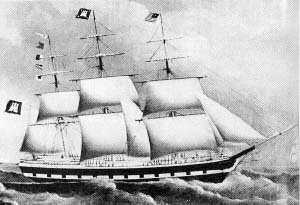
The Humboldt was built in Germany
Humboldt (1862)
Reminiscences and Journal of Christian Anderson
Anderson, Christian. Reminiscences and journal (Ms 1917), p.
7.
LDS Church Historical Department Archives
Bertelsen, Annie E., Diary, (Typescript) Utah Pioneer Biographies
vol. 5, pp. 31-32 (FHL)
. . . Mar. 17, 1862--My brother John came from Jyland where he had been laboring as traveling elder in Aalborg Conference the last four years. We went together to "Wester Broe where our brother Julius was staying, to visit him. When John commenced to preach to him he said he did not want to hear it. He was not in the church. Neither was our brother Peter.
Tuesday the 18th — Accompanied John to the steamboat whereon he left for Falster where he was going on a visit previous to going to Zion, as he had been released from his station for that purpose. While John was in Falster I was sent for by the head of the firm that I had been working for, for four winters, and he wanted to hire me by the month to take charge of the storehouse (they were wholesale dealers). I went and made the contract and was to commence on the 1st of May.
Wednesday April 2— My brother John returned from Falster.
Thursday April 3— We went together to the office in Lorenzensgad as John wanted to see President Van Cott who presided over the Scandinavian Mission. He told me that I could get the privilege to go to Zion that year if I could cook on the ship for the emigrants. I knew but very little about cooking, but I was anxious to go to Zion, so I answered yes I would do my best, and thus I would get free passage across the Atlantic Ocean. I got very busy getting ready as the company should go on the 7th instant. I went and compromised with the Jew so he would not get disappointed.
Monday Apr. 7th — Bid goodbye to my friends in Copenhagen and left on the steamship "Aurora which had on board a company of immigrants from Sweden.
Tuesday Apr 8 — Landed at Kiel and joined a company of emigrants from Jutland and traveled on the railroad from Kiel to Hamburg, and went on board the sail ship Humboldt the same evening.
Tuesday May 20 — Landed at New York after a rough voyage and considerable sickness and death among the children.
We continued our journey on railroad from New York to St. Joseph, and from there on steamer up the River Missouri to Florence, where we had to stop and wait for the Church teams from Utah.
Monday 27— Arrived at Florence where we stayed till July 24, and had a good time with lots of fun for the young folks who did not have much to do but play.
July 24 — We commenced our slow journey across
the plains with ox teams in Captain John Murdock’s company, I walked nearly
every step from Florence to Salt Lake City, where we arrived Sept. 27th.
. . . [p.7]
------------------------------
Autobiography of Anders Persson Lofgreen
Lofgreen, Anders Persson. Autobiography 1991.
. . . At noon April 6, 1862 Brother Pehr Nilsson
came and told us that we were to be in Malmö the next morning at 7
to go on board a ship to Copenhagen and then continue to Zion. I
had previously talked to a farmer to drive us to Malmö. He was
a neighbor of Nils Anders, where we now lived. The short notice caused
us to be very busy to lead our things we had and be on our way for we had
no more time than we needed to go the 25 miles to Malmö.
At sunset we bid farewell to our brother-in-law Nils Andersson and Parnila with the thought never to see each other again, for their faith in Mormonism was very weak for they were more against than for it. Parnila judged us very hard for she said she was sure that our sick little daughter wouldn’t reach our destination. But we went in the comfort and faith in the Lord who guides everything. And a few days after our farewell our daughter was well again.
In Malmö in time we went down to the bridge to wait for the ship which was out on a short testing run. During that time I went uptown fixing a few necessary things and many people gathered at the bridge for curiosity to look at these damned Mormons leaving their land of birth. Here my wife and children had to listen to the most rotten language that can be uttered by a person with her right mind. It did not take me long before I was back but then these people had quit their foul language for then there were many Mormon families down at the port. Some to go to Zion and some to help.
About 9 o’clock the ship was back and in a short while all those who would to Zion were on board. The whistle sounded and in the same moment the paddle started to move. Thus farewell to our native country and to our friends. About 3 o’clock we were on shore again in Copenhagen and here our company increased with Danish Mormons and we Swedes had to change ship to another large ship which would take us to Kiel. We were soon ready to continue our trip.
Towards evening my wife, with our 10 weeks old child on her lap, tired and sleepy of last night’s journey from Billegerga to Malmö, wanted to go to sleep as soon as possible. This ship was not built for passengers and as such it had no accommodations for us emigrants. Some women and children were shown below deck and nothing else could be found than making their beds of barrels, which was not too pleasant for these women, most of whom I am sure were used to good beds.
This was not the only unpleasant thing, but our baby
became sick and cried all night, so we lost that night’s sleep and rest.
I and my two eldest sons took our resting place on a big chain rolled together
in circles. My two sons rested well on it while I had to share my
wife’s discomfort with our baby’s cries.
This was the second might we had no sleep or rest, but towards morning
the child became quiet.
Soon we were in Kiel very thankful to the Lord for his protection during our journey on the narrow path we had started out on. The sea was calm as a crystal sea during our voyage from Malmö to Kiel. Here we took our things onshore and were soon loaded on a railway.
Here the Mormons increased again so we were 300 people. Soon we were ready to leave and the iron horse started to breathe heavily and we were on our way in a south westerly direction towards Hamburg. Thus we had reached Hamburg in two days. Here we were transported in some flat boats out to a sail ship that would take us to New York. It was late in the evening before we all were on board. We were 500 persons who emigrated to America, 200 non-Mormons. [p.39]
When all were on board we were shown our berths, we were to be two in each and as fast as we could we fixed them to get a nights good rest which we got, as the ship did not move during the night. The next morning we sailed down the river, put out the anchor, took in water for the voyage over the Atlantic. The next day, April 10, all sails were up and also the anchor and hurrah for New York with Humboldt. After one day we were told to fasten everything very well to walls, etc. We had hardly finished it when the ship started to roll quite hard and it was very difficult for most of our as we had never been on the sea before. We could hardly reach our beds to lie down in. The one who has never been on the sea can never imagine how it is in hard wind. They threw up till the stomach was empty and then it went the other way. After a couple of hours it was over but it took us a couple of days to get everything in shape again, and most of us very feeling fine. A Danish brother by the name of Hanssen, who had been on a mission in Denmark and now was released to go home to Zion again, which was located at "Plain City, Weber County, Utah" was our president or leader from Hamburg to Florence (which was located some way north from Omaha).
Now Hanssen split our company into four groups and put an elder in charge of each to see to it that no contention would arise and also to call the members together morning and evening to pray. The elder was also in charge of the sick to help them. A few were sick till death. It was a terrible thing for the parents to see their small children be lowered into the wet grave to be swallowed up be different animals. We had a satisfying voyage to New York despite these small things and others not worth mentioning.
We had good food and enough water even though it became stale before we reached shore. When winds and waves allowed, the young had their dances and games on the upper deck but sometimes a storm came very suddenly and the waves went over the boat. At one of these occasions my wife was on deck with our son Nils, 6, and washed him, when the wave went over them and tore Nils from his mother, but she grabbed something to hold on to at once and was not in the same danger as our son Nils to be thrown from one side to the other under danger of being crippled. But thanks be to the Lord for the good crew we had on board this ship, Alexander Humboldt. [COMPLETE NAME OF SHIP] When the mother cried for help a sailor came and saved him. From this time I was sick but not in bed.
When our own rye bread which we brought from
our home was gone for we would supply our own food till we reached the
ship Humboldt, then I could not eat the bread they offered us and therefore
I was sick all the way, but my family could eat and drink everything and
felt well. When we began to come close to New York our president
pretended to be poor and asked the Saints (Mormons) for contributions,
so he could buy clothing when we arrived in New York. I gave him
2 dollars.
The 2nd of June we landed in New York and felt very happy to feel land under our feet so we could walk around as sober people.
On the 4th we took the train and after many changes we arrived at St. Joseph. There we went on board a steamer and sailed for three days on Missouri River up to what was then called Florence.
On June 11 we landed at Florence where we stayed in six weeks waiting for the ox train that would come from Zion to take us to our destination Zion (Utah Territory).
While we were in Florence I realized that Brother Hanssen’s character was different than on the ship. In our Sunday meetings they preached very strongly that we would pay what money we had to go with the Church train, if somebody kept more than was necessary to go over the [p.40] plains they would feel pain and ache in their legs. It was likened unto Ananias and his wife who kept part of the money when they wanted to join the Apostles of Jesus.
It was hard to listen to these sermons and our faith was tried in this and other things. Because of my faith in the gospel and our leader (Hanssen) I obeyed his and the other leader’s admonitions and paid 50 dollars on my debt for the journey across the plains. This money I paid to Hanssen. While we camped at Florence some of the emigrants were making tents to be used by those emigrants that would go with the Church train and we worked hard to house all in the company, about 500.
While we worked on the tents Hanssen was very busy buying up cows, oxen and wagons to some well-to-do (even some of his own country men who did not pay one cent for their trip across the plains) families who should cross the plains on their own. That meant nothing but cows to his not-so-well-to-do countrymen in the Church train.
One day it happened that Hanssen and one of his fellow brethren in the gospel were looking in his accounting book about something. I happened to pass them and glance at the book where I saw the figure 37 at my name which caused me to stop and look at something else so I would not disturb them. When they were through I went over to Hanssen and asked him what was meant by 37 at my name. He could not answer to my satisfactions saying it was something that I had paid for my journey across the plains. After some unpleasant words between I showed him it should have been 50 instead of 37.
When I had showed he made his excuses saying he did not know how he made the mistake. Before we finished I asked him to go with me to Joseph Young, who was the emigration agent and who would receive the money that was collected for our journey. He would not. He promised to pay what was lacking and I received them before we left Florence.
These things were hard for us to understand and were a trial to see our leading men do that and I had given him 2 dollars, when we were on board Humboldt. The day we were ready to leave Florence, Hanssen had bought two pair of oxen and a wagon and paid with different merchandise. Now he was not poor anymore as he as when he left Humboldt.
We were from 12 to 14 persons in each wagon and thus we could not bring along much, no boxes or chests. We had to empty our bed pillows and mattresses and much of our clothing we had to leave there for we had only 2 sacks and pack all our things in. This was a trial too, to see these things left behind and hot get anything fro them. We understand that there were many things trying to stop us from walking on the narrow road.
On July 24 we started the long ox train over hundreds of miles of plains and dangers of being lost in the streams. . . [p.41]
. . . Saturday September 27 we landed in Salt Lake
City. Al our things were unloaded and we tented and put our small
belongings into the tent and pondered where we would find a home for the
coming winter. Our food was gone, only a few pieces of bread left.
Now we saw how our friends on the journey nearly all were taken care of
by friends and relatives. Then farewell to us and off in different
directions in "Teretoriet to their destinations. . . [p.42]
------------------------------
Humboldt 1866
Jenson, Olof. Autobiographical sketch (Ms 11373), pp. 1-3.
LDS Church Historical Department Archives
. . . I was baptized a member of the Mormon Church at the age of ten years, by E. S. Greco, at Ostra Torp, Sweden.
Shortly after, sometime between the 10th and 15th of May, 1866, we left our home, which had previously been sold and the furniture auctioned off. This was the beginning of a long journey, for our destination was Utah. We traveled by team to Malmo.
Around three sides of the city of Malmo, there is a canal several hundred feet wide and the other side is bounded by the ocean. While in Malmo awaiting transportation, a few of us boys were playing in a boat, that was tied to one side on the canal. While we were playing, the boat broke loose and floated down the stream. After some time, we were rescued by a party on the canal, an brought back. From Malmo, we went to Copenhagen by steamboat, and from there, by steamboat, to Hamburg, [p.1] Germany. June 2, 1866, we boarded a sailing vessels, the Humboldt, as steerage passengers, to cross the Atlantic Ocean to America.
The food on the boat consisted of soup, potatoes, beans, fish, bread or hard tack biscuits. The cooking was done in iron pots so large that the cook could get inside. No bread was made on the ship, the biscuits having been made months before and were extremely hard and dry. The potatoes were sour and soggy. The drinking water was taken from the River Elbe, in Germany, put in wooden barrels, that had been burned on the inside, and was as black as coal, when we drank it. Water was also put in large iron barrels, holding about five hundred gallons, and when the water from the wooden barrels was exhausted, the water from the iron barrels was used. This was red with rust. Pigs would object to the food and water but we had to take it.
The beds on the ship were made of common lumber, with room for four in width and were two tiers high.
There were about three hundred Latter-day Saints emigrants in the company. We had a good trip except for fog as we neared the New Found land Coasts; where another sailing vessel ran into us causing slight damage to our ship. When we were in mid-ocean, I did a boyish prank. Outside, under the bow of the vessel, where anchor and chains are hung, I ventured out unknown to my parents or anyone else. I sat there for some time and was able to see beneath a part of the vessels as the boat plowed through the ocean. This was a very dangerous thing for me to do. Had I slipped and fallen into the ocean, no one would have known what had become of me. But I climbed back safely.
We were six weeks crossing the Atlantic Ocean and were glad when we reached Castle Garden, New York, where we stayed for three days. We all had to pass a doctor’s inspection before landing. Had there been any contagious diseases on board, we would not have been allowed to land. We left New York City and went up the Hudson River in a boat to Albany, New York, where we put in very dirty cattle cars. After many days, we reached St. Louis, Missouri having changed cars at Chicago, Illinois. A Brother Johnson was president of the company. We went in a paddle wheel steamer up the Missouri River to Florence, Nebraska, now called Omaha, where we remained two weeks waiting for [p.2] ox teams from Salt Lake City.
The one spring of water that was used by the Saints in Florence for drinking had been poisoned by some of the citizens of that place, because of hatred towards the Saints. Consequently, the water could not be used and we had to go to Missouri River for drinking water and for general purposes.
When we started for Salt Lake City, Peter Nebeker of Willard was captain of the entire company. There were forty-eight teams, and each team consisted of two yoke of oxen for each covered wagon. Each wagon was loaded with merchandise and provisions, besides our luggage. All those who were able to walk, were expected to walk all the way to Salt Lake City. Mother and father rode part of the way on the latter end of the trip, mother was side and had to ride. We boys walked all the way.
Carl Loveland and Charlie Valentine of Brigham, were night herders. The oxen had to be herded as the Indians might drive them away. But the Indians were friendly and came to us only once on the trip. They wanted food, clothing, guns, and ammunition. The only thing we could give them was a sack of flour. After accepting it, they peacefully left us. When camping at night a corral was made using the wagons and arranging them with the tongues inside, with an opening at each end of the corral. The object of the corral was to protect ourselves and enclose the cattle, when necessary, from the Indians.
William Packer of Brigham was teamster of our wagon. We traveled on a average of ten miles a day. Bread was made in Dutch ovens and buffalo chips were used, at times, as fuel. When fording the Platte River, the bottom was very uneven and it was necessary to put five or six yoke of oxen on a wagon, so that some could pull while others had to swim in places. I remember one wagon box, load and all, was lifted from the gear and it floated down the river some distance before it was rescued. As we young boys could not swim, we would cling to the rear end of the wagon box. Mother was a small woman.
Consequently father had to hold to her or she would have been carried down the stream. After reaching the other side of the river, we had to pause for a few days to dry our clothes. The weather was good throughout our entire journey across the plains. We saw herds of buffalo. We reached Salt Lake City, Saturday, Sept. 29, 1866. . . . [p.3]
------------------------------
Italy
Diary of Hans F. Hansen
Hansen, Hans Frederick. Diary (Ms 12330), fd. 3, p. 1.
LDS Church Historical Department Archives
March 16, 1852. On the above mentioned date we left Denmark going in a round about way through part of Germany and thence to Liverpool, on a somewhat delayed journey. We continued our travel to America on the sail ship Italy from Liverpool, where we were supplied with twenty eight day’s provisions. We suffered an awful lot from hunger and sickness, but the Lord’s hand was over us because we wanted to serve him, but some of us died after eight weeks and two days travel on this ship. We finally arrived in New Orleans, near the Mississippi River in America where we stayed two days. After this we went on the steam ship up along the river to St. Louis, where we stayed another two days and where we bought provisions in order to go through Arkansas. We left St. Louis and went on the steamship up the Missouri River to Kanesville where we arrived in June 1852. There we purchased some wagons and some oxen for the trek across the country to the Rocky Mountains. We were unable to purchase enough wagons and oxen for our trip and we had to stay there one month, and then bought some more equipment and prepared ourselves to leave which was set for the first of July. We left Kanesville for the journey ahead of us which we were told was some eleven hundred miles. During the travel we suffered an awful lot from cold and hunger and shortage of food, but the Lord’s blessings were still with us and we prayed to the Lord and that is what saved us.
There are forty wagons in the company. We proceed on our way with a prayer to the Lord. Our first Captain is Kelsey and our second captain is C. Butler and both of them are good men, and if we will do just as they tell us, everything will be all right. My thoughts are always that I soon will be able to live in what I dream of as a real home, together with the others, and there have peace, and worship God as we desire and no other things will have power to change it.
This is the 20th of October, 1852. I am so happy to think
that I would be among this people, and where the Father’s spirit so prevails,
and where the apostles receive the word and spirit and strength from the
first and only God, to hold his hand over us, and I feel the same spirit
which gave me testimony that this was God’s work. My sister Stine
came out with Father Saby from Norway, and they live near Ogden, Utah.
. . . [p.1]
------------------------------
Autobiography of Augusta Dorius Stevens
Stevens, Augusta Dorius [Autobiography] (MSS A-322) pp. 1-5, (Utah
State Historical Society.)
Augusta Dorius Stevens, daughter of Nicholi and Sophia Christoperson Dorius was born October 29, 1837 in Copenhagen, Denmark. When I was two years of age I lost one of my eyes through an accident. I had many minor accidents, but got through them alright. I attended school until I was about thirteen years of age. About that time the Mormon elders came to Copenhagen with the gospel of Jesus Christ of Latter-day Saints. My father embraced the gospel and was baptized the 14th day of November 1859. My brother John F.F. Dorius and myself were baptized the 14th day of December 1850. For this reason I had to quit school on account of joining this then unpopular religion.
We lived in the same house where the LDS meetings were held, we lived downstairs and the meetings were held upstairs. One night the mob came up to the hall and broke the door down. They wanted to get Brother Erastus Snow and to subject him to bodily punishment. We had to break up the meeting and Brother Snow walked out with the crowd of Saints and the mob did not get him.
My mother could not see that our church was any better than her Lutheran church and so she did not join until 1862 when my two brothers, Carl and John left Utah for a mission to Norway. While there the boys went to Copenhagen, Denmark and took mother with them to Norway to the city of Christiania where they made their headquarters and where she was baptized. Mother did not come to Utah until 1874. I was accordingly away from my mother for twenty two years.
I did not know how many persons had joined the church when I left for Utah. But at that time the spirit of gathering became an important item among the saints in Copenhagen and there were twenty eight persons who got ready to emigrate with Elder Erastus Snow when he returned from his first mission in Scandinavia and I was one of this number.
I had assisted a [p.1] family by the name of Ravens as a girl in their home at general domestic work. Mr. Ravens was a sea captain, the family was quite well off. They had joined the church, took quite a liking to me for the work I was doing for them and inasmuch as I had also joined the church, they offered me the opportunity to join them in coming to Utah and they paid my way. My father thought it would be a good thing for one of the family to go to Zion and the rest of the family would come later. So it was arrange for me to go. I thought this was a fine plan and I was happy to think I was the first of the family to go to Zion.
The day came for us to start, it was the 4th day of March 1852. I had great faith in the gospel I had embraced so I felt all would be well for me. But when I said farewell to my parents and brothers and sisters, and seeing the steamboat sail out and my folks begin to fade out of sight, I felt alone and I surely felt badly and wept as I then realized for the first time that I was alone to face the world and that too on foreign soil. If I had known or realized how far that journey would be, I certainly would have felt worse, but traveling was something new to me and there were many interesting sights for me to see which were interesting and entertaining and I wonder sometimes how I received courage to leave my family and go to a strange country and then too, when I did not know how far we should have to travel to get to Zion and I could not talk the language. But it was the gospel I had received and the spirit of the Lord that helped me. I was ignorant of the world and did not understand it as I came to know later. When I think of one of my daughters starting out at that age, going into my fifteenth year, I wonder how it would go for her. But if she had the same faith I had I think it would be alright for her too. But there are few who have such strong faith as those who came from the old country in those days. I have never regretted that I came when and as I did, but am thankful to the Lord that I was thus permitted to come to Zion. [p.2]
As the steamship on which I left Copenhagen reached Liverpool England, we transferred to a sail ship by the name of Italy and the ship propelled by the wind on the sails took nine weeks in which to cross the Atlantic ocean and we landed at New Orleans. The Mississippi River at its mouth was quite shallow and sometimes the wind was unfavorable and our larger sail ship was tagged up the river by two small steamboats, one pulling on each side of the ship Italy. Thus the ship was pulled up to the city of New Orleans. From this city we completed the balance of our river journey by steamboat to the City of Kanesville on the Missouri River. This unloading point is on the east side of the river and we remained there a month to prepare for our crossing the plains, getting the oxen, wagons and equipment ready for the journey. At this point I experienced a new phenomenon. There came one day the worst wind and thunder storm I could ever imagine; an experience I had never known in Denmark or on the journey so far. The appointed time came for the great journey across the plains into the then almost unknown west. The wagons and equipment and members of the emigrating party were taken over the Missouri River by ferries and the oxen, cows and horses had to swim across as there were then no accommodations for ferrying animals across the Missouri.
There were representatives of several nationalities including Americans, but our particular division of the emigrant train which included fifty wagons, there were twenty eight from Copenhagen and in our company of ten wagons there were included quite a number of Americans. Our company was presided over by John Butler who was the captain over our company which occupied ten wagons. The entire fifty wagons with occupants was presided over by a head captain in the person of E. Kelsey, and the whole emigrant train is known as Kelsey’s Company. There were then five companies with ten wagons to each company. Each presided over by a captain; a chief captain to preside over the entire train of fifty wagons. The women generally rode in the [p.3] wagons and always slept in the wagons. Personally I thought the emigrant wagons most remarkable vehicles as I had never seen anything of the kind before starting on this journey. Upon nearing the Rocky Mountains, the oxen became somewhat worn out and then it was necessary for many women to walk while traveling. Upon camping at night the wagons were driven in a circle and the camp fires were made inside the circle. Being young and in my fifteenth year, this being the year 1852, it became a part of my regular duty to gather buffalo chips which served as part of the fuel for the camp fires. During the first part of the journey across the plains, the novelty of travel was new and the evenings across this trip we felt to enjoy the company of the members and friends we had made. One member had a fiddle as we then knew it and all joined in the evening dances around the camp fires within the big circle. Prayers and hymns were part of the daily morning and evening program. After walking a good deal during the days, I felt so tired I could often have been glad to have gone to bed without supper but I always had to help with the dishes and help with camp duties including the preparing of the beds. . . .
. . . One of the singular incidents that happened enroute was the occasion of a stampede of a herd of buffalo which came direct toward our wagon train. The stampede ran providentially just in head of the train with the fierceness [p.4] of the rush and tramp and as it appeared almost a cyclone of dust. This caused a great commotion and almost stampeded among the oxen and horses of the train. The few rifles available were used and fortunately enough for the emigrants, a few buffalo fell which were prepared and this gave us extra provisions on the long journey in head of us. Upon another occasion nearly a dozen Indians came on their horses and approached the emigrant train. A great deal of apprehension was caused among the emigrants as they felt sure an impending disaster was before them. They thought this was the first contingent of hordes of Indians that lurked in the ravines near the trail. The daily prayers were answered and we were assured the Heavenly Father was mindful of the needs and protection of his Saints. The Indians spread their blankets by the side of the trail and each wagon was required to give its toll of food to the Indians as it passed. . . .
. . . When we had advanced to the Green River Station, now Green River, Wyoming, the supply of flour had been exhausted. The fall snows commenced bringing the cold blizzard and wintery blast all of which added to the perils of the journey. It became necessary to send a man with the best and fastest equipment on to Salt Lake City to get four and rush back to Green River which was only sufficient to sustain the party in the train for the balance of the trip.
On into the mountains we went along the already broken trail which had now been traveled over by the e migrant trains for five years. We arrived in Salt Lake City October 16, 1852, after eight months and twelve days of journeying since I had waved my last farewell to my parents and friends. . . . [p.5]
------------------------------
James Nesmith
Letter from P. O. Hansen. - January 8, 1855
Hansen, P. O. [Letter], Latter-day Saints’ Millennial Star,
17:5 (Feb. 3, 1855) pp.70-71.
Progress of the Emigration from Copenhagen to Liverpool.
Liverpool, Jan. 8, 1855.
President F. [Franklin] D. Richards.
Dear Sir – In accordance with your request, I proceed to write a brief sketch of the journeying of the Scandinavian emigrating Saints from Copenhagen to Liverpool.
We left Copenhagen on the steamer "Cimbria, Captain Engel, on the 24th of November, being over 300 in number, all in good health and excellent spirits, and arrived at Frederikshaven, a sea port on the east coast of Gothland, at 10 o’clock next morning, where we were to embark 143 more passengers. During the after noon we took their luggage on board, and early in the morning to the 26th they embarked, after they were mustered by the police. Our prospects were very fair till about two o’clock next morning, when the wind turned southwest, and began to blow so heavy that our captain, who I found was very cautious and of much experience as a seaman, deemed it necessary to turn about, and seek the nearest harbor in Norway.
Before four o’clock in the afternoon we arrived in the port of Mandal, which is an excellent natural harbor, surrounded by very high and steep granite rocks, which were as much of a curiosity to the Danes as a ship load of "Mormon emigrants were to the people of Mandal.
Here we lay till the 7th of December, during which time many lodged on shore, and the people were uncommonly hospitable. The brethren were frequently requested to come and preach, and on informing me of the same, I gave them such instructions as I though proper, and let them go with my blessing.
When I wrote to President Van Cott, I informed him of the circumstance, and I also wrote to Elder Peterson, the President of The Norwegian Mission, suggesting the idea of sending some missionary down to make use of the opening.
On the morning of the 7th, after witnessing storms and tempestuous winds nearly every day or night, it appeared so far favorable that the captain thought he would venture to start, yet as all the other captains and the pilots in port advised him not to, he hesitated till 11 o’clock. Captain Rasmussen, from Copenhagen, who had been exceedingly kind, and rendered us much assistance, came out with us as far as the pilot came, and when he left he said, "You will surely come back.
It was rather calm till toward midnight, when it commenced blowing from southwest, and the sea rolled very high and violently. Very soon part of the bulwarks were broken in, and some boxes crushed. It became worse and worse, and at about two in the morning, the Captain said he would turn about and put back.
We preferred Mandal to any other place, but the wind, waves, and strong current rendered it very dangerous to turn the vessel to run in, wherefore we had to go clear back to Frederikshaven, where we arrived on the 9th, about four p. m., and found many vessels bound for England, and more came in every day.
We lay here weather bound till the 20th, half-past six a. m.; during which time we had almost continually rough weather and contrary winds. I had as many as possible go ashore, and we had much to do to take care of our wet clothes and bedding.
In this town our missionaries previously never could get any entrance, but we had many meetings and left a good impression.
Before we left, the chief of the police requested the captain and myself to come to his office, which we did, and were treated very kindly by said gentleman, who, after asking some questions to satisfy himself that all was well with us, and our answers being recorded, he made us promise that we would see that the passengers had provisions enough, and were taken every possible care of to prevent sickness on board. You may know that so many people piled together as we were, and having been almost buried in the sea, could not look very agreeable to a gentleman of the better class.
When leaving this port, we had very good prospects, and felt refreshed, but in the night of the 221st – 22nd, it became [p.70] more rough than ever, insomuch that we were obliged to turn about again. Our good captain felt rather discouraged about it, and I must confess that I could not help feeling bad to think of being turned back three times, but the Saints were quite contented, and thanked the Lord for their preservation. About two o’clock the wind suddenly turned north, and the captain immediately steered for Hull again, and we rejoiced.
On the 24th, about noon, we anchored in the Humber, and Elder Thomas Williams soon came on board, and told me how you had been looking for us, &c. By his exertions we were enabled to start in the morning per railway, after being very kindly greeted by the Hull Saints. We arriver in Liverpool in the afternoon before four.
The company express much gratitude for the comforts and kind reception they have met with here, and wish me to make it known to you and all who have been assisting. As for myself, I should like to express my feelings, but how can I?
May we live to finish our work, and thus see the
fruits of our labors as faithful servants, is the prayer of your humble
brother in the New and Everlasting Covenant, in the name of Our Lord Jesus
Christ. Amen.
P. O. Hansen. [p.71]
Letter from Peter Olsen Hanson - February 19, 1855
Hanson, P[eter] O[lsen], [Letter], Latter-day Saints’ Millennial
Star 17:17. (April 28, 1855) pp. 270-71.
Mouth of the Mississippi, Feb. 19, 1855.
President F. [Franklin] D. Richards.
Dear Sir--The vessel lying very still this afternoon, I seat myself to commence a letter, which I suppose will be time enough to close when we are ready to leave New Orleans.
I feel to rejoice in the goodness of our Heavenly Father, to thing how quick we have been brought to this place, and the Saints rejoice with me. Yesterday, about [p.270] noon, we cast anchor here under a heavy wind from the northeast, and it is astonishingly cold for this part of the world. We have had but one rough day on the whole voyage, and that was last Sunday, when we were near the island of Abaco. Neither have we suffered from heat at anytime. There has been some sickness amongst us, especially diarrhea and its opposite, which you know is often caused by imprudence. Twelve have died, mostly very old folks or little children, which were sick before we started; none of those who were helped from the Fund. [Perpetual Emigration Fund] The provisions were very good.
My two counselors, and the other brethren which were appointed or chosen, have done well. We have had much satisfaction in our meetings, both Sundays and week evenings, and the Spirit of the Lord has been poured out upon the brethren in a goodly degree. I could not avoid speaking well of our captain [Captain Mills], for he has been uncommonly kind, condescending, and well-disposed toward us; and while I think of my great reason to be thankful, I will thank you and the brethren around you for all your kindness, and all your toilsome labors for our sakes.
It looks doubtful whether we shall be towed from
here today, and I will drop my pen till another time.
Feb. 27.
I am sorry that I did not get the letter in the post-office at New Orleans, but I hope you will forgive me, considering my busy times. It is difficult to write while the boat is in motion. It is now the 27th, and we are above Natchez. We have had four deaths since we left the bar. There is no epidemic or catching sickness among us. I think our sick ones are mending, with the exception of one child. It is good for us it is as cold as it is. Brother Snow’s instructions were, not to take too many on one boat. We left 50 in charge of one of my counselors on another boat. Brother McGaw had the two boats engaged when we arrived. I with the remainder am on board the "Oceana, Captain Miller, and I never met with better treatment in any vessel.
May the Lord bless you and preserve you is the desire of your
unworthy brother and obedient servant,
P. O. Hanson.
N.B.--The Saints thank you for the extra provisions. My love to the brethren in the Office. [p.271]
------------------------------
Journal of Peter Olsen Hansen
Hansen, Peter Olsen. Journal (Ms 1437 2), pp. 118-20,24. Acc.
#17787.
LD Church Historical Department Archives
. . . A large ship had been chartered for my
company but as I did come in time it was occupied by another company of
Mormon emigrants, but as it had drifted into the shoreland, lost part of
her reel, the emigrants had to disembark. The ship was set in the
dry dock to be repaired. [ITS NAME WAS "Helios".]
Brother Linforth came & took me to his house to dine where I found, President [Franklin D.] Richards & Elder Jaques & some sisters. My feet were very sore from running around with Brother Williams.
At night I went and slept with Brother Richards in the office, and on the 26 in the morning I went to see the Saints in the hotel, and received instructions, and stayed there hence the coming night with Elders Hogan & Martin.
A smaller ship, the James Nesmith, was then chartered for us and when she was ready to receive us. We moved on board; after which we received the luggage. Also one week’s provisions, consisting of bread, flour, peas, pork, cheese, tea, sugar, rice, chocolate &c. The ship being too small for the whole company 24 were left to come afterwards with Brother Hogan. A child was born.
After the ship was hauled out of dock, the doctor came on board but we were not cleared. Next day the doctor on board again & we were not cleared. Another child born. Then we were cleared with 441 passengers and Niels Mounitoens [Mauritsen] child was buried. On the 12 of January we were ready to leave, and as it was rather calm we had a little steamer to tow us out a little ways. Meantime according to given instructions I called the brethren together & had Brother Hans Peterson interpret my written appointment which placed me in charge of the company till we should reach St. Louis we [UNCLEAR, PROBABLY MEANING, where] Elder Erastus Snow would make further arrangement. Chose two counselors Johan Eilertsen & Nils [Niels] Peterson & organized the ship into 7 districts &c. Brother Hans Peterson was my secretary & done much good on the way and is yet amongst the faithful. Elders were chosen to preside in the districts, and arrangement was made for cleanliness &c and the whole was sustained by unanimous vote. I put upon Brother [Johan] Eilertsen to get as marshall see that no iniquity was going on, nor unbecoming conduct, and Peterson placed as sergeant of the guard.
Next day we had a fine breeze and got out of the Irish Channel, and an infant died and was committed to the watery grave.
Sunday the 14. We held three meetings.
Monday 15 was a day of airing and washing. Peter Petersen died & was buried. He was 75 years old. A good old man. Some of the passengers, a nice family, had caught the itch from somebody left behind in Liverpool, and our captain very kindly administrated salve unto them in the cooks galley at night and they rejoiced in his goodness. Captain Mills has often the elapse of many years been inquiring for me in Salt Lake City while I was on a mission in Denmark.
Tuesday [16th] the emigrants were again airing &c washing.
On Wednesday [17th] evening the breeze ceased and we had a calm. A child was born.
On Thursday [18th] the calm continued and the first mate & I served out provisions, viz: a weeks rations. Next day we began having big swells, which continued till Sunday afternoon when we began to have a little, were blessed with a little wind. This day we held two good meetings, buried a child and marriage [of] two couples.
On Monday [22nd] it was more windy and we buried another child of Mauritsen.
On Tuesday the 23rd our fore topsail yard broke down. When we were sailing with reefed top sails and a new yard was taken up.
On Thursday 25 we had smooth water & pleasant weather and we buried Just Larsen, the father of Alexander Justesen who was shot by the Lamanites/Sanpete in Sevier valley some years afterwards.
On Friday 26 we were sailing fast. I had received from Brother F. [Franklin] D. Richards 1800 yards of Noukoen or cotton canvas for tents & wagon covers worth £50, 12 shillings, 6 demies 22 [-] of thread with £1.13.0 & a lot of needles worth 2.shillings 11. and this day I commenced selling out these things.
On the 27 we also sailed fast. Buried Staffenson's child. On Sunday we held [p.118] two good meetings and married four couples.
On Monday we buried another child 9 years old.
On Tuesday the 30 we got into the trade wind.
On Friday the 2nd of February a child was buried. The fine weather continued till Sunday the 4th when it rained whole day. We had two good meetings and buried a child.
On Monday it was calm & rainy. But on Tuesday we had a fine breeze again, which continued throughout the week.
On Saturday a child was buried.
On Sunday the eleventh it was very rough. Several sails were tore in pieces. We were going right to the Isle of Abaco, but had to bear off east for fear of being cast on the shore. We could have no meetings for the ship rolled, too much, but I married a couple. The stove came loose in the galley so no cooking could be done. A child was buried.
On Monday 12 it was quite pleasant again and many sails were seen. The ship "Mediator of New York passed closely before us, and what a beautiful sight it is to see a fine ship ride over the long billows, where one half of her keel may be seen at the time out of water. In the evening we passed "Hole in the Wall.
On the 13 we passed several islands, the Great Isaacs, the Hen & Chickens &c. The captain & I bought a barrel of oysters from the fishermen.
On Wednesday the 14 it was rather squally and on Thursday slow sailing. The captain & I bought a barrel of oysters off a fisherman for a dollar.
On Friday 16 we had good going & passed a Philadelphia schooner and we passed the last of the Tugases, with fair wind.
On the 17 we had fair sailing, but in the night it became rough and continued.
On Sunday the 18th . In the morning we buried Anne Nielsen and about noon we anchored off the mouth of the Mississippi.
On Monday the wind kept blowing, heavy from land. Pilot came on board in the morning and the wind blew heavy from land. A child was buried.
The water being too low on the bar we remained at anchor two more days but on Thursday the 22nd were towed into Pilottown after burying a child in the morning. A fourteen year old girl was also buried onshore I think. She died from the affects of the itch spoken of before. At night we were taken over the bar and started up the river.
Friday the 23rd was cool, and we arrived at New Orleans at noon. Pretty soon our emigrant agent Elder [James] McGaw came on board and told me he had two boats engaged for us. In the afternoon we took our provisions on deck, when it was discovered by the second mate that and revealed to me that William Snow the first mate had hid up a big lot of our provisions, a purpose to steal it.
On the next morning we shipped fifty passengers with
the "Moses Greenwood in charge of Elder Nils [Niels F.] Petersen, one
of my counselors and gave him a brother along who could speak a little
English and a proper share of provisions. And in the afternoon the
[UNCLEAR].
"Oceana came and took the rest of us and we started at dark having to serve all and no one to wait on me I came away from a pair of good new boots and also lost my best coat, a deep blue broadcloth dress coat.
The 25 was Sunday but circumstances did not allow of holding a meeting, but I served out provisions.
Monday was very cold. We buried Nicolai Dorius's child near a sugar plantation.
On Wednesday the 28 we overtook the other boat.
On the first day of March we buried another child.
On Saturday the 3rd we passed the City of Memphis in the night and after that it was no longer cold. The cold air however I thought was a blessing in those unhealthy regions. Last night we met some floating ice. [- -]
On Sunday we met considerable of ice. Buried Axel Tulgren's child.
On Tuesday the 6th we buried two children. One of them was Hans Wilhelmson's. This complained of not getting enough to eat while on the sea and suffered his children to steal, when he was called in question and being very growlish. I, being moved upon, said that if he did not repent they would die all of them. They were husband & wife & three children, and all died before we left the Frontiers.
On the morning of Wednesday we passed the quarantine & arrived in St. Louis at [p.119] 3 in the afternoon I walked up to the office and found Elder Snows who then was publishing the "Luminary. I recollect a Brother Hart being there to assist him in his multitude of business. Two or three went ashore apostatizing. According to the contract I had a right to cabin passage for four persons. I took one myself let my counselor have another, and my secretary another. The fourth I gave to a young sister whom I was taking along with the intention of having her for a wife by and by. The dining hall was beautiful, the diet very good and the serving at the table very good. The clerk of the boat whose name was Phillips had the appearance of a Libertine. He colleged [UNCLEAR] with a chambermaid who to serve him contrived to fix a cotton string through the door of the chamber where the young woman was sleeping so as to enable him to lift the latch and enter the chamber in the night. But the girl was very careful to turn the key before going to bed. When I learned of the fact I went and spoke to the captain about it and he got angry and talked very loud about it, promising ten dollars to anyone who could tell him who was guilty. Before I left the boat he told me that he was sure that Phillips was the villain and that the chambermaid had assisted him, but he had no way of proving the fact, but he would be sure to turn them off when the trip was out, and he did so.
One day as I was seeking for some in my chest it and being called away by my business I put a little box of mine into an empty barrel and some blankets and other things on top of it in the barrel and forgot it for several days. When I thought of leaving the box there and that there were valuables in it I went and took it to take it out, and found the two blankets missing, and after looking deeper I missed 2 small woolen shawls and when I looked into the box there was a little gold watch gone, which Mr. Alexander had given me; also a gold finger ring. I soon saw the blankets hanging in the office and went in and told Phillips that they were mine and after equivocating a little he let me have'em. Some day while at a wood pile the barber, a mulatto, left the boat suddenly and Captain Miller said Mr. Hanson, there's the thief, I assure you! I thought so myself. I felt grieved, but nothing could be done.
On the 8th about 70 persons went up to the hall for to stay in that city for want of means. A child and Wilhelmsen's wife died and was buried. I think S. in below. [UNCLEAR]
On the 10th those unable to go to Salt Lake City were sent in care of Elder Eilertsen with Paul Nielsen as interpreter on the "Polar Star, to be landed at Weston where they might obtain work and make a living. The rest of us, 204 souls, embarked on the "Clara for Atchison, Kansas Territory. I went to a lumberyard and bought some planks to make tent poles of. . . . [p.120]
On Saturday the 11 we had a Danish meeting in the hall at 1 o’clock.
On Monday we buried a child, received 24 wagons which were laid up on the [-] deck, and 11 cooking stoves [-] and started about six afternoon. . . . [p.120]
On Friday the 7th we [-] drove down into the City
and encamped on the Public Square west of Brother Kimball’s place, . .
. . [p.124]
------------------------------
Autobiographical Sketch of Hans Peter Larsen
Larsen, Hans Peter. Autobiographical Sketch of, (Special Collections
and Manuscripts, Mss 515) pp.3-4. (Brigham Young University, Harold B.
Lee Library, Provo Utah.)
. . . In the fall of 1854, we left home and
went to Copenhagen where the Norwegian and Swedish Saints were to gather
before starting. We took passage on the steamer "Simplids under
Captain Hansen.
We made our first stop at a little place and waited several days for the Yeallanders. We then started once more; a terrible storm arose forcing us back to a landing on the coast of Norway. We stayed there eleven days. The people were very kind to us. Soon we took our leave and crossed the North Sea, landing at Hull, England. From there we went to Liverpool by rail. Arriving there we were taken to an emigrant hotel where we stayed a week waiting for a vessel to cross the Atlantic.
We left Liverpool on the ship James Nesmith, taking six weeks for the trip across the Atlantic. The first mate on the ship hated the Mormons and made it very unpleasant for us. He tried to stop our holding meetings, but we appealed to the captain and he gave us permission to hold our meetings every Sunday. To get even with us, the mate served us poor food and little of that.
After crossing the Atlantic, we came up the Gulf of Mexico to the mouth of the Mississippi River, from there to New Orleans, then to St. Louis, where we were met by Erastus Snow. Getting our supplies to cross the plains, then changing steamers, we started for Atchison, Kansas. It was in the month of March and the weather was very cold. We suffered terribly until we made shelter for ourselves. Cholera broke out in camp and many of the Saints died. We stayed at Atchison, Kansas for ten weeks. All the men that could got work there getting the ground ready for a warehouse.
A man by the name of Milo Andrus went to buy cattle and [p.3] wagons
for us and as soon as he arrived with them, we started across the plains.
We were not familiar with driving cattle and we had a terrible time for
a few days. It took four men to a yoke of cattle (the cattle didn’t
understand the Danish Language).
We arrived in Salt Lake on the 9th of September, 1855, having
been nearly a year on the road. . . . [p.4]
------------------------------
Autobiography of Hans Peter Larsen
Larsen, Hans Peter. Autobiography. (Ms 8237, reel 4, item #71),
pp. 3-4. Acc. #33439.
LDS Church Historical Department Archives
We left Copenhagen in the fall of 1854 on the
ship "Simplede, with 400 Danish Saints. We had hardly got to sea
when a terrible storm arose which buffeled us around terribly and compelled
us to put back to port.
We waited several days and put to sea again. Another storm came, worse than the first and we certainly expected to go to the bottom.
The captain gave up hope. We lost our bearings and were driven up the coast of Norway, where the captain recognized the coast and worked his way into Fredrickstad Harbor. We stayed there for eleven days and put the ship in shape, and went to sea again. Another storm came on but we made out to get across to Hull, England where we took train for Liverpool.
We were in Liverpool a week when we took the ship James Nesmith for New Orleans.
We were six weeks on the voyage. The first mate was from Missouri, and hated the Mormons, so made it very unpleasant for us, the entire voyage. The first Sunday when we were holding a meeting he came and stopped us; but we appealed to the captain and he gave us permission. The mate then got even with us by giving us poor food and not enough of that. At New Orleans we took boat [p.3] for St. Louis, where we arrived without incident. There we were met by Erastus Snow and Milo Andrus, who took us in charge, and aided us in buying supplies for the journey across the plains. We then took boat for Atchison, Kansas. It was March and the weather was very cold.
We had not tents or shelter and were dumped off the boat into a grove of wood, where we had a hard time until we got tents made, after which we were quite comfortable.
Cholera broke out in camp. We got work for the men preparing ground for a ware house. We were there ten weeks. Brother Andrus was away buying cattle and we were busy making tents, wagon covers etc. for the journey across the plains. We were not familiar with driving cattle and we had a terrible time for a few days.
It took four of us to one yoke of cattle. The cattle did not understand Danish.
We reached Salt Lake in the fall of 1855, having
been nearly a year on the road. . . . [p.4]
------------------------------
Brief Sketch of Emily Christensen McKenna
McKenna, Emily Christensen. Brief sketch of my mother's life
(Ms 2735), fd. 276, pp.1- 2. Acc. #31958.
LDS Church Historical Department Archives
I, with my brother, sister and her husband, started from Torreberga to Malmo, a port town. Father hitched up the team and took us there to board a steamer, bidding us goodbye, knowing we would never see each other again. On the 19th of November 1854, we set sail from Copenhagen to join other Saints leaving there on the 24th. We left on the steamer, "Cambria. There were over three hundred in number. We reached Frederickshaven, a seaport on the east coast of Gothland, where we embarked with 143 more passengers on the morning of November 24th, bound for Liverpool, England. Our prospects were fair until about 2 o’clock next morning, when the wind turned Southwest and blew so heavy, our captain deemed it necessary to turn back and seek the nearest harbor in Norway, a port called Mandal.
Here we lay until December 7th, witnessing tempestuous storms day and night. When the captain thought he would venture a start, the wind commenced blowing from the southwest. The waves looked like mountains sweeping over the vessel and bouncing it like a plaything. We turned back hoping to reach Mandal but had to go to Frerickshaven again where we landed December 9th and stayed until December 20th, almost a month from the time we had left previously. The prospects looked good and we set sail again. The ship set sail again, but on the night of the 22nd, we returned again. The ship had almost been stripped of its rigging and creaked like it was breaking asunder. On December 24th, we steered for Hull and on to Liverpool. There was considerable sickness among the passengers and some had very little to drink. Although the cook was kind and distributed water among us. We rested in Liverpool several days and on the 11th of January 1855, went on board a sailing ship bound for New Orleans, North America.
Everything went well until the 11th of February when we encountered a tremendous storm that stripped the ship of all its sails but the next morning all was calm and we could see the West India Islands where natives swam out and gave us fish. Some of the passengers had very little to eat in the month we had been sailing. We arrived at the mouth of the Mississippi River on February 18th, where we cast anchor until a river steamer came to tow us up to New Orleans where we landed the 23rd of February 1855.
The next day we boarded a riverboat bound for St. Louis where we arrived March 7th.
Having spent all my money and some I had borrowed, I had to seek employment, but was advised by our president not to stay in the South but to push on Westward. We took passage on a riverboat going to Fort Leavenworth in Indian territory now the state of Kansas. From there, we traveled by wagon to Fort Riley and on to Omaho [Omaha], arriving there July 18, 1855. My brother got a chance to go on to Utah. He promised to take me with him but I had no money and he had very little left. I had become acquainted with [p.1] another Swedish girl Ellen Johnson, and she was anxious to go also. My brother talked it over with President Frank Wolley and it was arranged for Ellen and I to go with the company headed for Utah. We were to do the cooking and other jobs that we could do. My brother payed a little money and we put what belongings we owned on a hand cart, which we pushed and pulled. We had very few chances to ride. My brother fell in love with Ellen and later on she became his wife. We left Omaho [Omaha] about August 5th and arrived in Atckinson, three days later. Leaving the following day for Fort Kearny where we arrived September 27th, leaving for Fort Laramie the following day and arrived September 27th, continuing our journey up the Platt and arrived at Fort Bridger October 27th.
Our teams were worn out and the entire company weary of travel. Supplies were almost gone. We had seen some Indians along the way who were not hostile. It was important to cross the Rockies before winter snows, so we lest Bridger October 31st but it wasn’t long before we were traveling in 3 feet of snow, as an early winter fell upon us. We were compelled to leave camp on the very tops of the Rocky Mountains. The teams were without feed. They were tied to the trees and the men made huge fires to keep us and the animals warm as ti was bitter wold. The next day the sun was shining and we started downhill and through canyons where a little feed could be found. We were met by a company from Salt Lake with feed for the cattle and some provisions for the company. We arrived in Salt Lake November 18th, 1855, one year after leaving my native Sweden. . . . [p.2]
------------------------------
Family Records of Peter Neilson [Nielsen]
Neilson, Peter. Family Record (Ms 5345), pp. 5-9, 11. Acc.
#17756.
LDS Church Historical Department Archives
. . . Arrangements had been made by Apostle F. [Franklin] D. Richards with the captain of a large sailing vessel to take us to America. But as we were so long he became impatient and swore that he would wait for us no longer, so about the 20th of December he set sail for America, but she had but fairly gotten underway when a violent storm rose which resulted in breaking two or three of the large cross timbers of the ship and thus she was obliged to put back into port to get his ship repaired and instead of our taking passage on this ship we was on the ship James Nesmith. The arrangement was for seven hundred passengers, but instead of that number they would take but five hundred and fifty. [p.5]
Before leaving the docks the passengers were carefully inspected by two doctors to ascertain whether there were any contagious diseases among them. Two children were found to be thus affected and they with their mothers were taken on shore.
After sailing out of port we were organized into four wards. I being appointed to take charge of the third ward and O.P. [Peter Olsen] Hansen, president of the whole company.
We were treated very kindly by all the officers and crew of the ship excepting the second mate who was a wicked man and notwithstanding we had paid full fair there were some of the passengers who suffered considerably for the common necessaries of life.
The wind not being favorable. We made but little progress for three or four days but during this time the sea was rough and as a consequence there was considerable seasickness among the passengers.
On or about the 14th of January 1855 I received the hand of Miss Keren Nielsen in marriage, President O.P. [Peter Olsen] Hansen officiating. There was also another marriage at the same time, and before we had landed in America there had three or four other marriages been solemnized.
We had a very pleasant voyage excepting one day and a few hours when the wind blew a fearful gale and blew our ship back for the space of one day and three or four hours. When the storm struck us some of the passengers were sitting upon the deck but some of the tackle of the ship being broken they soon made their way below.
According to the prophecy of the brother before leaving Denmark, we espied a light on the [p.6] American coast Feb. the 11th 1855.
Two boat [boats] were sent out to meet us on which were two or three Negroes, the first we, the Danish Saints, had ever seen, which I assure you was a great curiosity to us.
The ship was but six weeks and three days in making the voyage from Liverpool to the mouth of the Mississippi River. There were eighteen deaths, old folks and children, in crossing the ocean.
When coming into the Mississippi our ship lodged on a sand bar from which we were unable to extricate ourselves so the next morning a tug boat was sent out to assist us, but it was unable to render us any assistance. Another boat was added but they failed to move the ship so the next day a third boat was added without any better success than before. The captain then said would have to remain here until the river rose. It was Sunday night when we struck the sand bar and there remained until between Wednesday and Thursday night (the water raising 6 feet) and even then the ship was enabled to move off only by the aid of three tug boats, one on either side and one on front and then we did not get clear of the bar until the next day. After getting clear it was no trouble for one boat to draw three ships into New Orleans.
As we sailed along the Mississippi from its mouth to New Orleans, (it being the latter part of Feb.) was to be seen on either side, skirting the banks of the mighty Mississippi extensive orchards of lemons & oranges, figs and other luscious fruits in tempting abundance. Back of these orchards and running parallel with them were numbers of Negro huts. [p.7]
While lying on the sand bar we saw myriads of fish of all kinds some as heavy as a half grown pig. We were advised not to eat them as for some cause they were considered not to be fit for use.
We found all kinds of the products of this section
to be extremely cheap: sugar 4¢, rice 2¢, and bacon 6¢ and
other things in proportion.
While stopping at New Orleans an apostate from the
Latter day Saints tried to induce us not to proceed farther on our journey
at present giving as his reason for such a course that the ice in the river
would prevent our reaching St. Louis. But at this juncture a missionary
from Utah happened along and advised us to proceed on our journey for said
he "the ice will be broken up and and [SIC] the river cleared before you
reach St. Louis. Our president therefore tried a steamboat and we
proceeded on our way for St. Louis after having laid in our supplies.
Before leaving New Orleans the captain came down to the ship and told us that this had been the most prosperous trip he had ever made across the ocean. The trip before this he had embarked with one thousand passengers, but no soon had he put to sea than they commenced to drink, play cards, quarrel and fight, besides they were filthy in their habits. From these causes disease took hold of them and before he arrived in America death had consigned seven hundred to a watery grave. On another and previous voyage he had embarked with three hundred passengers and from similar causes he arrived in America with but eleven souls, disease having taken the remainder away. "In the future," said he, "if I have my choice, I will [p.8] bring none but Latter-day Saints." Thus we can plainly see how the principles of the gospel of Jesus Christ enable His chosen people to escape disease and death, while on the other hand a wanton disregard of these sacred principles had carried so many to an untimely grave. Such has been the case in all dispensations of Gods providence to His children and such it will continue to be until the end of time.
But to come back to the main thread of our narrative, we arrived in St. Louis, having buried seventeen or eighteen of our number while on our way up the river. With this exception we had a prosperous journey.
At St. Louis we the pleasure of beholding the face of our esteemed brother and Apostle President Erastus Snow, who told us we had been the most prospered of any company of Saints that had yet come come [SIC] to America. In alluding to the number of deaths that had occurred on our way up the river, he said that the Prophet Joseph had predicted that the time would come when the Mississippi River would be poisoned so that it would be unsafe for the Saints to come in that route, but would have to come in by way of New York.
Means being scarce among the Saints we were advised to seek for labor in Leavenworth, Kansas and Weston, Missouri. While at these places the Saints were attacked with that dread disease, cholera, which was contracted from some clothes that were taken in by some of the passengers for washing. . . . [p.9]
. . . On the sixth day of September 1853 we arrived in Salt Lake City, having been ten months and twenty days since we left Copenhagen, a distance perhaps of between six and seven thousand miles. . . . . [p.11]
------------------------------
Autobiography of Annie Cathrine Olsen
Olsen, Annie Cathrine Christensen, [Autobiography], "Utah Pioneer Biographies,
vol 22, pp. 17-18, 20.
. . . About the first of December 1854, we boarded the sailing vessel at Fredericks Hound [Fredriks Haven] for England but the wind came from the wrong direction and we landed at Norway, where we stayed for one week. During that time we would climb up behind the cliffs to say our prayers so we would not be seen by the ship’s crew. A week later we started out for England the wind took us back to Fredericks Hound [Fredriks Haven], our starting point. This time the wind was favorable and we landed in England, Christmas Morning 1854. We boarded the train for Liverpool and arrived there in the evening, at which place we stayed for several days waiting for the ship to sail. During this time we had to eat horse flesh. My mother had brought a jar of butter and some dried sausage with her, which I remember tasted good to us.
About the first of January 1855, we boarded the ship James Nesmith and sailed with 440 Scandinavian Saints and one British Saint, across the Atlantic Ocean. The first three days of our voyage we were all very seasick but after getting better I got such an appetite that I could not get enough to eat. [p.17] My mother, not being very well, could not eat her portion of hardtack, so I got part of her portion, as well as my own.
One day a terrible storm came up. I was standing on the middle of the deck holding to a large barrel just under the hole of the ship. I felt impressed to move under the deck and just as I did so, and had gone a short distance, a mast beam broke and fell, breaking the barrel to pieces, so you see how necessary it is to heed the promptings of the Spirit at all times.
On February 23, 1855, we landed at New Orleans, from which point we took a steamer and sailed up the Missouri River to St. Louis where we stayed one day and went to Church. From there we sailed on to Leavenworth, Kansas, where we landed at a place which was later called "Mormon Grove. We had to clear the snow away so we could pitch our tents, it being necessary for us to wait here until the arrival of the oxen, and my brother, sister and a young girl, whose emigration my father had paid for, had to go out to work to help keep up expenses.
After being at Leavenworth sometime, cholera broke out in camp and the officers came and made us move farther from town. My mother was very sick at that time, and quite a number to [of] the young folks of the camp died.
The oxen finally came and we started on our long journey across the plains in P. O. Hanson’s Company. . . . [p.18]
. . . my mother was bit on the wrist by a scorpion or poisonous insect of some kind. Her arm began to swell until it went up in her body. She was very sick all the rest of the journey until one evening we reached Salt Lake Valley and my mother passed away the next morning without seeing the great Salt Lake Valley that she had gone through so much to reach. This was the later part of September 1855. . . . . [p. 20]
------------------------------
Diary of Anders Beck
Beck
Anders Diary, pp.3-4 donated by Betty Jo Ivie.
LDS Church Archives
. . . Middle of November, 1853, we left Bornholm, myself, wife,
daughter, my youngest sister, and wife’s cousin Cecilia Christiane Jensen.
We stopped in Copenhagen about one month.
December 22 or 23 , 1853, we left Copenhagen in a steamship for
Kell, from there to Gluck State on railroad, in a steamship to Hull, England.
Left Liverpool in ship Jesse Munn January 3, 1854, and came to New Orleans
February 10th in a sailing ship. Stopping there a few days, then
took a steamboat up the Mississippi River to St. Louis, but before coming
to St. Louis, many took sick with cholera and died. Our daughter,
Anne Christine, commenced being sick when in New Orleans and when yet on
the Mississippi River, I took sick with cholera. One nearby said,
"He will die. I was very sick, but the elders laid their hands on
me. I did live, but before I got well, our girl died (she was blessed
when a child) on March 7, 1854, on the Mississippi River, and was buried
on land [p.3] in the forest. I was not able to follow her to the
grave. I have thought if I had been sick at the time, I could have
prayed to the Lord and she might have lived and I also nearly died.
Thinking about what the Lord said, "I will take two of a family and one
of a city and bring them to Zion. And inasmuch as we were only me,
and my sister and her husband, I thought we would both live and come to
Zion, and we did. It was through the mercy and power of God that
we came.
We stopped St. Louis a month, having a good time there.
Went on steamboat up Missouri River Kansas. Stopped there and around
until late in June, 1854, started for Salt Lake City with ox team, 62 wagons,
4 oxen and two cows to each wagon and some extra wagon cows and horses.
Arrived the 5th of October, 1854 in good health, spirit, and without any
money. A cow, a wagon, a cooking stove, and a few other things. .
. . [p.4]
Autobiography of Mads Fredrick Theobald Christensen
Our Pioneer Heritage. comp. by Kate B. Carter, vol. 9 (Salt Lake City: Daughters
of Utah Pioneers, 1966) pp. 396-97
. . . After several days we went aboard the Jesse Munn and started
to float down the Channel and out on the Atlantic, steering much to the
south of west in order to get into a warmer zone where the vessel could
take advantage of the trade winds. We received our rations of food
once a week. This was a regular allowance of uncooked food, such
as peas, rice, salt, beef, sugar, coffee, and also fresh water once a day.
The beef was salt beef.
There was a kitchen range midship where an Irish cook held sway,
abusing nearly every person who needed something cooked. Outside
stood our cooking utensils in a long row from early morning until late
evening, waiting their turn to get on the hot stove where they would get
half cooked and then be taken away by us. Another cook in the adjoining
kitchen prepared the meals for the crew who were rationed. The two
cooks could not agree and because of this they had a fight with the permission
of the captain. It was held for the public in regular sailor style,
which I had the nerve to witness. Entirely stripped to the waist,
they went at each other with heavy blows to begin with, keeping it up for
perhaps an hour, by which time they both were so jaded that the blows could
not hurt much. I do not remember if this battle decided the supremacy
of either of them or if they came out even.
For many days the weather was warm and the wind a dead calm,
so the vessel scarcely moved. We could then play and dance on the
deck just so we kept out of the way of the sailors who had their duties
to perform. Again, we had wind storms, causing uneasiness for our
safety.
After some seven weeks of sailing, we passed the Island of Cuba
at some distance. At first its mountainous outlines against the sky
appeared as outlines of clouds, but gradually they became more plain and
distinct. I judge we did not get nearer than four miles, but it caused
a great deal of relief, excitement and rejoicing among the passengers,
as it was a part of America. Passing Cuba we sailed again into the
Gulf of Mexico out of sight of land, passing Florida and after several
days, entered the muddy waters flowing out of the great Mississippi River,
many miles out to sea. The change of waters could be seen long before
we entered them.
Soon a pilot vessel came out and lay alongside while the pilot
boarded the ship and took charge of it. The next day we were in the
Mississippi River and cast anchor off New Orleans. After inspection
by the health officers, we were permitted to go ashore and view part of
the city. Here we saw the slave market where slaves, male and female,
were offered for sale. They stood in rows outside the dealer’s place
of business, where he would cry them off to passersby, much like other
merchandise while the slaves were dressed so as to appear to the best advantage.
After a delay of two or three days we were [p.396] transferred to a large
steamer with tremendous large side wheels as propellers. These steamers
were floating palaces in appearance, painted white and handled mostly by
crews of Negroes.
Wood is the fuel to make steam but when two steamers come alongside
steering the same direction, a race goes on and then oil and fat pork is
thrown into the furnaces to increase the steam power to its utmost capacity.
Along the riverside are dense woods where the boats occasionally stop and
take fuel aboard, the fuel being carried on the shoulders of the Negro
crew. Foodstuffs were very abundant and cheap and large quantities
of leftovers from the tables of the officers and first class passengers
were thrown overboard into the river, while we look on longingly.
On the water floated oranges, apples and other foods.
We were on the steamer about ten days and landed in St. Louis.
There we were temporarily quartered in a large storage house, buying our
food at the grocery shop where the price of nearly everything was five
cents a pound. It was calculated that we should be there about six
weeks so a number of the brethren took jobs on a railroad then being constructed
in Illinois about 40 miles from St. Louis. Another boy and myself
went along to earn a few dollars. When we had worked there about
three weeks we received word that the company had left St. Louis, and gone
to Kansas City, then a trading post. We quit work and asked for our
pay through an interpreter. The paymaster refused to pay us but after
some parleying paid the men various amounts just as he pleased. As
I was hired for seven dollars a month, he refused to pay me anything as
I had not worked a month. After some argument, mainly that I couldn’t
get to the company without money to pay my way, he ordered the cashier
to pay me five dollars. In doing so, the cashier gave me a worthless
bank bill for three dollars and two one dollar bills. When we boarded
the steamer that was to take us to Kansas the steward refused to take my
three dollars and I had but little more than one dollar besides it left.
There was but a few minutes left until the boat would leave, and it was
time for quick action to arrange to go with the men.
I hastened across the street to get the bill changed and seeing
an old lady behind a fruit stand I asked her for some apples and held out
my hat to receive them, telling her I was in a hurry. She about filled
the hat. I thought perhaps she would not change the bill to get five
cents out of it, so I ordered one pint bottle of whiskey which I saw standing
on the shelf, all the time shaking for fear she would refuse to take the
bill. On handing it to her she held it very close to her eyes, then
paid me the change. I was saved by my own dishonesty. I reconciled
that act as best I could in this way of reasoning; I did not make the bill
and could not help that it was not as good as all the others. I hoped
she might be able to pass it again.
Well, I got aboard the steamer, paid my fare and got to Kansas
where my mother was glad to see me, having had much worry for my safety.
. . . [p.397]
Autobiography of Johanne Bolette Dalley
Dalley, Johanne Bolette, Autobiography, An Enduring Legacy, vol.
4 (Salt Lake City: Daughters of Utah Pioneers, 1981) p. 272.
. . . My sister Lanie (Johanne Helene), five years old, and I,
with my uncle and his wife and some others, left Denmark sometime in December
1853, and left Liverpool on New Year's Day, 1854.
I was very well (except for an attack of dysentery caused by
eating too many prunes--the only thing that was palatable at my command,
other food entirely unfit to eat) during the voyage, but helped those who
felt worse than I did. We landed in New Orleans in February 1854,
and soon traveled up the river toward St. Louis. The cholera broke
out and a great many died. I helped wait on the sick and dying, and
to prepare the dead for burial. We couldn't always get boxes in which
to bury the dead and many were merely wrapped in sheets and put under the
ground. That was a very sad, terrible time for us all. Our
family was one of the very few not suffering with the disease. We
reached St. Louis about April 1, 1854. A great many died there also.
. . . [p.272]
Reminiscences and diary of Hans Jensen Hals
Hans Jensen. Reminiscences and diary (Ms 4718), pp.
4-5 (typescript).
LDS Church Historical Department Archives
3 January 1854 we sailed out through the Irish canal and had
Wales on one side and Ireland on the other and on out into the Atlantic
Ocean. Sailed south until we came to the west part and from there we had
a steady wind every day. A number of the passengers were seasick
in the forward dining room, otherwise we were well. Time was long
as the sailing speed lasted 11 weeks. We had meeting every Sunday.
We were divided into groups at prayer morning and evening. There
were some deaths among us, especially children. Five couples were
married, of these Maren Eircksen and I were one. And it came to pass
the 15 March, and we were wed by Christian Larsen in the meeting.
The same day I was married I was ordained an Elder. We had the best
wedding we could under the circumstances. We were upon the ship.
On the 17 we first saw the land of America. We sailed passed the
West Indian Islands and were in the Gulf of Mexico when a large American
steamship took us and 2 other ships into tow. It gave new life to
the company to see the beautiful land of America. We sailed up the
Mississippi River, and enjoyed ourselves by seeing the beautiful place,
New Orleans, and was there 2 days. We enjoyed ourselves visiting
the city and surrounding area. We then went on board a large steamship
and sailed up the river to Saint Louis, this took 10 days. On this
trip many died of Cholera. The ship was infected with it. We
found employment and went with our company. I went onto the forest
and cut timbers for wagons but was cheated out of f weeks work. The
other company from Scandinavia came to Saint Louis under the leadership
of Zions Olesen and continued on shortly after to Kansas. We went
with another company to Kansas, a 9 das sail up the river Missouri.
Many also died here, also of Cholera. The power of God was made strongly
manifest among us as many who were ill became well through administration.
I was often called upon to administer I companionship of Brother Wkov.
When we came to Kansas we received our wagons and lived in them and in
our tents in the forest. Here we bought provisions for the trek across
the plains. Many died of Cholera and among them was my mother.
She became ill in the evening and died the next morning. She was
buried in the Kansas forest 1 English mile form the town. She died
in good faith in the Gospel to the last was very ill but didn’t deny the
Lord. The whole camp was moved out upon the plains on the western
side of the stake. Here we received 4 oxen, 2 cows to each wagon,
and we began to set them in yoke. [p.4] There were several companies of
English Saints here also and a large number of Mexicans. My brother
Laurits became acquainted with a merchant from Mexico of Santa Fe, and
was talked into traveling with him, to my great sorrow. Their company
went and we didn’t know it. We now began our trek in the plains.
73 wagons, Olesen from Zion was captain. We reached Salt Lake the
5 October (1854), and camped on Union Square. Many gave us gifts.
Diary of Hans Hoth
Hoth, Hans. Diary, (Typescript), (Translated from German
script by Peter Gulbrandsen), (Mss C-F 67) pp.2-62. (The Bancroft Library,
University of California, Berkeley)
It was in the evening of December 16th 1853, that I and my daughter
Doris traveled with the coachman Denn from Schleswig to Rendsburg, and
from there by train to Hamburg. After having attended to my business
in that city, I traveled on the 19th to Oldesloe and Reinfeld to bid farewell
to my relatives and friends.
22nd. I returned to Hamburg, and traveled on the 23rd with the
Mormon missionary and several Mormons from Holstein and Hamburg to Elmshorn.
Here I met with my wife and children and close to 300 Mormons from Schleswig,
Denmark and Sweden. Everybody had had to pay their own traveling
expenses to Elmshorn. From here our further transportation was handled
by Morris & Co’s office in Hamburg, the fare for adults from Glückstadt
to New Orleans was 38 prussian tahler, and 32 tahler for children.
From Elmshorn we went by train to Glückstadt, and the same day went
on board the English steamer, "Quine Dhe Scotland, Here we found our hopes
sadly shattered. We had imagined the we were to travel on a ship
which was fitted out to carry emigrants; but had to content ourselves with
boarding a freighter, and we were not treated much better than ordinary
freight or ballast. We were all lying along with our luggage in a
room down below, and had to creep and crawl over to one side of the ship.
Many families were completely separated from one another, and it was impossible
to think of sleeping. A Dane, 82 years old, died today. [p.2]
24th. We set out to sea. One hardly saw a smiling face
any longer, and we were in a sad position. Hot food or warm drinks
were unobtainable; most of the passengers were seasick, and those who were
not sick could become so from listening to the moaning and weeping of the
sick ones. The ship had been loaded with coal, and we were all as
black as Negroes from the coal dust. We remained in this disconsolate
position for 3 days and 2 nights. During this time we had no stormy
weather, but the wind was continually against us, and towards evening on
the 27th we arrived in Hull. We spent the night at our usual place
on shipboard. A child of Danish parents, 4 weeks old, died today.
27th. We obtained orders to make ourselves ready for continuing
the journey. As we and our luggage had already been examined by the
control, we were taken to the railway station at 2 o’clock in the afternoon.
Our luggage remained on board, and was to come on the next train.
We were not satisfied with this arrangement; but wanted to take our things
with us. We began to quarrel with the agents; but had to yield to
force and leave Hull without our luggage. I did not see anything
of Hull beyond the streets through which we went to reach the railway station.
The railway station itself was beautiful and imposing. The harbor
was likewise very beautiful. We left for Liverpool on a special train
at 3 o’clock in the afternoon, and came through the towns [p.3] of Howden,
Selby, Normington, Brandford, Leeds, Hudbersfild, Manchester and Bolton
to Liverpool. But as it became dark at an early hour, I saw little
or nothing at all of the cities and the country we passed through.
The country around Hull was pretty, flat and fertile.
Farther away it was more mountainous. The railway was frequently
on a higher level than the towns and villages, and sometimes it also went
along below the surface at considerably long stretches. From Hull
to Liverpool is a distance of 140 miles. At 10 o’clock in the evening
we arrived in Liverpool, and were received by an agent from the office
of Morris & Co; who distributed us into two hotels. The place
in which I and my family lodged is called "Rheinischerhof, in Paradis
Street. The owner’s name is Stern. He was a German Jew; but
a friendly and agreeable man.
We all had a thorough clean-up, and everybody was satisfied with
the service. Liverpool is a nice city, has an extremely good harbor,
and wide streets, but these were very dirty. Here is a considerable
amount of trade and traffic. There are many large and beautiful stores
in the city, and also many factories.
In size and beauty the railway station surpasses everything I
have seen so far. Every thirty minutes a train leaves for the towns
which lie around Liverpool. As far as one can see, many rich people
live here; but never have I [p.4] seen so many poor people and beggars
in a city, as I have seen here. At this time of year, it was still
rather cold and there was snow on the ground, one saw adults and children
go around barefoot, and frequently almost quite naked. At every street
corner and on every street are beggars who stop one. Today a 70 year
old Danish lady died. We were in Liverpool until the 31st.
At 10 o’clock in the morning we received instructions, or to be more correct,
we were ordered to go on board. But as our luggage had not all arrived
from Hull, and as the ship was not yet clean and in order, we refused to
obey the order. But tomorrow it was a holiday, and all had to be
quiet and peaceful. Furthermore, they threatened us with leaving
us behind and letting the ship depart without us, if we did not obey the
command, thus wasting our good money. Finally the agents promised
to bring all the luggage on board the ship, and only then did we go on
board the three master, "Jessie Munn, Captain Duel. We had only
been on board for some hours, when we saw ourselves just as much, or similarly,
cheated and disappointed as we were in Glückstadt. The agents
and the crew now treated us as they pleased, and we had to dance entirely
to their tune. We stayed in port overnight, I rented a place to sleep
in the 2nd cabin, as the room below was not to my liking. We were
27 Germans and 4 Danes in this cabin. For this accommodation each
of us paid 1 Specie. [p.5]
1854 January 1st. We were towed for a distance of 6 miles
by a steamer and threw anchor, till the 3rd. In these 2 days we received
an exceedingly bad treatment, neither food nor drink were sent down to
us, and many times we quarreled with the helmsman (2nd mate) and other
members of the crew in such a manner that it bordered on fighting.
I therefore warn everyone of my countrymen against the office
of Morris & Co in Hamburg and their agents in Hull and Liverpool, and
against transportation via England altogether. Today the captain,
our luggage and provisions came on board. The anchor was raised and
the voyage continued in the Atlantic Ocean. Our position was improved
in some respects, thus we obtained both food and drink.
4th. Extremely good wind. Today everybody was looking
for their luggage, of which much was missing. Some boxes and packages
had been opened and pilfered, and many trunks and packages had completely
disappeared.
5th. No wind at all. Many passengers were seasick,
and so was I and my family. The calm lasted only until 5 o’clock
in the afternoon. Then it began to blow, and during the night we
encountered stormy weather, which, as we were not yet used to it, made
us much afraid. But neither men nor ship suffered from it, and as
the wind came from the northeast [p.6] it was to our advantage, and we
covered a good distance. The storm kept us until noon of the 7th.
Then it decreased in strength; but it carried us rapidly forward.
Today a child of Danish parents died, 2 ½ years old.
8th. Also today the wind remained good. I and my
family except my oldest daughter, have overcome the seasickness.
A child of Danish parents died. It was 3 weeks old.
9th. Calm. Today we had the joy of seeing several
of the sick ones on deck again. Since we left Liverpool we have not
experienced any cold weather, and now the air begins to be warm.
A child
of Danish parents died, 2 years old.
In the evening a storm was blowing, and it kept on until 8 o’clock
in the evening of the 10th. This time no damage was done either,
nor was the fear no longer as pronounced as during the first storm at sea.
During the last few days we only rarely saw a ship. Today we saw
5.
11th. East wind. We made good speed. 11 degrees
heat. There is great discontent among the passengers, because there
is not handed out as many provisions as was promised us in the contract.
12th. Wind and heat as yesterday. Besides, a steady
rain. A child of Danish parents died, 2 years old. [p.7]
13th. Calm until evening. Then a strong easterly
wind. It rained all day. Today a couple was married.
14th. Strong east wind, at the same time warm air and steady
rain. Many on board were sick.
15th. Wind and air like yesterday. Today we saw 2
islands. They were unknown to the captain, and he did not know their
names. This seemed unusual to me.
16th. Calm, and at the same time unusually warm.
A child of Danish parents died, 3/4 years old.
17th. Good wind. 14 degrees of heat. The idleness
bothers me.
18th. Wind and weather as yesterday. The voyage went
rapidly forward today. A Danish women lost her mind.
19th. Oppressive heat. All the sick had to come out
on deck today. The beds were aired, the sleeping places fumigated
and cleaned. The number of sick people is increasing. Today
a child of Danish parents died, 1 year old.
20th. Continuously favorable wind. The sun rose at
5 o’clock, and set 6 in the evening. Today I saw fishes from 12 to
16 feet in length.
21st. Strong north-easterly wind, which drove us rapidly
forward. I saw 3 fishes which were about 50 feet long.
22nd. Wind and weather as yesterday, thereat oppressively
hot. Today I saw flying fishes. They were quite white, about
1 foot long, had a pointed head, used the fins instead of wings, and flew
approximately 50 yards before they dived again. [p.8]
23rd. Wind and weather still like yesterday. Towards
the evening the wind gained strength. Everybody was afraid of storm;
but we were spared from it, however. I saw many water-swallows, which
look very much like land-swallows. Today died in our cabin a child
of German parents, 1 ½ years old. (Ehrich’s child).
24th. The east wind today changed into storm. The
main mast broke in two, 2 sails blew into the ocean carrying pieces of
wood and rigging with them. Many of the sick fell out of their beds.
The crying the screaming of the sick and healthy during the storm cannot
be described; even the captain and the entire crew seemed to be discouraged.
The storm continued until 9 the evening. A Danish woman, 70 years
old, died in our cabin.
25th. Calm. A steady rain fell during the entire
day, thereat the air was oppressively hot. I cannot remember having
experienced such a warm day in Germany. Several thefts have been
committed lately, and today 2 watches were stolen in our cabin.
26th. Still calm weather and steady rain. Today I
observed that also the rain is salty.
27th. Good wind, continuous rain. I saw flying fishes.
2 of the crew became angry at each other, and fought with each other so
long, that both fell breathless to the deck, unable to fight any longer.
28th. Strong easterly wind. We made 10 miles every
hour. Fishes of about 40 feet in length and 10 feet in diameter [p.9]
let themselves be seen near the ship. They were blue and seemed to
be quite daring.
29th. Calm. 16 degrees heat. Ever since we
have been on the ocean we have not had such beautiful and pleasant weather
as we had today. Many of the sick were out on deck. All were
happy and content, and there was dancing in the evening. Yesterday
the last quarter of the moon was still visible, and this evening the new
moon shone quite brightly.
30th. Calm. 13 degrees of heat. One certainly
does not see cities and beautiful landscapes. It is now 15 days since
we saw land, and this was only in the distance. But, nevertheless,
the sea-voyage also has its pleasant side. One feels the happiest
with good health and a good wind, and also with friendly association.
Also on the ocean many beautiful things, are seen which frequently far
surpass in beauty, what one sees on land. When one views the beautiful
clear sky, and the rising and the setting of the sun, then it must be admitted
that this is far more majestic to behold on the ocean than on land.
31st. Still calm weather, as well as being oppressively
hot. Today work went on to repair the broken mast, during which a
sailor was injured. This evening there was dancing again.
February 1st. Good northeast wind. The journey proceeded
rapidly forward. I had imagined that the voyage would be far more
[p.10] dangerous than this one is. The only thing that makes the
journey tedious for us and which frequently causes dissatisfaction, is
that many of us have just cause for complaint over the harsh treatment
by the crew, as well as over the delivery of provisions. Whoever
does not look out for himself, or is soft and pliable, is cheated.
2nd. Wind as yesterday, but somewhat stronger. Today
my little Anna was taken sick. There appeared several large and small
birds, from which I conclude, that we are not far from land.
3rd. Still good wind. My presentiment as to seeing
land soon, has been confirmed. This morning we saw at a distance
of 4 miles, 3 islands, and in the afternoon we saw 2 more. We passed
close by the latter. It is called Montinere [LOCATION UNKNOWN], and
it seems to be rather large and mountainous. We saw 4 high mountains
on the islands, and the one nearest us was touched by a cloud. The
lowland was cultivated. We saw people working in the fields.
This sight was a great joy to us.
4th. Calm. The islands have disappeared from sight
and again we see nothing but sky and water. All are longing to have
the water exchanged for land. Here the moon is visible all day long,
and for the last few evenings it was directly overhead at 6 o’clock.
5th. Good wind. Again birds appeared, and there was
much grass and moss on the water, which gave us hope of seeing [p.11] land
again soon. It seems as if many of us cannot stand the hot air, for
every day more people get sick.
6th. A strong northeast wind blew during the night.
During the last calm two hatches had been opened in the forward part of
the between decks, and in the stormy weather last night the water rushed
in with such force, that the passengers had to leave their beds.
Many trunks and packages were wet all through, and great damage was done
as a result of this carelessness. Even sick people who had no assistance,
and who could not get out of bed by themselves, were lying in water.
7th. It is still blowing from the northeast. Each
hour we cover 15 miles. We are continuously among islands of which
we often see some in the far distance. Many large birds, very much
like storks, were close by us all during the day. In the evening
we saw the island of Santo Domingo, 4 miles distant.
8th. Wind the same as yesterday. We have not as yet
had as good sailing wind as we had during the last 3 days. Today
we saw the islands of Cuba and Jamaica, 2 miles distant, of which the latter
spread out before us as a long stretch of land extending beyond range of
the eye. My little Anna is well again. Many of the sick on
the between deck have also recovered. In the last few days the air
has been somewhat cooler.
9th. It did not blow during the night, and today it is
again oppressively hot. Today provisions were distributed. [p.12]
The bread was spoiled and was handed back to the captain. At noon
we could still see the island of Jamaica. Today a Dane and an Englishman
engaged in a fight, and the latter was the winner.
10th. Southwest wind. For the first time we had the
wind against us. Today we saw the island of Kaiman. On another
island the light in a lighthouse was to be seen in the evening.
11th. Northwest wind, not much better than yesterday.
Many fishes, 30-40 feet in length appeared. We sailed continuously
among islands. Although we had no cause for complaint about much
stormy weather or misfortunes of that kind, everybody longed to be off
the water soon, for the lack of good drinking water, a variety of food
and liberty, now made the journey unpleasant for us. A child of Danish
parents, 2 years old, died today.
12th. Good wind. Today we passed by the western tip
of Cuba. We were quite close to the island and saw the lighthouse
and several buildings. The fields were green. Something was
being harvested, but we could not see what it was. The land appeared
to be flat and unbroken. Today we saw some sea-eagles.
13th. East wind. Today we had ships around us continuously.
It somewhat helped to pass the time, and gave us the hope of landing soon.
The anchor chain was put in order. Today I made up for the captain
my list of all the passengers on board the ship. We were 352 persons
besides the crew, of which 321 were Mormons and their children. I
did this work in the [p.13] captain’s cabin. There fell into my hands
accidentally a list from Morris & Co. made up in Hamburg. I saw
to my astonishment that the captain had carried each passenger 2 prussian
thaler cheaper than we had paid, and that these 2 thaler accrued to the
missionary, Carn [Daniel Garn], who had chartered the ship. I told
this to our president on board the ship, who promised to investigate the
matter later on.
14th. Calm. 18 degrees of heat. We saw large
fishes, which followed us for a quarter of an hour. They were very
bold and only disappeared when they were shot at.
15th. Calm until 4 o’clock in the afternoon. Then
it began to blow hard from northwest, almost like a storm. Around
7 o’clock almost all the sails were taken down, and the ship drifted about
as it would. At the same time it rained violently, and we were very
much frightened. Even the captain and the rest of the crew were afraid,
and seemed to fear danger. Everything went well, however. Today
the captain gave us hope of soon arriving at the Mississippi.
16th. The strong wind kept on blowing till around midnight,
and in the morning we had drifted back quite a distance. But we soon
regained lost ground, as the wind was good all day. Shortly after
noon we saw a lighthouse, and then several ships lying at anchor.
The water changed color and became yellowish. Contrary to the captain’s
expectation we were near the Mississippi, where he had thought of arriving
2 days from now. The pilot-flag was instantly hoisted, and [p.14]
at 4 o’clock a pilot came on board. We sailed on close to the river’s
mouth and anchored. There was joy and happiness on shipboard.
Today it was so cold that we had to put on warm clothes. Today a
child of Danish parents died, 2 years old.
17th. Today it was very cold and windy. We were lying
still. Many ships came up alongside, and they all anchored here.
The Danish woman who lost her mind on the 18th of last month died today.
She left behind her husband, and 2 small children.
18th. The weather was somewhat pleasanter. This morning
10 large vessels bound for New Orleans lay close to us. Already at
6 o’clock steamers came out from that port, and around 8 o’clock we began
to raise anchor. At 10 o’clock came a steamer by which we were towed
2 miles up the river. All the ships were brought up here. The
pilot disembarked, the anchor was dropped and the captain’s papers were
inspected by an official. Now a steamer was placed between 2 sailing
vessels at a time, in order to tow them up the river. The anchor
was raised, and the journey continued. For the first 8-10 miles there
was nothing to see along the river except uncultivated land on which grew
reeds and small bushes; but then the country took on a better appearance.
We sailed past woods and beautiful estates. The fields were beginning
[p.15] to be green and plowing and sowing were going on. At this
place the Mississippi is half a mile wide; but he current is not rapid.
19th. We kept on sailing all during the night. As
we looked around us in the morning we were in an exceedingly beautiful
country, and the farther we proceeded, the more beautiful it became.
On both sides of the river were beautiful country-seats, sugar plantations,
beautiful meadows and forests. The owners live for the most part
in small but pretty houses, which were usually situated in an orchard.
There was already fruit on the trees, mostly oranges. The workers,
usually Negro slaves, live in small houses or huts near their masters.
All residences are near the river. The cultivated land is behind
and between the houses, and where it ends there is nothing to be seen but
forest. The land is level and sugar and cotton are the two main products
which are raised here.
20th. At 2 o’clock in the morning we arrived in New Orleans.
Here it is still winter and cold. That is what a German inhabitant
told me this morning. But I meant, that even though it is still winter
and cold, I would not like to feel the heat here in the summer time.
He replied that there was still floating ice in the river, and since this
has not completely disappeared, it is still winter although the ice comes
3-400 miles from here. The fields were green, the gardens made ready,
and many seeds had already shot high up above the ground. The cows
were grazing in the tall grass [p.16] and the heat at this time of year
seemed strange to me. The first think I undertook to see was the
harbor. Our ship was lying near to one end of the port. I had
probably been walking a couple of miles or so, as I made inquiries about
the length of the harbor. I found out that it is 5 miles long, and
that there are at present 914 sailing vessels and 81 steamers in the harbor.
I walked the whole way along the waterfront, and it gave me much pleasure.
Never before had I seen so many large ships in one spot. Most of
them were three-masters, and only a few of them were small vessels.
There was much life going on at the port, and thousands of workers as well
as many carriers were busy. I went part of the way along the harbor,
and, coming back, part of the way through some streets near by. The
streets are wide and straight, but very dirty and badly paved, owing to
the wet ground. The whole city lies on the lowland, and swamps and
bogs are to be seen in the heart of the city. There is hardly any
regulation of the streets. Dead cattle lie in the thoroughfares,
and wherever ones goes, there is a bad odor. I was tired and went
on board ship.
21st. Again I went out early to view the city and to see
anything unusual and remarkable. The city is 8 miles long and 1 ½
miles wide. It has about 110,000 inhabitants of which about 7,000
are Germans and 8,000 Negroes. I saw the new custom house, which
is being built and which is to be completed 7 years from now. It
is 250 ells or 500 feet square, and 4 stories high, the wall is made of
[-] granite. [p.17] I have never seen such an imposing and costly building.
The scaffolding alone has cost 6,000 dollars. The Hotel Dhe Charles,
one of the most beautiful buildings in the city, is built of marble stone.
It is 5 stories high and is also an imposing sight, but it cannot compare
with the customhouse. I saw the orphan-asylum which is planned beautifully
and impressively, and visited some of the most important factories, such
as carriage-factories, cotton-spinning plants, and iron-foundries, of which
I had likewise never seen any before which could compare with them in beauty
and size. The railway station, and the railway itself, are not so
beautiful. The churches are only small. I was in 3 of them
whose interiors were rather pretty. The drinking water is not good,
and it is very unhealthful for strangers. Through pipes it is led
from the Mississippi into the city. As far as I went in the city,
I saw no pumps, nor did I see any cellars.
22nd. Today Washington’s birthday was celebrated.
Early in the morning there was shooting of cannon; the national guard,
led by beautiful martial music, marched through the city to an open spot
where all sorts of amusements were open to the public all day long.
In the evening the city was illuminated, and feasting and dancing went
on in all the streets in the city. Here the river is one mile wide.
Across from New Orleans lies the small town, Algier. It is nicely
built, and has large factories for iron and cotton goods; also many steamers
are being built there. Today I was not [p.18] feeling well, and could
not go out. Furthermore we were busy packing, and even today we went
on board the steamer "St. Louis on which we were to be taken to St. Louis.
This ship is built to carry emigrants, and we promise ourselves more comfort
than we have had hitherto.
23rd. We only finished packing and putting our luggage
on board the ship yesterday evening, and when I woke up this morning our
new ship with all of us on board, was lying at the other end of the harbor.
Today I had much to do in our new quarters. When I was through working,
I wrote 2 letters to Hamburg and took them to the post office. On
the way back I came through a street where slaves were being sold.
400-500 dollars were being paid for the largest and handsomest men and
women. For a short while I watched this business, and went from there
with a saddened heart.
24th. This morning I went out to see the market-place where
meat, milk, grain and vegetables are being sold. The market was held
in 2 wooden structures, built for this purpose. Horses and carriages
cannot enter here. Each of the buildings is 400 feet long and 300
feet wide. The amount and variety of products which are daily brought
to the market, is indeed remarkable. I was probably there for about
2 hours, and would like to have stayed longer; but I became ill, had to
go on board and go to bed. I read the German newspaper that is being
published here. It contained the news that from Jan. 1st to February
4th, 38 steamers and close to 200 [p.19] sailing- vessels had been lost
on the Mississippi. Since Feb. 3, 6 steamers had been lost by fire
in the local harbor, while 5 had been badly damaged.
25th. I felt somewhat better today and went out to see
how the engines and other sunken material were taken out of the water from
the 6 burned steamers. A ship came in from Africa carrying 80 wild
people. I saw some of them. Their skin was copper-colored,
their hair long and black. Their clothes were made from the hides of wild
animals; but most of the wild men were quite naked. They had rings
through their noses and ears, and some of the men had bells on their legs.
All were tall and well built, and were immediately offered for sale as
slaves. Here, and in the entire state, the slave-trade is a legal
and profitable business; but public slave-markets are only allowed in this
city. Merchants and wealthy families keep slaves, men as well as
women. They are also given permission to marry. But the children
they raise are the property of the slave-owners, and if the number becomes
too high, they are driven to market and sold for a good price. A
cannon-shot is being fired every evening at 8 o’clock, signifying that
then all the blacks must be at home. Whoever is found to be on the
streets after the firing of this shot, receives severe punishment.
Only blacks who are residents or free can obtain permission to stay out
longer, and this is only given in return for a large and safe bond.
We left at 2 o’clock in the afternoon. On this side of the river
at least as far as we came today--the landscape was [p.20] just as beautiful
as on the other side. We sailed on until 9 o’clock and then dropped
anchor.
26th. The steamers which sail on the rivers use wood for
fuel, of which there is sufficient stock on hand. Our ship too supplied
itself with wood at this place, and at 8 o’clock we set out again.
Sugar plantations, beautiful grain fields, forests and meadows, follow
each other continually. Everyone who has journeyed in this region
will admit that it is beautiful and pleasant to travel here. But
everyone who still carries in his heart a grain of love for his fellow
men, must look on the beauty with contempt, when he sees the poor blacks,
who just as much as we white people, were created by God as free human
beings, and who are being treated by their white owners as cattle, and
often not even as well as that. There are masters who have from 3-to
400 slaves. Today we stopped several times to take on sugar, and
this gave us time and opportunity to go ashore. I went along with
the others and saw the owners’ magnificent residences and gardens, and
I must admit that I had never seen in Germany more beautiful estates than
these properties. But when I turned my gaze towards the poor Negroes,
with their wives and children working in the fields, then all the great
and beautiful lost its value for me. The day went by with these stopovers
and trips, and at 10 o’clock we again dropped anchor.
27th. The journey continued very early in the morning.
When I awoke our ship was once more lying close to a sugar-plantation to
take on sugar. The region was exceedingly beautiful, and many of
the passengers considered it the [p.21] most beautiful we had seen so far.
The owner’s residence was not a very large one, and it stood in a garden
full of the most beautiful fruit-trees and flowers. We went ashore;
but were only allowed to view the garden from the outside. The owner
had 350 Negro slaves. A number of women and children were working
in the garden, and a white overseer whip in hand, stood behind them.
We looked contemptibly at this brute. He understood, and brought
us on board escorted by 2 large dogs. This beautiful region continued
until noon. Then the country became higher and mountainous, and appeared
to be healthier. The residents fell wood and sell it to the ships’
captains. As far as the eye reaches, there is wood to be seen, and
many thousands would still be able to make a living here. Towards
evening the region again became somewhat prettier. We passed by the
two small towns of Petersport and Frankville. The inhabitants are
mostly Germans and Frenchman who raise grain and cattle.
28th. We traveled all night long. The nights are
very cold here, and in the day time it is still oppressively hot.
There are farmsteads, which are not inferior in beauty to many of the sugar-plantations.
The soil is extremely good, and much farming is being carried on. We came
across many settlers who felled trees, and who were beginning to cultivate
the land. We stopped at the town of Nidshid. This settlement
has a very romantic location, and is built entirely on the mountain side.
There seems to be considerable trade here. We were only ashore for
a short while. Most of [p.22] the inhabitants are Germans.
We were asked, if there were any workers from the building-trade with us
who would care to remain, and inquiries were directed to me about servant-girls.
Good wages were being offered. Much coal is found in this region.
In the evening we passed by 2 more small settlements, and at the latter
of these we took on wood for fuel. It was dark when this was brought
on board. I have not been feeling entirely well ever since we left
New Orleans.
March 1st. This morning we stopped at the city of Quickbonne.
This was also a mountain-city, and it was built in a very rambling and
disorganized fashion. As seen from the river, the streets and the
houses lie one above the other, and it presents a beautiful sight.
The church stands on one of the highest peaks of a mountain. As only
a brief stop was made we saw little of the city. On both sides of
the river is continuous forest. The soil is good, it is frequently
quite level for many miles at a time, and at such places cotton and maze
are being raised. In the evening we saw at different places fires
in the forest. These had been set by the owners in order quickly
to get the trees out of the way, so that the soil could be turned to use.
The illumination was magnificent to behold.
2nd. Today I made the acquaintance of a young man from
Kiel, whose name was Theodor Falk, and who was also on board. He
had been in the Danish war, and we entertained each other [p.23] with stories
and recollections of that time. Here the air is cooler, the fields
are green no more and the forest is not as pretty as it has been for some
time. It seems as if we have suddenly been transferred to another
climate or into another season. I hear that the settlers who fell
trees and then sell the wood, earn so much money in a short time that they
are able to pay for and cultivate the piece of land they have bought.
It struck me as peculiar that a saw was never used for this kind of work,
but only an axe in the use of which, the Americans are experts. Today
a 3 year old child of Danish parentage died.
3rd. At an early hour this morning we came to the settlement
of Napoleon, where we stopped and tarried for a short time. There
were only 9 residences there, all built on a big, imposing scale, and these
9 buildings all carry the name of the settlement, such as Napoleon’s apothecary,
store, hotel, pool-room, and so on. Divine service was being held
in a chapel near the river. The inhabitants are mostly Frenchmen.
As yesterday the region consists of nothing but forest on both sides of
the river. Where the trees have been chopped down, are cotton plantations.
Today I was very ill. I placed blame for my sickness on the bad drinking-water,
and the many worries and troubles I have to endure on account of my family,
especially my wife.
4th. I had to stay in bed all day today. We had many
sick people on board. We were altogether 460 passengers on this ship.
4 dollars was paid for each adult, and 2 dollars for [p.24] every child
under 14. From New Orleans to St. Louis is a distance of 1200 miles.
We were made to hope that this journey could be completed in 6-8 days.
But yesterday we had only covered half the distance. This journey
was very expensive to most of those who had not supplied themselves sufficiently
with provisions, and who now had to buy them on shipboard or where we stopped.
5th. Today we often sailed between small islands, some
of which were inhabited. These islands have been cut away from the
mainland by high tide and the strong current in the river. At many
places we saw the land swept away, so that trees were left standing in
the river. In this way the river was constantly made wider, though
not deeper, and it became more and more dangerous for traffic. Frequently
large areas of cultivated land were washed away, and houses that stood
near the river, collapsed. We stopped at the city of Memphis.
The stay was only a brief one, and we could not go ashore. This is
only a mountain city, large and beautifully planned.
6th. Last night we were held fast between tree-trunks,
and about 2 hours passed before we got loose again. But no damage
was inflicted on the ship, however. The first sight that met us this
morning was that of a sunken steamer. We stopped, but could not be
of any assistance. The passengers had been saved, but most of the
freight had been lost or ruined. Some members of the crew were still
on board, and [p.25] they were bringing the salvaged load ashore.
The ship had left New Orleans one day ahead of us, and had sunk the day
before yesterday. These steamers cannot travel on the ocean, but
only on rivers, as they are very lightly built. Usually a steamer
of this type is 180-200 feet long, and 50-70 feet wide. It only draws
4, and, at the most, 5 feet of water. The heaviest freight lies in
the bottom of the hulk. The engines are on the lowest deck.
The furnace is located in about the center of the ship, and here the fuel
is stored. Forward is an empty space, and aft are sleeping accommodations
for the crew, and also for the passengers who do not pay the highest price.
On the 2nd deck in the center of the ship are usually 2 large halls, and
forward is an open space for light freight. Around both halls are
cabins, usually with 2 beds in each. From these cabins one door leads
into the hall, and another opens outward to a wide passage, that runs around
the entire ship. Carriages and light freight are taken to the 3rd
deck. On this 3rd deck is a small house built of boards into which
the rudder projects from below. Here sits the pilot, because the
many bends of the river and the tree-trunks which often dot it, cannot
always be seen from below. A pilot on this river must know the waters,
as well as a coachman or a pedestrian knows the highway in the dark.
Many of these ships have 2 engines.
7th. Today we sailed constantly among small islands of
which some were inhabited by 2 or 3 families. The main industry is
the raising of pigs of which hundreds are seen running around. [p.26] In
the afternoon we stopped at the city of Cairo. It has 50 houses at
most; but many buildings were under construction. The town is situated
on the Ohio River, which flows into the Mississippi at this point.
Here work is going on on [SIC] a railway to the city of Ohio and New York.
This railway will be continued on to California, and it will be 3000 miles
long. Many tradespeople, artisans and saloon keepers live on abandoned
steamers that have been fitted out as residences. Inquiries were
made about workers from the building trade, and high wages were being offered.
A city with the same name was formerly located at this place; but had now
sunk into the ground. During the building of the railway, several
ruins of the former settlement have been found. A steamer carrying
600 passengers was destroyed this winter by running into floating ice not
far from here. Many of the passengers lost their lives, and the survivors
were taken ashore. Their provisions were lost. On account of
the amount of floating ice no ships arrived for several days, and as there
was also a heavy snowfall, the survivors were forced to remain in Cairo.
Here the stock of provisions ran out in a short time, and famine-conditions
prevailed among the residents and their guests, until food had been obtained
from St. Louis. This took 16 days, a journey which can be made in
3 days under favorable conditions. Close to 700 persons in the town
died of cold and starvation, and had help been delayed 2 day longer, no
one would have remained alive. [p.27] Today a child of Danish parentage
died on board our ship. It was 5 years old.
8th. We stayed here overnight. Today I went ashore
again to look over the construction of the new city. It is being
built at about the same spot where it used to be. The houses are
for the most part built only of boards. I spoke with the violinist
Ole Bull of Norway, who was formerly well known in Germany. He too
had been a passenger on board the wrecked steamer, and was glad to hear
news from Schleswig. Freight was unloaded and taken on at this point,
and at 2 o’clock the journey continued. We had hardly been on our
way for an hour, when once more a sunken steamer that hardly held together
was seen lying ahead of us. The region on the left bank in these
parts is very mountainous. The river is continually more and more
dangerous for traffic. We ran against a tree-trunk, and down below
the ship became full of water, much freight being destroyed. Several
hours passed before the damage was repaired and the ship made tight again.
It was fortunate that this happened in the day time; in the dark our fate
would have been a bad one, in any case. Towards evening we passed
by the small mountain town Kienkuta [LOCATION UNCLEAR]. It has large
and beautiful buildings, and is built according to a plan. No stop
was made. In this region there are many saw-mills and coal-mines,
and marble is being dug and worked. Along the bank are neat small
houses, whose residents make a living, felling trees and hewing stone.
A violent thunderstorm [p.28] came up during the night and besides that,
it rained very hard. It was so dark that the pilot could not see
any longer. We came too close to the shore and got stuck fast.
Three hours went by before we were free again. During this work a
sailor feel through a hatch down below, and was severely injured in the
head and breast. We stopped at the town Gebzarka, where we remained
until daybreak. During the night a young girl of Danish parentage
died. She was 14 years old.
9th. The sailor who fell into the ship’s bottom yesterday
died this morning. The town of Gebzarka [LOCATION UNCLEAR] is the
most methodically built of all the towns I have seen so far on the Mississippi.
It lies close to the river on a beautiful plain, has large, massive buildings,
2 churches, factories of various kinds and well paved streets. We
left early, for which reason none of us could go ashore. We had not
gone very far before 3 sunken steamers were seen lying ahead of us.
Two of them had been shattered by tree-trunks and the boiler of the 3rd
had exploded. Some sailors were still on board the latter ship.
Today we sailed continually between mountains, some of which were very
high. Along the river there was often level land that was cultivated
and inhabited by people from the mountains. It is beautiful to travel
here, and there are often new things to be seen. Now one sees high
hills, and now mountains of rock that also contain marble; chalk-mountains
and coal-mines; now, down in the valley, beautiful grain-fields and orchards,
and then again small forests with much game, especially deer, wild horses,
wolves and large snakes. [p.29] At some places the mountain people live
in the valley down below, and again at other places they are higher up
in the mountains, either one presenting its pleasant picture to the traveler.
In the last few days we have had continually more and more sick people
on board. Also my small Anna and myself have never felt quite well
ever sine we left New Orleans.
10th. This morning we had a heavy thunderstorm. It
rained until noon and then the air became clear. The captain let
us to hope that if the weather remain fine, we would arrive in St. Louis
tomorrow. Today we passed by numerous small villages and settlements,
all in the process of construction, and all having a beautiful location.
Again we saw mountains where marble was being quarried and worked.
We stopped at a stone-quarry where we took on with us to St. Louis a slab
of marble 14 feet long. Here almost 100 people were employed.
At another stone-quarry freight was unloaded, and here granite was being
worked. This was made into milestones for the railway, foundations-stones
and grave memorials. 140 men were employed here and among them were
quite a few Germans. I spoke with the Baas or overseer, a skilled
bricklayer from Ploen in Hostein whose name was Homann, and who had already
been in this place for 6 years. He showed me a 26 foot long stone,
intended for a grave-memorial. Nothing pleased me more at this place
than the neat, small houses in which the workers live. The are frequently
scattered over quite a wide area. They are built according to a simple
plan, but [p.30] both inside and out they are so neat and tidy, that it
is true many a large and first-class residence in the cities lags far behind
when compared with those others in this respect.
Today also we saw a sunken steamer which had been wrecked by
floating ice. A child of Danish parents died. It was 4 years
old.
11th. The day had hardly begun when a steamer overtook
us apparently bent on passing us. It approached too close to the
shore, ran against tree trunks, and sank before our very eyes. The
passengers hurried up on the 3rd deck. The freight was apparently
spoiled, for hardly half an hour had passed before it was 10 feet under
water.
Shortly after noon we stopped at a small island called Quarantine
Island. Here all ships coming from New Orleans have to stop to be
examined by doctors who find out, if there are any contagious diseases
on board. If there are many sick people on board, the ship must lie
in quarantine, and the sick remain behind. Cholera had broken out
on our ship; but only among the Danes who lived very immoderately.
28 were suffering from this disease of which number 7 were detained.
During the medical examination the remainder crept out of their beds and
hid themselves. But besides these there were many sick passengers,
who did not suffer from Cholera. At 4 o’clock we saw St. Louis, and
it gave rise to much rejoicing. [p.31] We landed at 5 o’clock. I
was feeling rather well. Today my wife caused me a lot of vexation
and trouble. It seems as though she would rather have seen me dead,
so that I could never set foot in St. Louis. My little Anna was very
sick. We kept her in hiding when we stopped at the island, and came
out successfully. German people came on board, and we knew some of
them. My wife immediately took the little one to the home of one
of these friends. Our ship was examined by 2 doctors, and many sick
people, who had kept themselves in hiding when we stopped at the island,
were taken to the hospital.
12th. I learned this morning that the 7 who had been detained
on the island had already died. Thus, form the time we left Glückstadt
until today, 43 have died. Of these 1 was a child of German parentage,
while the remainder were Danes. Today I spoke with several acquaintances
from Hamburg. Rented lodgings for myself in Carr Street, but remained
with my children on board the ship, and put my things in order. Sadness
pervaded the ship, for every hour more and more people took sick, and even
today 9 more Danes died.
13th. 6 Danes died during the night. This morning
I moved into our lodgings together with a traveling companion, Erich from
Reinfeld in Holstein. It consisted only of 2 rooms, but we contented
ourselves with it in order to save money. We paid 6 dollars a month
for it. [p.32]
All the Germans left the ship today. Also some Danes went
ashore; but many of them had to remain on board the ship, as they were
either sick or without lodgings. Towards evening the order was given
that all should leave the ship, for now there was hardly a healthy person
left on it. A large tent was erected outside the city, and all the
Danes taken to it. I visited my little Anna, who was still very ill,
and looked over a section of the city. And with this the day ended.
14th. The first thing I did was to go and see my little
Anna. She was sicker than yesterday, and could not come to the lodgings.
From there I went to see the Danes. During the night some more of
them had died. Today houses were rented where they moved in; but
they had to content themselves with very narrow quarters. Sailing-ships
do not come up the river. The harbor is 2 miles long, but not sightly,
because it lies so close up against the city. There is much traffic
here, and crowds of people, horses and carriages are to be seen here daily.
From the harbor 16 streets go through the city. They all have names
and are crossed by 21 cross streets, named according to their number (from
1 to 21). Two of these cross-streets, the 2nd and 3rd, are more than
a German mile long. When the entire area that has been set aside
for the city, is covered with buildings, each street [p.33] will be from
1 ½ to 2 German miles long. The streets are all perfectly
straight and wide. They are not paved; but macadamized. The
stones that are being used are mostly limestone. For that reason
there is a thick layer of dirt on the streets in wet weather, and when
the weather is dry they are constantly full of dust. This dust is
extremely harmful and unhealthy. The commerce is important.
Here are many industrial establishments, namely iron-foundries, sugar-factories,
and many others. The number of inhabitants is placed at 150,000.
This cannot be determined definitely, however, as many leave every day.
It has been estimated that there are close to 40,000 Germans in the city.
There are only a few Negroes. As far as I know, there is said to
be about 120 different denominations here, and close to 200 churches, and
many of the sections have more than one church or meeting house.
Many of these churches or meeting houses are not larger than an ordinary
residence. There are many large and beautiful houses in the city,
and some still more beautiful are being built constantly. There are
also many made only of boards, that are old and dilapidated, being built
without plans. But these are gradually being demolished or burned
down, and better houses built in their place.
15th. I visited my little Anna again, and although she
was still very ill, I took her with me into our lodgings. We sent
for a doctor, who told us that she was suffering, from something that sapped
her strength. Today I made endeavors [p.34] to earn something, either
through business or work, but unfortunately I succeeded in neither, as
I could not speak English. In order not to be idle any longer, I
and 4 friends made preparations to go to the railway that is being built
in the state of Illinois, and work there.
Today we put our things in order, obtained tickets from an office
where workers were hired, and decided to leave tomorrow.
Here in St. Louis there is much wealth and prosperity, but also
much poverty. Although the slave-trade is carried on here only on
a small scale, a conspicuous brutality holds sway both among adults as
well as among children. This evening I was pursued by the latter, who probably
noticed that I was a foreigner; they threw stones after me, although I
had done them no harm.
16th. This morning we set out on our journey. The
state of Illinois lies on the other side of the Mississippi. A steamer
takes one across to the other side. To begin with the region was
very sandy. The highway goes through mountain, forest and valley,
and many beautiful farm-steads are found hereabout. At noon we arrived
at the small town of Bellville, 14 miles from St. Louis. We went
to a hotel where we had some refreshments, and without taking a further
look at the small town in which there is really nothing unusual to be seen,
we continued our journey. Here the highway ended. The road
on which we were now walking had only been built recently. It led
through a long, dense forest in which we saw numerous [p.35] deer and wild
boars. Twice the latter behaved, as if they were going to attack
us, and we had to flee. At 7 o’clock in the evening when it was already
dark, we arrived in the small town of Maskuta, 8 miles form Bellville.
The road leading to that small place was extremely bad, and we often had
to wade knee-deep through water and swamps. We were therefore very
tired, looked for rooms and went to bed early.
17th. We slept well during the night. In the morning
we learned, that the river Oko, which we had to cross, had gone over its
banks, and that an area, 3 miles wide, on the other side of the river was
under water, so that we could not get through. We were not frightened
however, and wanted to examine the situation ourselves. At 6 o’clock
we set out again, but had not been going very far, before we heard the
same story once more. Around noon we came to the river, which is
12 miles from Maskuta, and realized that what had been told us was true,
and that we had to wade 3 miles through water, if we wanted to continued
the journey. Here we met other people who wanted to get across, and
we agreed to hire a vehicle, but no farmer wanted to go. We were
therefore obliged to turn back again, and went straight back to Bellville,
stayed there over night and came back to St. Louis. empty-handed.
18th. We were told on the way that German workers were
being sought on another railway; but as today was Sunday, the journey to
that place was postponed until tomorrow.
19th. We went to the place, and talked with the man who
hired the workers. As he heard we had never done that kind [p.36] of work
before, he would not take us, and once more we had to turn back.
Now my wife began to bake waffles, and found a good market for them.
I often went out trying to earn something, either through business or work,
but whatever I earned was rarely of any importance, as I could not speak
English. This, and the sight of my sick child, saddened me very much.
The child got worse every day, and hopes of improvement began to dwindle.
23rd. I have forgotten to note that my daughter Amalia
was married to A. Kalthoff in Liverpool. Today she gave birth to
a daughter.
Up until now I often went around with nothing to do, and at home
there is nothing else to do but wait on my sick child. This and the
worry my wife causes me every day, made me sick also, ill-humored and sullen.
I pass over to the 26th. Today I and my son-in-law who likewise rarely
earned anything, was offered work on a large estate, to which we will go
tomorrow. Today fire broke out and 3 large houses burned down.
There is much brutality among the people here. Today 2 boys got into
a quarrel, and wounded each other with knives to such an extent, that one
of them died immediately and the other some hours later. Today 2
boys had tied a 3rd to a tree and beaten him to death. It is not
at all uncommon to hear of similar cases, which the parents and the authorities
seem to view with great indifference, for the punishment administered is
only mild. Children from 8-12 continually carry knives, daggers and
pistols. [p.37]
27th. Today we went to the estate and found work.
Wages were 12 dollars a month in addition to board and lodgings.
Our work consisted in helping the gardener. I was well again, and
glad to be working. The owner of the estate was a native born American,
named Lindel, and the estate is called Lindelsplatz (Lindels place?--P.G.).
He was a man with a 2 million dollar fortune, and he had arrived penniless
in St. Louis as a man-servant. The estate does not comprise much
landed property, only a small amount of grain is raised, and only 12 cows
are being kept (these 12 cows give about 3 cans of milk daily). The
garden covered 40 acres (an acre is 200 square yards), and was kept mostly
for pleasure. Young fruit-trees and flowers were taken to the city
daily to be sold, and besides this income 1800 Dollars was still being
spent annually in wages and for seeds and such things. During the
summer-months 4 gardeners and 16 workers are being employed.
The name of the first gardener or Baas is Krausnek, a native
of Berlin. Practically all the workers were Germans.
April 10th. Nothing new was to be seen or heard here, the
work was always the same and for this reason I have passed over the intervening
days. Today we had a heavy thunderstorm, and lightning struck a house
and it burned down. For several days we have had the sultry atmosphere
that precedes a thunderstorm, and it has been oppressively hot; besides
we often have frost during the night. It is frequently oppressively
warm [p.38] in the morning, and so cold before noon that one has to put
on gloves. From this one may conclude that it must be very unhealthy
in these parts. During the summer months cholera and yellow fever
are the usual diseases. I had now been working for 3 weeks, and as
I came home on the 22nd. My little Anna had died in the morning.
This was a hard blow to me. She was buried today. She was 7
years old.
. . .
26th. Heavy thunderstorm, accompanied by wind and hail.
Many large trees were uprooted, and some houses collapsed; but the greatest
damage was caused by the hail-storm. In St. Louis and the neighboring
districts, most of the windows facing west were smashed, so that there
was a shortage of glass. It had already been decided by the Mormon
church that we Germans were to leave St. Louis on May 10th, and as our
month comes to a close tomorrow, we shall stop working.
27th. Today we said good by to our boss, and parted as
friends. As long as I was working every day, I was not troubles by
thoughts of my dead child . . . but now it all came forcefully to mind,
I worried deeply over both and had to suffer a great deal. I was
almost sick from sorrow.
28th. Went to the harbor to look at the work of loading
and unloading the ships. Plenty of people are busy here every day.
A merchant told me that the number of workers employed at the harbor each
day is placed at 1200, and the number of vehicles drawn by 1 or 2 horses
at 200, while it could be truthfully said that every morning, one could
figure 3000 people had business of one kind or another at the harbor.
Quarrels and fights are common here. People stab and cut with knives
or shoot with pistols, and not infrequently someone is being killed.
Such a brutality as holds sway here, not only among the lower
classes but also among the so-called educated classes, is unknown in Germany.
The newspapers continually contain [p.40] news of murders and robberies,
but so far I have not read that a murderer has paid the customary penalty
for his crime. Women too shoot, stab and fight. Today 2 women,
who apparently belonged to the educated classes, had a fight while the
men were looking on. When the women got tired and stopped fighting,
the men continued anew. One of the ladies had a pistol and shot her
opponent in the back. She was arrested, but was immediately out on
bail, and the whole case comes to nothing. In Germany I often heard
American freedom praised; but Germany will remain a happier country, if
this freedom is never introduced.
29th. I wrote all day. In the evening 5 houses burned
down, and it was the cause of much fighting in the streets. The fire
engines are beautiful and well made, but the workers or firemen are undisciplined.
They are usually intoxicated and rob and steal. The fire engines
look like locomotives.
. . .
Today I visited a factory where locomotives are being made.
Never before have I seen in a factory such beautiful and splendid machinery
as in this one. I was also in a factory, where agricultural machines
were made of iron and wood. Many of these machines are not known
in Germany, and many of those which are also being used in Germany, are
made quite differently.
May 1st. Writing.
2nd. Beautiful promenades, parks as well as antiquities
or other curiosities, are not to be seen here. Everybody is merely
striving to become rich, and this is the reason for the brutality.
From a German, who has been here for a considerable length of time, I today
got some writing to do. To me this was a pleasant way of passing
the time. Thought was also given to our approaching departure, and
preparations were being made. There is a very considerable immigration
this spring. It is said that already 12,000 have arrived here in
St. Louis since New Years. Yesterday 3 steamers sank near the city,
while 1 was destroyed by fire. This evening 3 houses burned in my
immediate neighborhood.
3rd. The fire alarm was heard at 3 different times during
the day. 11 houses burned down. When I saw a fire engine here
for the first time, I did not know what kind of an engine it was, and took
it for a locomotive, as it is quite [p.42] similar to it. It is beautifully
made and answers the purpose very well. All fittings, excepting the
tires around the wheels, are made of brass. I looked at the interior
of a factory where turned work is being made. Here there were 24
lathers, all of them driven by a steam engine. The finest work for
wheel-wrights, carpenters, joiners, chair-makers and turners was being
manufactured here at great speed. This evening I watched a fight
between wagon drivers.
4th. I went to see 2 steam-driven flour mills. These
also contained beautiful machinery and these steam mills produce better
flour than the usual water and windmills. 8 new churches and about
200 new houses are under construction. The building of houses proceeds
ver rapidly here, and the architecture is not like that of Germany.
5th and 6th. Writing continuously.
7th. Writing. I also took a walk through the city.
The neighboring region is beautiful and romantic at some places, and work
is being done there to make it still more beautiful. Many new streets
are also being planned. A forest near the city, also included in
the area that is to be built up, was in the process of being cut down,
and this work gave employment to close to 1,000 men.
8th. . . . In the evening 4 houses burned down. A number
of Indians have been stopping over here for several days. Today I
saw 5 of them. They were naked and only the back was covered by a
hid. They were armed with bow and arrow, and displayed their ability
in shooting. At a distance of 50 steps, two of them knocked a 5 cent
piece from where it was placed. This is as large as a usual Schilling
piece (German coin. P. G.) They also showed us some of their dances
and in doing so made comical jumps. One moment they were standing
on their legs, and the next on their heads. In these dances they
also demonstrate the strength of their nerves.
10th When I was out on business today, my attention was called
to some stone-cutting establishments of which there are many here.
Finished stone [p.44] are also displayed. I found them beautiful
and decided to visit some of the displays, which I had an opportunity to
do today. I was in 2 establishments, and must admit that never before
had I seen such beautiful and ornamental work in stone, as was displayed
there. Practically all the work was slabs of marble of various sizes.
Whoever sees this beautiful work, must admit that the stone-cutters in
St. Louis belong among the greatest artists in that line.
11th and 12th. Were spent writing.
13th. Took a short trip into the country with my children.
We saw some turtles of which one was rather large. We came across
farmsteads, where more than 200 pigs were being kept. It was getting
dark as we were on our way home, and we were overtaken by a heavy thunderstorm.
It blew and rained besides, and we came home tired and wet to the skin.
14th. I learned the I probably cannot get away from here
as yet, and that I shall perhaps have to be here a whole year. This
news was discouraging to my family, as well as to myself. The reasons
were these: I did not myself possess the money or the means by which I
myself could obtain the necessary capital for the long journey, and Jurgens’
widow from Schleswig, who had already promised to lay out the need travel
money, went back on her word, as missionary Carn [Daniel Garn] had cheated
her out of a considerable sum of money, and she was not going to leave
yet. [p.45]
15th. . . .
16th to 20th. Were spent in writing. I have also
been ill from melancholy and gloominess.
21st to 25th. Sick. Today several of my friends left.
Among them were practically all the German Mormons, whom I would like to
have accompanied. There was thunder and lightning, combined with
storm and rain, and some of the streets in the lowest part of town were
quite flooded. Houses and basements were full of water.
26th. The local papers write a great deal about the European
war. I read today that some English and French warships were lying
at the harbor of Kiel. Much is also being written about Denmark,
and it is stated that the Schleswig citizenry of Eckernforde and Husum,
still do not want to be entirely obedient to the Danes, and that quarrels
and arrests are common occurrences. One does not hear much news at
this place. The fire-alarm is usually sounded every day; sometimes
3-4 times in one day. And not infrequently someone is being beaten
to death or shot. This is nothing new, however, but an old and usual
happening that goes with American liberty. There is much thunder
and lightening at present, often of a violent character, and of much longer
duration than in Germany. [p.46] But it is only seldom one hears that it
has struck. Many ships sink or come to grief in other ways, for both
the Mississippi and the Missouri continually become more and more dangerous
to traffic, and now, in the months of spring, large pieces of land and
forest, as well as buildings, are being washed away by the river, incurring
loss of lives.
27th. Today I received the joyous news in regard to getting
away. This came about solely through a merchant by the name of Thomas
William from Salt Lake City. Each year this man arrives here to buy
goods. He charters 160 wagons, and every time he takes along some
families without means.
28th and 29th. Put my things in order for the departure.
30th. I brought some of my luggage on board. Saw a child
being run over and crippled by an omnibus. In the evening 5 houses
burned down.
31st. Spent the day writing, and delivered what was written.
June 1st. Had a quarrel with my landlord on account of
my going away. I looked over a saw-mill and a steamer on which the
wheel was placed aft.
2nd. Saw a fight among Irishmen during which some were
severely wounded by [-] I was in a stone-cutters establishment and saw
a piece of marble, 21 feet long, 7 feet wide and 3 ½ feet thick.
In this marble was carved a head of Christ, and with the crown of thorns,
and 2 folded hands interwoven with garlands. There were several people
[p.47] there to look at the marble, and everyone admired the beautiful
and artistic work.
3rd. Took leave with one of my friends. Wrote two
letters to Schleswig, to Pohlmann and Ulrich, and took them to the post
office. In the evening 4 houses burned down causing the death of
2 children.
4th. We went on board the steamer "Australia. I
took rooms on the 3rd deck, as it was most pleasant here. There were
about 200 passengers of us. At 5 o’clock we left the harbor, to the
accompaniment of music. At 1 o’clock at night we stopped at the mouth
of the Missouri, where this river flows into the Mississippi. As
far as we came today, there were beautiful landscapes on both sides of
the river.
5th. All passengers on the 3rd deck also have their wagons
there and sleep in them, the same as I and my family did, and last night
we slept very well. This morning we passed by the city of St. Charles,
and towards noon the city of Augusta. Only a small area of land around
here is cultivated, and on both sides are dense forest and high mountains.
In the afternoon we sailed past the towns of Washington and Hermann, stopping
at neither one. From what I could see of all of them they were only
small and irregularly built. In the evening we saw 2 places where
grapes were being grown.
6th. A strong wind blew during the night, and it was mostly
against us. On the left bank are high mountains and on the right
flat land. Here too grapes were being grown. [p.48] The owners of
the vineyards live in small attractive houses near the river, surrounded
by beautiful flower and vegetable gardens. We stopped at the city
of Shitubert, but only for a short time, nobody could go ashore.
In the afternoon we passed by the city, Jefferson City, capital of Missouri,
and residence of the Governor. Here there is a penitentiary, surrounded
by a 30 foot wall. The city is only a small one, and has some factories,
while the chief business of the residents is the corn-trade. It was
already dark, when we came to the small city of Nahsoun, where we stopped.
This town had been built recently, and had only 50-60 houses that were
completed. The church stands on a mountain, and can be seen from
far and wide. In the evening we had violent thunder and lightning.
7th. This morning we were awakened by the rain, and were
wet in our beds. A stop was made at the city of Brunsville.
This too was only small, and there was nothing unusual to be seen there.
At this point the river has a strong current and many turnings. It
is dangerous to navigate, especially at night when so many tree-trunks
are floating in it, with only a little of the trunk above the water’s surface.
In these parts there is much level and cultivated land. The farmers’
dwellings are for the most part log-cabins. Around noon we passed
by the town of Glasgow, it has 2 churches of which one stands on a high
mountain. The town lies close to the river, [p.49] surrounded by
high mountains. Marble is being dug and worked at this place, and
there are also several saw-mills there. In the evening we sailed
past Lexington. All I saw of the town was some houses, as it was
already dark. We ran into a heavy thunderstorm, and it rained almost
all night long.
8th. It was still dark when we came too close to the shore,
and our ship ran aground. It took time and effort to get loose again;
but it was accomplished without doing damage to the ship. Also at
this point the river has a strong current and we could not go faster than
3 miles an hour; we sailed past the towns of Napoleon and Siplei.
They were both small, and were still in the process of being built.
Both lie near the river at the foot of a mountain, but in a beautiful region.
There we saw a steamer that had sunk today. At this point one sees
nothing but forest and mountains from the river, and yet; behind these,
there is said to be beautiful, cultivated land. Towards evening we
came to the town, Leiponde. Of the town itself there is little to
be seen, as it lies behind a mountain. The residents are said to
be mostly German farmers who carry on the greatest grain-trade on the Missouri.
It was already dark when we came to the newly built colony, Waine City,
where freight was unloaded. We were asked if any craftsmen, especially
carpenters and joiners, were aboard who would care to stay on.
9th. At 5 o’clock in the morning we landed at the City
of Kansas. It lies near the mountains, and seen from the river, along
which stand some houses, it present a beautiful [p.50] view. The
church stands on a high mountain. The inhabitants are said to be
mostly Dutchmen and Germans. In this region close to 2,000 Mormons
were in camp. Among them were the Danes, still alive, who had come
across the ocean with us. At this point the current was so rapid,
that frequently our ship stood quite still. Around noon we came to
the city of Pakville, which lies on an elevation near the river.
There was much building activity; inquiries were made about craftsmen;
and high wages were being offered. On the right bank is much cultivated
land, on the left forest and mountains. Here marble, sandstone, lime
and coal were bing dug. Neither on the Mississippi nor on the present
trip, have I seen such a beautiful and romantic region, as the country
we were passing though today. Here the river is 1 miles wide.
We saw the fort, Levensfort [PROBABLY, Levensworth], a mile to the left
and back from the river, sailed past that and landed 4 miles father along,
at our destination. This was located in a forest where an open space
near the river was called Liberty Place. Work was immediately begun
unloading the ship, and tents were raised. Those who did not have
any, arranged their wagons so that they could sleep in them, or built themselves
huts of shrubs. The ship was chartered, and for the most part loaded
with merchandise by the merchant, Wiliams. Most of the passengers
were Mormons, and they had to pay the captain for their own passage from
St. Louis to this place, as well as pay for their luggage. From here
to St. Louis is 480 miles. [p.51] Sleeping was out of the question during
the night, as all the freight and luggage was being weighed. Nobody
was mournful about this, however; but everyone was glad to be here, and
that the voyage had come to an end.
10th. In the morning everyone tried to get his things together.
Places for cooking were being contrived, and people slept, fished or hunted.
11th. I learned today that my friends who left St. Louis
before me, are still in camp in this neighborhood. In the evening
we were visited by some of them. Near here, but on the opposite side of
the river, lies the city of Weston, from where a ferry goes across the
river. From this place 200 oxen came today for our further transportation.
We brought 20 freight wagons with us from St. Louis, of which some were
loaded with freight today and sent to the actual meeting place for the
Mormons, 6 miles from here. We liked it rather well here in the forest;
but the drinking water, which we drew from the river, was bad and unhealthy.
12th. Very angry and up until now unknown enemies last
nigh moved in on us. They were mosquitoes. They gave us but
little sleep, and tormented us so much that this morning our faces and
bodies were swollen. Today I took a walk with my children to the
assembling place, where I met with my friends from Germany and St. Louis.
The road leads past fort Levensforth [Levensport]. It is a small,
unimportant fort, occupied by 200 soldiers. It stands on a mountain
in a beautiful territory, but has neither earthworks nor wall. On
the way [p.52] back we saw a rattle-snake that had been killed.
13th. I helped to keep watch last night. Not far
from us we heard the howling of wolves. In the morning we had thunder
and lightning accompanies by heavy rain and hail, which lasted practically
all day long. We had to sit in the tents and had no hot food or drinks
until evening, as the fire would not burn.
14th. The last of Wiliams’ freight was taken away today
and only some empty wagons still remained behind. All the passengers
likewise got away. These were [p.53] Americans and Englishmen, many
of them with their own wagons, and for the time being Wiliams loaned them
oxen to get to the meeting place. I too had my things in order, but
as there were not enough oxen, I had to content myself with staying here
today, alone with my family. The day passed quickly, however, for
the ferry went continually back and forth, and the river is still crowded
with ships. This helped us to pass the time. But it was not
without fear and unrest that we laid ourselves down to sleep, because here
one is always surrounded by brutal people and wild animals.
15th. We slept quite well and were not disturbed.
I waited all day for oxen; but none came. We had a thunderstorm and
once more had to sit in our tents all day. When the rain stopped,
I went with my children into the forest to pick strawberries, of which
there are many here, but they were quite sour. We saw some large
snakes and killed 2 of them.
16th. The night passed without our experiencing anything
unpleasant. I went to the assembly place to find out about my transportation.
It seemed as if I had been entirely forgotten. Here everybody was
working hard, and when I saw the commotion, the irregular living and disorder,
I decided not to take any wagons as yet, and to remain in the forest for
some days yet, at least until Wiliams who was not yet here, would return.
On the way back I met some Indian men and women on horseback, who were
very much decked out. In the evening we had thunder and lightning,
and never before had I experienced such violent thunderstorm. It
rained heavily besides. [p.54] Our beds were wet through and through, and
we had to stay up all night. The weather has been beautiful every
evening, and I took a walk along the river on which an unusually large
number of steamers appeared this evening. I was tormented a great
deal by the mosquitoes.
17th. Towards morning we lay down in the grass to sleep;
but one of us had to be on guard all the time. Then we tried to dry
out beds again, and this did not take long. I went to the ferry every
day. This was only 10 minutes walk from where we were, and there
I often met with an acquaintances. Today I talked with a man who
was surprised when he heard that I and my family were quite alone in the
forest. He advised me to leave the place before the Indians discovered
me, which might lead to serious consequences. My family immediately
began to pack. I went to the assembly place, obtained a carriage and we
drove up there today. We had hardly left before Wiliams arrived with
another shipload of merchandise.
18th. All the families that were to get transportation
through Wiliams, (we were now 12) had been accepted on condition of working
on the journey, in whatever, manner and whenever they were able to do so.
For this every worker was to receive 15 dollars per month, besides free
board. (Adults who did not work, such as women, had to pay 75 dollars
for transportation and board, and besides, they were required to pay 12
½ dollars for every 100 pound of luggage they carried with them.
Everyone of the workers could take along 100 pound of freight free of charge.
We were told of this today, [p.55] as nobody had any more money with which
to go back.) I too was immediately put to work today, and had to
look after the oxen, to which work 3 of us were assigned. In the
evening I visited some friends. Here about 2000 Mormons were encamped,
besides a caravan which traveled about among the Indians with merchandise
and traded with them. This is a beautiful region. The land
is level, but not cultivated. Here runs a small river, called Salt
Creek. The State of Missouri ends, and the territory of New Brasco
begins. It formerly belonged to California; but now the entire region
is divided into 3 sections, New Brasco begins. It formerly belonged
to California; but now the entire region is divided into 3 sections, New
Brasco, the territory of Utah and the state of California. The territory
of New Brasco is as yet inhabited only by Indians. In recent times
the government has bought or forcibly taken this land from the Indians,
and has let it be known lately, that whoever wanted to stake out land for
cultivation could do so. A piece of land measuring 160 square yards
costs from 1 1/4 to 5 dollars. The payment falls due after a period
of 5 years. Whoever does not then want to keep the land, may turn
it back again, but obtains nothing for the work on it. The Indians
are free to live in the territory, but just as is the case with strangers,
they have to buy back their own land from the government, and must pay
three times as much for it, as they got it for in the first place.
Also a sample of American liberty. [p.56]
19th. Today the first train of Mormons departed, it was
made up of Englishmen, Germans and Frenchmen. I took car of the oxen
until noon, and in the afternoon went out to fish. There is only
one kind of fish here, and it is just like the bream in Schleswig; only
not so good. I often long for a meal made up of the latter.
I saw 2 large rattle-snake of which I killed one. I took off the
rattle which is at the end of the tail.
20th. Another train of Mormons departed, and most of them
were Germans. Only a few German families are left behind. I
took care of the oxen and today saw the first wolves. In the afternoon
a German family came back. They were Swiss and the man’s name was
Rebello. With them was the tailor Lau as driver, and for some reason
it was mostly his fault that the oxen would not pull, and that the man
had to return.
21st. My friend Rebello took sick this morning and died
3 hours later of cholera. During the last few days several have been
sick with cholera here, and 5 have already died from it here in camp.
The sickness first broke out among the Danes, who live like pigs.
I accompanied Rebello’s remains to the grave, and then went with 5 other
men to the landing place to load H. Williams’ freight wagons with cargoes.
22nd. Helped in loading.
23rd. Had to help in getting 4 loaded wagons out of the
forest. Each wagon was being drawn by 12 oxen. All of them
had never been yoked before and for this reason they were very wild.
The road was bad and we often got stuck. Finally 2 [p.57] wagons
turned over, and 2 remained sticking in the mud.
24th. Together with 3 other men I had to remain on guard
with the broken wagons during the night. It was beautiful weather;
but the wolves and mosquitoes frightened us and gave us trouble.
In the afternoon I again helped with the loading, and 2 oxen that were
yoked together fell. They came too close to the river and tumbled
in. After much long drawn out and difficult work we got them out
again alive.
25th. Helped to load wagons. In the afternoon I helped
reloading the 4 wagons that had suffered mishaps. At this work a
man was injured. Here, near the river, the mosquitoes tormented us
so much, that frequently we could not get an hour’s quite sleep during
the entire night. They are not bigger than small gnats, but sting
as badly as large bees. Our faces and bodies are swollen therefrom
all the time.
26th. Today I only helped with the loading until noon,
and then went back to Salt Creek, as the work was too hard for me.
Every day strangers pass through here to buy land or to pick it out.
Some raise a tent on it and remain, while others hammer stakes into the
ground bearing their names, and return. When I look at this beautiful
and cheap land, my thought often go back to Germany where the land is so
densely populated and so expensive, and where so many people, now living
in poverty, could make a good living, if they were only over here. [p.58]
I just learned that the departed Mormons are camped only 14 miles from
here, that Cholera has broken out among them, and that several have died
already.
27th. Took care of the oxen. Here where we are, all
land has been staked out and bought. Already today began the hauling
of lumber and building of houses. All the required lumber as well
as doors and windows, can always be obtained ready-made, and a log cabin
or a house of sawed lumber is built in two days.
28th. The same work as yesterday. To me it is the
most tedious work I have done in all my life. Almost all of William’s
oxen are now here, and we have 728 to take care of. 10 men, of whom
4 on horseback, are continually engaged in the work; but I am on foot all
the time. Strangers are still passing through here every day, in
search of land they which to buy. All land is said to be bought up
300 miles away from here. All that is said to have been sold, covers
an area of 11,000 square miles, and it is mostly level and had good soil.
29th. Last night I was keeping watch. The farmers in this
region, of whom there are only a few, however, go in a great deal for raising
pigs. There are people who have from two to three hundred pigs, they
run for miles, and often for weeks into the wilderness, but always find
their masters again. [p.59] One night recently they paid a visit to our
pork, and wrought great damage. We were also visited by a herd last
night, and had difficulty in driving them away. Again took car of oxen.
30th. I went to the river early to help with the loading.
July 1st. I stayed here overnight. Helped until noon,
and then returned with 6 wagons, 2 of which turned over. I saw 11
wolves.
2nd. I took care of the oxen until noon. An ox ran
into the swamp, and as it could not be gotten out, it was shot and killed.
An hour later I saw that 5 wolves were around it, devouring it. There
are already several houses ready, and ploughing is already under way at
some places.
3rd. I went with 2 men to the river to keep guard over
the freight which was lying there. We passed the time fishing.
4th. During the night we took turns keeping watch.
There was much shooting all night long. This shooting was a forerunner
of today’s celebration. The Fourth of July is the greatest and practically
the only holiday celebrated in North America; at least this day only is
celebrated as a day of joy and festivities. On July 4, 1776 the Americans
cut themselves loose from England, and made felt their rights which still
obtain. In the morning there is divine service, [p.60] and in the
afternoon all the imaginable amusements take place in towns and villages
throughout America. Today we received orders to make ourselves ready
for departure.
5th. I put my things in order and the day was spent in
doing this. My wife was ill today. I again learned the some
of my friends and travel-companions have died among those that are ahead
of us.
6th. Took car of oxen. A man was kicked by an ox
and severely wounded. I counted 30 small rattle-snakes in a puddle.
My son Freidrich found a large turtle. I spoke with a man from Husum
named Andresen, who was a relative of Straus of that place.
7th. I helped load wagons until noon, then the oxen were
yoked up and we were off at 4 o’clock. Our train consisted of 68
persons, 21 wagons and 260 oxen. One wagon belonged to Rebello’s
widow, and the tailor, Lau, was its driver. Each wagon was drawn
by 12 oxen and carried a load of 5-6,000 pounds. Women and small
children were distributed among the wagons, and the men who were in good
health had to work. Some men and women were chosen to cook on the
journey. An old Englishman, named Mohr, I and 3 boys got the job
of driving the loose and superfluous oxen, and of caring for the oxen on
the road, morning and night, and on rest-days. The leader [p.61]
of our train was an American, named Farr, and the man in charge of the
commissary was also and American, named Danny. Both had already made
the trip several times. . . . [p.62] [ON PAGE 119 THE TRANSLATOR NOTES
THAT THE FEW REMAINING LEAVES DESCRIBING THE ENTRY INTO THE SALT LAKE VALLEY
ARE UNFORTUNATELY NOT AVAILABLE].
Journal of Christian J. Larsen
Larsen, Christian J. Journals (Ms 1090), vol. 4 (manuscript
translation) pp. 90-104, 110.
LDS Church Historical Department Archives
23rd. We obtained some hot drink and was soon busy in getting
our luggage ashore and o board the railroad train. I administered
to Sister Tolman, who had a fit or convulsions. I had to do some
business with Mr. Berting agent for the Morris-company.
24th At seven o’clock in the morning we started for the
city of Glückstadt, arriving there at 11 a.m. We were all hustled
into a large hall, where we were given some hot drink and later we brought
our luggage on board the steamer "Advin of Skablund. I wrote a letter
to Pres. Van Cott, giving an account of our journey so far. Elder
Daniel Garn brought 33 German Saints to join our company, which brought
our number up to 354 souls.
25th At 7 a. m. we started down the river Elbe and encountered
some difficulty with the ice, but got out all right.
26th The wind was favorable when we started for Hull in
England at 7 a.m. A baby boy, nine months old, son of Brother Anderson,
died that day.
27th A child of Jens Anderson died and was buried in the
sea that day. Between 5 and 8 p.m. we reached Hull. Brother
Sven Larsen and I went ashore and took lodgings for the night. Brother
Peter Jensen from Hals died and the ship company attended to his burial.
December 28th After getting our luggage on board the train
we left Hull about 2 p.m. and arrived in Liverpool at 11 p.m. After
getting a bowl of warm soup, we all went to bed, which was a [p.90] sweet
rest for all.
Dec. 29th I called on President F. [Franklin] D. Richards,
at the Mission Office and later in the day, I took a stroll out in the
city. In the evening we had a meeting and Elder Daniel Cearns [Garn]
moved that the 33 German emigrants should be included in the company under
my charge, which was agreed to. Johaunes Bohn was proposed and sustained
as clerk and recorder for the company. Several of the brethren spoke
in that meeting, giving good advice and council. From that time till
January 1st all were kept busy in getting their luggage and themselves
on board the big sailing vessel: Jesse Munn.
Dec. 30th & 31st I wrote a letter to President Van
Cott and also to my brother C. G. Larsen, in Bornholm. This day all
the emigrant came onboard the ship. An aged woman, mother to Christen
[Christian] Kjar [Kjaer] died here.[p.91]
Jan. Sun. 1st & Mon. 2nd 1854 In company with several others,
I made a stroll up in town. Later in the day, provisions were issued
according to the number of persons in each family, and the ship was brought
of the docks and anchored in the river.
Tues. 3rd A steam tug pulled our ship out to sea this day.
According to instructions from President Van Cott, I divided the company
into wards, appointing an elder to have charge over each. Brother
A. Berthelsen was ordained a priest. In the evening, we had a very
good prayer meeting. The following ten days are not recorded.
Fri. 13th We had a very interesting meeting- the Spirit
of God was in our midst- I united in marriage, Sister Sophia Larsen to
Brother Anders Petersen [Pedersen], and, in connection with Elder Iven
Larsen, ordained 3 elders, 3 priests and one teacher; we also blessed children,
belonging to Brother Eriksen [Ericksen]. My wife and I fasted.
Feb. Wed. 8th We held a council meeting with a view to
raise some means for some people, who had not the money to pay for their
passage up the river, and it was unanimously agreed, to not leave anybody
behind, and to this end, a savings-box or bank was established, into which
anybody might contribute according to means to spare and their charitable
dispositions; the funds to be used under direction of the president. [p.92]
We had a very much blessed day, enjoying ourselves by songs, speeches,
and prayers, and the Spirit of God was over us all. The day before,
we had passed the island of Santa Domingo, and in the evening we had the
island of Jamaica to our left and Cuba on the right of us.
Sun. 12th We held a meeting, beginning at 10 a.m. and several
of the brethren spoke- the Spirit of God was with us. I joined Sister
Sophia M. Christensen to Brother Laurity Smith in marriage. Re-covering
our meeting at 2:30 p.m. I spoke at some length on the theme of the
powers and gifts of the priesthood, and we then partook of sacrament, and
I then ordained one elder and seven priests, and we all gave praise to
our Heavenly Father.
Thurs. 16th Thursday We arrived at the mouth of the great Mississippi
River, and anchored about 4 p.m. We all gave praise to God, that
he had so well preserved us across the great Atlantic Ocean. Each
one of the presiding elders had had regular prayers meeting in the ward,
every week, and we held two public meetings every Sunday and partaken of
the sacrament. We had five adult persons die on the voyage, and 7
small children had died. 3 of these had died before we came upon
the Atlantic, and two of them were very old people.
Sat. 18th A steamer pulled our ship up tho the telegraph
station, where we anchored for two hours; then [p.93] another steamer took
us in tow, but that slow progress. I wrote a letter to President
Van Cott and also one to Brother Widenborg in Norway.
Sun. 19th We held our meetings as usual and I ordained
Brother Hans Jensen, Hals, an elder, and married him and Maren Eriksen
[Erickson], making them man and wife.
Mon. 20th We readied New Orleans this morning, but we were
disappointed in not finding the emigration agent, and none of us could
express ourselves much in the English language, consequently we took up
the Danish counsel, but he gave us very little encouragement, but as we
were leaving him, we were followed into the street, by his secretary who
seemed in sympathy with us, and asked us where we wished to go next, and
we then told him, that we were Mormon emigrants, and he then told us that
he was himself a Mormon, but that it was not known, and he believed that
he was the only Mormon in the city, and he was afraid of being discharged,
if it became known. He gave us information about the place where
the Mormon emigrants had bought their provisions the previous year and
the next thing was to find a steamer to take us farther up the river, to
St. Louis, and we succeeded in making a bargain with a Mr. Brown, who was
the captain of the very large steamer, by name: "St Louis. Our company
had the second [p.94] cabin, which consisted in a number of small rooms,
outside the great saloon, but yet on the same deck as the first cabin passengers
had place, and our accommodation we very satisfactory, except for the slow
progress made by the steamer. The brethren were made busy in getting
all the luggage onboard this steamer, from the sailing vessel, while Brother
Sven Larsen and I made arrangements for and bought the provisions to take
with us up the river and also for our further journey across the desert
plains.
Wed. 22nd By 6 p.m. we had everything belonging to our
company on board the steamer, and the next day, Elder James Brown, who
was appointed by Apostle Orson Pratt, to be the agent this year, and it
was a great relief to us. I informed him our situation and of our
arrangements and bargains, and he said, that it could not have been made
better, if he had made them himself- it was the hand of God, who has done
it for us.
Sat. 25th About 11 a. m. we left New Orleans- all were
in good spirit and felt well.
Sun. 26th We held meeting in the afternoon, and I married
Nora Weinberg to A. Berthelsen.
March Wed. 1st We held a council meeting at which Sven
Larsen and I gave an account of all our expenditures for the company.
I took occasion [p.95] and say to the assembly to be patience and forbearance
with one another and making it as convenient for all as circumstances would
permit.
Sun. 5th We held a meeting in the afternoon and partook
of the sacrament.
Wed. 8th We held a private council and settled some difficulties,
that existed between some brethren from the Aalborg Conference and their
president. After some talk and explanations, everything was made
straight. Thanks to God for it!
Sat. 11th In the forenoon six of our company were attacked
by "Cholera Morbits, and were taken on board the Quarantine Boat, a few
miles before we reached St. Louis. Five of them died, but one, Sister
Kjor [Kjaer], got well and joined us in St. Louis, three days later.
We reached the city before night, and called on Brother H. [Horace] Eldridge,
at his office, and I there received two letters, one of them from Zion.
Sun. 12th I attended the English (American) meeting, and
spoke a short time. My wife and I were invited for supper to an English
family, and we returned on board the steamer, we found that my wife’s brother
had been attacked by "cholera and we watched over him all that night.
Mon. 13th He, Waldemar [Valdemar] Olsen, died at 6:30 that morning-
passing away quietly in the Lord. Assisted by a Brother Buchland
from Zion, I tried my [p.96] best all day to rent a house for the company,
but in vain, and the sick people were therefor under the necessity of making
beds of their clothing on the floor of the pier by the river. We could
proceed no farther, on account of ice in the river at that time.
After much persuasion, I succeeded in renting a small room for my wife
and I, and also one for Christen Hansen and his wife the owner was a Brother
Gjare (?). It was a very quiet night.
Tues. 14th After much effort on my part and assisted by
Brother Buchland, we had all of the emigrants comfortably house before
night that day, for which all felt very thankful. We had rented two
large halls; one in the Mounds Hotel, for the emigrants from Copenhagen,
and another with the Ullaget Hotel, for the rest of the emigrants.
I had much to do by administering to the sick, during that week, as several
had been attacked by cholera and some died after we had reached St. Louis.
Sun. 19th I attended meeting with Saints from Copenhagen,
and spoke to them and administered to some of the sick. In the afternoon
I and my wife attended English meeting, and at 5 P.M. I attended meeting
with the Saints in Hotel Ullaget. Several of the brethren spoke in
that meeting, and we all tried to cheer up and encourage one another, and
we realized that the Lord recognized our prayers; [p.97] for many of the
sick were healed, although some died.
Tues. 21st This day I filled my 23rd year, and Horace Eldrige,
Empey, Buckland, his wife, and Brother Folkman took dinner with us.
During the week, I was much taken up with waiting upon and blessing the
sick. One day I was across the river to find work for some of the
brethren. I wrote a letter to President Van Cott.
Sun. 26th I was to meeting with our people in the Mound
Hotel and administered the sacrament to them, and at 5 p.m. I met with
the Saints in Hotel Ullaget and we enjoyed the presence of the Spirit of
God in our midst, and we were almost free from sickness- Thanks be to God!
Fri. 31st We had this day a special council meeting, .
. . A company of English speaking people, numbering 460 persons past St.
Louis this day. [p.98]
April 2nd We had fast day and meetings in both the hotels-
partook of the sacrament and thanked God, that all sickness had left us,
and the spirit of peace prevailed among us, for which gave praise to God.
Mon. 3rd This day, the emigrants in charge of H. P. Olens
arrived, and I conducted him to President Eldridge’s office. Afterwards,
I went on board the steamer, that had brought them and there I found my
parents and my brother and sister, who had come in that company, and they
were all well. My parents then remained with me until we left St.
Louis. In the evening we had a special council meeting at which complaint
was presented against Jeppe Christensen for drunkenness and some thieving
also, he felt very humble and asked forgiveness, and promised to do right.
At the same meeting the subject of raising means for those who were deficient,
so that all could go together, that wished to , if there were means that
could be spared, and, after a lengthy discussion, it was voted unanimously
that all would help as much as in their power, and some of the brethren
who had donated at the former meeting, donated again. During the
week, I was busy assisting the people in various ways. [p.99]
Sun. 9th I attended meeting in the Mound Hotel and spoke
there and confirmed two brethren who had been baptized here. We partook
of the sacrament and had a very blessed day. Eight adults and eight
children had died from cholera, since we left New Orleans.
Thurs. 13th This day we went on board the ‘Houdauson the
steamer that was to take us to Kansas, leaving St. Louis at 6 p.m.
arriving there in safety.
Tues. 18th We landed at the same place that H. P. Olsen’s
company went ashore; and as usual, according to our instructions and customs,
while we were on the sea and traveling on the steamers on the rivers, I
called the company together for prayer, but soon after, Elder H. P. Olsen,
who had been in charge of the other company, and who we expected to be
our captain across the plains, came and forbade us to assemble for prayers
and for any religious meeting as long as we remained encamped in this locality-
for, said he, we were now only a few miles away from the very people, who
had persecuted and driven the Saints from their homes, but our company
felt very much disappointed by this order. I answered, that as he
was now in charge, I would submit and do as he wanted.
Wed. 19th I collected the money from the company, where
with [p.100] to pay the freight for our provisions and luggage on the steamer,
and settled my accounts with the company and also with the captain, and
from that day and till the 9th of May.
May Tues. 9th I was kept busy, by assisting the Saints
in their preparations for their journey across the plains. I administered
to many of the sick, also in Olsen’s company and wrote several letters,
etc. We moved in small parties, or by families, to Westport- eight
miles from Kansas- and when we all had gathered there, then the company
was more fully organized by Brother Empey, in the following order: H. P.
Olsen, captain; C. J. Larsen, chaplain; Brent Nielsen, wagon master; Peter
Thorseu, captain of the guard; Jens Hansen, captain of the camp; Jens Jorgensen,
captain for 10 Wagons; A. Weinberg, captain for 10 wagons; Peter Beckstrom,
captain for 10 wagons; A. Anderson, captain for 10 wagons; C. Capson, captain
for 10 wagons; Valentinensen, captain for 10 wagons; Captain H. P. Olsen
was to have a wagon and two yoke of oxen for himself, besides a horse to
ride or else a mule, and that the company should also have 4 or 5 horses
for their use. Each wagon might have eleven persons and not more
than 25 hundred pounds of luggage and provisions to carry.
Wed. 10th Assisted by Brother A. Weinberg and A. Andersen,
I consecrated some oil and blessed Sister Hansen and Brother Paterson’s
children, and wrote in my journal. In the [p.101] evening, a meeting
was held, to take under consideration what use should be made of the 900
dollars which were surplus, after all the wagons and oxen had been paid
for and it was decided, that 90 dollars was given Captain H. P. Olsen,
to buy a horse; 300 dollars for horses to the company; 200 dollars set
apart to pay for being ferried across some rivers, and the remaining 310
dollars to be kept in reserve, to buy provisions with when needed.
This latter provision was with the understanding, that the money should
be refunded, as soon as they circumstances would permit, by the parties
borrowing such money, after their arrival in Zion. I blessed some
oil and the next thing I was to solicitate for some more money for Captain
Olsen from such parties, who had surplus means.
Fri. 12th I had collected 60 dollars and five cents for
Captain Olsen, which I handed over to him, which it 150.00 to buy his horse
for. From this day, I and some other brethren were made to make trips
back and forward, to buy provisions for the company, to take across the
plains, I kept accounts of all this business, besides blessing a number
of children nearly every day.
Wed. 10th Brother A. Winberg, this day, baptized a man
and in connection with him, I confirmed him a member of the church. [p.102]
May Sun. 21st I married Brother Jens Black and Baletta
and on the 22nd wrote in my journal. A Brother Jens Petersen died
this day.
Fri. 26th This morning at 8 o’clock, I had the people together
for the first time, since we left Kansas, and we attended to prayer and
singing, as we where years do before, and we did likewise in the evening
at 6 o’clock. Jepppe Christensen’s wife died.
Sun. 28th This day we held meeting in our camp; both fore
and afternoon and observed it as a fast day, partook of the sacrament,
and we rejoiced in the opportunity that we thus had, again to sing, pray
and speak openly.
Mon. 29th & June 3rd I wrote a letter to President
Van Cott in Copenhagen, and to my brothers in Denmark. During the
week, I made a list of names of all the emigrants, and also made account
for our expenditures for provisions and other items bought for the company,
and, in company with H. P. Olsen and Brent Nielsen, met the agent, Brother
Empey, to whom we presented the accounts, between us and him, which was
satisfactory on both sides. This had taken up the whole day.
Sun. 4th We held a council meeting at which complaint was
entered against Brother Hans Jensen Straud, for unchristian-like conduct
and for apostasy against certain principles in the gospel. His certificate
of priesthood was remanded, and he was warned [p.103] and advised to repent,
and ask God for forgiveness, that he might get the good spirit again.
In the afternoon we held meeting and partook of the sacrament, and I spoke
to the people for some time, and the Spirit of God seemed inspire and cheer
every heart. As the time was now near for our start on the plains,
it was decided to draw lot for the animals. Our captain informed
us that he had been advised or ordered to take the companies over a new
road for several days-but by whom so ordered, I never learned- but, said
he, there would be found better grass that way, and he then enquired if
the company was willing to do so- all agreed to this proposition.- He farther
stated, that it would be necessary to equip five men with arms, like soldiers,
to be on guard on that road, and the following brethren were selected:
William Walentnsea, A. Andersen, Frederick Nielsen, Peter Madsen, and Brother
Rüs.
Sun. 11th We held meetings, both in the forenoon and in
the afternoon, and partook of the sacrament. Brother C. Schou and
I occupied the time speaking, blessed some sick persons and consecrated
two bottles of oil.
Thurs. 15th After prayer in the morning and breakfast,
we started and traveled. . . . [p.104]
. . . Tues. Sept. 12th A company from Salt Lake Valley
brought us some flour, and from that time on, we were not left in want
for anything, as teams would come out to meet us with provisions.
Oct. Thurs. 5th We, this day, reached the end of
our journey-making our final camp in Salt Lake City at 6 p.m. I then
settled my account with the brethren. . . .[p.110]
Autobiography of Svend Larsen
Larsen, Svend. Extracts from my Autobiography. (Ms
2943) item 2, pp.10-11 (typescript translation).
LDS Church Historical Department Archives
. . . I again took leave of my family 2 ½ hours after
my arrival at Hals and sailed off for Copenhagen on the 3rd with some brethren.
Had a gentle wind from northwest and arrived at Copenhagen on the 6th in
the evening. Labored for sometime among the Saints and among non-
member strangers. Again sailed away, with Brother and Sister H. P.
Jensen [POSSIBLY: Hans] to Hals, where we arrived September 26, and found
my family well, and happy at my arrival. Stayed for a few days and
sailed on October 4th for Copenhagen with a cargo of Saints, where we arrived
on the 7th; had storm and contrary wind. I now the [-], after having
offered it for sale at many places, left it with Brother Van Cott to sell;
was called to take a mission tour in Jutland; preached in Randers and vicinity
and unto my wife’s 9 relatives, who lived at 2 ½ [10 English] miles
north of Randers; baptized [-] Marie [-] on Nov. 24th, and later Fredrick
[-]. On the 27th I arrived at Hals and found my family in the best
of conditions. On December 1st we took farewell of the Saints in
Hals and I set off to Aalborg with my family, where we departed on the
following day with the steamer "Iris for Copenhagen and arrived on the
3rd; were lodged in a [-] hall where 172 Saints were now living.
On the 22nd we were embarked with a number of the Saints on the steamship
"Slasvig for Kiel (here our journey to Zion is commenced), where we arrived
on the next day and continued to journey to Glückstadt where we embarked
on this steamship "Queen of Scotland and sailed for Kiel on the 25th,
where we arrived on the 27th, and continued the journey to Liverpool on
the next day by railroad. Were shown to the Hotel Inn[-] in Paradise
Street, from where we were embarked aboard the mailship [p.10] Jesse Munn,
Captain John [-]. Brother Christian Larson was appointed president
of the company of emigrants, I and Brent Eileen his counselors. We
sailed from Liverpool on the 3rd of January, 1854, and arrived at New Orleans
on the 20th of February. Had about 14 persons die on the journey.
We started out for the city of St. Louis with the steamboat company, several
took sick and died. On March 5th we arrived at St. Louis. On
the 19th my wife died; three of the children had died before her.
Two children and the wife are buried at St. Louis. On April 17th
we left St. Louis and came to Kansas City on the 18th some month.
We pitched our camp about two miles from the city, where we tarried about
two months, and thereupon left with [--] team train for Salt Lake City.
Out of about 700 Danish, Norwegian and Swedish, there were more than 200
that had died on the journey. Of my family which consisted of seven
members, we were three living who came to Zion on the 5th of October, 1854.
S. Larsen
I do not expect that all this will be published in the Stjerne.
On October 6th, in the morning, I hoisted from the wagon on a tent pole the white banner with the ‘coat-of-arms’ "The Lion of Zion, which brought to me which brought to me [SIC] many visitors and I had to make explanation about the meaning of the symbol. I was kindly received by a resident Norwegian family and in their company I attended conference for three happy days. At sight of God’s prophet and apostles my mind was penetrated by a strange good feelings ever that I had been favored by the Lord to live in a time when a telegraph line has again opened between heaven and earth, by means of which the kingdom will forever remain. The Lion with the radiant eye in its gilded halberd [-] during these three days, whereupon a brother whose means I have forgotten took a liking to the symbol and paid me one dollar for the same. It was continuously in my mind to travel southward in order to seek work. Where upon it full to my let to be offered work at the place of Brother [-] Phelps in Alpine City 30 miles south of Salt Lake City, and waited for him during the autumn and winter, in building a house, cutting down logs and [-] lumber. [p.11]
------------------------------
1858 Voyage
Diary of Anton Andersen Jansen
Jansen, Anton Andersen. Diaries (Ms 745), fd. 2, pp. 90-101.
LDS Historical Department Archives
Tuesday, March 2. Still in Hamburg - no way has opened
for our trip as of yet.
Wednesday, March 3. Brother Iversen talked to the agent
and he promised to get through to Bremen to see about the trip.
Saturday, March 6. It was presented to the company, and
unanimously accepted, that we should pay into a fund $5.00 for everyone
over 12 year old and $2.50 for those between 1 and 12. This was to
pay for our lodging and food along the way, which amounted to about 3 R.S.
8 M daily. Any money left over would be used for company emergencies.
I was chosen foreman for Group Number 4. This evening about 9:00
p.m. we started toward Bremen by train. We went through stations
at Bosehøede, Hanøver and got to Bremen about 10:30 p.m.
and boarded the ship. The ship left about 2:00 a.m. and things went
well until about midnight. Then a storm came up and they had to lower
the sails. They didn’t fire up the motors but let the ship drift
around in the North Sea about 50 or 60 miles out. We all got seasick.
Some of us were less sick than the others. After a day of sickness
I got so I could help the others - which I did with great pleasure and
thanked God that I could.
Sunday, March 7. The weather became better.
Monday, March 8. We’re still on the sea. There is
no wind. They have no coal and we’re out of food. So we returned
to Bremen Harbor. We got there about 7:00 p.m.
Wednesday, March 10. We remained in the harbor. Sister
Madsen died this morning. Some of the brethren and I carried
her off the ship and into town. This is where she’ll be buried.
Thursday, March 11. We were out and should have sailed
today but couldn’t because of Iversen. [p.90]
Friday, March 12 - Sunday, March 14, 1858. We sailed out
of the harbor about noon and continued heading rapidly west until we could
see the coast of England. We dropped anchor in the late afternoon
and could have gone ashore - but decided to remain on board.
Monday, March 15. We got to the railroad about 10:45 a.m.
and rode to Liverpool, arriving about 6:00 p.m. We were lodged in
quarters made especially for emigrants and we had things very good.
Tuesday, March 16. In Liverpool - I looked around the town
a little. There are many happy people here.
Wednesday, March 17. In Liverpool - I wrote a letter home.
Thursday, March 18. We boarded the ship, John Bright, in
the afternoon.
Friday, March 19. We anchored just out of the harbor.
We were given provisions for eight days. Several attendants boarded.
Saturday, March 20. More ship's helpers boarded.
We were all given medical examinations.
Sunday, March 21. Still under preparation.
Monday, March 22. We weighted anchor and a tugboat pulled
us out into the open sea about 2:00 p.m. It stayed with us
until about 2:00 a.m. the next morning.
Tuesday, March 23. Beautiful and still weather. We
didn't sail far today. But we are all well. [p.91]
Wednesday, March 24. A steamship came by about 10:30 a.m.
and towed us until about 9:00 p.m.
Thursday, March 25. Good wind. We sailed on quickly
- beautiful weather.
Friday, March 26. Beautiful weather - didn't sail very
far.
Saturday, March 27. The same.
Sunday, March 28. Fast day. We got a strong wind
and sailed speedily. Several people go seasick today. Sophie
had been sick a couple of days before the strong winds. She got very
sick today. I'm even a little sick.
Monday, March 29. Good weather - we were all on deck.
Received more provisions.
Tuesday, March 30. Northeast wind. Good weather and
we sailed forward beautifully.
Wednesday, March 31. Went on the same.
Thursday, April 1, 1858. Good wind. We sailed about
20 miles an hour.
Friday, April 2. Hard wind, but not exactly on our course.
Saturday, April 3. Good weather. We all washed our
clothes and bathed. We all got on deck today. [p.92]
Sunday, April 4. Good weather in the morning. We were all
on deck and feeling very good. Bad weather began in the afternoon
and it stormed all night.
Monday, April 5. Bad head wind. Peter Jorgensen's
little boy died this evening.
Tuesday, April 6. In the night there was a terrible wind.
It blew some safety rails off the ship and blew in the door to the kitchen.
But it settled down in the day and we made good time.
Wednesday, April 7. Still weather and we didn't move.
We bathed and cleaned up our belongings.
Thursday, April 8. Good weather and we sailed back on course.
Sophie and Karin and some of the others who had been sick began in feel
better and get up and around.
Friday, April 9. Good weather. The sea got rough
around noon, but later it calmed down and we made good time the whole night.
Saturday, April 10 - Wednesday, April 14. Good weather.
We sailed on making good time.
Thursday, April 15. A sister from Silkeborg (the Aarhus
group) died.
Friday, April 16 - Tuesday, April 20. Sailed on, making
good time.
Wednesday, April 21. Good weather but didn't sail too far.
Thursday, April 22. Beautiful and very still weather. [p.93]
Friday, April 23, 1858. Morning fog. Good wind, but
we couldn't sail before the afternoon. We sighted land around 3:00
p.m. We sailed alongside the land and our hearts were filled
with jubilation and joy. We thanked God for bringing us safely over
the Great Waters and to Ephraim's land of inheritance. A tugboat
came out and pulled us into New York Harbor. We anchored and remained
on board for the night. We were busy getting our clothes together
and preparing to go ashore tomorrow.
Saturday, April 24. We finished getting our gear ready
and were examined by a doctor. A steamboat came out and took us to
shore where we were recorded. A Brother Stichousen met us and was
a great help. We went to an emigrants' hotel (Walker Hotel), where
we had a very good time both physically and spiritually. There were
very good rooms. Better, I think, than many places in Scandinavia.
It cost $1.00 per day.
Sunday, April 25. We stayed at the hotel and had a good
rest.
Monday, April 26. We got ready and went to the station.
We got our clothes from the ship. The package that Anders and I had
our clothes in was gone. We went a short ways on the ferryboat and
then got on a train. We went on day and night.
Tuesday, April 27. We stopped in a town by Lake Erie.
We had a fantastic meal for 25 cents a person. We changed trains
there and continued our trip. 460 miles out of New York.
Wednesday, April 28. Got into Cleveland this morning and
had lunch there. We changed trains and continued on.
Thursday, April 29. To Chicago. We got off the train
and went to the Hotel Waverly House. A nice place.
Friday, April 30. It's about 968 miles from New York to
Chicago. We got on the train, "The Empress, and got into Iowa. [p.94]
Saturday, May 1. In the morning we went to a hotel and
ate. There we met a Brother Height and Brother Haier and several
English brethren. They rented a room for us and we went there in
the afternoon. There wasn’t much room and we all slept on the floor.
Sunday, May 2 - Friday, May 7. We remained here and it
was decided which people should first head out to Zion. The financial
records were completed. Madsen and Christensen had a meeting to decide
what should be done about some company money that there was a misunderstanding
about. It worked out all right. We’ve gone about 238 miles
from Chicago - about 1206 miles from New York.
Saturday, May 8. Council in the morning, wherein we were
organized. Fourteen of the brethren and Height and Haier will leave
for Zion and four sisters who had to be on their way. The names of
the brethren are: H.T. Lund, N.C. Poulsen, N. Adler, L. Jorgensen, A.P.
Oman, T. Johannesen, H. Neilsen, K. Svendsen, N.P. Olsen, M.C. Greigersen,
C.A. Madsen, N. Knusen, and myself - fourteen in all. Those who will
remain for now were organized with Folkmand as president and Fjeldsted
as councilor. We left the group about 5:00 p.m. Several were very
moved. We made camp after about 3 miles and slept in our wagons.
I must remark here that Jørgen Andersen has treated me very well
and has paid for my trip to Zion without any obligation for me to repay
him. I feel that the Lord has blessed me very much in this for my
work.
Sunday, May 9. We had very bad weather, but it still went
well except for a mud hole that took an hour to get out of. We went
about 18 miles. We leave every morning between 6 and 7:00 a.m.
We cook and bake only in the morning and evening.
Monday, May 10. 19 miles.
Tuesday, May 11. Through Brooilig. Stayed in the
"Green Mountain House. 20 miles today.
Wednesday, May 12. Met J. Yong and Lii - 20 miles. [p.95]
Thursday, May 13, 1858. It began raining hard around noon,
with thunder and lightning. Went through Nuneten - 90 miles from Iowa border
and over Skunk River. We drove on a little and camped. Brothers
Haight, Lee and two others and the 4 sisters rode on to Fort Des Moines.
15 miles today.
Friday, May 14. Through Delphien and over the Des Moines
River on a ferry that went under its own power. 20 miles.
Saturday, May 15. 23 miles today.
Sunday, May 16. We didn't travel because of hard rain.
Monday, May 17. Very bad weather. Through Wentlent.
It began to be better. We made 14 miles.
Tuesday, May 18. Bad rain. Around noon we crossed
the South River. 25 miles.
Wednesday, May 19. About 30 miles.
Thursday, May 20. Through Indian Town and Louis Town.
30 miles.
Friday, May 21. Through a hilly area. Council Bluffs
and Crescent City, where we stayed at a hotel with a brother. We
met several members. 35 miles.
Saturday, May 22. Stayed there and Brother Haight came.
Sunday, May 23. We stayed there. Brother Joseph Young
came and some other brethren. I talked to Miccelsen. [p.96]
Monday, May 24, 1858. Crossed the Missouri River and on
to Florence. I met Brother Grønbak and Brother Ekelund and
I went with them to Omaha and stayed the night at Didriksen's. 6
miles.
Tuesday, May 25. Grønbak and I talked with several
members today. We heard both good and bad things. I had a good
time visiting with them. Then I went back to Florence in the evening.
6 miles.
Wednesday, May 26. We prepared our gear for the trip over
the plains. Took care of the horses, etc.
Thursday, May 27. Wrote to Brother Wedeborg and J.W. Andersen.
Friday, May 28 - Monday, May 31. Took care of the usual
business.
Tuesday, June 1. We finished our preparations and our 4
wagons began their trip. We met up with some who had left before
us on our second day out so there were 12 wagons in all.
Wednesday, June 2. There was heavy rain last night so travel
went slowly. We camped at Elkhorn. 14 miles today.
Thursday, June 3. We drove along the Platte River, past
an Indian town and another town. An Indian came and ate dinner with
us. 20 miles.
Friday, June 4. Along the Platte River and across the stream
that was clear full of water. 25 miles.
Saturday, June 5. Across two bodies of water, so we had
a lot of work. We camped outside of Columbus Town. 18 miles.
[p.97]
Sunday, June 6. We met a group coming from Zion.
They gave us information and said things should go fairly well. They
said some were being moved out of Zion. There were 6 brethren and
a Major Ken, who had been sent to Utah from Washington to investigate conditions
there. He seemed to be a liberal man. We camped and the members
held an evening meeting in the field. 17 miles.
Monday, June 7. Had a lot of work crossing the Platte River.
But, luckily, everything went well. We finished and rested.
Tuesday, June 8. We continued on our journey. The
company was organized. Eldrid was made captain and Joseph Yong his
aide, and Haight is chaplain. There are 37 men, 13 wagons, 29 horses,
and 17 mules - 46 in all went from the river and up the bank to the left.
20 miles today.
Wednesday, June 9. We crossed a lot of water, bu it went
well. 26 miles.
Thursday, June 10. We saw a lot of animals today.
Everything went well. 26 miles.
Friday, June 11. We got to the Waad River about 10:00 a.m.
The bridge was gone, so we made a new one. We ate lunch and went
over by 3:00 p.m. 28 miles.
Saturday, June 12. 31 miles.
Sunday, June 13. We had beautiful weather and a smooth
day traveling. 44 miles.
Monday, June 14. Very dry weather. 25 miles.
Tuesday, June 15. We met several Indians and gave them
some bread. We saw a large company on the other side of the river.
They had many animals and looked ready to assemble. 28 miles. [p.98]
Wednesday, June 16. We met two Indian tribes. 30
miles.
Thursday, June 17. We saw a train traveling toward the
States on the other side of the river. 30 miles.
Friday, June 18. We saw a large and a small company heading
toward the States. We also passed a large Indian camp. They
had many horses and colts. 35 miles.
Saturday, June 19. We saw two large trains heading toward
the states. 35 miles.
Sunday, June 20. 20 miles.
Monday, June 21. We passed the wagons traveling back
to the states. 32 miles.
Tuesday, June 22. We passed Fort Laramie this afternoon
and got into a very hilly region. 35 miles.
Wednesday, June 23. 26 miles.
Thursday, June 24. 30 miles.
Friday, June 26. 28 miles.
Saturday, June 26. In the morning we passed Deer Creek.
There was a settlement of mountain men on the other side of the river.
They came over and we traded them buffalo hides for provisions. 26
miles. [p.99]
Sunday, June 27, 1858. In the morning we came to another
settlement of mountain men and traded for some more provisions. There
were also a few Indians. There was a bridge over the Platte River
and the north and south trails joined. Two wagons left the company.
In the afternoon we passed another settlement. In the night the two
wagons camped along side of us. 24 miles.
Monday, June 28. We left the Platte River and found the
trail quite sandy. We met two wagons coming from Salt Lake.
32 miles.
Tuesday, June 29. In the morning we drove past a settlement
that looked very peaceful. We came to the Devil’s Peak, where there
was a settlement. We passed about 20 wagons which were trying to
get provisions. There was a large cliff along the right side of the
wagon. 34 miles.
Wednesday, June 30. In the morning we passed a small company
which had a great number of livestock. But I don’t know where they
were going. 34 miles.
Thursday, July 1. Very rocky and hilly area. Loud
thunder and rain in the evening. But it let up in the night.
28 miles.
Friday, July 2. Good weather. We had lunch near Sweet
Water. I had been very sick with fever and have laid in the wagon
for about 14 days. But I am beginning to get my strength back and
feel better. Thunder and rain in the afternoon. We drove until
1:00 a.m. and then camped alongside a little creek. 34 miles.
Saturday, July 3. Very sandy trail. We had lunch
at Little Sandy, where there was good grass. We veered to the left
and finally camped at Big Sandy, having crossed them both. The grass
for the horses here was terrible. 24 miles.
Sunday, July 4. We drove this morning. At lunchtime
we encountered a wagon train of apostates. There were about 16 wagons.
We crossed the water. Later in the day met another two wagons and
[p.100] several men who were laden with provisions. In the late afternoon
we came to Green River. There were many tents and people there.
We crossed the river on a ferry - it cost $6.00 for 4 people. The
traveling went very well today. 24 miles.
Monday, July 5. Early in the morning a messenger from the
army came by with some information about the soldiers going into Salt Lake.
Later in the day, when we came to Hensfork River, there were about 10 soldiers
who stood watch at a bridge. They didn’t say anything to us except
that we should be on careful guard for Mormons. They said Johnson
had gone into Salt lake and that we should go straight to him and get 300
to 400 men to protect us from the Mormons. They thought we were going
on to California [spelled "Karlefornien]. We met another messenger
later in the morning. We crossed the Hensfork River twice today.
40 miles.
Tuesday, July 6. Around noon we drove past Fort Bridger
and a little farther on we met another messenger from Salt Lake.
He told us that peace had been arranged and that everything was in good
order. Later we passed some men and a wagon. 36 miles.
Wednesday, July 7. We met and passed several wagons.
We’ve gone about half-way through the mountains. We drove as quickly
as possibly because of overhanging banks. 35 miles.
Thursday, July 8. We met several brethren and others.
We drove around through much water. There were steep cliffs, especially
on one side, but the brethren had built guardrails there. 33 miles.
Friday, July 9. We had very steep cliffs to contend with,
but we drove all the way into Salt Lake City because there was no grass
for our animals. We arrived about midnight and spent our first night
camped in the street. 30 miles.
Saturday, July 10. We were very thankful to the Lord for
bringing us happily to our destination. The most joy I have felt
since I first saw the coast of America was seeing Salt Lake. I quickly
met some friends; Peter Hansen and N. Jensen were the first danes I spoke
with. . . . [p.101]
Journals of Hans Peter Lund
Lund, Hans Peter. Journals (Ms 1420), typescript translation
LDS Church Historical Department Archives
. . . We visited members and prepared our journey. I bought
two woolen blankets and some clothes. I think I spent a lot of money
though I had most of what I needed for my journey. I visited my family
to say goodbye. As usual, they would not talk about the gospel.
February 20 - At noon some of us emigrants left and arrived the
same night in Korsor where we met some Saints. President Wiederborg
told us if we decided to go via Kiel, this was not possible because the
ice was too packed. We decided to travel over the Isle of Fyn.
I.N. Iverson was our leader, C.A. Matson and C.O. Folgtman [were] his counselors.
Fjelsted was clerk and Wiederborg would go with us to Hamburg. Even
though it was really cold we decided that three brethren and I should go
by boat to Fyn the same night and we arrived in Nyborg 21 February at noon.
Some members arrived and we left for Odense and then Assens, where we stayed.
February 22 - [Went] by steamboat to Aaresund and from there
to Haderslev and then to Flensborg where we stayed from morning to noon.
Here we found a man who was very bad for us. He asked for sixty five
rbd. [UNCLEAR] for a cup of coffee, crackers, and a cup of beer for each
of us and some had beer in [that] the night. But the Lord will pay
him. We went by train from Flensborg to Hamburg where we arrived
February 23rd happy and joyful. We stayed at a hotel where we were
treated well. We paid three [-] for food a day.
February 26 - Wrote a letter to G. Gudmundson. The ice
is still packed and it does not look good for us to continue the journey.
We go sightseeing and we are happy.
February 28, Sunday - We had two meetings.
March 1 - Brother Rasmussen, his wife, and daughter arrive.
March 2 - We decided to go to Bremmerhaven because it is impossible
to leave Hamburg for ice. Same day we were divided into eight groups,
ten in each. I was a leader for the third group.
March 3 - We left on wagons and arrived in Bremmerhaven March
4th and boarded the steamboat, "Moen."
March 5 - We left for England, but a terrible storm met us and
we had to return to Bremmerhaven, where we arrived saved in the evening,
March 9th.
March 10 - We rested and received coal and our beloved Sister
Matson, who got sick on board, died. We walked around in Bremmerhaven
and bought things we needed for the journey.
March 11 - We tried to leave again but the ship could not move
for ice.
March 12 - We left in beautiful weather and arrived in Hull,
March 14th in the late afternoon.
March 15 - At ten forty five a.m., we left by wagon for Liverpool
where we arrived at six p.m. and we stayed overnight in an emigration hotel.
We had a nice meal and visited places in the city. We saw many nice
things and we saw really [UNCLEAR] poverty.
March 18 - Golkmann and Elsie Funk got married by J.N. Iverson.
In the afternoon we entered the big emigration ship John Bright where we
were settled on deck three. We were towed out of the dock and received
provisions which were biscuits, sugar, tea, peas, flour, oat flour, beef,
pork, salt, mustard, pepper, vinegar, potatoes, and rice. [p.27]
Sunday, March 21 - Iverson went on shore.
March 22 - A boat towed us out.
March 23 - We had to wait because of the wind.
March 24 - Another boat towed us out.
March 27 - We began to feel seasick.
April 1 - Strong wind.
The night between April 2nd and 3rd - Poulsen dreamt that Helga
died.
Sunday, April 4 - Easter. Nice weather. Peder Jorgensen's
son, sixteen weeks old, died and was buried in the ocean.
April 5 - Members gathered together and we gave a prayer.
The wind was tolerable.
Monday, April 19 - The strong wind, the yard, the topsail, and
the [-] sails broke but no one was hurt. We were all well and nothing
serious happened before April 15th when Karen Marie Svendson died, twenty
two years old. She was buried the same day. April 16th I got
really sick during the night of stomach spasm but I was well again soon.
April 21 - Several little birds came on board which means that
we were near America.
April 23 - Fog, but clear. Later on and we could see the
coast. Much joy went through our hearts when we saw the promised
land. A steamboat towed us in and Saturday, April 24th we went on
shore. We found a hotel where we paid a dollar a day for board and
lodging. In a counsel conducted by Iverson we decided to give Omand
and Poulsen fifteen dollars each for their work as cooks and we paid two
dollars each.
April 26 - We went by train to New York, [-], Buffalo, Cleveland,
Chicago, Davenport. We paid a dollar in Chicago. We arrived
May 1st and met Haight who was left here to lead a group. We had
several meetings Sunday, May 2nd.
Monday, May 3rd - The sisters washed our clothes. We should
go to Zion with Haight. Iverson conducted a counsel. He settled
our accounts and Davidson paid thirty dollars for his trip on the train.
We decided that fourteen brethren should follow Haight but we did not have
enough money. But we got help and I borrowed six dollars...
In the afternoon of May 8th, fourteen brethren, Haight, and Hoer
left and the ward was in a bad condition. We settled in the field
and slept in our wagons.
May 12 - Joseph Young and L. came.
May 19 - They left us again to go to Fort M. The sisters
followed them. Our journey went well because the road got better.
We passed several rivers and cities.
May 21 - We arrived at our camp near Council Bluff. . . . [p.28]
[July 9]. . . In the evening we arrived in Salt Lake. . . .[p.29]
1868 Voyage
Bradfield, William Henry, [Reminiscences], Treasures of Pioneer
History, comp. by Kate B. Carter, vol. 3 (Salt Lake City: Daughters
of Utah Pioneers, 1954) pp. 60-61.
I, William Henry Bradfield, son of George and Sarah Vockins Bradfield,
was born November 7, 1859, at Newbury Berkshire, England. We belonged
to the Latter-day Saint Church and it was our desire to come to Zion.
By the year 1865, enough had been saved to send Charles, Thomas and Elizabeth
with some Saints coming over. Father was working very hard to get
fixed to bring the rest of us when he got sick. In August 29, 1866,
he died in Ealing, England, at the age of 45. His wishes were that
Mother should still come to Zion; so, for the next two years we all worked
hard and saved our money to help out.
With money we saved and made out of selling our belongings, and
whatever my brother Charles sent us from Salt Lake City, Mother, Mary,
Joseph, Caroline, Jane, Eliza and I left Liverpool, England, June 4, 1868,
on the sailing ship John Bright. We left my brother, George, who
was married. I remember how mother cried when we [p.60] left my brother
standing there saying, "My son, I’ll never see you again on this earth,
but we will meet in heaven!
There were 760 on board ship, 660 being Latter-day Saint converts.
We were on the water six weeks, nearly all the time the sea was wild and
stormy. One night Captain McGaw told the Saints they had to give
up the ship; so, if they believed there was a God, they had better ask
for help. We children were clinging to mother’s dress and crying.
If ever there were prayers offered up, it was that night, and they were
answered! Next day was a beautiful day and we children went on deck
where we could see the rigging all torn away and the masts cracked.
We arrived in New York harbor July 13, 1868. Our things
were put on a platform and while we children watched them, Mother went
into town and got some bread and cheese. We were then put in cattle
cars for the train trip west to Laramie, Wyoming. The cars were so
crowded we could hardly sit down. There was little food or water
for the next ten days. When we got to Laramie, we were met by wagons
and mules. There were 50 wagons for six hundred immigrants.
Joe Rogers, of Fillmore, drove our wagon. We reached Salt Lake City
in late September, 1868. [p.61]
Reminiscences of Annie Batt Bird Caffall
Caffall, Annie Batt Bird, [Reminiscences] Heart Throbs of the
West, comp. By Kate B. Carter, vol. 9 (Salt Lake City: Daughters of Utah
Pioneers, 1948) pp. 35-36.
I was born in South Wales on August 22, 1864, the daughter of
Thomas and Elizabeth Bevan Batt. I was christened Annie Batt.
In May [p.35] of the year 1868 we left Wales to emigrate to the Territory
of Utah. I was four years old and my sister was five. My mother
was too ill to make the journey; but father and I, and my sister, set sail
on the John Bright, with a prayer that mother could join us the next year.
However, she died before this wish was realized. The John Bright
had been discarded as unsafe for ocean travel, but with persuasion and
the skillful efforts of the crew and passengers, she made the voyage in
forty-two days. It is interesting to note that this boat sank, with
all on board, on her return to sailing. My father was a ship’s carpenter,
and his services were continually demanded. Of necessity, we two
little girls were left in the hands of sympathetic strangers. A storm
arose, our fright mounted, and on more than one occasion, we were lashed
to the mast to secure our bodies from being washed overboard. These
experiences, together with our loneliness, lack of sufficient food, and
grief to at parting from our mother, tended to so reduce our weight that
father carried both of us little girls across the plains on his shoulders.
I became very ill and as a result lost my eyesight for two years.
However, the kind ministrations of friends in Kaysville aided my recovery.
We arrived in the Salt Lake Valley on August 24, 1868, having traveled
under Captain Horton D. Haight.
As one of the numerous honors heaped upon living emigrant pioneers
in the Centennial Year, 1947, the United Airlines became host to six men
and women over the pioneer route to Nauvoo and return to Salt Lake City.
At age 83, I enjoyed to traverse the plains via the air as a contrast to
my journey in the arms of my father at four years of age, seventy-nine
years ago. [p.36]
Autobiographical Sketch of Mary Ann Williams Jenkins
Jenkins, Mary Ann Williams, [Autobiographical Sketch], In The
Samaritans, comp. by Raymond R. Martin and Esther Jenkins Carpenter (privately
printed, 1968). p. 140.
LDS Church Historical Department Archives
. . . We went on board ship the 4th of June. It was a sail
called John Bright. We were on the sea six weeks and two days.
The sea was very rough, at times, and I was very sick. Our life on
the ship was anything but pleasant. My stepmother was the only one
who could speak English.
We were allowed a certain amount of provisions each day.
We would fix it the best we could and take it up on deck to be cooked.
We had oatmeal, split peas, bacon out of brine, hard tack, which is great
big, flat biscuits as big as saucers and as hard as iron, very few potatoes,
brown sugar and a very small portion of flour. The water was in large
wooden kegs which got very stale before the end of the journey. There
was a man that used to come every day through the ship to clean and gather
trash, etc. Articles he picked up were put in a barrel and then that
afternoon were held up to be identified or sold. One day mother missed
her black dress. She looked everywhere then she thought of the man
that cleaned. She rushed up on deck just in time to see her black
dress being held up. She was certainly glad to get her best dress
back again. I remember a lady getting buried in the sea and seeing
the husband and the small children weeping. In after years I met
this man because he had married an aunt of my husband.
A steamer came out from land to get us from the ship. We
landed in Castle Garden, now called Ellis Island, in New York harbor.
We were examined by doctors. Then we were put on the steamer again
and taken to the harbor of New York. We landed on the pier.
The pier was out over the water with no railing but a shed over it.
We were there overnight and slept on the ground as we had to have our own
bedding. That evening Mother went up town to get bread and cheese.
She saw some tomatoes and thought they were some nice fruit, so she bought
some. We tried to eat them but couldn't. That was our first
experience with tomatoes. We saw our first bar of ice here, also.
Next day brother Sammie came up missing. We were terribly worried
as he could have easily fallen over the side of the pier. We looked
everywhere when finally I ran along by the side of the railroad track and
there he was across the track playing with some children. I was surely
glad to get hold of his fat, dimpled hand, although I also felt like shaking
him for running away. I saw a woman and a child crying. The
husband had gone up town and drank too much beer, when coming back he walked
off the pier and was drowned.
Next day we boarded the train. When on the train we had
to buy our food whenever the train stopped long enough. At one stop
father sent me after fresh water. The stream coming from the fountain
was small, and it took quite a little time to fill the container.
I thought they expected me to get it full. Just as I turned I could
see the train starting to move. I ran and a man reached down and
grabbed me and lifted me onto the moving train. It was a close call.
I often wondered what would have happened had I been left behind because
I couldn't speak a word of English. We crossed the Mississippi River
on a steamboat. We then got on the train again. Some people
died because of the heat after we crossed the river. We came as far
as Laramie on the train traveling night and day. We stayed in Laramie
a couple of days. The boys from Utah were there with wagons and mules
to take us to Salt Lake City.
We left Laramie July 27th and arrived in Salt Lake August 24,
1868. All that were able to walk did so. . . . [p.140]
Interview of Celestial Roberts Knight
Knight, Celestial Roberts, [Interview], Utah Pioneer Biographies,
vol. 17, pp. 131-33.
. . . [She] came from England in a sailing vessel. John
Bright, an emigrant ship carrying over 700 passengers, all Mormons from
various European countries; Sweden, Norway and Denmark, etc.
Celestial was seasick before the tug boat went back. It
lasted from shore to shore. Every morning she was brought a hot jug
of coffee, with heavy cream and sugar bread and butter, which she handed
to her mother or sister or some of the older women.
There were two stowaways: one a man and a small child of about
13 years old. They had seen them as the ship was getting ready to
sail. They used such foul language that the captain threatened to
throw them overboard.
June 4, 1868. Six weeks on the sea. [p.131]
Castle Garden in New York.
July 1868. Took train to Ft. Leavenworth (it may have been
Ft. Laramie) by way of St. Louis, Chicago, Detroit, etc. That was
before the Chicago fire. They bought their food on the way.
They had to wait in Leavenworth (Laramie) for a train. The people
came in a mob to see them and stared at them as if they were cattle.
They acted as if they had never seen a person before. The reason
was that they were Mormons and one well dressed woman with some girls acted
so impudent that Philip her brother who was on guard, had to put her out
of the enclosure. The mob became so abusive that the men in charge
loaded them on cattle cars and started them westward.
John Murdock and a man named Warner.
Mule teams and horse teams. They could see Indians ahead
and in the distance, and Captain Murdock counseled them to drive out around
the railroad camps and do not stop day or night till they got out of the
way of the camps and thus they would avoid the rough element that is generally
found around the railroad camps as well as the Indians which might be hanging
around them. No [-] was to walk. "The Scandinavian were great
for walking and that was for them more than for any of the others, as there
[were] to be nobody away from the wagons. Sometimes women would waylay
them and beg them to come to the camp and get warm or get some food.
But they never did. They reached Salt Lake City August [p.132] 18,
1868. . . . [p.133]
Diary of Michael Mathisen
Mathisen, Michael, Diary. pp.1-10. Donated by Lenore
C. Passey.
LDS Church Historical Department Archives
. . . Friday, May 29, 1868. In the afternoon at five o’clock
our trip began from Christiania in the steamboat Oder to Hull (England).
There were aboard 159 passengers of whom we were 59 Hellig - Mormons.
Together with children, our president C.C. Christensen. The trip
continued in the night out of Christiania Fjord. The wind was quiet.
Saturday, 30th. Arrived at Christiansen at 9:00 o’clock.
Left at 12:00 o’clock. Rain and fresh southerly winds. Many
of the passengers were seasick.
Sunday, 31st. Journey continued well. The weather
was fine.
Monday, June 1. In the morning about 6 o’clock we arrived
at Humber River and anchored at dock. The president, Christensen
went ashore at arrange our trip further. At 5:30 we left by train
from Hull to Liverpool.
Tuesday, 2nd. We arrived at 3:00 o’clock in the morning
at Liverpool, met our hotel agent who had other emigrants from Denmark
and Sweden. A few of us went to the Hotel Columbia and were there
the whole day.
Wed., 3rd. This day we took our baggage out of customs
and put it aboard the ship John Bright: out of New York, 1444 tons.
In the afternoon the emigrants came aboard, 724, and took their places.
The Scandinavians on the lower deck. In the afternoon the steamship
pulled out from the dock and we anchored red. Weather was fine.
Thursday, 4th. In the afternoon the President G. Richards
came aboard together with a few brethren from the office in Liverpool.
The president talked awhile and [p.1] asked the Lord to bless us on our
trip. Our ship now had on board English, Welsh, Scotch, Swedish,
Norwegian and Danish, with Elders M. Gaw (leader) and C. O. Folkman and
F. C. Anderson as advisors. Conditions continued well all night.
Friday, 5th. We could see the coast of Ireland - very clear
- the journey excellent. Some are beginning to get seasick.
Saturday, 6th. A little wind which gave us a chance to
set our sails and to get along without the help of the steamboat.
Many became seasick in spite of a calm sea and fine weather.
Sunday, 7th. Favorable weather which gave speed to the
boat - about 10 miles. Sea was not high. In the morning we
all gathered on the upper deck to receive encouragement and instructions
about our new conditions.
Monday, 8th. Wind favorable but not strong. Most
of the sick were brought on deck and they improved. The young ones
amused themselves with various games.
Tuesday, 9th Last night an elderly Welsh woman (70 years) passed
away. She was quite weak when brought aboard, but had chosen to die
among her friends rather than be left behind even though a wet grave awaited
her. Little wind and progress slow.
Wed., 10th. Wind unfavorable - almost still. Health
conditions better. Many were on deck and enjoyed a little rain.
Thursday, 11th. Wind unfavorable. There were small
inconveniences due to difficulties in preparing food. The passengers
amused themselves on deck dancing and concerts. We passed a Norwegian
brig coming from America. The captain, [p.2] Senette and first mate
came aboard to fine out our condition. We sent messages back to Liverpool.
In the evening there were dances and concerts.
Saturday, 13th. Quiet wind and sea. In the evening
we contacted an emigrant ship, "Harvest Queen, which left Liverpool the
same time we did.
Sunday, 14th. The wind, north westerly - cool breeze.
Some seasickness. In the forenoon we met on the highest deck and
further instructions were given in the English language. An hour
later the Scandinavians had a meeting on the lower deck.
Monday, 15th . Calm and foggy. Each day at 10 o’clock,
passengers gathered on upper deck while the lower deck were cleaned.
Tuesday, 16th. Wind variable, southwest easterly.
Cold and foggy and some rain. An English sister was struck on the
head by a piece of loose sail. Passengers in general happy and content
and the young people amusing themselves with dancing. At eight o’clock
a horn is blown to call all together to their allotted place on deck.
Wed., 17th. Still calm with thick fog. Received provisions
for 7 days.
Thursday, 18th. Northwesterly wind and cold fog.
A few are seasick. A child has been in the hospital with measles
but is now frisky and active.
Friday, 19th A sister from Gottland is sick with "Blodgang.
We are now about 1300 English miles from Liverpool.
Saturday, June 20th. Westerly variable wind and overcast.
The holy ones are divided into groups. The Scandinavians are No.
1. They get meat and water first every 5th day. New moon tonight
- wind increasing. [p.3]
Sunday, 21st. Strong northwest wind. A Swedish sister
fell on the upper deck on account of high seas. She was thrown back
and forth, got a blow on the head and a crushed kneecap. Many seasick.
McGaw reminded to remember our duties every day. In the evening C.
Christensen spoke to us.
Monday, 22nd . Southwesterly wind. Fair weather.
Almost everyone well.
Tuesday, 23. Same weather. We get our provisions
today. We are 1600 east miles from Liverpool.
Wed., 24. Wind and fog. Everything going well.
Thursday, 25th. Same wind and weather. Passed an
iceberg today. A boy fell on the deck and broke his leg, thigh.
Evening a high sea so the ship rolled. A Scotch sister fell and broke
two ribs. Saw another iceberg.
Friday, 26th. West wind not so strong. Passed two
more icebergs. People are dissatisfied with food and cooking.
Sat., 27th. Cold fog - no wind. Because of bad feeling
the first "Semmemand tried to poison two English sister by giving them
a piece of cake with Spanish flies in the raisins. But, a crew member
saw a gave warning.
Sunday, 28th. West wind, cold fog. Passed many icebergs.
President Christensen spoke to us about now and hereafter. Very interesting.
Monday, 29th. Very cold. Saw icebergs about 1 ½
miles away. In the evening the wind was northeast. [p.4]
June, Tuesday the 30th. North wind, beautiful weather.
We saw many fishing boats. One came aboard with fish, codfish, haddie,
and halibut; which were bought and we had a very delicious dinner.
Saw many whales.
July, Wed. 1st. West wind and fine weather. Passed
fishing boats which were anchored.
Thursday, 2. We are about 700 miles from New York.
Friday, 3. West, southwest wind, nice weather. About
4 o’clock we saw land, Nova Scotia ten miles away.
Saturday, 4. The U. S. A. Independence Day was celebrated.
We, the passengers were awakened at 4 a.m. and 14 brothers with guns marched
around the deck and saluted the captain and leaders of the brothers, then
up on the afterdeck where they fired 13 shots. When the flag was
raised a 9 time hurrah was given. After that we sang a Psalm.
Fireworks in the evening.
Sunday, 5th. Westerly wind, fog and cold. Had a meeting
in the forenoon and in the evening on the lower deck. Everything
alright.
Monday, 6th. Good wind - east, northwest. Good weather.
Everyone busy washing clothes and cleaning everywhere. Getting ready
for the train trip and getting rid of the big trunks to have luggage as
light as possible.
Tuesday, 7th. Same weather. Scrubbed both decks.
Quiet afternoon.
Wed., 8th. North wind and fog. A couple of children
have a light case of measles.
Thursday, 9th. Same wind and weather. Concert of
deck this evening. [p.5]
July, Friday 10th. North wind, nice weather, fog.
About 200 miles left to New York. We passed a ship that had left
3 weeks ahead of us from Liverpool with emigrants.
Saturday, 11. Westerly wind - nice weather. Concert
in evening. Things alright.
Sunday, 12th. Same weather. 4 o’clock the pilot came
aboard. We [had] two meetings. One on the lower deck for the
Scandinavian people.
Monday, 13th. Same weather.
Tuesday, 14th. 9 a.m. we dropped anchor in New York.
At 11 a.m. we left the John Bright and boarded a steamship which
took [us] to Castle Garden where the luggage was weighed. Later we
crossed the river to the railroad station and where we spent the night.
During the night one of the brothers drowned - - he walked out over the
pier.
Wed., 15th. We went sight seeing in town and bought a few
things for the trip. We left New York on the train at 9:30 p.m.
Thursday, 16th. At 9 a.m. we changed trains, and traveled
again at 12 noon - kept on all night. We passed Utica and Rochester.
Friday, 17th. Passed through Albion, Lockport, and stopped
at suspension bridge for 4 hours. Many of us looked at Niagara Falls.
We changed trains and started at 3:00 p.m. and traveled on through many
beautiful places.
Saturday, 18th [19th]. During the night we passed Hamilton
in the morning, London. At 11 o’clock [p.6] we arrived in Detroit.
Crossed the river, took a bath and bought food.
Sunday, 19th. At 2 p.m. we arrived in Chicago. Left
at 7:30. We had seen the town. We traveled all night.
Monday, 20th & 21st. Tuesday at 12:00 noon we crossed
the Missouri River to Omaha, Nebraska where we bought food. Many
were sick from the heat. One sister died of sunstroke.
Wednesday, 22. At 8:00 a.m. we passed Grand Island, a big
station and many houses. We saw two prairie fires. Also saw
a large Indian camp. At 7:00 p.m. We passed the river to North
Platte.
Thursday, 23rd. We saw several Indians. Also antelope.
Here the country didn’t look as good as the country we passed through yesterday.
We saw big Indian camps. Many animals too. In the evening we
came to the station at Laramie City but stayed in cars during the night.
Friday, 24th. In the morning at 4:00 o’clock we were told
to get up, take our baggage out of the train and load it on the mule train
we
followed about one miles. There we camped by the river, washed our
clothes and bathed. It was very pleasant.
Saturday, 25th. Each persons baggage was weighed separately
and loaded on the wagon to which we were assigned. We were gathered
in groups of ten to fifteen. One child died.
Sunday, 26th. It rained all night. For those who
had no tents it was very uncomfortable. Lovely weather today.
Monday, 27th. We were called out at 4:00 a.m. to get ready.
Traveled 18 miles and camped by little Laramie. [p.7]
July, Tuesday 28th. We traveled about 20 miles, climbing
continually. One child was buried.
Wednesday, 29th. Continued our travels over a very rocky
country, always more hilly and upward. Here were lots of antelopes
and therefore, called Antelope Hills.
Thursday, 30th. Very bad road - many became impatient.
Friday, 31st. Came out of Antelope Hills in the evening
to Platte River. Waded over and camped on the other side.
August, Saturday 1st. Traveled along the Platte River over
many hills. Bad and rocky road. We camped by Bridger Canyon.
Very cold during night.
Sunday, 2nd. Kept on over Bridger Flat and camped at noon
by Pacific Spring; about 5,700 above sea level. Here the air was
very pleasant. Snow was down in the mountain clefts. Night
cold. I stood my first watch here.
Monday, 3rd. Kept along the same creek until we came out
of the pass. The road was very uneven, overgrown with thistles, grass
very poor.
Tuesday, 4th. The road was mostly even again. Naked
prairie without water, grass or firewood. We camped by a little creek
where there was enough water.
Wednesday, 5th. Kept along on Bitter Creek. Water
bitter with minerals, alkaline salt. The creek runs through desolate
and bleak. But road was hard and even. Vegetation, mostly sagebrush,
greeswood, with very little grass between. We saw many antelope,
eagles, and several kinds of birds. [p.8]
August, Thursday 6th. The road became sandy and uneven.
Part ran along the new railroad. Water was bad and many suffered
from diarrhea and became weak.
Friday, 7th. We continued along the same creek and railroad,
over the same desolate country. The air was light and clear, very
pleasant, warm during the day but very cool at night. We traveled
about 25 miles a day.
Saturday, 8th. Along the same creek the road was very difficult
and the water bad. In the evening we came to a spring (mountain)
where we also found "rundgrass which is good for cattle.
Sunday, 9th. Traveled upwards about 3 miles and then down
until we reached Green River in the evening. There we found all conveniences
for a camp. Good water, firewood and grass.
Monday, 10th. Today the company had rest since the wagons
had to be brought over the river. The emigrants had an opportunity
to wash and do other necessary things. In the afternoon I crossed
the river and was then in Utah Territory. In the evening all who
wanted to dance could do so. So far three English and one Swedish
child had died. The rest of us were well.
Tuesday, 11th. We traveled as far as Blacksfork by noon
and camped. In the afternoon we continued up along the same river
until we crossed the Hanesfork. In the evening we made camp on the
bank.
Wednesday, 12th. Today it rained so hard we couldn’t travel
along the Blackfork.
Thursday, 13th. Traveled on. All well.
Friday, 14th. Road uneven. Many were weak mostly
from the water in Bitter Creek. [p.9]
August, Saturday 15th. Continued the journey under the
same conditions.
Sunday, 16th. Better road. Everyone satisfied because
we neared the end of our journey.
Monday, 17th. We passed through Echo Canyon and through
Vibor [Weber] where we refreshed ourselves with milk.
Tuesday, 18th. Continued on down the canyon. Everything
all right.
Wednesday, 19th. At 12:00 noon we arrived at Tiendegarden
in Salt Lake City. Everyone happy and satisfied. In the afternoon
I brought my baggage over to Brother L. Borg in the 3rd Ward and there
I took my first lodging in Salt Lake State. . . . [p.10]
Autobiography of Mary Ann Chapple Warner
Warner, Mary Ann Chappel, [Autobiography], (MSS B-289), bx. 11,
pp. 1-3, (Utah State Historical Society).
. . . Our home was always open to the Mormon missionary and seven
years after the church was organized my grandparents joined the Church
of Jesus Christ of Latter-day Saints. My parents joined the church
on July 29, 1852.
On June 4, 1868, they decided to emigrate to America, and bidding
goodbye to relatives and friends, sailed from Liverpool, England on the
ship John Bright, captained by John Towart. The ship was an old one
and was tossed about by the waves like a piece of drift wood.
One day when the air was dense with fog, another ship rammed
into us and out a jagged hole in the side of our ship which immediately
began to fill with water. All hands were called to man the pumps.
The sailors dumped all excess baggage overboard, including my mother's
prized feather beds, with the exception of one which she refused to part
with, saying if it went down she would go with it. Clothing was taken
and supposedly dumped overboard, but later my father discovered a sailor
wearing some of his clothing. It was difficult to persuade father
from demanding its return, but the sailors were considered a bad lot and
were not past helping one to fall overboard, so father said nothing about
it. Mormon emigrants, of which there were about seventy-five were
kneeling [p.1] in prayer and singing songs to keep up their courage.
It was with much rejoicing that the leak was repaired and the voyage continued.
In the six weeks it took us to cross the ocean, many incidents
both good and bad occurred and so our hearts were filled with prayers of
thankfulness when we sighted land and sailed into New York Harbor.
We were in New York only a few days before we started for the
prairies. We rode in a freight car, which was crowded to overflowing,
to Laramie, Wyoming, where we abandoned the freight car and started on
the last lap of our journey to Utah by mule teams and covered wagons.
Our wagon train was led by a capable man, John R. Murdock. The teamster
of our wagon was Joseph Paine, a lad of 16.
We shared our wagon with another family making thirteen in the
wagon, so it was impossible for us to ride except on rare occasions, when
we were too tired to drag one foot after another. My mother and father
took turns carrying a ten month old baby, my sister Emilie, all the way
to Utah. I was six years old and my brother Harry was one year older
when we crossed the plains and although we started out with light hearts,
our enthusiasm wilted considerable before we arrived at our destination.
On the sides of the wagon were the water barrels from which we got the
water with which to quench our thirst but it was usually hot and not very
tasty.
Our journey was a peaceful one, unmarred except by and occasional
stray Indian. Despite the fact we saw only a very few Indians, a
sharp look-out was kept so that we would not be taken by surprise in case
of an attack. As we traveled along the dusty, hot trail, father often
shot rabbits and other wild game so that we would have a change of diet.
As evening drew near and the wagons were drawn into a circle for the night,
I used to go out with the other children and fill my apron with buffalo
chips for the fire. Then mother would start out [p.2] to prepare
our evening meal and make soda bread, which was as yellow as gold and tasted
as bitter as gall. Never in her life before had mother baked bread,
as in England a person took their bread to the baker and he baked it for
one cent. It was no wonder that our soda bread was so bitter although
I think now that is what kept us so well on the trip was the soda in the
bread. After the evening meal and when dusk had fallen, from somewhere
came the sound of a violin being tuned and then a burst of merry melody.
Dancing and singing usually followed, blotting out for the time being the
thought of the tedious toil that lay before us. Following this bit
of welcome entertainment usually came story telling time. A huge
circle was made around the blazing campfire, following a silence, then
began the tales of previous happenings and deeds of the Indians.
Blood curdling stories of massacres, scalping and raids of the Indians
were recited, until the very blood in my veins ran cold and as I gazed
beyond the cheerful light of the campfire, each sinister shadow seemed
to conceal and Indian, hideously painted and half naked. So terrorizing
were some of these stories, that I could hardly move. After the evening
prayer, when silence claimed the camp and everybody was asleep, I often
lay awake, afraid to even close my eyes.
Death kept pace with us from day to day and claimed many of the pioneers before we reached Salt Lake City on August 19, 1868. We stayed at the tithing yard for three days after we reached Salt Lake City until we got located. . . . [p.3]
------------------------------
Charles Buck
EIGHTY-SECOND COMPANY. -- Charles Buck, 403 souls. On the seventeenth of January, the clipper ship Charles Buck, Captain Smalley, sailed from Liverpool, England, with four hundred and three souls on board including the remainder (about seventy) of the Scandinavian emigration for the season, in charge of Elder Eric G. M. Hogan, and the remainder of the British Saints who had been reshipped from the Helios, the whole under the presidency of Elder Richard Ballantyne, who had recently arrived in England from his mission to Hindostan.
The emigrants, who sailed on the Charles Buck, were somewhat depressed in spirits, because of their long detention in Liverpool; and by living in unhealthy places as well as on scanty diet, their general health had become somewhat impaired. When they came on board seasickness also prostrated many, but through the blessings of the Lord attending the ordinance of the laying on of hands, and anointing with oil, together with such medicines as the spirit of wisdom dictated the brethren to administer, the sick were raised to health, and only three children died during the voyage. One of these was a boy, seven years old, who got entangled in the ropes of the ship, about a week after sailing from Liverpool, and was thrown overboard and drowned. One birth also occurred on board. The voyage throughout was prosperous; the winds being light and the sea calm. In consequence of head winds after leaving the Irish Channel, the ship took a more easterly course than usual, and came in sight of the Cape de Verde Islands on the tenth of February. A favorable wind then brought her to the Islands of Guadaloupe and Antigua on the twenty-seventh.
The English part of this company who had been shipped on board the Helios at Liverpool by President F. D. Richards, had been provided for on an unusually comfortable and liberal scale on that ship; but when finally reshipped on the Charles Buck, the excellent provisions furnished by President Richards were withheld from them, and in their stead some raw oatmeal, coarse biscuit and a little rice and flour were furnished; and even of these articles a sufficient quantity was not shipped, so that the passengers, after being out six weeks, were placed on short allowance of provisions. This was about two weeks before their arrival in New Orleans. For several days many of the Saints had nothing to eat but oatmeal cakes or porridge, and for three days only two quarts of water was served out to each passenger.
Notwithstanding these unpleasant circumstances, the emigrants manifested an unusual measure of cheerfulness and patience. Whatever sickness and debility they suffered was chiefly occasioned through the want of something nutritious and desirable to eat.
About the fourteenth of March, 1855, the Charles Buck arrived at New Orleans from which city the emigrants continued the journey up the Mississippi River on the sixteenth, on board the fine steamer Michigan. Through the exertions and preferred help of Elder McGaw, the church emigration agent at New Orleans, together with the liberal contributions of those Saints who had a few shillings to spare, the whole company were taken along. Had it not been for this, a number of the Saints would have stopped at New Orleans to earn means, wherewith to pay their passage to St. Louis or Cincinnati, later on. The fare from New Orleans to St. Louis was three dollars and a half for each adult passenger; children under fourteen and over one year, half price. The captain of the Michigan behaved very badly toward the Saints. As the boat left the warf in New Orleans, John Eccleson fell overboard and was drowned. Four children died on the way to St. Louis. A Danish brother by the name of Nordberg fell overboard the morning before arriving at St. Louis and perished.
On the twenty-seventh of March the company arrived at St. Louis, from whence one hundred and ninety-one Saints reembarked on the third of April, in charge of Elder Richard Ballantyne, who was instructed to land at Atchison, and take charge of all P. [Perpetual] E. [Emigration] Fund passengers who would be shipped to that place. Forty of the Danish Saints under the preseidency of Elder Hogan, left St. Louis for the same destination on the thirty-first of March, and joined P. O. Hansen's company a few days later in Leavenworth; and thence subsequently traveled to Mormon Grove, near Atchison. In consequence of the rivers being low, boats were scarce, and fares very high, and it was with considerable difficulty that the brethren at St. Louis succeeded in shipping the company to Atchison. The unprecedented rush of people to Kansas and Nebraska also materially increased the rate of fares and the difficulty of shipping to the upper county.
Church Chronology p. 53
"Wed. 17. [Jan. 1855] -- The ship Charles Buck sailed from Liverpool, England, with 403 Saints, under the direction of Richard Ballantyne. The company arrived at New Orleans about March 14th, and at St. Louis March 27th."
. . . We remained in Manchester until the fall of 1854 when in November 16th 1854 we received word to be at Liverpool on the 20th to set sail on the 23rd. We arrived all safe on the 20th at Liverpool and on the 22nd embarked on the ship Hollies for New Orleans after we had all got on board and had gone to bed during the night a terrible gale came from the Irish Channel and took our ship, anchor and all and took over to the New Brighten side of the River Mersey as we was in the River ready for to set sail in the morning and a tug boat was crossing the river in the night and the wind took the boat and dashed her into our ship damaging her very much. On the morning of the 23 when we was expecting to sail we found her to be on her side when the tide went out and was a difficult matter to get her righted however in the afternoon as the tide came in a heavy gale came from the Irish Channel and took a small ship called a brig loaded with wheat and sent her direct [5] [paper torn; two or three words missing] breaking our bulwarks and while the two ships was in this condition [word missing] craft or black flat and the wind took her in between the two ships and it was a terrible job to get them all apart it took two [p.6] hours to clear them away so we could start that day and the ship sprang a leak and some government inspectors came on board to see what damage she had sustained and the word was given that she was not fit or prepared to stand the voyage so we was brought back into Port and we went hunt up lodgings and we remained in Liverpool until the 17th of January 1855 when we embarked on the fine clipper ship named Charles Buck and on the morning of the 17th bid farewell to the old country that gave us birth after we had been out on the sea 3 weeks the sailors said we would be in New Orleans in about 5 weeks but not so for I remember on a Sunday morning when we met together on deck to hold meeting the captain came out in his tarr poling suit and called aloud all hands on deck and I tell you there was not much time for a black squall came up and it was awful wind and rain first mate said it was as bad a storm as he had ever seen and it lasted 6 days sea rolling mountains high and our little craft rolled about like a piece of wood and the crew was afraid we was doomed but I had no fear then for I was too young to realize the danger we was in but I should fear now as I can look back and wonder how in the would those ships ever made the trips but the Lord as ever watched his people in crossing the sea since the year 1837 for none has ever gone down either sailing or steam vessels but all has crossed safe up to the year 1905. We arrived in New Orleans on the 15th of March 1855 making 8 weeks and 4 days crossing the Atlantic Ocean. We remained there for two days. When we arrived or before we tied up to the wharf. Land sharks in the [6] shape of men came along the side of the ship in little small boats and climbed up on board and they came so thick and fast that Brother Ballantyne had to station a [p.7] guard to prevent them from going down in among the passengers and some of them were very impudent and was going down any how but the guard made a stand and said if any one tried it he would do it at his peril but they did not go down or there would have been bloodshed.
On the evening of the 17th commenced piling our luggage down the gangway on to the steamboat Michigan there was between 5 and 6 hundred passengers on our ship and about 400 from another that set sail from Liverpool the same time of day that we did. Her name was Tempest and besides the two ship loads there was other passengers first cabin & steerage making in all not less 1,1000. We had a time to find our Luggage all piled together. Night came on and we had to sleep the best way we could for that night. Next we had to hunt around and find our things. It took us about 12 days to get to St. Louis as there was a heavy current. River was rising ice breaking up large trees coming down the river the Mississippi & Ohio and Missouri Rivers all rising made a large steam and a heavy current and the trees would get into the wheels and smash them. Then we would have to stop and repair and altogether made us about 3 days longer than we should have been however we arrived at St. Louis on the 29th of March in the evening dark and we had to get off the boat and get our luggage on the wharf and fix the best we could for the night to sleep. Mother, two sisters and myself got our boxes and walled them around and spread a tent over and then we got inside and laid there till morning. The tent we had was made on sea coming along Mary Ann and Sarah after making or help to make 40 or 50 tents kept one so we made use of it as I mentioned. The next day the 30th of march [7] cousin Benjamin Broomhead came down with a team and took us up to his [p.8] house. He and his wife Sarah made us very welcome and was as kind as could be. They had been here in St. Louis about 3 years and was very comfortable. We remained there about 6 days and recruited up a little and the folks did some washing &c. On the 5th of April we embarked on the steamboat Golden State and in the afternoon we started up the great Missouri River after traveling slow as the water in some of the places was very shallow there was one of the boat hands was at the front of the boat throwing a lead attached to the end of a rope to see how deep the water was. Sometimes he would say no bottom but not often the next throw would 5 feet then 4 then sometimes on the sand bar then what a work to get her off the sand bar but we arrived at Atchison on the 9th of April. Atchison was just laid off for a city but there was only about 6 houses there then and no landing for the boat but we got off her all right and about one hour about 3 teams came to move us out 2 miles to make our first camp. This was the first time I ever saw oxen work and I asked the man to let me drive. He gave me the whip but the old fellows did not care to be drove by a green horn however we got to our home or Camp and pitched our tent and in a few days felt quite at home. We had four more besides ourselves making 8 in number, in a few days we commenced to work making a landing for boats and making streets some working at saw mill and at different kinds of work we worked for about 6 weeks in Atchison in company with 2 others. Went over on the other side of the river to work in Missouri [8]. We was ferried over we was there one week only and came back then. The emigration commenced coming in boats every boat brought a load of Saints till we soon numbered thousands and our company [p.9] move about 5 miles to Ickery Grove [Possibly, Hickery Grove]. We called it Mormon Grove and we commenced working on the large farm some plowing some planting corn and some making a ditch around the farm. It is a beautiful farm rich land this taken for the outfitting post to cross the plains. There was about 3000 Saints emigrated that year 1855 there was three independent companies started before our company got ready however just before we started some of our relatives came on the last ship and came to the grove 2 weeks before we started. There was old grandma Robbins over 93 years old Aunt Nancy James Joseph Mary Cyrus Robbins we was the first of the 13 Pound Company. Our relatives came in the second company. We started on our journey on the 27th of June and then started the fun. Green cattle and green drivers made it amusing. Cattle running away wagons upsetting however I was very fortunate myself as I had drove cattle ever since I came to Atchison and I found it a good thing. . .[p.10]. . .we felt thankful that we arrived this was on the 27 day of September 1855 after being on the way for about 10 months. [p.12]
Diary and Reminiscences of Richard Ballantyne
. . . (Monday 15th I went down to the ship Charles Buck in the forenoon and gave the emigrating Saints their berths to sleep in. During the afternoon they came on board with their luggage.)
Tuesday at 1 o'clock the doctor [p.205] and other officers came on board to inspect the passengers and see that none go to sea sick they were all allowed to pass.
[NOTE: AT TOP OF PAGE 206 IS WRITTEN, 1855 Liverpool, January 16th]
Wednesday morning, 17th I bade my brethren and sisters in Liverpool farewell, and after receiving some books from Brother Richards and settling some business with him, I went down to the ship and got on board about two o'clock. The passengers were then called, and, with the exception of one by the name of William Leigh were found on board.
Between seven and eight o'clock at night the steam tug came along, and after weighing anchor, took us out to sea.
As we were going out the River Mersey I called all the brethren together and Brother Mark Fletcher read the following letter to them:
15 Wilton Street Liverpool
December 20th, 1854
To the Latter-day Saints on board [p.206] the Charles Buck
This certifies that Elder Richard Ballantyne is appointed to preside over the company of Saints sailing on board the ship Charles Buck hence to New Orleans, and they are hereby exhorted to receive his counsels and abide in the same, that the blessings of life and salvation may attend them on their journey. Elder Mark Fletcher and Eric G.M. Hogan are appointed to aid Elder Ballantyne as his counselors in conducting the affairs of the company while crossing the sea; and inasmuch as the company continue united, remember their prayers in the season thereof, and are obedient to the instructions of their presidency, they will be blessed with a safe and prosperous voyage.
Signed by Franklin D. Richards
President of the Church of
Jesus Christ of Latter-
day Saints in Britain [p.207]
On board the Charles Buck January 17th.
After the forgoing letter had been read the brethren voted unanimously to sustain me as their president during the voyage, and also to sustain Elders Hogan and Fletcher as my counselors.
I afterwards blessed my counselors and set them apart to their office then called upon as many as are willing to serve the Lord and work righteousness on this voyage to raise their hands to heaven in token of it. They all with one accord raised their hands to heaven. I then gave such instruction as their circumstances and the preservation of their health required, and, as was necessary to the preservation of their virtue and chastity.
I also observed that if any one felt disposed to grumble while on this voyage we would like him to volunteer his services, and we would set him apart to that work. No one would volunteer, and my counselor, Mark Fletcher, [p.208] nominated me to that office. I said I would accept of it if they would with one heart sustain me, and I would endeavor to magnify my office and grumble only as a man of God should. They voted unanimously to sustain me in this.
I observed during the meeting that if any one was resolved to work wickedness on this voyage we would like him to make it manifest. No one manifested a disposition to do so. I said if any one felt a lacking desire to do anything evil in secret they might as well avow it openly, because if they did not repent the Lord would make it manifest to His servants, and they might rest assured that we will not spare. It is too late in the day to work wickedness in the Kingdom of God, and have that wickedness concealed. The spirit of God will scrutinize the acts of the children of men, and openly reveal the deeds of the transgressor.[p.209] After singing a hymn the brethren were dismissed with the blessings of the Almighty.
[NOTE: AT TOP OF PAGE 210 IS WRITTEN, 1855 ship Charles Buck January 17th.]
January 18th Thursday. During the day I visited through the ship and administered comfort and blessings to the sick. In the evening I met with my counselors and divided the company of Saints into four parts, to be organized into four wards, and appointed a president and his two counselors over each. Elder Eric Hogan, my first counselor, was appointed to preside over the First Ward, which is entirely composed of Danish Saints. Elder William West was blessed by me and set apart to preside over the Second Ward, which is composed, as are also the Third and Fourth Wards, of English and Scotch Saints. Elder Mark Fletcher was appointed to preside over the Third, and Elder David Hutchison was blessed and set apart to preside over the Fourth [p.210] Ward.
[NOTE: AT THE TOP OF PAGE 211 IS WRITTEN, Organization into 4 wards]
I then gave instructions concerning the cleanliness of the ship, and appointed the male members of each ward to take their turn in cleaning out all the filth in the morning, at 6 o'clock, before any of the families are up. The First Ward to do the [-] cleaning and sweeping out the ship the first morning, and so on to the second and last, so that each able bodied man may do an equal share in this work. Then as soon as the ship is cleaned the people shall be called upon to arise and dress themselves and immediately thereafter unite, under the direction of the president of each ward, in prayer, praise, and thanksgiving to the Lord. Then after morning devotion prepare breakfast and enter with cheerful hearts upon the duties of the day.
[NOTE: AT TOP OF 212 IS WRITTEN, 1855 January 18th ship Charles Buck]
In like manner, in the evening, I instructed the presidents of wards, with their counselors, to call the people of their wards together at 7 o'clock before retiring to rest [p.211] that they may again call upon the Lord in a united capacity, and receive such instruction as may be necessary from time to time, doing all things, and exercising themselves in meetings in that way, that the Holy Spirit shall dictate.
After I had given the forgoing counsel the president proceeded immediately to carry it out, and while the different wards united in singing the songs of Zion, and listened to the counsels of their presidents, the Holy Spirit rested down upon them so that my heart was inspired to rejoice in the Lord, and the society of his Saints.
[NOTE: Another Cabin Passage IS WRITTEN ON THE LEFT HAND SIDE OF THE PAGE]
January 19th Friday. Having obtained a first cabin passage, and having a comfortable private room to myself, besides the privilege of occupying other two rooms with the captain and his lady, and another passenger, and also being blessed with the most excellent food at the same table with the captain, I felt, under these favorable and pleasant circumstances [p.212] [AT TOP OF PAGE 213 IS WRITTEN, The Lord’s goodness recorded] to give praise and thanks all the day long to the name of my God. For what I am more than others of my brethren that the Lord should deal so graciously towards me. Since I left my home the Lord has ever been very gracious and though I left without purse or script to travel many thousands of miles, and to go round the world. [A cabin passage all the way round IS WRITTEN ON THE SIDE] the Lord has ever opened my way, to not only obtain a passage by sea when it was necessary, but has provided me, through his great goodness, with a cabin passage from San Pedro to San Francisco from thence to Calcutta in the same comfortable manner, and from Calcutta to [UNCLEAR POSSIBLY, Madras] where I had accomplished my mission, and nearly wore out my body in the latter place, He again was near, and ever present, to open my way, so that without money, I again rode upon high places over the sea, and enjoyed all the comforts of the captain's cabin and now that my journey is terminating and I am crossing the Atlantic to complete [p.213] my voyage around the earth, He has more abundantly blessed me than heretofore.
[AT TOP OF PAGE 214 IS WRITTEN, 1855 January 19th ship Charles Buck]
We are riding on a fine, first class ship, of 1400 tons tonnage, with a splendidly furnished cabin, and the captain and his lady makes me welcome to their generous hospitality. What more could I desire? The Lord has far more than fulfilled my expectations when I left my home in His service, He has inspired me with a desire to be comfortable, while crossing the oceans and seas, and according to the faith thus begotten within me, and these desires, my way has been opened to go forth from nation to nation, and over each successive sea, bay, or ocean, in His name with thanksgiving and praise. And, as I have hitherto done, I have dedicated my private room where I may worship the Lord and call upon His holy name. This I do that I may improve the privileges He has given me to His own glory, and that I may [p.214] so manifest my gratitude in suitably appreciating His mercies as that He may not in His anger deprive me of them.
[NOTE: AT TOP OF PAGE 215 IS WRITTEN, Two teachers appointed in each ward]
In the evening of this day I called on the four presidents and requested them to appoint two teachers in each ward, to watch over the Saints, and see that no iniquity is practiced.
In connection with my counselors I visited the Saints in every part of the ship and administered to the sick. Found no cases of dangerous illness, but many that felt sick in their stomach, and pained in their heads, owing to the motion of the vessel, and their not yet being used to it. Found no case of affliction only what is common among the Saints in crossing the sea. To all such we spoke words of encouragement and consolation.
Saturday January 20th 1855. This morning I feel to [p.215] to [SIC] give thanks to the name of my god for His marvelous kindness.
[NOTE: AT TOP OF PAGE 216 IS WRITTEN, 1855 January 20th ship Charles Buck]
During the day I visited the Saints and administered comfort to the afflicted. In connection with the ordinances of anointing with oil, and laying on of hands, I administered castor oil to such as were feverish, from colds, and costiveness in the bowels. They have all been relieved by this treatment. In some cases of debility and weakness, accompanied with derangement and chilliness of the stomach I have counseled them to use a little brandy, in warm gruel. This has also had the desired effect. In one case of colic I administered a dose of peppermint and laudanum, and Brother Hutchison was relieved by it, and now feels well.
In the evening of this day a council of the Priesthood was held, and various opinions, and amendments to the organization offered, which only indicated to me that [p.216]
[NOTE: AT TOP OF PAGE 217 IS WRITTEN, Difficulties of legislation]
persons destitute of experience, however zealous they may be, and anxious to do right, make very poor and injudicious legislators. There was warmth enough manifested which I had to check and moderate, but far too many schemes to lay needless restrictions upon the brethren and sisters. The subject that engrossed the most attention was how every one should have an equal privilege in cooking their food. This question seemed to perplex the minds of the brethren, and is one, above all others, difficult judiciously to manage. If too many laws are made to regulate it, contention for individual rights would be the result, and we therefore decided to get along without imposing on the brethren and sisters a multitude of improfitable laws and ordinances, recommending in a most urgent manner the necessity of charity, mutual forbearance, and a kindly disposition to accommodate each other. In [p.217] so large a company viz. 403 Saints, and about 40 Irish who are not members of our church, it is next to impossible for every one to be as well accommodated as they would like, as they only have one large stove to cook by. The meeting was adjourned till Monday at 12 o'clock. I thought I would give the brethren the privilege of reflecting a little more on the various questions before passing unnecessary laws and ordinances.
[NOTE AT TOP OF PAGE 218 IS WRITTEN, 1855 Bay of Biscay, January 20th]
Sabbath January 21, 1855. This morning after visiting the Saints and the sick, and finding the most of them well, and three sisters, who have had slight fever, recovering we met, between decks, in a public capacity to worship the Lord and partake of the sacrament. We administered the sacrament with unleavened bread, and water. We had an excellent meeting. The Lord blessed me greatly [p.218] imparting instruction, and the Saints listened with the most intense interest. The Danish Saints met by themselves and Elder [ERIC] Hogan taught them in their own language and administered to them the sacrament also.
[NOTE: AT TOP OF PAGE 219 IS WRITTEN, Meetings and sacrament between deck]
In the evening we had a testimony meeting, and I never before was in a meeting where a better spirit prevailed, and where better feelings and resolutions were manifested. I rejoiced in the Lord for the goodness and mercy to His Saints, for they truly seem to be of one heart. And the elements are all apparently under the control of the Lord for our good. During the meeting the ship continued to sail as smoothly and though we were in a comfortable room on land. My soul feels to say what shall we render to the Lord for all His great goodness, for thus far no company of Saints ever made better progress, or in [p.219] all respects were more highly favored.
[NOTE: AT TOP OF PAGE 220 IS WRITTEN, 1855 January 21st between Spain and the Azores]
My discourse today was, partly, exhorted by Brother Speicht, and shall have it recorded in my other journal. Many things taught were precious to myself, and they may be to my family. For which reason I shall endeavor to preserve some of my teachings or rather such things as the Holy Spirit shall communicate for the salvation of the Saints, in my charge.
Monday January 22 1855. The Saints generally are in good health; and all are recovering from seasickness. Everything seems prosperous.
At ½ past 12 I met with the Priesthood in council. It was then agreed that 8 men be appointed to stand successively at the galley doors, two at a time, to see that every person has their turn in cooking.
2: That the teachers make it their [p.220] special duty to watch over the sisters and see that they have no improper familiarity with the sailors.
[NOTE: AT TOP OF PAGE 221 IS WRITTEN, Meeting of Council]
3: That the sisters have the use of the water closets on one side of the ship, and that the brethren, and the sailors, have the use of those on the other side.
The meeting was after, singing and prayer, adjourned till Wednesday at 2 o'clock afternoon.
A meeting was appointed for the sisters the evening to know their determination in regard to keeping aloof from the sailors.
7 o'clock: The meeting being opened with singing and prayers, I arose and spoke to the sisters, especially the unmarried, to beware of associating with unbelievers, for what fellowship hath light with darkness and what communion hath she that believeth with an infidel and so far as preaching the gospel to the sailors is concerned the sisters are relieved from [p.221] all responsibility.
[NOTE: AT TOP OF PAGE 222 IS WRITTEN, 1885 January 22nd on board ship]
The brethren who hold the priesthood are appointed to that work, but until they repent and are baptized, and have proven by their faith and works that they love righteousness, repose no confidence in them. Have nothing to do with them, but show by a proper and positive reserve that you respect yourselves as Saints, and that your confidence is in those men who are able to counsel you for salvation, and promote you to honor and exaltation in worlds to come. The sisters in the valley of the mountains hardly consider a man entitled to their confidence till he had gone forth to the nations to preach the gospel, and has proven his integrity in work and in deed. Those who are weak in faith and righteousness can hardly have the privilege of associating freely with our females, far less those who have never made any confession of Christ or obedience to his gospel. [p.222]
[NOTE: AT TOP OF PAGE 223 IS WRITTEN, Meeting of the Sisters]
The sisters being now called upon to manifest their resolution in regard to this matter, and testify as they might otherwise be led by the Spirit, . . . Others expressed their feelings in like manner testifying that they were willing to obey counsel, . . .
The Spirit of the Lord was copiously poured out upon the sisters, and all present, and we had a heavenly time and an entire amalgamation of our feelings in one. I rejoiced greatly and felt to praise the Lord because of His good spirit and the unity that prevails.
During the meeting I united [p.223] in marriage two young couples. Previous to so doing I instructed them concerning what would be their duties as husbands and wives and of the sacred and endearing ties which they were about to form.
[NOTE: AT TOP OF PAGE 224 IS WRITTEN, 1855 January 22nd]
Tuesday 23. Served out 1 lb. butter each to the passengers, and other provisions provided for them. Administered to several persons who are still feeble. A quarrel took place between one of the brethren and the cook, about cooking sooner for an Irish passenger then he was entitled to.
The last 24 hours nearly a dead calm, and a very unpleasant rocking of the vessel.
Wednesday and Thursday 24th-25th. Much seasickness, in consequence of a heavy sea, and an unusually unpleasant motion of the ship. Friday evening had a prayer meeting [p.224] that was pretty well attended.
[NOTE: AT TOP OF PAGE 225 IS WRITTEN, Prayer Meeting on Board]
I opened it with a few remarks showing the privileges of the brethren and sisters, and that a record in kept in heaven of those who appreciate their privileges and talk often one to another for mutual strength and consolation. And, saith the Lord, "they shall be mine in that day when I shall make up my jewels." A Brother Grimmett [ Grinnett] arose and spoke in tongues, but not by the Spirit of the Lord. I had made a few remarks concerning our duty to pray for those who are afflicted, and Brother Grimmett through over anxiety, and not being sufficiently aware of the subtlety of the evil one, gave way to a spirit that was not of God. I was constrained to rebuke it in the name of Jesus Christ, and we had a good meeting. I was led to remark that a person may for a moment be under a false influence, like Peter the Apostle of our Lord, and yet in the main course of life, and in the discharge of duty, that same person may [p.225] habitually be under the influence of the Spirit of the Lord.
[NOTE: AT TOP OF PAGE 226 IS WRITTEN, 1855 January 24 Prayer]
I felt to admonish the brethren and sisters to be sober, and call upon the Lord, so that when we pass through the valley of death, where the Destroyer rideth upon the face of the Mississippi and other western waters, and where many of the Saints have fallen a prey to His grasp, our faith may not fail, and our lives may be preserved.
I also said that when I am alone upon the waters, my only care is to so live before the Lord as that He may preserve me in storms or tempests or in whatsoever I am called to pass through on sea or land. But I am now associated with the Saints of God, and I can not only for myself, but also for them, for whatever they are called upon to pass through I must pass through it with them, so that we are all interested one in the welfare of the other and if one member suffers our sensibilities [p.226] should be so acute as that we may all suffer with it. And when one rejoices we may all rejoice together. When the bond of our unity is so perfect, and our feelings are so sanctified by the Spirit of the Lord, then shall we realize that exquisite happiness into which the Lord desires we should enter, and then shall the knowledge of God be unfolded to our understandings.
[NOTE: AT TOP OF PAGE 227 IS WRITTEN, Meeting and Teachings
After many testimonies and much singing, and several prayers, I admonished the brethren to continue humble and united and especially to see that the sick do not suffer. I expressed a desire to have meeting on the upper deck on Sabbath morning if the Lord will favor us with good weather and which I believe He will grant.
Friday 26th. This morning a most distressing accident occurred. One of the sons of Brother Grimmett, [Grinnett] [p.227] a boy seven years of age, fell overboard and perished in the sea. The ship was sailing so fast and the boats so difficult to launch, that nothing could be done in time to save him. He lay on his back on the surface of the waters for a few seconds, and then disappeared. His parents were greatly distressed. His father was in an agony of distress. I tried to comfort him and his wife, and though a most distressing providence, the Lord gives them grace to acknowledge His righteous hand and to reconcile their feelings to it.
[NOTE: AT TOP OF PAGE 288 IS WRITTEN, 1855 Death of Brother Grimmett’s [Grinnett’s] boy by drowning]
27th Saturday. In various ways I tried to comfort the hearts of Brother and Sister Grimmett and their distressed family, such as by blessing and instruction, and furnishing them some nice biscuit, cheese &c, for I have learned that such tokens of sympathy and interest goes much further and has greater [p.228] efficacy than words alone.
[NOTE: AT TOP OF PAGE 229 IS WRITTEN, Sabbath 28 January 1855]
In the evening I met in counsel with the priesthood, and from the reports it appeared that every one on board was doing about as well as could reasonably be expected, excepting some commissions [-] on the part of the presidents of wards and the teachers in keeping the water closets clean for the sisters. Some of the sisters have such filthy habits that they all get up on the seat with their feet, instead of sitting on it, and so besmears it that the next sister who comes finds it so filthy that she cannot use it.
I am ashamed of such nasty habits, and, to prevent them , we have been obliged to appoint a guard to watch over their water closet, and see that they are kept clean.
Sabbath 28th. I preached a funeral [p.229] discourse to comfort the heart of Brother Grimmett's family. And that all present may improve this solemn and distressing providence.
[NOTE: AT TOP OF PAGE 230 IS WRITTEN, January 29 and 30th 1885]
Partly through sympathy with this afflicted family, and ministering to others who have been sick, I have been very unwell for several days but I pray my Father in Heaven to strengthen me for the duties which rest upon me, and give me a large portion of the Holy Spirit that my wisdom and usefulness may be increased.
Sacrament was administered in the afternoon and prayer meetings were held in the evening.
Monday and Tuesday, considerable seasickness as the weather has been boisterous, and the sea high for the last three days. The between decks have been very uncomfortable with the spillings of water and other [-] [p.230] while the ship has been rolling. And on Wednesday 31st the day being fine and the sea calm, every trunk and box was removed, and the between decks was thoroughly cleaned by sweeping, scraping, and washing. The unwholesome vapor which, during the stormy weather, was fast accumulating has been removed by removing the wetness and filth by which it was occasioned. And much sickness is thereby prevented through the blessings of the Lord.
[NOTE: AT TOP OF PAGE 231 IS WRITTEN, January 31, 1855]
Served out provisions today for one week, it being one day later than the usual time. Notified the presidents of wards that a general meeting will be held this evening as I wish to speak, through the aid of the Lord, on the following subject, viz: How to manage the cooking - obeying counsel - necessity of personal cleanliness, and thorough cleaning of the ship, and keeping it dry between decks, to preserve health. Our present circumstances [p.231] and how to prevent the adversary from taking the advantage of us - also concerning provisions, lights, oil, &c.
[NOTE: AT TOP OF PAGE 232 IS WRITTEN, January 31, 1855 Accident]
Yesterday morning the daughter of Sister Hall, a girl of eleven years met with a severe accident, by which the forepart of her leg, below the knee, was and open to the bone about eight inches in length. A large piece of wood slid from one side of the deck and struck her leg, producing the fearful gash referred to. Fortunately the bone does not seem to have been injured. It was so badly laid open that the captain and I had to press the wound together and sew it up with a needle and thread. We also poured some liniment on it after bandaging it well, and further bandaged it with four pieces of thin wood to prevent her bending her leg and thereby injuring the wound. [p.232] The little girl was very patient and the sewing of the wound did not seem to pain her much. It now seems to be doing well. Has not swollen much, neither does it pain her much since it was dressed.
[NOTE: AT TOP OF PAGE 233 IS WRITTEN, February 1st 1855]
February 1st Thursday. Last night we had an excellent meeting. The spirit of the Lord rested on me and on the people in an unusual manner. In connection with topics mentioned in the previous page, I spoke a little on the principle of our marriage relations, and how after a servant of God multiplies his family by commandment of the Lord, and according to His Law, the Lord increases his substance so that he is enabled to sustain what the Lord hath given him. But if a man through ambition, or lust, or any other impure motive, seeks the enlargement of his family, and his dominion, and not to obey the commandment [p.233] of God, and glorify His name, that man is taking the surest steps to ruin himself and lose those members of his family which he previously had. No man should run in these matters any faster than the Spirit of God directs. Seek the counsel of the Holy Spirit and not the guidance of your own feelings. Do not run away from the Holy Ghost and follow after the dictates of your own evil hearts.
[NOTE: AT TOP OF PAGE 234 IS WRITTEN, 1855 February 1st Provisions Murmurers]
In relation to the provisions furnished for the passengers I said that Brother Richards had done according to his contract, but when the accident happened to the Helios, and the passengers were shipped on this vessel, the captain of the "Helios" did not furnish the same provisions for them, but swindled them out of their cheese, pork, butter, vinegar and their articles, and sent the passengers on this ship, with only, biscuit, oatmeal, rice, flour, sugar, and tea, and further more has ordered that the surplus provisions shall be retained, and not given to the passengers, as would have been done if [p.234] they had gone on the Helios, and no accident had occurred. I said I did not feel to curse him for his rascality in thus cheating the Saints, for I believed that God will do it without, unless he repents, and makes ample restitution. And I said that Brother Richards had more than fulfilled his contracts by kindly giving to you a present of 6 ½ firkins of butter.
[NOTE: AT TOP OF PAGE 235 IS WRITTEN, there appointment, with councilors]
Some disaffection was at first manifested by a Brother Dixon and others, but after a more full explanation they seemed to be satisfied, and I said if after what has been said any one feels disposed to murmur for the provisions on the "Helios" I will pray the Father, in the name of Jesus that he may be sent back to get them, or we will at our next meeting appoint that person to grumble for the company, and as many as unite with him we shall appoint to be his counselors.
Today I waited on the sick all the forenoon and gave such medicines as they needed. [p.235]
[NOTE: AT TOP OF PAGE 236 IS WRITTEN, 1855 Sanctification] In the evening a prayer meeting was held, and after the meeting had been opened, and several had spoken, I addressed the brethren and sisters on the principles of sanctification, and observed that sanctification must begin in us with the Holy Ghost purifying our hearts, eradicating every evil thought and desire, suffering no evil expressions to flow out of our mouths, nor any jealousies to nestle in our feelings; then after the spirit is sanctified by the Holy Ghost or the worth of sanctification is begun in the heart, we must cleanse our bodies with pure water, and our clothes; and our bedding; and our floor, and our habitation we must purify and every thing pertaining to it and us. Our children we must also instruct, pray with and for, and keep them clean in body and pure from sin.
After having thus cleansed the [p.236] ship, ourselves, our children, and every thing pertaining to us, then will the atmosphere be pure and healthy, the unwholesome vapor depart, the Holy Spirit will rest down upon you, and cheerfulness, life, and salvation will be the inheritance of the Saints on this ship. This is the kind of sanctification that we need for present salvation, while crossing the sea, and while you are all pent up together in the hold of the ship.
[NOTE: AT TOP OF PAGE 237 IS WRITTEN, How accomplished.]
I said I was ashamed that the mate of the ship should have had occasion to keep the water back till this should be done. Thus it is that the Lord brings on us the law of the Gentiles when we will not keep His commandments.
In regard to sanctification I would say that the work devolving on us in [p.237] order to enjoy the Holy Ghost, and become perfect, differs under different circumstances, as when we enter into a temple we are required to purify ourselves in a somewhat different manner.
[NOTE: AT TOP OF PAGE 238 IS WRITTEN, 1855 February 1st]
Friday 2nd. February spent the most of the day administering to the sick, and I am thankful that they all seem to be doing well.
Have commenced making tents with which to cross the plains.
Saturday 3rd I was sorry to observe a quarrel between two of the brethren. I went to them, and told them to stay themselves, and we would meet in council and settle the difficulty. They immediately parted, and afterwards settled it themselves, and confessed their faults in a public meeting.
When the council meeting was [p.238] held in addition to other business, we admonished Brother King for rebelling against my decision and saying that I was partial, and that he would not approbate a certain arrangement concerning a berth. Brother King confessed that he gave way to a wrong spirit, and was sorry for what he had said, and asked forgiveness of the council, and of me, which was readily granted.
[NOTE: AT TOP OF PAGE 239 IS WRITTEN, Council Meeting]
We altered the arrangement concerning each ward cleaning the whole ship by turns in the morning, and ordained that the president of each ward see to the cleaning of his own ward every morning, and also that the ship be kept clean during the day.
Much anxiety was manifested to make new laws, which amounted to this that the brethren through indolence are not wiling to carry out those already made. I gave some counsel and reproof on this point which was well received.[p.239]
[NOTE: AT TOP OF PAGE 240 IS WRITTEN, 1855 February 4th Sabbath]
Sabbath 4th. Had meeting on the upper deck. Brother Mark Fletcher preached, and Brother Hutchison gave a good exhortation. The day being damp not many attended. The sailors were invited but did not attend. In the afternoon we had sacrament and the Lord was with us. Good instructions were given, and those who had offended, confessed, and were forgiven.
Monday 5th. Visited the sick; cut out 19 tents, and gave them to Emigration Fund passengers to make, as they will have the use of them while crossing the plains. We have cut up 9 bolts of Nankeen, and there as yet 10 bolts in the hold.
We had an excellent prayer and testimony meeting in the evening. Many of the brethren spoke and I gave much good and precious instruction, concerning which and other instructions that I have given to [p.240] the Saints, Brother Hutchison said they were precious to him, and such that he would not forget in time nor in eternity.
[NOTE: AT TOP OF PAGE 241 IS WRITTEN, February 6, 1855]
I felt truly joyful in the society of so excellent a company of Saints, that are willing to obey counsel, and who enjoy a peaceable and lovely spirit.
February 6. Tuesday. This morning the upper deck is crowded with a busy crowd of cheerful Saints all intent on sewing the tents according as they have been taught. It is truly pleasing to see so much happiness and contentment, combined with our active desire to do all that is required.
There is only two persons confined to bed today, and these are going to be removed into the hospital that they may have more fresh air. Mr. Label, who shipped some of the passengers, had put some passengers [p.241] into the hospital but the captain has given orders for their removal to the 'tween decks in case the sick require it.
[NOTE: AT TOP OF PAGE 242 IS WRITTEN, 1855 February 7th]
Wednesday 7th. The weather is beautiful and warm, but in consequence the 'tween decks are getting very unwholesome, as the 2nd mate has had the 'tween deck washed every day, which caused such an unwholesome vapor to arise that I spoke of it to the captain, and he has given orders not to wash, but to scrape the 'tween decks clean, thereby preserving the dryness as well as cleanliness of the ship. I have had much concern and anxiety of mind to preserve the health of the passengers, and I pray the Lord to give me wisdom, to manage aright, and influence with the captain and officers to secure what is for their welfare.
Thursday 8. Yesterday, and today, there has been a busy scene on deck. The most of the sisters are seated in happy groups making the tents, while the children are playing happily and contented around.[p.242] Had a meeting on the upper deck in the evening. We hung up two lanterns and assembled between the main mast and the galleys. After singing and prayer, and singing Brother Fletcher made some remarks on the subject of faith, and as some of the sailors were listening I spoke for some time on the first principles of the gospel and the gathering of God's Elect. Also made a few remarks showing how the Saints come into possession of that knowledge by which they can without presumption say "We know we are of God and all the world lieth in wickedness."
[NOTE: AT TOP OF PAGE 243 IS WRITTEN, Meeting on Deck]
Friday 9th. Day fine. Saints busy making their tents. Meeting in the evening when Brothers West, and Sturrock made some very edifying remarks. The second mate acted very ugly after meeting, and laid hold of a boy to hurt him, but I told him he must not do so, and he let the boy go.
Saturday 10th. The few sick are getting well, for which, and for general improved health, let the Lord be praised.[p.243]
[NOTE: AT TOP OF PAGE 244 IS WRITTEN, 1855 February 10th Cape Verde Islands]
We have not obtained the North-East Trade winds, as we expected, and in consequences of this, and head winds, we are this forenoon in sight of the Cape Verde Islands. The names of those we see nearest to us are St. Antonia, an inhabited island, and St. Vincent, an island that is without inhabitant. The following sketches I have taken of them at a distance of 75 miles, bearing south.
[Sketch drawn labeled St. Antonia. Underneath Latitude 17° N. and Longitude 25° West is written.]
[Sketch labeled St. Vincent is drawn.][p.244]
[NOTE: AT TOP OF PAGE 245 IS WRITTEN, February 10TH 1855]
Saturday. Held a council meeting in the afternoon and instructed the Priesthood to beware of rendering evil to evil for any man but rather pray that God may soften the hearts of the officers and men for his own glory, and the good of the Saints. Also taught them to be careful not to bring up or encourage false accusations either against individuals, or the company in general. And if a sinner arise that anything is stolen, be very careful to make a through search before you believe it. Rather believe good concerning the people of God than to believe evil, and as many rumors of this, and that, being stolen has prevailed, and been encouraged, check this disposition of false accusing, as it appears that the most of such reports are afterwards proven to be false. I wish to maintain the good character of the Saints, and of individuals, till it be clearly proven that they are guilty of some misdemeanor.
In the evening we called a meeting of the Fourth Ward as some of the members of that ward have manifested a disposition from time to time to trample the president of the ward [p.245] and the laws of the priesthood under their feet. It was thought more good would be done by calling the whole ward together than by calling the individuals before the council. After the meeting was opened I said that any person who is disproved to rebel against the authority of the Kingdom of God has no right to be in that Kingdom, and if they are determined to maintain their opposition they shall be renounced from it.
[NOTE: AT TOP OF PAGE 246 IS WRITTEN, Ward Meeting-Instructions &c]
After much instruction, and exhortation, two sisters arose and made confession, and asked forgiveness. They were forgiven, but some of the brethren who were in fault did not confess. We did not name the guilty parties as we thought that all whose consciences convinced them of sin might be led by the spirit of the Lord to freely make restitution. I exhorted those, who had not, to confess their faults to their president, and do better in time to come.
My counselors also spoke, exhorting the brethren and sisters to give heed to counsel.
Sabbath February 11th. The infant child [p.246] of Charles Hartley died at two o'clock this morning of diarrhea, and was buried in the ocean at ½ past 10 o'clock in the forenoon, in Latitude North 17.° 30." and West Longitude from Greenwich 36.° 53.".
[NOTE: AT TOP OF PAGE 247 IS WRITTEN, 1855 February 11th Death of Brother Hartley’s child]
The corpse was sewed up in a blanket instead of being put in a coffin, and a quantity of sand wrapped up with it, towards the feet, to make it sink. Before depositing the body in the ocean the brethren, and sisters, assembled on deck, sung a hymn and offered up prayers, dedicating the body of the child to God to come forth in the morning of the first resurrection. Brothers Fletcher and Hutchison then carried the body of the child on a flat board to the bulwark of the ship and it slid down into the water, and immediately sank out of sight. We then sang another hymn, prayed, and I preached a discourse concerning the general dealings of God with the righteous and the wicked, and their families, and the necessity of submission to all of His providence. Also spoke of the preexistence of the spirit, its union with the tabernacle, in [-] [POSSIBLY, order] [p.247] to receive a fullness of glory in the resurrection, and of the salvation that is in Christ Jesus for young and old.
[NOTE: AT TOP OF PAGE 248 IS WRITTEN, 1855 Funeral Discourse-February 11th]
The salvation of the child is unconditional-all are alive in Christ, and at death they depart from the ills of this life to mingle with the spirits of the just. Not so with those who have grown up and have sinned. They must repent, and be baptized and receive the Holy Ghost, before they can enter into the Kingdom of God. On this occasion I also spoke a few words concerning the "Spirit in prison" and justified the dealings of God to men, by showing that all who hear not the gospel in this life will hear it in the spirit world. Jesus preached the gospel to the spirits in prison, and so must His servants, when they leave their ministry in this life.
At 2 o'clock we met and partook of the sacrament between decks. I had earnestly prayed to my Father in Heaven to refresh me, and the congregation, and he heard, and answered my prayer. My weakness of body departed and I was enabled to give much instruction to comfort [p.248] the Saints. My discourse was chiefly concerning the necessity of living by prayer and fasting in order that we may enjoy the Holy Spirit, for when we lose the Holy Spirit we feel doubtful and like John say "Art thou he that should come, or do we look for another."
[NOTE: AT TOP OF PAGE 249 IS WRITTEN, Testimony concerning my counsels]
There was a good spirit prevailing, and after some testimonies, and singing, Brother Fletcher arose, and said, that during the forenoon services, after the funeral, many questions arose in his mind, and one was "has our president’s counsels to the company been judicious or have they not?" He said a voice answered, saying, the counsels of your president have been given in wisdom and by the revelations of Jesus Christ, and if the company of Saints on this ship had given strict heed to them they would have been more blessed than they have.
While my brother delivered this testimony a thrilling sensation of joy passed through me, and I felt to praise the Lord for such a token of approbation.
Monday 13th. Day warm. My health poor. General peace and health on board.[p.249]
[NOTE: AT TOP OF PAGE 250 IS WRITTEN, 1855 February 15th]
Thursday 15. For some time the 2nd mate, has been very abusive to the passengers and has attempted to use unbecoming familiarity to the females. He goes through the ship in the morning among the deck passengers saying ". . .You pray to the Devil all the evening and want to lay in bed in the morning" and many such sentiments of abuse flow from his lips. But even with this he is not satisfied. Brothers Fletcher and West have informed me that he goes through and puts his hands about the women's heads and necks while in bed telling them to arise &c.
Last night we had a meeting, and among other counsels, I advised the brethren and sisters to be patient and pray for those who have not the light of truth to guide them, suffering all manner of vile language, but by no means should the sisters suffer any [p.250] man to use such rude and ungentlemanly conduct towards them, and if they should leave a mark on such fellows, or throw something around their ears, I would sustain them in it when they are so insulted.
[NOTE: AT TOP OF PAGE 251 IS WRITTEN, Latitude 19° North, Longitude 35° West]
There has been some quarreling this morning between the 2nd mate and some of the brethren, and the 2nd mate came to me and asked me to one side to inquire if I had said that he used improper familiarities with the women. I told him I had, and who had informed me of it. And also that I had given counsel to the sisters to resent such conduct. But that I had done so in general terms, and no man need consider the counsel as being directed against himself unless he be guilty of the conduct referred to. He went off saying that hereafter he would let them sleep as long [p.251] as they please.
[NOTE: AT TIP OF PAGE 252 IS WRITTEN, February 17th 1855]
Saturday 17th. Yesterday we saw 5 ships. Laid the circumstances of the Saints so far as they have sustained abusive treatment from the 2nd mate, in part, before the captain. He seemed disposed to find fault with our people and to sustain the conduct of the 2nd mate. I said that though our people had failings, and did err sometimes, that they were generally a good people, peaceably disposed, but that Mr. Lewis, to my certain knowledge, had grossly abused them, both in his language and in his actions, having in several instances used violence to the brethren. He said he must sustain the officers, but if I wished he would talk, again, to Mr. Lewis, I said I don't know that it will do any good, but I felt to make known to you [p.252] the situation of affairs.
[NOTE: AT TOP OF PAGE 253 IS WRITTEN, various difficulties]
I have felt much grieved because of the difficulties that threatens us, and have advised the brethren to be careful to avoid difficulty, to lay aside every feeling of revenge and remember that the commands of the officers must in general be obeyed. Though, if they require in an insulting manner more than is right they should be treated with indifference, for passengers have rights as well as officers.
Found this morning that Sister [Sybella] Pollard had injured herself, and raised hard feelings, in consequence of writing a complimentary note to the Chief Mate, Mr. Parker. I spoke to her, and she confessed, saying that he had done it to represent the feelings of another lady, not in the church, but that she had signed no names to it. I counseled her to seek the spirit of wisdom to direct, and as she has [p.253] brought herself into trouble with her "Sweet heart" and others, in consequence of it, that she must now bear the consequences, and act wisely in time to come. We must bear the smart of our own folly, and make restitution to those we have injured as the spirit of the Lord shall direct.
[NOTE: AT TOP OF PAGE 254 IS WRITTEN, February 16 [SIC] 1855]
The winds have been light and contrary for some time, but this morning we are sailing in our course.
I got 2 barrels of pork from the captain for which I paid four pounds per barrel, and sold it at five pence per pound which is cheaper than it is sold in England. As the Saints have had no meat allowed them, this has made them very thankful.
This week, . . .
[NOTE: AT TOP OF PAGE 255 IS WRITTEN, Death of William Aitkin’s child]
Another child died at 9 o'clock p.m. of the 13th last in Latitude [blank] North and [blank] Longitude West. It was buried in the sea on Wednesday the 14th at 10 in the forenoon. The child's name was Helen Aitkin son of William Aitkin. We sung a hymn and united in prayer before the burial and sing another hymn afterwards.
On Saturday 17th the Priesthood met in council to consider and hear reports concerning the conduct [p.255] and circumstances of the Saints.
[NOTE: AT TOP OF PAGE 256 IS WRITTEN, February 19th 1855]
The cooking seems to be the only matter that is difficult to manage, but even with this the Saints get along pretty well. The general condition of the Saints was very favorable represented. . . .
Yesterday (Sabbath) I preached [p.256]
[NOTE: AT TOP OF PAGE 257 IS WRITTEN, Sister Sutton gives birth to a boy.]
on the quarter deck. My discourse was upon the 3rd and 4th chapters of Micah. I was very weak in body and lungs, but the Lord was very gracious to me, and my lungs were made strong, and I was much edified, and so were the Saints. It was a season of peculiar joy and satisfaction; several of the brethren arose and bore testimony to the excellent things which had been given by the Holy Spirit. In the afternoon we partook of the sacrament between decks. The Saints were reproved for their indifference to the ordinance and want of thought as manifested in the want of cleanliness in that part of the ship where we met to partake of it.
Exhorted the Saints to continue in counsel and not get indifferent and careless in cleaning themselves and the ship, lest the Destroyer be let loose among us.
This morning abut 3 o'clock Sister Sutton gave birth to a boy. She, and the child are doing well. She was brought up to the hospital. (February 19th)[p.257]
[NOTE: AT TOP OF PAGE 258 IS WRITTEN, February 19th 1885]
Monday. This morning, as usual, I visited every part of the ship, where the Saints are berthed, and inquired concerning their health. Found all well excepting a few that are now recovering. I gave those who are weak and have infants some arrowroot to nourish themselves and their infants, and otherwise administered to those who need care and attention.
One of the Danish brethren, yesterday, struck Sister Hutchison in the cook house, and has since accused Brother Hutchison of being an "English Liar." A large lump has since appeared on Sister Hutchison's side. I advised Brother Hogan to try and reconcile the parties.
In the evening an excellent testimony meeting was held. The chief topics discoursed were the sin of ingratitude, the necessity [p.258] of being passive like clay in the hands of the Potter and the mixture of goats with the sheep. A goat may be know in various ways. The breath, spirit, clothing, and general conduct of a goat is different from a sheep.
[NOTE: AT TOP OF PAGE 259 IS WRITTEN, Sheep and Goats]
February 20. Tuesday. A bad spirit manifest among the Irish passengers, who unite with the sailors, as they are most Roman Catholics. Provisions were served out today. Water is served out every day, but provisions only once a week.
Provisions-this evening I learn that there is likely to be a deficiency of provisions. The question naturally arises have the passengers had more than their just allowance of provisions weekly, or was there too little put on board at Liverpool? Most fortunately we are able to answer these questions. Mr. Lewis, the second Mate,[p.259] first measured the provisions yesterday as usual, or a portion of them, and then weighed that that [SIC] was measured, when it was found that the flour measured overran the weight by about 1/4 lb. The tea was deficient 1/5 - The rice hardly made weight - The biscuit was about right. The sugar measured did not hold out weight - The oatmeal was not weighed.
[NOTE: AT TOP OF PAGE 260 IS WRITTEN, Provision, deficient and cause thereof]
Thus it appears, by clear proof, that the passengers have not had more each week than their just allowance, and hardly that, equalizing one thing with another; and that the true cause of the deficiency existed in their not being a sufficient quantity put on board at Liverpool for the voyage. Provisions have only been served out for 42 days and the laws of England require that a weekly or daily allowance [p.260] be furnished for seventy days. I am happy that it cannot be proved that in serving out the provisions the brethren have given any more than just measure. And I am also happy that the second mate has superintended the measuring out from week to week ad that neither myself nor any of my brethren have had the charge of this matter. Though the brethren have helped when they have been called upon by the second mate.
[NOTE: AT TOP OF PAGE 261 IS WRITTEN, February 21st 1855]
Wednesday 21. In stating the fact to the captain this morning that the passengers had not had more than their dust allowance he got very angry. And insultingly and unjustly declared that our people had had the charge of the provisions, and that thinking [p.261] they would have a short passage, they had greedily used more than belonged to them. I said it was not so - They never had charge of the provisions, neither does it appear from evidence that they have had more, but rather less, then they should have had weekly.
He also complained that our people was troublesome to get along with and that he had been annoyed with their complaints. I answered "The people are more intelligent than steerage passengers generally are and understand what their right are, and how they should be treated. They do not feel disposed to submit to abuse without making known their grievances, when endurance ceases to be a virtue [p.262] but treat them as they should be treated and they will prove to be the most orderly, contented, and civil passengers that you ever had.
[NOTE: AT TOP OF PAGE 263 IS WRITTEN, Difficulty with Captain Smalley]
Some hard words were exchanged and I felt that the captain was disposed to injure and blame our people without cause and he said what he had to get rid of the necessity of making any further provision for the passengers, or calling at some port for supplies in case the wants of people should require it. This caused me firmly to assent their rights and vindicate their characters.
The captain then said that the second mate must have given passengers full rations that are [p.263] only entitled to half rations.
[NOTE: AT TOP OF PAGE 264 IS WRITTEN, February 21, 1855 Longitude Latitude ]
The passengers were all called on deck to find out if any had received more than their due, and also to learn if any more passengers are on board than should be. Everything was found correct, and the only conclusion is that provisions were never shipped to sustain so many passengers for seventy days.
I am very thankful that every thing appears so clear, and satisfactory pertaining to this matter.
[NOTE: AT TOP OF PAGE 265 IS WRITTEN, Sickness-Cramp is the stomach and bowels]
February 22. Last night after retiring to rest I was called up by the 2nd mate and found Sister [Janet] McDonald in a swoon! Life seemed to be nearly extinct, her pulse was gone, and her countenance looked pale and deathly. Brother [Mark] Fletcher and I administered to her, and [p.264] blessed her and she opened her eyes and began to revive, but she complained saying "O my stomach" "O my stomach." By which I learned that she had cramp in the stomach which led me first to give her a few drops of peppermint in a little water which gave her some relief by breaking the wind which had accumulated: but as she still complained I gave her about ½ a teaspoon full of powdered ginger in a little brandy and cold water, and this gave her additional relief so that she shortly fell into a sleep and got into a free perspiration. In about 2 hours I gave her a tablespoon full of Caster oil and 2 drops of the oil of peppermint to carry off any acrid matter, relieve the bowels and prevent inflammation from increasing.
[NOTE: AT TOP OF PAGE 266 IS WRITTEN, February 22nd 1855]
This morning she is better, though very weak, and I felt last night and do feel this morning to praise the name of my God for His [p.265] marvelous mercy in blessing me with wisdom and judgement in my administrations to the sick. And I pray my Father in Heaven to continue His great mercy to me and to give me a wise and understanding heart that I may know how to walk in and out among this people over whom I have a charge, and be able to walk before my God this day, and all others, with a perfect heart, and that all my administrations to the sick and afflicted may be increasingly efficacious and that I may have wisdom and power to instruct them in the things of the Kingdom of God.
. . .
In the evening we had a general prayer meeting, but there was not much of the spirit [p.267] of prayer manifested. Some singing, a little teaching concerning "growing in grace and in the knowledge of the truth," and a few testimonies of the truth of the work.
[NOTE: AT TOP OF PAGE 268 IS WRITTEN, February 23rd 1855]
Friday 23rd This morning the second mate drove a "Brick bat" at Brother Hostmart for not getting out of the doorway in obedience to his commands. Bro. Hostmart being from Denmark does not understand the English language, and did not understand what was spoken to him. The 2nd mate afterward came upstairs from the ‘tween decks, where he was serving out the water, went into his room got a pistol, and carried it down stairs in his pocket.
Fortunately the "Brick Bat" did not hurt any person, but might have killed or seriously injured some of the children. I spoke of this to the captain, and he [p.268] told the 1st mate, Mr. Parker that if Mr. Lewis cannot give out the water without abusing the passengers some other person must be appointed.
[NOTE: AT TOP OF PAGE 270 IS WRITTEN, Causes of diarrhea]
Two or three persons are still unwell but they are recovering.
Saturday 24th Day fine. Fair wind. Some cases of diarrhea owing to diet and hot weather. Administered all forenoon to those who are unwell. No cases of serious illness except Brother Campbell's child who has been coming down with diarrhea since some time before we left Liverpool. The diarrhea is generally accompanied with great debility, and loss of appetite and is chiefly occasioned by the use of too much oatmeal, ofttimes not more than half cooked, and the lack of those necessary comforts which should have been furnished for the use of the passengers. [p.269]
[NOTE: AT TOP OF PAGE 270 IS WRITTEN, February 24th 1855]
Today Sister Amelia Mercer sent me the following poetry:
"Ode to our Respected President"
Elder Ballantyne's the man who stands an head,
He is one of the great and noble bred,
His kindness and wisdom, and perceptive powers, Far, far exceeds the depths of ours. 2nd In the morning you'll see him prancing along, To visit the active, the sick, and the strong,
Dispensing his blessings to friends and to foes,
His presence is sunshine wherever he goes.
3rd
Now Saints I would have you be up with the lark,
Elder Ballantyne's the man can catch in the dark.
And if his good counsel you will but take,
I believe you will land in Great Salt Lake.
4th
And when we reach there we’ll shout and sing,[p.270]
"Brother Ballantyne's acted to us like a King,"
And may the Lord bless him with a 100 wives
And thousands of children, and thrones besides.
[NOTE: AT TOP OF PAGE 271 IS WRITTEN, Rotten Branches-where to leave them]
February 25 Had an excellent meeting on deck in the forenoon. The opening the meeting I said I was thankful to the Lord that our voyage has been so tedious and long, as we now begun to learn murmurers and complainers, and by and by we will begin to prune the tree and leave the rotten branches and those who bring not forth good fruit, at New Orleans, St. Louis, and other places. The wicked are carried along with us in the day of prosperity because they love the things of this life, but in the day of adversity they murmur, because the love not the Lord, nor the truth of His Kingdom. Brother Fletcher preached a good discourse and I afterwards gave the Saints a test by which to know their own heart. I said when sheep are attacked by dogs, they do not grin, and show their [p.271] teeth and bark and snarl, and snap like a dog. But they are passive, or flee out of the way of the pursuer.
[NOTE: AT TOP OF PAGE 272 IS WRITTEN, February 25th 1855]
Should we see the sheep growl and snap like a dog, we would begin to think that it was not a sheep, but possessed a disposition entirely different. Neither do we expect the Saints to return railing for railing, but contrawise blessing. They should not manifest the disposition of a dog, if they are sheep, or if they wish to be considered sheep neither should they manifest the frisking vanity of a goat if they do not wish to be considered goats, neither should they if they wish to be looked on as sheep besmear the sheep with their filthy and unwholesome breath, and their evil spirits and conduct. Again, among this people we see, as in the natural world, the disposition of every kind of animal - both wild and tame. But the more ravenous, such as tigers, grizzly bears, and lions, we keep out of the fold, lest the flock should be devoured. The ass is less dangerous, but he is stubborn, and lazy: And some we have among us.
In the afternoon we partook of the sacrament "tween decks" as usual, as we have not felt that it would be pleasing to the Lord [p.272] to partake of the sacrament on the upper deck, where we might be disturbed by those who are not of us. In the evening we held another meeting, below, and the spirit of the Lord Jesus was largely enjoyed by the Saints, and by the brethren who spoke. I did not speak as the brethren had spoken so sensibly, and by the Spirit, and we had much good instruction. Brothers Hutchison, West, Fletcher, Harrison and Dixon were the chief speakers.
[NOTE: AT TOP OF PAGE 273 IS WRITTEN, Who is a concubine?]
After the meeting I asked Brother [Mark] Fletcher (as he had been speaking about Concubines) if he knew what constituted a person a concubine? He tried to explain, but I told him he was incorrect, and I said that a concubine differs from a free woman in that she is given to a husband by her mistress - she being the property of her mistress, the same as a horse, or other property, and not a free woman, as Hagar, Bilhah, and others, but that when she is so disposed of to a husband by her mistress, she becomes his legal and lawful wife, before he has any sexual intercourse with her. And thus she is called a concubine to distinguish her from the woman that was originally free, but she is not a prostitute, or whore, but a virtuous and lawful wife: Neither were Abraham, Jacob, and other men of God, whoremasters, or those who held unlawful intercourse [p.273] with the other sex.
[NOTE: AT TOP OF PAGE 274 IS WRITTEN, February 26th 1855]
Monday 26. Near the Island of Guadeloupe and others of the Windward Islands. This morning as usual went through the hospital and tween decks visiting the sick, and learning the condition of the Saints. Two days ago several persons were much trouble with diarrhea and other sicknesses, but this morning I feel thankful that they are all some better and the most of them are restored to health. I feel to praise the name of the Lord my God that He has blessed all my labors for the benefit of the sick, whether in anointing with oil, and laying on of the hands, or in giving medicines to such as have not faith to be healed. I have found a dose of “prepared chalk” and a few drops of laudanum, or a little brandy, a safe and effectual cure of diarrhea, in every instance when the bowels have first been cleared of the acrid matter by a dose of caster oil or rhubarb. I sometimes give rhubarb and magnesia, and generally in giving rhubarb, I give a little ginger with it, as it helps the action of the physic, and prevent it gripping the stomach or bowels.
[NOTE: AT TOP OF PAGE 273 IS WRITTEN, Who is a concubine?]
[Sketch labeled Guadeloupe is drawn.]
and many spices that are grown in the East Indies. It is governed by the French. About the year 1842 the Island was visited by terrible and destructive earthquakes. It is in Latitude 16 N. and 61.48 West Longitude.
[NOTE: AT TOP OF PAGE 275 IS WRITTEN, Islands of Guadeloupe]
Antigua
To the southwest we saw, at the same time, the island of Antigua at a distance of 25 miles. The following sketch I took of it while sailing between the two islands.
[Sketch is drawn labeled Island of Antigua.]
The above is an English Island. There is but little fresh water on it, and the inhabitants are obliged to save rain water for use.[p.275]
[NOTE: AT TOP OF PAGE 276 IS WRITTEN, February 27th 1855]
While yet in sight of Antigua we saw the island of Montserrat directly ahead presenting a lofty, rugged appearance. The following sketch I took of it when distant about 5 miles. The bearing of the island was north west.
[Detailed sketch labeled Island of Montserrat is drawn.]
This island was very interesting and discovered by Columbus. It is 9 miles in diameter and has a beautiful appearance. We saw beautiful farms on the slopes of the mountains, and in connection with farm steads, two windmills, that are probably used in grinding the sugar cane. The mountain sides were studded with cedar, and other trees. The passengers were much delighted with the sight of these islands after being about 6 weeks at sea and having seen no land during that time only the Cape De Verde Islands.
This morning there is excellent health on board.[p.276]
[NOTE: AT TOP OF PAGE 277 IS WRITTEN, Provisions getting short]
Provisions are being served out. There is no more sugar, nor flour, and 1 lb of biscuit to each adult passenger, only, is being served out instead of the usual weekly allowance of 2 ½ lbs.
In the evening I called a general meeting and after singing and prayer and singing again I arose and spoke to the Saints, saying, "I am very thankful to my God and Father, that we are permitted to meet under such favorable circumstances. We have good health, yea as good as any company that ever crossed these waters considering the condition of the people when they came on board we have pleasant delightful weather, and a good, comfortable, well ventilated ship to sail in. And above all I feel grateful to my God, and Father, for so large a portion of the Holy Spirit, as this company enjoy, whereby they have been patient, and content, under all circumstances, since my first acquaintance with you at Liverpool. And now my brethren and sisters shall we murmur when we have no more sugar, and flour, and when we have only a small portion of bread? Will murmuring and complaining bring us these things or will they only add to our sorrows? We are in [p.277] circumstances where we cannot help ourselves.
The captain and officers are not to blame. Who then is to blame? Probably a little more flour and sugar has been given out than should have been given weekly, and in regard to the biscuit, it appears that the ship broker in Liverpool never shipped a sufficient quantity. Did the Lord know that we would be brought into these circumstances? He did, and has suffered it for our good, and if we acknowledge His hand in this, and be patient, and walk uprightly before Him, He will sanctify the food you have, and give you a relish for your oatmeal, and rice, and biscuit, and tea, and inasmuch as you walk humble before Him, and keep all of is commandments, He will not suffer the destroyer to enter among you to destroy your lives. Brethren, will you do these things? They testified that they would, and be obedient to counsel. We had a joyful and blessed meeting for which I felt to praise the name of my God. And if the Saints will only do as they now feel the Lord will bless us, and prosper us, and would send us relief in a way we do not look for.[p.278]
[NOTE: AT TOP OF PAGE 279 IS WRITTEN, February 28/55 Opposite the Island Puerto Rico]
Wednesday 28. This morning the captain kindly gave me about ½ a barrel of sugar to give to the feeble, and to those who have young children. I had said to him at the breakfast table that I really felt sorry for those who are in poor health, and for those who have little children, as the latter cannot be pacified without a little sugar to their food, and the former are so languid that they have no appetite for their food without it. Thus he was moved upon to open his heart for which I feel very grateful to God my Heavenly Father.
In the course of the day I give out some of the sugar, and those who received it felt very grateful for it. We are sixty miles south of the island of Puerto Rico: Fine sailing.
Thursday March 1st. During this day we have managed to get the tents finished, and Brother Fletcher cut out cloth for 20 wagon covers. There was cloth enough left for another tent, and so we cut it out, and will have it made tomorrow. Thus we have 20 wagon covers, and 21 tents with which to cross the plains. Today we are sailing past [p.279] St. Domingo.
[NOTE: AT TOP OF PAGE 280 IS WRITTEN, March 2nd 1855]
The island is directly North about 75 miles. This island is governed and settled by Negroes. It is 350 miles long and about 3/4 as large as the territory of England, not including Wales, or Scotland.
We had an excellent meeting this evening, ‘tween decks. Brothers Fletcher, McDonald, and West spoke their feelings which were very good, and gave some excellent instruction. I afterwards arose and said that I was thankful to God for the peace we enjoy among ourselves, and that the officers on board, especially the second mate, is now more civil, and peaceably disposed. Some of the brethren testified to the preciousness of my counsels and said they had learned much from them and during the last 10 weeks had learned more than they had for 10 years previous. I observed that I loved the confidence of my brethren and their testimonies in my favor, but that I loved the confidence of my God and a conscience void of offense before Him much better.[p.280]
[NOTE: AT TOP OF PAGE 281 IS WRITTEN, Opposite the Island of Santo Domingo] As those who are under me are not always capable of judging righteously of the actions of those who are over them. But my God is, and so is my brethren of the Priesthood that are over me, and therefore I must highly prize their favor, and testimonies in my behalf. I said we are learning each other, and those who feel disgraced by us we will withdraw the hand of fellowship from, that they may have full liberty to associate with those they love better. But I am thankful that but very few feel so. Not more than about half a dozen out of four hundred. . . .
Friday 2nd General good health one woman, not in the church has the gravel. I have given her some medicines, and she feels some better.
[NOTE: AT LEFT-HAND SIDE OF PAGE 281 IS WRITTEN, this treatment soon relieved her and she felt very grateful to me.] Hot solutions of Cream of Tarter, Linseed gruel, and about a teaspoon full of spirits of Nitre every hour in a little water, is what [p.281] I have given to her. Some children, and others are occasionally troubled with diarrhea, for which, after the bowels are cleansed, I have given Laudanum and "prepared chalk," which has invariably strengthened the stomach and checked the purging and also giving a better appetite.
[NOTE: AT TOP OF PAGE 282 IS WRITTEN, February 2, 1855]
This sketch I have taken of the South West point of the Island of St. Domingo the bearing of the land is north from the ship, and distant about 20 miles.
[SKETCH OF TWO ISLANDS IS DRAWN LABELED SAINT DOMINGO.]
Note: The little island to the right is separate from the island below.
Saturday 3rd. Still in sight of the St. Domingo. Met in council this afternoon . . .
Sunday 4th. A good meeting on the upper deck. Day fine. After much instruction to the Saints, and cautioning them not to murmur for want of provisions, and other things. I counseled the Saints to divide their biscuit, and other articles, one with another, that the present scarcity may be a cause of uniting, and cementing our affections, and not of discord and complaining. The Saints lifted up their hands in token of their willingness to do so, considering it better to show liberality and love toward each other than to be stingy and selfish. We had sacrament in the afternoon when the infant child of Brother and Sister Sutton was blessed. I took it up in my arms and blessed it as an heir of eternal life and a member of the Kingdom of God, and as one whose genealogy shall be reckoned in Zion to come forth in the first resurrection.
This evening excellent fair winds and good sailing.[p.283]
Tuesday 6th. This evening the infant child of Bro. Sutton died about 7 o'clock, of canker.
Wednesday 7th. This morning after singing ,prayer, and some instruction to the Saints, we committed the body of Brother Sutton's child to a watery grave.
The second mate has of late been quite civil and pleasant to the passengers, and we do not hear from him so much profane and abusive language. General peace and good feelings on board. All the flour and biscuit was served out yesterday. The water is getting short. The captain and his lady are more kind and pleasant than previously. With this lady (Mrs. Smallen) I had a long conversation last night after tea. She wished to know if we believed it is right for a man to have more than one wife. I said, yes, when he is commanded of God, but not for his own pleasure.
12th. Anchored at the mouth of the Mississippi River. Sailor fell over board and was drowned.
13th. An old lady of the Danish Saints died, and was buried on an island.[p.284]
Ballantyne, Richard, [Letter] Latter-day Saints’ Millennial Star. 17:19 (May 12, 1855) pp. 300-303. LDS Historical Department Archives My Dear President Richards--Through the tender mercy of God, our Heavenly Father, I am at this time permitted to take my pen, in order to give you a brief account of the voyage thus far of the ship Charles Buck, and the Saints on board.
We have been longer in accomplishing the voyage to New Orleans than was expected when we left Liverpool, yet for this I am not sorry, as the Saints in consequence have in many important respects gained a profitable experience; and some of them say, that they have learned more during the last few weeks than they had during as many years previous. We have had peace and quietness, and a ready disposition to receive and obey counsel. [p.300] Indeed, in this respect, the British Saints on board seem previously to have been well instructed, and I have had much joy and satisfaction in my presidency over them.
It is well known to yourself and others, that this company of Saints were much exposed while in Liverpool, and that the general health of the company was somewhat affected thereby. Their long detention had somewhat depressed their spirits, and living in unwholesome places, and on scanty diet, had somewhat impaired their health. When they came on board, seasickness prostrated many, yet through the blessings of the Lord attending the ordinances of laying on of hands and anointing with oil, together with such medicines as the spirit of wisdom dictated us to administer, the sick were raised to health, and only three children have died. One of these three was the son of John Grimmett, a boy about seven years old. He got entangled in the ropes of the ship, about a week after we left Liverpool, was jerked overboard and perished in the sea. This was a most distressing accident, as the ship was sailing fast at the time, and the boats were in such a position, and so fastened, that nothing could be done in time to save him. His father and mother were greatly distressed, but I comforted them, and their feelings were soothed, and they feel to acquiesce and acknowledge the hand of the Lord in this severe affliction. His mother had a dream during the night, concerning this accident, and both of his parents had charged him to be careful, but the little fellow, as if doomed to a watery grave, was soon out of their sight, and while leaning over the bulwarks, was jerked into the foaming ocean. This has been a solemn warning to other parents and children. The next death was the infant child of Brother Charles Hartley. It had been afflicted with dysentery before coming on board, and nothing that we could do was sufficient to save its life. The third was the infant child of Brother William Aitkin.
We have had one birth on board, but the infant is suffering severely from canker, and is in a very precarious condition.
The provisions were not of the best quality, and these consisted of oatmeal, flour, biscuit, rice, sugar, tea, and salt. Having no meat nor butter furnished by the ship, the little of the latter article which you generously donated was gratefully appreciated by all good Saints. Some few have murmured because they had not the variety which you furnished for the Helios, but since the reasons were set before them they have generally been content.
Our voyage upon the whole has thus far been very pleasant. The winds have been light and the sea calm. In consequence of head winds after leaving the Irish Channel, we sailed a more easterly course, and came in sight of the Cape de Verde Islands, on the 10th of February. We then obtained a wind that brought us to the Islands of Guadalupe and Antigua, on the 27th. We did not obtain the trade winds so soon, neither were they so strong as usual, which accounts for the length of the voyage.
The captain has been kind, and has allowed the passengers all the privileges which could be expected. The day after I came on board, he gave me charge of the medicine chest, and has since given me the privilege of using such medicines as he had for his private use.
We have got along well with all on board, only the second mate. He began to use the brethren in a rude and tyrannical manner, and to use improper familiarities with the sisters. . . . . . . In various ways he acted in an abusive manner. Sometimes, when calling the people up, he would put his hands into bed, around the heads and necks of the sisters, which caused me to counsel them to leave a mark upon him, or throw something about his ears; but this coming to his ears, he has since let them alone, and he is now quite peaceable.
The provisions began to fail after being six weeks out, and, since, we have had no flour, nor sugar, except about half a barrel of sugar, which the captain gave me, of his own, to divide as medicine among the feeble, and those who have little children. This gave great relief, as the children could not be pacified without something to their oatmeal and rice. He has also sold about three barrels of pork, and some molasses to the passengers, which have given them a better relish for their food, and proved a great blessing. The pork was sold at 5d. and 6d. per lb., and the molasses at 6d. per quart.
There are yet oatmeal and rice enough; and one pound of biscuit a-piece to be distributed today. Last week there was [p.301] only one pound of biscuit served out to each adult.
It appears there was not a sufficiency of biscuit put on board at Liverpool for the voyage, but of the flour and sugar I am not able to speak positively. I am however inclined to believe that these articles were rather liberally served out during the fore part of the voyage.
I am glad that I took no charge of the provisions, as the captain might have blamed us for extravagance. Neither had any of the brethren the charge of this business. The second mate always got out, and kept an account of, the provisions served out, and neither the captain nor myself knew till the sugar and flour were gone, that there was any danger of being short.
I do no know that any one is to blame, as the voyage was not expected to be so lengthy, except that Mr. S., the broker, did not ship a sufficient quantity of biscuit. The captain did not feel to be stingy nor rigorous, so long as there was plenty, neither did he expect that any article would not hold out. It was served out by measure, instead of being weighed, and this probably is the cause of the sugar and flour failing so soon. But this cannot be said of the biscuit. There never was biscuit enough shipped to serve during the voyage.
Monday Morning, 12th March
I resume my pen, beloved President Richards, to give you a few more items of news. And, first, I would inform you that we got 21 tents made and 20 wagon covers cut out some time ago. The sisters engaged in making the tents with much pleasure, and while thus employed they enjoyed themselves exceedingly.
I would also mention that we held a Conference on board on the 8th and 9th, to refresh the Saints, and much precious instruction was given, and a large portion of the Holy Spirit was enjoyed. Elders Fletcher and Speight are making out the minutes, to be sent to New York and St Louis; and I thought of also sending you a copy of them, but to save postage it may be as well to let you have them through the medium of the Mormon, or Brother Snow’s paper.
Many of the Saints have had nothing to eat but oatmeal cakes or porridge for several days, and they have been on two quarts of water daily for three days, yet they feel happy and content. We have excellent health on board, with few exceptions, though the people don’t look rugged as they probably would, had they been better fed. The experience we have had in being supplied with provisions by a ship broker in Liverpool, should be a caution to the Saints, and should inspire them with many feelings of gratitude for the liberality you have manifested in providing for them across the ocean.
[It should be borne in mind that the passengers on the Charles Buck were transferred from the Helios by her captain after she had stranded, which is the reason why we had not the provisioning of the Charles Buck. --Ed. Star.]
My health began to give way about two weeks ago, in consequence of much care and anxiety for the Saints, and continual labors in administering to the sick, and imparting instruction, but I am again recruiting; and I thank the Lord that He has enabled me during the whole voyage to be around administering blessings to His people. I hope you have recovered from the excessive fatigues an anxiety that devolved on you through many unfavorable circumstances connected with the shipping of this company and that you have secured payment for damages sustained; and I pray God, our Eternal Father, to bless and uphold you.
The Saints on board, during the Conference, proposed a special vote of thanks to you, for your great care and kindness towards them, and it was heartily and unanimously carried. A very sincere and cordial vote of thanks was also give to Elder Edward Martin, for the valuable services he render to these Saints in Liverpool. And I was very happy to see that neither your kindness nor Elder Martin’s has been forgotten.
We are now within thirty or forty miles of the Mississippi River, with a good fair wind, and we hope to be in the river alongside the tug, sometime today.
I might here say, that a full supply of provisions will have to be provided for the company from New Orleans to St. Louis, as there are no surplus stores. About 320 of the Saints will go to St. Louis. The others will have to stay in New Orleans a short time, to obtain means to take them to St. Louis or Cincinnati. I think all the Danish will make their way to St. Louis. They held a Conference, and have had their own meeting during the voyage. They feel well. Elder Hogan has given them good instruction. [p.302]
It has been thought wisdom to provide for the Danish Saints at New Orleans, the same as for the P.E. Fund passengers, as they are not acquainted with the coin of the country, nor the prices of provision, &c. They feel thankful that we have proposed doing so.
Elder Fletcher, and the other three presidents of wards, have been a great help to me; they are good men, and have always been unanimous and cordial in the discharge of every duty. We have had prayer meetings morning and evening, preaching and sacrament meetings on the Sabbath, and a council meeting of the Priesthood once a week. Three have been cut off from the Church--two sisters, and a Danish brother, who was baptized in Liverpool. One of the sisters desired to be cut off that she might have full liberty to keep company with the first mate. The other was cut off for general inconsistency of conduct, and keeping company, during untimely hours, with the second mate. Though these have been a dishonor to us, the sisters generally have respected themselves, obeyed counsel, and maintained a modest and becoming reserve. We have had a guard all the time, which has been a little annoyance to the sailors, but through it they have been kept out of the between-decks, and some that might have fallen have been preserved. As one of the sisters cut off is a P.E. Fund passenger, it is expected that she will pay her own passage, in the event of leaving us.
All the receipts have been signed.
March 17th.
I again take my pen to inform you that we left New Orleans last night, late, on board the fine steamer Michigan. Through the exertions and proffered help of Elder McGaw, together with the liberal contributions of those Saints who had a few shillings, we have taken the company along en masse. One of the sisters before named left us, refused to pay her passage, and secreted what goods or clothing she had. Brother McGaw accompanies us to St. Louis.
The health of the Saints in general is very good, but we are greatly crowded, as there were about 150 deck passengers on board before ours were shipped, and there was no other boat in port for St. Louis, only the Michigan. It was, therefore, our only alternative to crowd our passengers on after the best part of the boat had been taken up. There are on board over 500 deck passengers in all. This may militate against the health, as it does against the convenience and comfort, of the Saints, but we trust, through exertion and care on our part, and the blessings of the Almighty, not may will perish on these waters. The river is very low, which is the cause of so few boats being in the trade at present.
Praying the blessings of the Almighty to rest upon you, I remain your brother in Christ,
R. Ballantyne
P.S.-- Elder McGaw sends his love, and he will write you soon. R.B. [p.303]
Dear Brother Taylor:
I take my pen to inform you of our present position and circumstances, on board the ship Charles Buck, which left Liverpool on the 19th of January for New Orleans, having on board 400 Saints and a few other passengers. The company are in good health, good spirits, and are contented and happy. It is eight weeks tomorrow since we left Liverpool. Provisions began to fail two weeks since, and during the last few days we have been on short allowance of water. The voyage has been longer than was anticipated. Nevertheless, we have had no murmurings. The Saints have been patient and happy.
We are now in the Mississippi River, being tugged up to New Orleans in company with other three ships. We crossed the bar this morning. Yesterday cast anchor, for the night, outside the bar, where one of the sailors fell overboard and was drowned, and where at two o’clock this morning, an old Danish lady died. We buried her on one of the little islands at the mouth of the river. We have lost four children by death during the voyage, and had one birth and five marriages. Three have been cut off from the Church.
We divided the company into four wards, and each one appointed a president with his two counselors and two teachers. We had also a guard to protect property and virtue, which probably saved some from the evil power and influence of ungodly men.
Most of the company will sail for St. Louis. About 70 persons may be obliged to tarry in New Orleans to provide means for further progress. We would gladly have taken them all with us, but this is a poor company and there is no means to help the needy.
A part of the company are Scandinavians. They are a good people, and Elder Eric M. Hogan has had the presidency over them.
I would say for the whole company that for the light they have attained they are as good a people as I ever associated with.
I hardly expect to see you before I return to the mountains, but if we had got here a little earlier I had entertained a hope of making you a visit, both that I might be refreshed with your company and counsel, and benefited in other respects.
We had a conference on board, a few days ago, which lasted two days, and we had a blessed good time. The Saints were much refreshed and encouraged. Praying God, our Eternal Father, to bless and prosper you in your responsible calling.
I remain your brother in the gospel,
Richard Ballantyne
March 19, 1855
I write this postscript to inform you that after tarrying at New Orleans two days, the entire company was shipped for St. Louis on board the steamer “Michigan.” Last night we left New Orleans. On the previous date I said we probably would have to leave some at New Orleans ; but through the liberality of [p.30] the Saints themselves, and the exertions of Brother McGaw, together with aid which he has liberally proffered, we took the responsibility of putting all of the Saints on board.
There was only one steamboat in port for St. Louis and we had to pay $3.50 per head for passengers over fourteen years, and for children between one and fourteen years, we pay half price, infants free . . . .
Before our people came on board, there were about one hundred and fifty other deck passengers on the boat, which makes it very unpleasant, inconvenient and unhealthy. But the Saints are generally in good health at present and I trust through our efforts and the blessings of the Lord, not many of them will perish.
R. [Richard] B. [Ballantyne] [p.31]
. . . After I got married commenced the most eventful period of my life for I with all my Father’s family started to the gathering place of the people of God in Utah. We left Liverpool or I should have said was going to leave Liverpool on the ship Helious [Helios] but after we had embarked and had been on board two nights during a storm she broke loose from the anchor in the river and run aground and the government officers would no let her got to sea until she had been inspected on the dry docks so we was put ashore again and had to stay one month. She was advertised to sail on the twentieth of December 1854 but we did not get to sail until some time in January 1855. We then sailed in ship called the Charles Buck. And as there was [p.8] some dispute between our shipping agent Brother Franklin D. Richards and the captain of the “Helious” we did not get the provisions that was provided for us. And the consequence was that before we got half over the sea our provisions began to run short and we had rather hard times but then it was only a prelude to prepare us for what was before us. Suffice it to say we was greatly blessed of the Lord in our journey and arrived all safe at New Orleans some time in March. From here we took steamer to Saint Louis up the Mississippi River. We was eleven days on the river between Mew Orleans and St. Louis we stayed here some eight days and met with some of our old friends who were very kind I will just mention some of their names, formost among them was Alexander Dow who has since come to Utah and apostatized and gone back, and Brothers James & Thomas Adamson from the Boreland who were very kind. James never came to Utah but Thomas gathered that same year and is now a faithful man of God. From there we took steam boat for Atchison in Kansas. We was nine days from Saint Louis to Atchison. There was then but few inhabitants in this part of the west there was only some three houses in the town. We moved out some six miles from the river and took up a section of land, that is to say the brethren who were in charge of the emigration for that year. And we the emigrants commenced to build houses and fence and plow the land. We stayed here until the second day of July when we was organized in to a company with Richard Ballantyne as captain. William Glover as captain of the guard. While we was camped here cholera broke out in the camp but through the blessings of the Lord there was not many died. There was eleven persons to each wagon to travel across the plains and there being nine of our own family there was only two persons traveling in our wagon. The cattle and wagons belonging to the P. E. Emigration Company and the emigrants paying so much for their use. Therefore there was in our wagon my father & mother with their family consisting of myself and wife, I being the [p.9] only one married at the time. My brothers James, William & Robert with my sisters Mary Ann & Janet there was also a young woman by the name of Jane Pilkington and a motherless girl by the name of Eliza [Elizabeth] Pinder. Our traveling from the Missouri River was not then as it is now with the exceptions of the wagon tracks that former companies had made. It was a trackless desert, we saw the first herd of buffalo the second day after we started and if I mind right killed one the third day. We would average about fifteen miles per day and we saw herds of buffalo and deer almost every day and when we got up on the Platte River the whole country seemed alive with them. We killed what we wanted for use but never wantingly destroyed any. Our journey across the plains and through the mountains was very labourous and wearying. And I have many times thought there was no comparison between us and ancient Isreal for with them the Lord preserved their shoes and clothes but with us when we arrived in the valley of Salt Lake the most of our clothes were wore done [PROBABLY MEANING, down] and our shoes wore off our feet. We arrived in the valley on the 25th of September 1855 almost wore out men and women of us but full of hope and full of the spirit of our holy religion.[p.10]
Journal of Richard Ballantyne Emigrating Company A general record of the organization, transactions, and circumstances of a company of Saints on board the ship Charles Buck crossing from Liverpool to New Orleans under the Presidency of Elders R. [Richard] Ballantyne.
The Saints came on board this ship on the 15th of January 1855. The laying in the Bramley Moor Docks we remained in the dock until the morning of the 17th. By this time the Saints had got their berths arranged their luggage and passed their inspection of government officers [p.1] not one of them was rejected by the doctor all were in good health and spirits to begin their journey. At 10 o'clock the ship let her moorings and was towed out of the dock into the River where she lay waiting for the evening tide. At 8 o'clock P.M. the steam tug came along side of us for the purpose of taking us out to sea. Mr. Smaley [William Smalley] the captain came on board at this time having come down the River with the steam tug. Having got the steam tug fastened to the ship we put to sea with a fair wind [p.2] and a fine night. Not many of the Brethren saw the ship start as we were holding a meeting between the decks at the time, Elder Ballantyne having called on the brethren to meet together to read to them the letter of appointment which he had received from President Richards, appointing him to be the president of the Saints on board this ship and Elders Erick G.M. Hogan and Mark Fletcher as his counselors. The letter was read and gave great satisfaction to all present - it promised a safe and speedy passage across the Atlantic inasmuch as the Saints carry [p.3] out the instructions given them by Elder [Richard] Ballantyne.
Elder Ballantyne spoke to the Brethren of the importance of keeping themselves pure and virtuous and of walking as becometh the Saints of God that the captain and sailors might read our religion by observing our walk and conduct. He exhorted them above all, to use their influence to preserve the virtue of the sisters by counseling them not to associate with the sailors and strangers on board and to protect them in every possible manner that not one of them may be deceived by any means [p.4] while crossing the seas. It was decided that the ship be divided into 4 wards that each ward have a president with his 2 counselors and 2 teachers to hold prayer meetings every morning and evening and to go round among the Saints as circumstances might require to administer to them and build them up in their most holy faith. The following are the names of those appointed for each ward; Ward No. 1 Erick G.M. Hogan president, Stefanus Moss and Hans Lunblad counselors; Rasmus Brun [Brunn] and Lars Nelson [Nilson] teachers.[p.5] Ward No. 2 William West, president, and William H. Sturrock & Thomas. Orr, counselors, etc. Thomas Palmer and Archibald MacFarland [McFarland] teachers. Ward No. 3 Mark Fletcher president. James Mercer, Samuel Mullner, counselors; George Crowley and Joseph Leadbrook [Ladbrook] teachers. Ward No. 4 David Hutchinson, president. Matthew King and William Irvin counselors. Samuel Park and John Todd, teachers.
Council meeting January 20th Elder Hogan opened the meeting by prayer. Elder Ballantyne presided. The council discussed the following subjects; [p.6] keeping guard by night, cleaning out the ship, arranging about the water closets, and the management of the cooking galley. It was unanimously voted that each ward take it in their turn to guard the hatchways by night, cleaning out the ship every morning and that the water closets on the left hand side of the ship be left for the use of the ladies and those on the right side for the gentlemen. The management of the cooking galley was found to be a very difficult subject [p.7] to legislate about and as some of the brethren were getting rather warm on the subject, Elder Ballantyne proposed that we have a special council for the purpose of discussing the subject which thing was readily agreed to. It was proposed and carried that we have 2 meetings on Sundays and 2 testimony meetings during the week. Monday and Thursday evenings were fixed on for this purpose. The council adjourned until Monday the 22nd at 2 p.m.
January 21st Elder [David] Hutchinson opened the meeting with prayer. Elder Ballantyne addressed the Saints [p.8] for a short time. He said it was a privilege which he had not enjoyed for some time. He had been on the sea before so that it was nothing new to him but he had never crossed the Atlantic under so favorable circumstances as we were doing at the present time. The winds and the waves were in our favor for which blessings we should be thankful to our Heavenly Father. He exhorted the Saints to be faithful that they might have the blessings of health and strength that disease and sickness might have no place among them, [p.9] that the spirit of God might be with them to protect them from every evil thing that might beset their path while journeying up to Zion. He had been in this church for twelve years and he knew by experience that the blessings of God could only be attained by obedience in keeping the commandments of God. He reminded the Saints of the objects they ought to have in view in gathering up to Zion. Namely that the might be able more fully to learn the will of God and do it. He exhorted all the Saints to bear with each other's [-] he exhorted husbands [p.10] especially to be kind to their wives and wives to be subject to their husbands and to assist each other in training up their children in the fear of the Lord that they may prove a blessing to them in time to come. The sacrament was next administered by Elders [Mark] Fletcher and [William] West after which, privilege was given to the Saints to tell their faults to each other, but not a fault was mentioned. All who embraced the privilege granted them to speak bore testimony of the peace and unity that existed and expressed [p.11] it as their opinion that a better company of Saints never left Liverpool for that purpose of gathering to the Sand of Zion. Elder Fletcher dismissed the meeting by prayer. Notice was given that there would be a testimony meeting in the evening. Elder [William] West opened the evening meeting by prayer when many of the Saints present bore testimony of the truth of the work of the last days and much of the spirit of the Lord was [- - -].
At 2 p.m. the council most to consult the [- - - -] for the better regulation of the cooking [-] as some [p.12] of the sisters & brethren were suffering on account of their not being able to get their victuals cooked in due season. There are two cooks in the galley one of them was provided by F.D.[Franklin D.] Richards (he is a Danish Brother by the name of [Anders] Nielson). In order to cook for the Scandinavian Saints as for as he is concerned there have been no complaining the other is an Irishman, not a member of our church. He has agreed with the captain to work his passage to America as passenger cook. There are on board of this ship a number of this man’s countrymen with whom it appears he [p.13] is particularly connected and he cooks for them in preference to others and strongly depriving the Saints of their rights. How to get this man to do justice to all parties was the principle difficulty the council had to contend with. Elder Ballantyne cautioned the brethren in council against making too many laws, reminding them that the Prophet Joseph said that as many laws was a curse to any people, and spoke of many inconveniences at sea that we could not remedy. It was proposed and carried that each ward furnish 2 men [p.14] to stand guard at the galley at their turns to see that justice be done to all parties and that the cooks place on the fire the pans and kettles as the guard directs. The following are the names of those who volunteered for that purpose: No. 1 Ward A.G. Sandkrist & Hans [POSSIBLY Jens] Gundersen, Scandinavians. No. 2 Heinz B. [Henry B.][S.] Wardman, Joshua Dixon,[-] Englishmen. No. 3 Ward [Thomas S.] G. Bell, John George Pinder. No. 4 Ward Angus McDonald, Augustus Martin.
After having discussed the above subject Elder R.[Richard] Ballantyne proposed that there be a meeting called for the purpose of ascertaining the feeling of the sisters with respect to their [p.15] associating with the sailors and strangers on board and to counsel them not to go on deck alone after dark. At night at ½ past 7 the sisters being assembled together Elder Ballantyne opened the meeting and explained to them that the object he had in view in calling them together was to learn what their feelings were with regard to associating with the sailors and strangers that are on board this ship. He also told them what were the feelings of the sisters in Zion with respect to men out of the church and in what light they look on the Gentiles who go there with the idea of being permitted to associate with them. [p.16] He showed the sisters that it would be time enough for them to begin to preach to men out of the church when they were more of the priesthood there to officiate and if any of the sailors wished to learn anything about the principles of this church & seemed to be religiously inclined they were just to direct them to some of the elders for any information they want and not to let their feelings be turned towards them by any crafty device of the devil. For the Devil can be religious when it answers his purpose. He counselled them not to go on deck after 9 o'clock at night [p.17] without some one accompanying them to protect them. The sisters agreed to carry out the council given on the above subject. Some of them said that they wanted nothing to do with either the mates sailors or any other men out of the church. They were going up to Zion that they might get husbands from the Lord.
January 26th at a general testimony meeting this evening an evil spirit attempted to palm itself upon the Saints through the medium of one of the brethren. Elder Ballantyne was there presiding over the meeting and he rebuked the spirit in the name of Jesus [p.18] to which the Saints responded Amen.
He gave some excellent instruction on the subject of evil influence and showed the Saints that the best of them were liable to be deceived by them and that it did not prove our brother to be a bad man or living in wickedness because our evil spirit had taken possession of him and manifested itself through him this evening.
January 27th I have to record an unfortunate circumstance which happened this morning about 1/4 to 8 o'clock. A little boy belonging to one of the brethren was leaning over the Larboard side of the ship and while in that [p.19] position he got entangled in a rope, which was connected to one of the sails and was thrown over board by it. His father was standing close by and gave the alarm when some of the sailors flew to the boats, others to the ropes with the intention of stopping the ship and towing a boat in order to save the little fellow from a watery grave but the boats were all lashed down and the ship was going at the rate of 8 or 10 miles per hour. Besides there was a heavy sea running at the time which would have made it almost impossible for the boat to have got near him before the [p.20] spirit had left its body and gone to a better place. The captain came on deck and before the sailors had got the boat untied gave orders for the ship to pursue her course. The name of the boy was George Grimmet [Grinnett] aged 7 years, the son of John and Sarah Grimmet from the [-] Branch of the Birmingham Conference.
Sunday January 28th. The Saints held divine service between the decks at the center hatchway. Elder Ballantyne was rather weak and unable to speak much but he felt that it was his duty to say something for the comfort of those [p.21] who had been caused to mourn by unexpectedly losing their little boy in a manner that but few of the Saints have ever experienced while crossing the mighty deep. He brought forward the cases of David, Job and many others of the ancients as well as modern servants of the Lord, to show how they tempered their feeling by the principles they believed when troubles came upon them which were similar in their nature, to this which has befallen Brother and Sister Grimmett [Grinnett]. He counselled the Saints against going on the forecastle and to be very careful and keep their children from the sides of the bulwarks [p.22] and other parts of the ship where there was any danger.
February 3rd. There was a council meeting convened today for the purpose of settling some differences which had risen between Elder Ballantyne and Elder King - The council was opened with prayer by Elder [William] West & Elder Ballantyne presided. Elder Ballantyne having removed Elder King's boy in order to accommodate a sister that was sick some differences afterwards arose between Elder King's wife and the sister that had been removed. Elder Ballantyne happened to be going through at the time and was using his influence to reconcile the parties when Elder King [p.23] came up and got rather warm about the matter and charged Elder Ballantyne with acting with partiality in wanting the boy removed. Elder Ballantyne said he did not bring the case before the council because Brother King had offended him personally but because the case involved an important principle in the Kingdom of God and if such things were allowed to pass unnoticed they would lead to anarchy and confusion Elder [Mark] Fletcher bore testimony to the statement of Elder Ballantyne. Elder [Eric] Hogan and several of the brethren spoke of their feelings with regard to the case all agreeing in their sentiments that [p.24] President Ballantyne had acted right and that Brother King had done wrong in saying what he had. Brother King acknowledged his error and asked forgiveness. The council unanimously forgave him and expressed themselves that they believed him to be a good man and that he would not have said what he had if he had kept his temper. Elder [Mark] Fletcher spoke about the cleaning out of the ship. He thought it would be much better if each family were to clean their own berths instead of each ward cleaning out the whole ship in their turns. Several of the brethren were of the same opinion. Elder [p.25] Ballantyne said he was afraid that if the responsibility fell upon so many that none of them would feel themselves bound to do it. It was proposed and carried that the president of each ward be responsible for the cleanliness of his own ward. The council was dismissed by prayer from Elder MackFarland [McFarland].
February 4th. The Saints held a meeting on deck this morning for the purpose of preaching the gospel to the captain, sailors, strangers and in fact to the whole city if they had chosen to assemble together within the range of the brethren's voices but they did not seem [p.26] inclined to come and hear the gospel of the Son of God which was preached in plainness by Elders [Mark] Fletcher & [David] Hutchinson. There is no doubt but the mates & captain heard all that was said and they were all the time about the cabin. As for the sailors they did not come very far from the forecastle and the meeting being close to the cabin they could not hear very well. Those of the sailors who were off watch had gone to bed and were very much displeased that those praying Mormons as they term us, should be allowed to have the bell ring at such a rate as to awaken them out of their sleep. [p.27] For be it known that the captain had given orders to have the bell rung so that every one in the city might know what was about to take place. As for the strangers who are most of them Catholics they followed the example of the sailors and kept too far off to hear anything that was being preached. They appear to have got enough of Mormonism already for the brethren have been discussing with them almost every night since they came to live among us and although there are some among them who are very clever in bringing forth arguments calculated [p.28] to overthrow the arguments of sectarians in general they found that they did not apply to Mormonism and they appear to be tired if not actually afraid of meeting the Brethren in discussion.
Saturday February 10th. We came in sight of the Cape De Verd Islands about 12 o'clock today. It was very cheering to us all to have a view of land once more, it being over 3 weeks since we lost sight of the Welsh Mountains.
Sunday February 11th. The Saints assembled on deck at 1/2 10 a.m. to see the body of a child which died about 2 o'clock this morning, committed to the watery element.[p.29] Elder Ballantyne made a prayer and discourse suitable to the occasion. The position of the ship at this time was Latitude 17.30 North Long 26.52 West at 2 p.m. The Saints assembled as customary at the center hatchway in the tween decks to partake of the sacrament.
Council meeting Saturday February 17th. Elder [Mark] Fletcher opened the meeting with prayer. Elder Ballantyne presided. The presidents of the various wards represented the Saints under their charge in good standing, with one exception, and that was the case of a Sister belonging to No. 2 Ward. This Sister [p.30] had become rather too familiar with the first mate and the teachers being constantly on the look out to see that nothing unbecoming or unrighteous be practiced on deck, she wished to be from under this jurisdiction as will be seen from the following letter from her to President Ballantyne:
Dear Brother,
I am very sorry to have put you to so much trouble. I did not know that I was not able to take care of myself. I cannot go to the stairs head but there are men sent after me. That, I will not stand so you may cut me off as I do [p.31] not want to put these men to any more trouble as I am capable of taking care of myself. That has been my wish for some time.
Yours Truly,
Elizabeth Kirkpatrick
Elder Ballantyne said he had seen Sister Kirkpatrick since receiving the above letter and he had tried all that he could to get her to alter her course but he had failed to make the least impression on her mind. She seemed determined to be cut from the church although she owned she was rejecting the gospel and the only plan of salvation by so doing. Therefore it was his mind that she [p.32] have the desire of her heart. Elder [Mark] Fletcher said it grieved him very much when he saw Sister Kirkpatrick keeping company with the First Mate. When Elder Ballantyne first spoke to him about her he felt that it would be best to bear with her for a short time to see how things would turn out but he now felt like cutting her off that she might feel her true position. Elder [PROBABLY Thomas] Orr said he knew the girl and had expected better things of her for she had seen & heard enough to have known better therefore it was his mind that she be cut off from the church. Elder Ballantyne called [p.33] on all who were in favor of cutting her off from the church to manifest the same by raising the right hand. Carried unanimously. The council was dismissed with prayer from Elder Hogan from February 17th to the 3rd of March no business came before the council for their consideration. All things have gone on as peaceable and with as much union as could be expected under the circumstances. The Saints have continued to hold their meetings on deck and in other parts of the ship & have been built up in their holy faith by the discourses & instructions of [p.34] President Ballantyne. The presidents of wards and others of the priesthood and but few have strayed from the path of truth and righteousness but today there was a case brought before the council. The following are the minutes of the same council meeting 3rd March Elder West opened the meeting with prayer. . . .
March 8th at ½ past 10 a.m. the Saints met in the capacity of conference. Elder Ballantyne presided and gave much good instructions to the Saints with respect to the manner of regulating their diet, conduct &c. On arriving at New Orleans and in going to St. Louis. The conference adjourned at 1 past M. [PROBABLY MEANING midday] until 6 p.m. conference met according to adjournment to transact business and receive further instructions conference again adjourned to ½ past 10 the following day. [UNCLEAR]
March 9th. Conference met at ½ past 10 & continued together until 1 p.m. A motion was carried [p.38] by the unanimous vote of the Saints that a subscription be entered into for the purpose of giving to Elder Ballantyne a testimonial of their affection and esteem for the kind attention he has paid to their temporal as well as spiritual interests during the voyage and that 6 men be appointed to carry into effect the above proposition. The following are the names of the men who were appointed by the conference for this purpose. Mark Fletcher, E.G.M. Hogan, William. West, David Hutchinson, William McFarland, George. Speight [SPEICHT]. Conference adjourned [p.39] until 7 o'clock p.m. Conference met at the time appointed, when the names of the various authorities of the church were presented to the Saints according to the usual method and were [UNCLEAR PROBABLY sustained] unanimously. The following is the representation of the conference: 2 high priest, 25 elders, 16 priests, 16 teachers, 4 deacons, 225 members, 3 excommunicated, 4 dead, 1 baptized, 91 unbaptized children, one of the 3 cut off belonged to the Scandinavians, who composed No. 1 Ward and was cut off by them for disobedience and unbelief. His name is A.G. Landkrist. At 9 o'clock p.m. the Conference was dismissed by prayer from Elder Sturwick [Sturrock]. [p.40] The following are the names of those who have been married during the voyage:
Mark Fletcher born in Faskin, Scotland aged 28 years to Mary Cook born in [-] Lincolnshire England aged 22 years on the 14th of January 1855. Elder Richard Ballantyne officiated.
Anton Christensen aged 24 born Normask Ribe Amt Lylland Denmark to Caroline Nilson aged 19 born in Nougent Ellang Lylland Denmark.
Anders Christensen aged 21 born in Romark Lylland Denmark to Grethe Christensen [p.41] aged 24 born in Norr Voorcin Lylland Denmark on the 18th of January Elder Hogan officiated.
Robert Nish born in Holytown Parish of Bothwell County Lanmark Scotland aged 18 years Agness Wilson born in Newarthill Parish of Bothwell County of Lanmark aged 18 years.
Joseph Moon born in Burrowash Derbyshire England aged 20 Emma Cook born on Burrowash Derbyshire England on the 22nd Elder Ballantyne officiated.
Samuel Stanton born in Leadbury Herefordshire England aged 24 Maria Bayliss born in Leadbury [p.42] Herefordshire England, aged 23 years on the 24th of January 1855. Elder Fletcher officiated. [p.42]
The following are the names of those who have died on the voyage:
Samuel Hartley the son of Charles and Eliza Hartley died on the 11th of February aged 1 year and four months old.
Ellen Aitkin daughter of William and Jane Aitkin died on the 13th of February aged 1 year & 4 months.
Charles Buck Sutton the son of Josiah and Dinah Sutton. This child was born on the 19th of February and died 2 weeks after. [p.43]
Sarah Autosen aged 57 years died on the morning of the 14th of March and was buried at the Balize at the mouth of the Mississippi.
John Eccleston aged 28 years. This man was drowned on the night of the 16th by walking overboard indirectly after the Saints had got on board the steam boat Michigan in order to pursue their journey to St. Louis.
Ann Hutchinson aged 1 year & 8 months the daughter of David & Sarah Hutchinson died on the night of the 16th . It was entered on Captain Allamy Plantation on the left bank of the river. [p.44]
Thomas Sutton the son of Josiah & Dinah Sutton died on the night of the 21st and was buried on the right bank of the river.
Kenna [UNCLEAR; POSSIBLY Kerena] oss the daughter of Stephanes and Davidsine Moss died on the morning of the 26th aged 6 years. Was buried on the right bank of the river a few miles below Chester.
Christine Nels Christensen the daughter of Nels and Engel Christensen. This child died on the morning of the 26 and was buried on the right side of the river St. Jinerr. [p.45]
1858 Voyage
Diary of Anton Andersen Jansen
Jansen, Anton Andersen. Diaries (Ms 745), fd. 2, pp. 90-101. Tuesday, March 2. Still in Hamburg - no way has opened
for our trip as of yet.
Wednesday, March 3. Brother Iversen talked to the agent
and he promised to get through to Bremen to see about the trip.
Saturday, March 6. It was presented to the company, and
unanimously accepted, that we should pay into a fund $5.00 for everyone
over 12 year old and $2.50 for those between 1 and 12. This was to
pay for our lodging and food along the way, which amounted to about 3 R.S.
8 M daily. Any money left over would be used for company emergencies.
I was chosen foreman for Group Number 4. This evening about 9:00
p.m. we started toward Bremen by train. We went through stations
at Bosehøede, Hanøver and got to Bremen about 10:30 p.m.
and boarded the ship. The ship left about 2:00 a.m. and things went
well until about midnight. Then a storm came up and they had to lower
the sails. They didn’t fire up the motors but let the ship drift
around in the North Sea about 50 or 60 miles out. We all got seasick.
Some of us were less sick than the others. After a day of sickness
I got so I could help the others - which I did with great pleasure and
thanked God that I could.
Sunday, March 7. The weather became better.
Monday, March 8. We’re still on the sea. There is
no wind. They have no coal and we’re out of food. So we returned
to Bremen Harbor. We got there about 7:00 p.m.
Wednesday, March 10. We remained in the harbor. Sister
Madsen died this morning. Some of the brethren and I carried
her off the ship and into town. This is where she’ll be buried.
Thursday, March 11. We were out and should have sailed
today but couldn’t because of Iversen. [p.90]
Friday, March 12 - Sunday, March 14, 1858. We sailed out
of the harbor about noon and continued heading rapidly west until we could
see the coast of England. We dropped anchor in the late afternoon
and could have gone ashore - but decided to remain on board.
Monday, March 15. We got to the railroad about 10:45 a.m.
and rode to Liverpool, arriving about 6:00 p.m. We were lodged in
quarters made especially for emigrants and we had things very good.
Tuesday, March 16. In Liverpool - I looked around the town
a little. There are many happy people here.
Wednesday, March 17. In Liverpool - I wrote a letter home.
Thursday, March 18. We boarded the ship, John Bright, in
the afternoon.
Friday, March 19. We anchored just out of the harbor.
We were given provisions for eight days. Several attendants boarded.
Saturday, March 20. More ship's helpers boarded.
We were all given medical examinations.
Sunday, March 21. Still under preparation.
Monday, March 22. We weighted anchor and a tugboat pulled
us out into the open sea about 2:00 p.m. It stayed with us
until about 2:00 a.m. the next morning.
Tuesday, March 23. Beautiful and still weather. We
didn't sail far today. But we are all well. [p.91]
Wednesday, March 24. A steamship came by about 10:30 a.m.
and towed us until about 9:00 p.m.
Thursday, March 25. Good wind. We sailed on quickly
- beautiful weather.
Friday, March 26. Beautiful weather - didn't sail very
far.
Saturday, March 27. The same.
Sunday, March 28. Fast day. We got a strong wind
and sailed speedily. Several people go seasick today. Sophie
had been sick a couple of days before the strong winds. She got very
sick today. I'm even a little sick.
Monday, March 29. Good weather - we were all on deck.
Received more provisions.
Tuesday, March 30. Northeast wind. Good weather and
we sailed forward beautifully.
Wednesday, March 31. Went on the same.
Thursday, April 1, 1858. Good wind. We sailed about
20 miles an hour.
Friday, April 2. Hard wind, but not exactly on our course.
Saturday, April 3. Good weather. We all washed our
clothes and bathed. We all got on deck today. [p.92]
Sunday, April 4. Good weather in the morning. We were all
on deck and feeling very good. Bad weather began in the afternoon
and it stormed all night.
Monday, April 5. Bad head wind. Peter Jorgensen's
little boy died this evening.
Tuesday, April 6. In the night there was a terrible wind.
It blew some safety rails off the ship and blew in the door to the kitchen.
But it settled down in the day and we made good time.
Wednesday, April 7. Still weather and we didn't move.
We bathed and cleaned up our belongings.
Thursday, April 8. Good weather and we sailed back on course.
Sophie and Karin and some of the others who had been sick began in feel
better and get up and around.
Friday, April 9. Good weather. The sea got rough
around noon, but later it calmed down and we made good time the whole night.
Saturday, April 10 - Wednesday, April 14. Good weather.
We sailed on making good time.
Thursday, April 15. A sister from Silkeborg (the Aarhus
group) died.
Friday, April 16 - Tuesday, April 20. Sailed on, making
good time.
Wednesday, April 21. Good weather but didn't sail too far.
Thursday, April 22. Beautiful and very still weather. [p.93]
Friday, April 23, 1858. Morning fog. Good wind, but
we couldn't sail before the afternoon. We sighted land around 3:00
p.m. We sailed alongside the land and our hearts were filled
with jubilation and joy. We thanked God for bringing us safely over
the Great Waters and to Ephraim's land of inheritance. A tugboat
came out and pulled us into New York Harbor. We anchored and remained
on board for the night. We were busy getting our clothes together
and preparing to go ashore tomorrow.
Saturday, April 24. We finished getting our gear ready
and were examined by a doctor. A steamboat came out and took us to
shore where we were recorded. A Brother Stichousen met us and was
a great help. We went to an emigrants' hotel (Walker Hotel), where
we had a very good time both physically and spiritually. There were
very good rooms. Better, I think, than many places in Scandinavia.
It cost $1.00 per day.
Sunday, April 25. We stayed at the hotel and had a good
rest.
Monday, April 26. We got ready and went to the station.
We got our clothes from the ship. The package that Anders and I had
our clothes in was gone. We went a short ways on the ferryboat and
then got on a train. We went on day and night.
Tuesday, April 27. We stopped in a town by Lake Erie.
We had a fantastic meal for 25 cents a person. We changed trains
there and continued our trip. 460 miles out of New York.
Wednesday, April 28. Got into Cleveland this morning and
had lunch there. We changed trains and continued on.
Thursday, April 29. To Chicago. We got off the train
and went to the Hotel Waverly House. A nice place.
Friday, April 30. It's about 968 miles from New York to
Chicago. We got on the train, "The Empress, and got into Iowa. [p.94]
Saturday, May 1. In the morning we went to a hotel and
ate. There we met a Brother Height and Brother Haier and several
English brethren. They rented a room for us and we went there in
the afternoon. There wasn’t much room and we all slept on the floor.
Sunday, May 2 - Friday, May 7. We remained here and it
was decided which people should first head out to Zion. The financial
records were completed. Madsen and Christensen had a meeting to decide
what should be done about some company money that there was a misunderstanding
about. It worked out all right. We’ve gone about 238 miles
from Chicago - about 1206 miles from New York.
Saturday, May 8. Council in the morning, wherein we were
organized. Fourteen of the brethren and Height and Haier will leave
for Zion and four sisters who had to be on their way. The names of
the brethren are: H.T. Lund, N.C. Poulsen, N. Adler, L. Jorgensen, A.P.
Oman, T. Johannesen, H. Neilsen, K. Svendsen, N.P. Olsen, M.C. Greigersen,
C.A. Madsen, N. Knusen, and myself - fourteen in all. Those who will
remain for now were organized with Folkmand as president and Fjeldsted
as councilor. We left the group about 5:00 p.m. Several were very
moved. We made camp after about 3 miles and slept in our wagons.
I must remark here that Jørgen Andersen has treated me very well
and has paid for my trip to Zion without any obligation for me to repay
him. I feel that the Lord has blessed me very much in this for my
work.
Sunday, May 9. We had very bad weather, but it still went
well except for a mud hole that took an hour to get out of. We went
about 18 miles. We leave every morning between 6 and 7:00 a.m.
We cook and bake only in the morning and evening.
Monday, May 10. 19 miles.
Tuesday, May 11. Through Brooilig. Stayed in the
"Green Mountain House. 20 miles today.
Wednesday, May 12. Met J. Yong and Lii - 20 miles. [p.95]
Thursday, May 13, 1858. It began raining hard around noon,
with thunder and lightning. Went through Nuneten - 90 miles from Iowa border
and over Skunk River. We drove on a little and camped. Brothers
Haight, Lee and two others and the 4 sisters rode on to Fort Des Moines.
15 miles today.
Friday, May 14. Through Delphien and over the Des Moines
River on a ferry that went under its own power. 20 miles.
Saturday, May 15. 23 miles today.
Sunday, May 16. We didn't travel because of hard rain.
Monday, May 17. Very bad weather. Through Wentlent.
It began to be better. We made 14 miles.
Tuesday, May 18. Bad rain. Around noon we crossed
the South River. 25 miles.
Wednesday, May 19. About 30 miles.
Thursday, May 20. Through Indian Town and Louis Town.
30 miles.
Friday, May 21. Through a hilly area. Council Bluffs
and Crescent City, where we stayed at a hotel with a brother. We
met several members. 35 miles.
Saturday, May 22. Stayed there and Brother Haight came.
Sunday, May 23. We stayed there. Brother Joseph Young
came and some other brethren. I talked to Miccelsen. [p.96]
Monday, May 24, 1858. Crossed the Missouri River and on
to Florence. I met Brother Grønbak and Brother Ekelund and
I went with them to Omaha and stayed the night at Didriksen's. 6
miles.
Tuesday, May 25. Grønbak and I talked with several
members today. We heard both good and bad things. I had a good
time visiting with them. Then I went back to Florence in the evening.
6 miles.
Wednesday, May 26. We prepared our gear for the trip over
the plains. Took care of the horses, etc.
Thursday, May 27. Wrote to Brother Wedeborg and J.W. Andersen.
Friday, May 28 - Monday, May 31. Took care of the usual
business.
Tuesday, June 1. We finished our preparations and our 4
wagons began their trip. We met up with some who had left before
us on our second day out so there were 12 wagons in all.
Wednesday, June 2. There was heavy rain last night so travel
went slowly. We camped at Elkhorn. 14 miles today.
Thursday, June 3. We drove along the Platte River, past
an Indian town and another town. An Indian came and ate dinner with
us. 20 miles.
Friday, June 4. Along the Platte River and across the stream
that was clear full of water. 25 miles.
Saturday, June 5. Across two bodies of water, so we had
a lot of work. We camped outside of Columbus Town. 18 miles.
[p.97]
Sunday, June 6. We met a group coming from Zion.
They gave us information and said things should go fairly well. They
said some were being moved out of Zion. There were 6 brethren and
a Major Ken, who had been sent to Utah from Washington to investigate conditions
there. He seemed to be a liberal man. We camped and the members
held an evening meeting in the field. 17 miles.
Monday, June 7. Had a lot of work crossing the Platte River.
But, luckily, everything went well. We finished and rested.
Tuesday, June 8. We continued on our journey. The
company was organized. Eldrid was made captain and Joseph Yong his
aide, and Haight is chaplain. There are 37 men, 13 wagons, 29 horses,
and 17 mules - 46 in all went from the river and up the bank to the left.
20 miles today.
Wednesday, June 9. We crossed a lot of water, bu it went
well. 26 miles.
Thursday, June 10. We saw a lot of animals today.
Everything went well. 26 miles.
Friday, June 11. We got to the Waad River about 10:00 a.m.
The bridge was gone, so we made a new one. We ate lunch and went
over by 3:00 p.m. 28 miles.
Saturday, June 12. 31 miles.
Sunday, June 13. We had beautiful weather and a smooth
day traveling. 44 miles.
Monday, June 14. Very dry weather. 25 miles.
Tuesday, June 15. We met several Indians and gave them
some bread. We saw a large company on the other side of the river.
They had many animals and looked ready to assemble. 28 miles. [p.98]
Wednesday, June 16. We met two Indian tribes. 30
miles.
Thursday, June 17. We saw a train traveling toward the
States on the other side of the river. 30 miles.
Friday, June 18. We saw a large and a small company heading
toward the States. We also passed a large Indian camp. They
had many horses and colts. 35 miles.
Saturday, June 19. We saw two large trains heading toward
the states. 35 miles.
Sunday, June 20. 20 miles.
Monday, June 21. We passed the wagons traveling back
to the states. 32 miles.
Tuesday, June 22. We passed Fort Laramie this afternoon
and got into a very hilly region. 35 miles.
Wednesday, June 23. 26 miles.
Thursday, June 24. 30 miles.
Friday, June 26. 28 miles.
Saturday, June 26. In the morning we passed Deer Creek.
There was a settlement of mountain men on the other side of the river.
They came over and we traded them buffalo hides for provisions. 26
miles. [p.99]
Sunday, June 27, 1858. In the morning we came to another
settlement of mountain men and traded for some more provisions. There
were also a few Indians. There was a bridge over the Platte River
and the north and south trails joined. Two wagons left the company.
In the afternoon we passed another settlement. In the night the two
wagons camped along side of us. 24 miles.
Monday, June 28. We left the Platte River and found the
trail quite sandy. We met two wagons coming from Salt Lake.
32 miles.
Tuesday, June 29. In the morning we drove past a settlement
that looked very peaceful. We came to the Devil’s Peak, where there
was a settlement. We passed about 20 wagons which were trying to
get provisions. There was a large cliff along the right side of the
wagon. 34 miles.
Wednesday, June 30. In the morning we passed a small company
which had a great number of livestock. But I don’t know where they
were going. 34 miles.
Thursday, July 1. Very rocky and hilly area. Loud
thunder and rain in the evening. But it let up in the night.
28 miles.
Friday, July 2. Good weather. We had lunch near Sweet
Water. I had been very sick with fever and have laid in the wagon
for about 14 days. But I am beginning to get my strength back and
feel better. Thunder and rain in the afternoon. We drove until
1:00 a.m. and then camped alongside a little creek. 34 miles.
Saturday, July 3. Very sandy trail. We had lunch
at Little Sandy, where there was good grass. We veered to the left
and finally camped at Big Sandy, having crossed them both. The grass
for the horses here was terrible. 24 miles.
Sunday, July 4. We drove this morning. At lunchtime
we encountered a wagon train of apostates. There were about 16 wagons.
We crossed the water. Later in the day met another two wagons and
[p.100] several men who were laden with provisions. In the late afternoon
we came to Green River. There were many tents and people there.
We crossed the river on a ferry - it cost $6.00 for 4 people. The
traveling went very well today. 24 miles.
Monday, July 5. Early in the morning a messenger from the
army came by with some information about the soldiers going into Salt Lake.
Later in the day, when we came to Hensfork River, there were about 10
soldiers who stood watch at a bridge. They didn’t say anything to
us except that we should be on careful guard for Mormons. They said
Johnson had gone into Salt lake and that we should go straight to him and
get 300 to 400 men to protect us from the Mormons. They thought we
were going on to California [spelled "Karlefornien]. We met another
messenger later in the morning. We crossed the Hensfork River twice
today. 40 miles.
Tuesday, July 6. Around noon we drove past Fort Bridger
and a little farther on we met another messenger from Salt Lake.
He told us that peace had been arranged and that everything was in good
order. Later we passed some men and a wagon. 36 miles.
Wednesday, July 7. We met and passed several wagons.
We’ve gone about half-way through the mountains. We drove as quickly
as possibly because of overhanging banks. 35 miles.
Thursday, July 8. We met several brethren and others.
We drove around through much water. There were steep cliffs, especially
on one side, but the brethren had built guardrails there. 33 miles.
Friday, July 9. We had very steep cliffs to contend with,
but we drove all the way into Salt Lake City because there was no grass
for our animals. We arrived about midnight and spent our first night
camped in the street. 30 miles.
Saturday, July 10. We were very thankful to the Lord for
bringing us happily to our destination. The most joy I have felt
since I first saw the coast of America was seeing Salt Lake. I quickly
met some friends; Peter Hansen and N. Jensen were the first danes I spoke
with. . . . [p.101]
. . . We visited members and prepared our journey. I bought
two woolen blankets and some clothes. I think I spent a lot of money
though I had most of what I needed for my journey. I visited my family
to say goodbye. As usual, they would not talk about the gospel.
February 20 - At noon some of us emigrants left and arrived the
same night in Korsor where we met some Saints. President Wiederborg
told us if we decided to go via Kiel, this was not possible because the
ice was too packed. We decided to travel over the Isle of Fyn.
I.N. Iverson was our leader, C.A. Matson and C.O. Folgtman [were] his counselors.
Fjelsted was clerk and Wiederborg would go with us to Hamburg. Even
though it was really cold we decided that three brethren and I should go
by boat to Fyn the same night and we arrived in Nyborg 21 February at noon.
Some members arrived and we left for Odense and then Assens, where we stayed.
February 22 - [Went] by steamboat to Aaresund and from there
to Haderslev and then to Flensborg where we stayed from morning to noon.
Here we found a man who was very bad for us. He asked for sixty five
rbd. [UNCLEAR] for a cup of coffee, crackers, and a cup of beer for each
of us and some had beer in [that] the night. But the Lord will pay
him. We went by train from Flensborg to Hamburg where we arrived
February 23rd happy and joyful. We stayed at a hotel where we were
treated well. We paid three [-] for food a day.
February 26 - Wrote a letter to G. Gudmundson. The ice
is still packed and it does not look good for us to continue the journey.
We go sightseeing and we are happy.
February 28, Sunday - We had two meetings.
March 1 - Brother Rasmussen, his wife, and daughter arrive.
March 2 - We decided to go to Bremmerhaven because it is impossible
to leave Hamburg for ice. Same day we were divided into eight groups,
ten in each. I was a leader for the third group.
March 3 - We left on wagons and arrived in Bremmerhaven March
4th and boarded the steamboat, "Moen."
March 5 - We left for England, but a terrible storm met us and
we had to return to Bremmerhaven, where we arrived saved in the evening,
March 9th.
March 10 - We rested and received coal and our beloved Sister
Matson, who got sick on board, died. We walked around in Bremmerhaven
and bought things we needed for the journey.
March 11 - We tried to leave again but the ship could not move
for ice.
March 12 - We left in beautiful weather and arrived in Hull,
March 14th in the late afternoon.
March 15 - At ten forty five a.m., we left by wagon for Liverpool
where we arrived at six p.m. and we stayed overnight in an emigration hotel.
We had a nice meal and visited places in the city. We saw many nice
things and we saw really [UNCLEAR] poverty.
March 18 - Golkmann and Elsie Funk got married by J.N. Iverson.
In the afternoon we entered the big emigration ship John Bright where we
were settled on deck three. We were towed out of the dock and received
provisions which were biscuits, sugar, tea, peas, flour, oat flour, beef,
pork, salt, mustard, pepper, vinegar, potatoes, and rice. [p.27]
Sunday, March 21 - Iverson went on shore.
March 22 - A boat towed us out.
March 23 - We had to wait because of the wind.
March 24 - Another boat towed us out.
March 27 - We began to feel seasick.
April 1 - Strong wind.
The night between April 2nd and 3rd - Poulsen dreamt that Helga
died.
Sunday, April 4 - Easter. Nice weather. Peder Jorgensen's
son, sixteen weeks old, died and was buried in the ocean.
April 5 - Members gathered together and we gave a prayer.
The wind was tolerable.
Monday, April 19 - The strong wind, the yard, the topsail, and
the [-] sails broke but no one was hurt. We were all well and nothing
serious happened before April 15th when Karen Marie Svendson died, twenty
two years old. She was buried the same day. April 16th I got
really sick during the night of stomach spasm but I was well again soon.
April 21 - Several little birds came on board which means that
we were near America.
April 23 - Fog, but clear. Later on and we could see the
coast. Much joy went through our hearts when we saw the promised
land. A steamboat towed us in and Saturday, April 24th we went on
shore. We found a hotel where we paid a dollar a day for board and
lodging. In a counsel conducted by Iverson we decided to give Omand
and Poulsen fifteen dollars each for their work as cooks and we paid two
dollars each.
April 26 - We went by train to New York, [-], Buffalo, Cleveland,
Chicago, Davenport. We paid a dollar in Chicago. We arrived
May 1st and met Haight who was left here to lead a group. We had
several meetings Sunday, May 2nd.
Monday, May 3rd - The sisters washed our clothes. We should
go to Zion with Haight. Iverson conducted a counsel. He settled
our accounts and Davidson paid thirty dollars for his trip on the train.
We decided that fourteen brethren should follow Haight but we did not have
enough money. But we got help and I borrowed six dollars...
In the afternoon of May 8th, fourteen brethren, Haight, and Hoer
left and the ward was in a bad condition. We settled in the field
and slept in our wagons.
May 12 - Joseph Young and L. came.
May 19 - They left us again to go to Fort M. The sisters
followed them. Our journey went well because the road got better.
We passed several rivers and cities.
May 21 - We arrived at our camp near Council Bluff. . . . [p.28]
[July 9]. . . In the evening we arrived in Salt Lake. . . .[p.29]
------------------------------
1863 Voyage of John Boyd
Letter Extract
"The John J. Boyd arrived on Saturday, 30 ultimate, having had
a prosperous voyage. The Saints were well and in good spirits; had
four deaths on board--two old persons and two small children. One
sister died on Saturday, after they arrived; she had recently been confined
with a stillborn child. They all speak well of the brethren who had
charge of them. They left for Florence at twelve midnight; I accompanied
them as far as Albany, and returned yesterday. They left Albany on
Tuesday, at seven p.m., all in good spirits. The two ships have arrived
with the African Saints, all well. They went on with the companies.
I was sorry to see so much luggage; 597 adult passengers in all, had 90,330
pounds of baggage! This was not weighed until we arrived at Albany.
They did not land at the Garden [CASTLE GARDEN] until twelve a.m. on Monday
and they were all at the depot at seven p.m., and had it not been for two
luggage cars getting off the track we should have started at half-past
seven.
The vessels came three days sooner than we expected, but all
went off very satisfactory to all parties. . . . [p.411]
Dear Brother,--Realizing that you are ever anxious to hear of
the progress and welfare of the emigrating Saints, I hasten to report the
safe arrival of the John J. Boyd, and give you a few items concerning our
progress thus far.
We cast anchor in New York harbor at seven p.m., yesterday, having
made the voyage in 29 days. We were much prospered and blessed of
the Lord [p.428] while journeying on the mighty deep. The company
was comprised of people from seven different nations, speaking different
languages, yet the utmost harmony, good feeling and order prevailed.
The brethren associated with me, Elders K. H. Brown, W. S. Baxter and the
district presidents, labored faithfully for the welfare of the Saints,
administering to the wants of the sick, and giving good advice to all how
to make themselves comfortable and happy.
I am sorry at having to report four deaths. The first occurred
on the 15th instant. Hans Petersen, aged 46 years, a native of Sjaelland.
He died at five in the afternoon, and was buried at nine p.m. The
cause of death was debility, accelerated by the sea passage. Elizabeth
Ann, daughter of William and Mercy Parkinson, aged eleven months and three
days, died of bronchitis, on the 23rd, at half-past eight a.m. and was
buried at five p.m. An infant daughter of Sister Ann [Ane] Jensen
died at midnight on the 27th, and was buried next day at five p.m.
It was born at eight a.m. on Monday the 25th. The other was Sister
Ann [Ane] Andersen [Anderrson] , from Sjaelland, aged 72 years. She
died on the 29th, at nine a.m., and was buried at eleven a.m. At
eight a.m., on Tuesday, the 5th, Sister Elizabeth Pearce; from England,
gave birth to a daughter. Mother and child are well. There
was, comparatively, little sickness in our midst; the strict attention
to the regulations for cleanliness, and a prompt attention to all who are
sick, with the blessing of God, preserved the Saints, generally, in very
good health. We had a number of men appointed in each district, who
made it their first duty every morning to brush and scrape the floor around
and under the berths, thus preventing filth and rubbish accumulating, and
keeping the air as pure as possible. I mention this plan because
I found it to work beneficially, and other companies may also be benefitted
by adopting it.
The weather was very changeable all the time. Sometimes
there would be a day or two of calm and delightful weather, when the Saints
would crowd on the upper deck and enjoy themselves, and then again several
days of hard blowing, that made the moveable goods tumble about and rendered
it rather difficult for the Saints themselves to "maintain their standing;
but we did not experience a single storm. On the 21st, which was
an extremely cold day, we passed seven icebergs. Two of them were
within a quarter of a mile to leeward - one was very large - and as the
sun shone upon the glittering masses they appeared beautiful. The
"Great Eastern came in sight to leeward of us on the 26th, and crossed
our bow at a distance of about five miles.
By strictly observing the "Mormon creed, that is, "minding our
own business, we were preserved from having any serious difficulty with
the officers or crew. The medical inspectors here, stated that they
never saw such a healthy-looking and cleanly company of emigrants come
into the port of New York as that on board the John J. Boyd. The provisions
served to the passengers have given general satisfaction. They were
all of the best quality; much better, in fact than the majority had expected
to receive. We held meetings, for general instruction, as often as
possible during the voyage, and prayer meetings were held morning and evening
in each ward. Several social meetings were held in the English ward,
in which the Scandinavian Saints joined, and we were much enlivened by
the comic and sentimental songs and recitations which a number of the brethren
and sisters engaged in.
It was my intention to have had this report finished and posted
in New York, but our stay there was so short and movements so hurried,
that it was impossible to attend to it, so, having an opportunity while
waiting to change cars, I will just add a little.
Sister Ann Jensen--the mother of the child whose death is mentioned
in the previous part of the letter from Kallehave, Denmark, died on the
evening of the 30th ultimate, from the effects of childbirth. The
body was taken on shore and buried. We were landed at Castle Garden
at two p.m., on Monday, June 1st, and the same evening at seven took the
cars for Albany, at which place we arrived next day at [p.429] two p.m.,
and changed cars. We changed again at Niagara Suspension Bridge on
the 3rd, at Detroit on the 4th, and arrived here last night at seven p.m.
A child named Brighamine Eleanora Henritte daughter of Brother [Christian
H.] and Sister [Eleonora] Braase, from Denmark, aged 8 ½ months,
died in the cars on the morning of the 4th instant.
This includes the particulars of our journey thus far.
There are many details that might be interesting to those who have not
crossed the Atlantic or traveled through the States, but in writing to
you I think it is unnecessary to enter into details. We leave here
at noon today.
The brethren join me in sending their kind love to yourself and
associates. Yours faithfully,
------------------------------
I, Henry Peter Jacobs, was born 27th of July, 1851 in Heckenberga,
Sweden, about 21 miles from Malmö, Sweden. Heckenberga is one
of five islands surrounded by a large lake. The only entrance to
this island was by a high stone bridge. It was a very beautiful mountainous
country, with rich soil. I can well remember spending many days picking
all kinds of wild berries in the mountains. The owner of this island
lived in a beautiful mansion. My father had a life lease on a house
and five acres of land on this island from which we gained a substantial
living together with a job my father had in working in his landlord’s distillery.
There was a very fine school on this island, one side being enclosed
by water. There was wonderful skating on the lake all during the
winter weather.
We were all happy and everything went well with us until father
joined the Mormons. Two Mormon missionaries came on the island, and
my father was very much interested in what they had to say, saying that
that was just what he had been looking for. He joined the church
and was baptized in the year 1854 in the Baltic Sea. Mother was baptized
the following year. When I became eight years old I was also baptized
in the Baltic Sea.
When the owner of the island heard that father had joined the
Mormons he became very angry and had him discharged from his work at the
distillery after 18 years of faithful service. He used his influence
in seeing that he couldn’t get any other kind of work, so it made it hard
for us to eke out a living. One winter we lived mostly on potatoes.
Out land wasn’t all productive, some of it being quite rocky, and other
parts swampy. The landlord took father to court to try to get the
land lease away from him, but the verdict was against him. This made
him all the more angry, and he tried hard to starve us out. [p.1]
. . . My mother and four children, the baby being only eleven
months old, left Malmö, Sweden, on the 15th of April, 1863.
Our first stop was at Copenhagen, Denmark. Next we went by water
through the North Sea to Kiel, Germany. Then by rail to Hamburg,
Germany. Here we encountered a big storm and had to anchor for two
days by an island called Cuxhaven in the North Sea. We next set sail
on the 30th of April on a three mast sailing vessel, called the John J.
Boyd. The ship was so crowded we could hardly move around, and some
of the Saints things were stolen.
On our way crossing the ocean we witnessed many harrowing experiences.
The sailors were really a tough lot, and would steal anything they could
lay their hands on. In our group of Saints the men would take turns
standing guard during the nights. There were five people died on
the way over. We witnessed one man’s body being thrown overboard.
They wrapped him in a blanket and tied him on a slab, then tied a sack
of coal to his feet then tossed it overboard into the ocean. It was
a terrible sight. Some screamed, others fainted. It was the
last time they let anyone witness this again. When we neared the
coast of Greenland we got in among five big icebergs, and we nearly froze.
We were four weeks on the ocean and how glad we were when we
saw New York. We were taken from the ship in rowboats to Castle Garden
for inspection which took two days.
Now we had sad news. When mother went to the Branch President
to get our money, he said he didn’t have any for us. Father had given
him enough money to get us to Utah. We weren’t the only ones that
had this happen to us, and when the authorities heard of this he was excommunicated.
[p.3]
Some of the Saints were very kind to us and shared their sea
biscuits with us but this didn’t last very long, and by the time we reached
Chicago we were pretty hungry. We had eleven changes by rail and
by boat before we reached St. Joseph, Missouri. There were no bridges
over the river so we had to go by ferry. There was one place in Missouri
that we had to go by rail and some soldiers had tried to derail our train
by putting big logs on the track and had burned some passenger cars, so
we had to go in big stock cars with only a little straw on the floors and
we were locked in until we reached St. Joseph.
When our train struck these big logs on the rails we were all
pretty well shaken up and some were hurt, but not seriously. When
we arrived at St. Joseph we were all pretty hungry, and it was pretty hard
on Mother with a nursing baby. My sister Mary had an expensive necklace
and she pawned this to get us something to eat and a warm drink for mother.
The white bread she got was wonderful. We had never seen white bread
before.
Now we had to take a boat again and were three days reaching
Florence, which was about six miles to Omaha, Nebraska. We had to
sleep on the ground here. The next morning we were told that there
were to be rations for all the Saints. While the Saints were getting
ready to cross the plains my sister went to Omaha to see if she could get
some work, which she did.
She got a job with an apostate family for 50 cents a day.
She saved enough to get some shoes for herself and a few things for the
rest of us. These people used their influence to try to get her to
stay with them, and offered her anything if she would stay. She prayed
about it, and some of the Saints told her not to and if she did she would
never get to Utah. It didn’t take much persuasion, because she said
there was such an awful feeling when she was in their home.
We crossed the plains in John Murdock’s Company. We left
Florence Nebraska June 15, 1863. I was then 12 years of age. . .
. [p.4]
. . . We turned north over the mountain down Emigration Canyon,
and on to Salt Lake City. We first went to the Eighth Ward Square
which is now known as the City and County Building Grounds. We arrived
there about 3 p.m. on the 2nd of September [1863.] . . . . [p.6]
------------------------------
. . . My parents had decided already to leave Norway and emigrate
to Utah for their religion. Selling their homes, namely Nordstrand
and Grundvick, they obtained enough money to take us all to Zion.
In April 1863, I left the home of my childhood and came to the land of
Zion in company with my parents, sisters, and brother.
We left Christiania the first of April on the steamer "Excelensen
and arrived in Copenhagen on the fourteenth. Here we [p.298] remained
eight days until the Saints had gathered from Norway, Sweden, and Denmark.
Among these Saints was a sister by the name of Anna Helena Dyresen, whom
I later became engaged to. She had been staying in Denmark with her
sister Marie Hansen, and had also prepared to sail in the same company.
From Copenhagen we left by steamship to Kiel, from there to Hamburg, where
we were joined by more Saints, and again traveled to Liverpool. Here
we boarded a steamship called the John J. Boyd, captained by J. N. Thomas.
The same afternoon, we were given our respective cabins where we took quarters
for our journey, being one thousand in number, of which seven hundred sixty-five
were Mormons.
After twenty-nine days on the ocean we arrived in New York, May
29, 1863. All members had to remain on board until examined by the
doctors to make sure no disease would be spread. This took considerable
time. After being examined, we were transferred to a place called
Castle Garden where we remained until evening. Here we were transferred
by rail across the Hudson and further across the states. Due to the
Civil War at the time, we were transferred several times to several trains
a day, sometimes being forced to ride in cattle cars. This was not
very comfortable, as there were no seats and we had to sit on the floor.
In transferring our baggage, the handlers would often break into our trunks
and cut holes in our leather satchels to steal our belongings. We
had to be on guard constantly, day and night. By doing this, they
got little for their trouble. After three days, we arrived in Florence,
Nebraska, on the thirteenth day of June. Dyre Amundsen, a brother
of my wife, who had come to Utah in 1862 in Captain Hooker’s company, was
called to go back to Florence, Nebraska, to meet the Saints and bring them
on to Utah. While there, he met his sisters, Anna Helena; Berta Marie,
her husband, Ole Hansen; and Olaus, Charles, Lilie, and our father Johan
and mother Karen Olsen. We stayed here until July first, when we
continued our journey by ox team over the plains with John Young as our
leader. While here, Anna Helena and I became engaged. We were
married in Echo, Weber Valley, September 9, 1863 three days before arriving
in Salt Lake City. . . . [p.299]
------------------------------
April 21, 1863, I immigrated from my native country Sweden with
happiness in my soul. Those I left behind were also satisfied that
I should leave for a better country as some of them wished to follow in
the near future. My brother Lars, was the only one who went with
me a little distance. His parting words were: "Please, brother, be
faithful. As tears ran down his cheeks we shook hands and I was
off for the seaport. I had obtained, through the kindness of my elder
brother, Anders, 140 rixdaler ($37.80), enough to pay my journey to Florence
on the Missouri River. The company of Saints I traveled with went
to Copenhagen, Denmark, Hamburg, Germany, and from there across the North
Sea to Grimsby, England, and over the country to Liverpool, where we stopped
a few days to get us ready to go abroad the sail ship John J. Boyd, which
was to convey us over the great Atlantic.
I was somewhat seasick crossing the mighty deep. My berth
was down in the hold, 3rd deck in the ship where all single people above
18 years and under 40 were huddled together, male and female. I and
my bunk fellows slept alongside of two young ladies on the right and left
of us. The weather was favorable all the way. We saw icebergs
and a few whales. We landed in New York, June 1, 1863, after a voyage
of 30 days being destitute of money to assist me the next ten days as we
now had to board ourselves until we reached Florence. On our journey
through the states we saw railroad wrecks and destruction in many places.
The Civil War was about to terminate.
Going up the Missouri River from St. Joseph to Florence was the
most pleasant trip we had had so far. But soon we were where the
Saints had their Winter Quarters when they were driven from civilization.
Here were relics of different natures; a house that Brigham Young had lived
in, a well that Heber C. Kimball had dug and the remains of the dugouts,
camping places and other sacred memories of gone-by times.
We stayed here among the hills and hazel brush for a littler
over two weeks, when Captain Sanders with his mountain boys gathered us
up and started across the plains. . . . [p.238]
. . . A little this side of the base of the mountains we see
the city of Great Salt Lake. It resembles in the distance below something
like a village where every house was surrounded by a ten-acre lot.
Arrived in the church pasture on Sept. 5, 1863. The next day we looked
over the city we had dreamed about.
The picture in our minds of the city, and the real city, failed
to have any resemblance. We nevertheless gave it but very little
thought. The city itself was nothing to us, we did not own one house
or one foot of ground in it, and I for my part, had not a cent even to
buy a meal with if I had been wanting one. . . . [p.240]
------------------------------
. . . no sooner closed than the workman who had been listening
attentively gave a hearty three cheers for young Brigham and that was the
name I went by till I left the shores of England; and took passage on the
John J. Boyd (a sailing vessel) on my way to Utah April 30th 1863.
The following ideas journal by inquiring was written on board the ship,
and my first attempt at poetry.
The quiver played on the lip of pride
as we parted by the railway side.
Swiftly from your view we went
To cross the seas in our assent.
Then on the prairie pitched our tent
As through the wilderness we went
The Rocky canyons we passed through
Then Salt Lake City came in view
And joy from soul to soul did flow
As we viewed the landscape area
Here is light and here is love
Here is blessings from above
Here is peace and unity
The gospel in simplicity.
We had beautiful weather crossing the ocean. Sighted the
"Great Eastern and passed very close to an iceberg floating about six
hundred feet above water. Mrs. Polks being seasick asked me to make
rice pudding. I done yet being so it was like the widows [--]. [p.5]
Began to rise and after taking out more than I had in the [-]
was this full. After 30 days voyage we were delighted with the beautiful
scenery as we neared Castle Garden, New York. I was forcibly struck
by the contrast between the English and American soldiers seeing many of
the latter when passing through the States from New York to Omaha.
Reaching Florence June 12 we left Florence with an ox train under Captain
McCarter, and I walked all the way to Salt Lake City about one thousand
miles driving a cow and carrying a gun most of the time. . . . [p.6]
. . . We arrived in Salt Lake Valley one beautiful evening Saturday
Oct. 3 [1863.] . . . . [p.7]
------------------------------
. . . I received a notification to be in Liverpool with my wife
& child on the 29th of April. I made the best preparations I could,
and was there at the time appointed and at once went on board the sailing
ship John J. Boyd. Here was a company of Latter-day Saints of near 700
all bound for Utah, about 6/7 of these were from the Scandinavian Mission
the remainder made up of English, Welsh, Scotch & Irish families. The
next day Apr. 30th we were towed out into the River Mersey and on
out to sea and thus commenced our journey to Utah.
Our journey across the Atlantic was made in safety & we landed
in New York on May 29th . My wife however was confined to her berth nearly
the whole journey, our darling little girl stood the journey across the
water most bravely, she was a little hero. I was well, with a slight exception
all the way across. As we neared New York my wife improved, but our darling
child sickened.
We took the railroad cars at New York, traveled up near the Hudson
River to Albany. Changed cars & on to Niagara, crossed the river just
below [p. 351] the Falls into Canada, run across a portion of Canada to
Windsor, then crossed a small lake to the American side at Detroit.
From Detroit on the Chicago, then again to Quincy on the Mississippi River,
cross the River to Hannibal, then to Palmyra and on to St. Joseph City,
Missouri. Here ended our journey by rail. We then went on board a
river steamboat and traveled up the Missouri River to Florence, Nebraska,
being on the boat 3 days and 2 nights. We were about 2 weeks on this part
of our journey from New York. Here myself & wife were called
to meet one of the greatest trials of life. Our darling little Polley who
was sickening when we left the ship at New York, daily grew worse as we
traveled west, and a few days after we reached Florence on June 19th she
died. At her death she was 1 year, 9 months, & 15 days old. Since that
time we have become more sadly familiar with the sickness that took her
from us, having lost two other children in a similar manner in Payson,
from that complication of children’s diseases often spoken of as summer
complaint, embodying, teething, canker, diarrhea, fever &c. We buried
her the next day in what is known as the Latter-day Saints old burying
ground at Florence. Here is buried many Latter-day Saints who died on the
way from Nauvoo & other places to the Valley, or Utah. Florence is
located on the bank of the Missouri River, some 6 or 8 miles from Omaha.
At Florence we were to commence our journey across the plains
with ox teams that were on the way from Utah to meet us. They, or
a least some companies arrived here a few days after our arrival from the
east, and it was only about two weeks after we arrived here that all was
ready to start out one company on their journey across the plains.
Myself and wife (We could carry our darling no further) were
in the [p. 352] first company under the charge of Captain John Murdock,
then of Lehi, Utah, we commenced this part of our journey on June 30th/
63. . . .
. . . We arrived in Salt Lake City on the 29th of August, making
just one day less that 4 months from the time we were towed out of Liverpool
docks. One month on sea, one month passing through the States and remaining
at Florence, and two months on the plains & passing through the mountains.
. . . [p. 353]
------------------------------
. . . On the 15th April, 1863, we hired a team to take us into
town, and from there we took a steamboat for Copenhagen, Denmark.
My father and eldest brother were left standing on the port,
and I felt as if my heart would sink within me. My brother came the following
year, with an old man who wanted company, but my father was never seen
by us again-having taken pneumonia and died on Good Friday on the 14th
day of April, 1865 at the age of 52 years, five months and three days.
Before we left Malmo, my father had given the captain of the
Mormon emigrants $30.00 to keep us going until we were settled, but when
we arrived in New York this man denied that father had given him this money,
and we underwent a great many hardships because of not having the money.
The first night out on the steamboat, someone stole part of our
bed clothes. The next day we landed in Kiel, Germany. From there we went
by rail to Hamburg, which was 11 miles from the harbor, and we had to walk
from the depot to the shore and carry our things. I was so tired
I fainted which frightened my mother very much. We now boarded a freighter
for England, traveling on the North Sea when we got in the Catiga. [UNCLEAR]
A heavy storm came up and we were very nearly drowned. Here we had to cast
anchor for two days near an island called Cuxhaven with over one hundred
men, women and children on board. [p. 9] We were a week getting to England
whereas we should have only been two days.
We arrived in Grimsby, England, but had to wait a half a day
until the tide came in and they then opened the flood gates so we could
land. After we did land, I was unable to walk naturally.
After we landed, another boat landed and they mixed their boxes
with ours, so the other company took our boxes and we never had as much
as a comb to comb our hair with until someone gave us an old one. Before
we landed in Liverpool we had to pass through five tunnels in one or two
of which we nearly succumbed with the smoke and dust.
In Liverpool, England, and there we boarded a three-mast sailing
vessel named John J. Boyd. They would not take less than 1,000 passengers
on a regular steamer, and our company only numbered 850. I was so used
to walking "sailor fashion that I felt fine on the Atlantic.
After we had been sailing for about two weeks we ran into five
icebergs. We came so close to these that we could see the large chunks
of ice floating in the water. It was very cold and a number of people nearly
froze.
While on our journey five people died on the ship—three old people
and two children. I had the experience of seeing them bury the first person—an
old man. They wrapped him in a blanket, head to the East, then laid him
on a plank and tied a sack of coal to his feet, and while reading the sermon
they tipped the plank down and he went in the water. It was an [p. 10]
awful sight to see. Some of the people watching screamed and some fainted,
so they never let them see anything like that again.
After we had been on the water about 25 days we saw the coast
of Greenland. One day a small boat came out with a doctor on board to see
if any of us were sick, but we were all well, and the next day when we
landed in the harbor of New York a small boat came out to our vessel, then
all of the sailors left the captain and threatened to kill him and also
the Mate if they came ashore. Sometime before this the captain and the
sailors had had some trouble while out to sea. We landed in the harbor
on Thursday, but this trouble with the sailors and the Captain kept us
on the ship until Monday, then a boat came and took us to Castle Garden,
and that was my first glimpse of New York.
We only stayed in Castle Garden long enough to get our baggage
through the custom house and on the train. Castle Garden did not appeal
to me in the least. In the middle of the street I saw a dead cat and dog
and filth and dirt existed everywhere. Nevertheless, we were all glad to
be on land again. We were on the Atlantic one month and two days.
I remember the first night we were off the ship. I sat up all
night drinking in fresh air, as it seemed wonderful to get off the ship
with its stench and terrible odors.
After considerable trouble our president of the Mormon company
obtained a ticket for us with eleven changes from [p. 11] New York to St.
Joseph, Missouri.
Before leaving Sweden my father had given the captain of the
Mormon emigrants $30.00 for mother to keep us going until we were settled,
but when we arrived in New York this man denied that father had given him
this money, and it was only the hand of fate that kept us from starving
to death again. The emigrants gave us some of their sea cakes, and it was
indeed hard on mother as she had a nursing baby.
When we arrived in Chicago we were nearly starved to death. Mother
told the president if he did not give us money to buy food she would let
people know he was letting us starve so he gave us one dollar. With this
dollar I went to buy some bread, and on my way back from the store I met
a lady with some bologna so I traded her two loaves of my bread for some
of her meat. This was the first time I had ever eaten or seen white bread,
as we had been used to dark bread in Sweden.
We now traveled on and crossed the Mississippi River on a ferry,
then we arrived in Missouri . This was during the Civil War and all of
the passenger cars had been burned as they locked us up in cattle cars
which had straw floors. There were no seats. We passed a soldiers’ camp
and it was here we ran into a place where logs had been placed to disrail
the cars. I happened to be standing up when the cars struck the logs and
the jolt threw me head foremost to the other side of the car among the
women and children. Everyone was crying and screaming. A few were hurt.
The cars were put back on the tracks again and we proceeded on
our journey and arrived in St. Joseph, nearly starved, [p. 12] about the
15th day of June 1863. We had no food nor no money to buy any with. All
we had was a necklace of cherry colored beads that my aunts and given me.
I asked a man to give us some bread and a cup of something warm for mother
to drink, in exchange for my necklace, but all he gave us was a cup of
coffee and one piece of bread. We children did not get a thing to eat.
We were then hurried on and we boarded a steamboat on the Missouri
River. That afternoon mother saw our president buy bread as she went to
him and told him we were starving and the children were crying for bread,
but he refused her. She started to tell what he had done, so he told someone
to give us a loaf of bread, and that was the last we received for the $30.00
father had given us for our expenses. We later found out for a certainty
that he had received the money, for when we arrived in Utah father sent
word and told us he had given the money to the president.
We were on the steamer on the Missouri River two days and two
nights. On the first day about noontime I had to pass the sailors when
they were eating lunch and one of the men gave me a large piece of pie,
but I was afraid to take it and went to the end of the boat and threw it
into the river, for I had heard and seen so much of the bad sailors that
I thought they wanted to poison me.
The boat could not travel at night on that river because of sandbars,
and on the second day another boat came alongside of ours, and we had a
terrible scare for they tried to steal a woman, and they did steal a man’s
clothes, watch and keys [p. 13] when he was bathing while the boat was
stopped. He called for someone to bring him a blanket to wrap around him
to enable him to get back to the boat so he could break into his trunk
to get something to put on. Evidently some sailors who had taken leave
off their ship had stolen his clothes.
On the third night we landed at Florence, which is six miles
north of Omaha on the banks of the Missouri River at 11:00 p.m., June 15,
1863. Here we had to lie on the ground until the next morning with nothing
over us, for all of our things were put in one big heap and we could not
find any of our bedding until it was light.
In the morning mother walked to Omaha which was six miles to
get something for us to eat. She was able to get some bread so we were
alright for that day. It was scheduled that the next day we would get our
allowance of flour and bacon which was sent to us from Utah by the Mormons
that were already there and were now helping new emigrants to come. Mother
sent me to get our allowance, but when I arrived there the place was so
crowded that I sat down in a corner and fell asleep. I did not come home
and Mother was worried and came after me to see what was the matter. The
place was all closed up so we did not get anything to eat until the third
day. They told me to come back and hep make tents and wagon covers for
two or three days.
Then mother talked with some of the apostates in Omaha and they
told her to send me down there to stay and not go on to Utah, as the journey
was so hard we would die crossing the plains. They told mother they had
a job for me cleaning house, and I [p. 14] received 50 cents per day and
by doing this was able to get me a new pair of shoes. Some of the apostates
in Omaha wanted us to all stop there and not come to Salt Lake, as they
said we would die crossing the plains, and they persuaded me to get a room
ready for us to move into, but a terrible feeling came over me every time
I thought of it, but mother thought we should stay. Then someone told me
if I stayed I would not get away and this made me more determined than
ever to go. I told mother I was going on to Utah and would not be
persuaded to stay. Mother then said if I was going she would have
to go too, as she could not make a living for the children all alone.
The third week we were there, there were ox teams which arrived
from Utah. Captain John Murdock and Mr. Hatch were in charge of this expedition.
We were afraid we were not going to get to go with this company,
as it was entirely filled up, but one man became ill and the captain told
them that he was too ill to make the trip, and advised them that it would
be better to stay and wait for the next train. Because of this man’s dropping
out, we were able to load our things and go in his place. . . . [p. 15]
. . . We arrived on the 8th Ward square, (which is now know as
the City and County building grounds) about 3:00 p.m. on the 2nd of September.
We were three months coming form Omaha to Salt Lake City and we made from
15 to 20 miles per day. . . . [p.19]
------------------------------
Kenilworth
I was born in Denmark, third of Sep. 1859.
Parents names were Cristian Pedersen & Jensine Sorensen Pedersen.
They received the gospel & emigrated left Denmark in May 1866 arrived
in Salt Lake Sept. [-]. They left with 4 children; Bina aged 10 years,
myself 6 years, Peder 4 & Ida one & half year. We were 8
weeks on the Atlantic Ocean. At the last the water we had to drink
got so bad it was full of white wigglers.
The last day a steamship came out & brought us to land.
A train then took us some distance & then, I think it was that we laid
over for 8 days out in the open. It was awfully hot there.
Father built a hut [p.1] with brush to shade us.
I remember I got so sunburnt I peeled the skin of my arms.
I think we were waiting for the ox teams to arrive & take us across
the plains. . . . [p.2]
. . . Sister Bina died just 8 days before we reached Salt Lake.
Oh just think, three children buried in little shallow graves with just
a piece of a sheet wrapped around them by the wayside. When we arrived
in Salt Lake mother was so worn out with sorrow waiting on the sick children,
& sitting in the wagon that she was all bent, could not straighten.
People said she looked like 60 years old. . . . [p.4]
------------------------------
I, Caroline Pedersen Hansen, was born September 3, 1859, at Bindslev
Sogn, Hjörring County, Denmark. I was the second child in the
family. One sister, Bine, was two years and five [p.66] months older
than I. My father’s name was Christian Pedersen and my mother was
Jensine Christine Sorensen. My parents joined the Church of Jesus
Christ of Latter-day Saints three years after I was born. They were
baptized the 21st of August 1862. In the year 1866 they emigrated
to Utah. By that time there were two more children in the family,
one a boy named Peder and my baby sister Ida, just a little over one year
old.
We boarded the sail ship Kenilworth at Hamburg, Germany, May
23, 1866. The ship sailed north on the east of England, to go up
north of Scotland. We had fierce head winds and were driven back
out of our course until at one time we could see the mountains up in Norway.
The last day on board, a steamship came out and met us and we were placed
on it. This ship took us to New Haven, Connecticut, where we arrived
on the morning of July 18, 1866. We stayed there only a few hours
then were placed on a train. History tells me that we went through
Connecticut, Massachusetts and Vermont to Montreal, Canada. We rode
in cattle cars part of the time. The road was on the north side of
the St. Lawrence River. At one time part of the train jumped the
track but none of our people were hurt. When we were across in the
United States again we had better train service. But while we were
passing through the state of Missouri the people were very bitter against
us. Our train ride ended July 29, 1866, at a place called Wyoming
in Nebraska. There were Church teams there waiting for us and we
soon began our trip across the plains with ox teams. But while we
were there getting ready to leave we found it very hot, and I remember
my father building us a hut out of brush to shade us from the heat.
I remember I got so sunburned I could peel the skin off my arms. . . .
[p.67]
. . . When we arrived in Salt Lake Mother was so worn out with
sorrow and with sitting in the wagon holding the sick children that she
was so bent over, she could not straighten up. People said she looked
like she was sixty year old. We landed in Salt Lake City on September
30, 1866. We had been one hundred twenty-nine days since we left
Hamburg, Germany, and we had left our home about ten days before that.
There had been four children when we left, now I was the only child left.
. . .[p.68]
------------------------------
. . . At 12:00 o’clock noon the emigrants were all seated in
the rail way cars and left Kiel for Altona, about seventy miles distant,
where we arrived after three hours’ pleasant journey through the green
and beautiful Holstein. This was my first railroad ride, and the
same could be said of the majority of those who composed the emigrant company.
Railroad-building had been commenced in Denmark only a few years previous
to 1866.
From the railroad station in Altona we all marched down the hill
to the banks of the River Elbe, where the women and children boarded a
little steamer and went by water, while the men walked a mile or so through
a part of Altona into the city of Hamburg, where we were all lodged in
an emigration house, and we enjoyed a comfortable night’s rest. Before
evening, however, I was out on one of my exploration trips, and after walking
long distances I lost my way in the great city of Hamburg, and only after
considerable difficulty found my way back to the emigrant house.
Everyone in Hamburg spoke German, which I did not understand.
On Saturday, May 19, 1866, in the afternoon, we went on board
the double-decked packet ship Kenilworth (a sailing vessel, with Captain
Brown in charge). The ship lay at anchor a short distance from the
dock in the River Elbe.
The Kenilworth was an old English sailing vessel and had been
chartered on easy terms. Though not intended for passenger traffic,
it had been fitted up on this occasion with bunks and other conveniences
on both decks for the comfort of passengers.
The next day, which was Whitsunday [p.14] (May 20) was spent
in locating the emigrants in different parts of the ship and showing each
family their bunks. Our family was given a well-lighted place on
the middle deck near the bow of the ship, and from our anchorage in the
Elbe we had a fine view of the surroundings, the cities of Hamburg and
Altona on the north and the low and flat country (Hannover) on the south
side of the Elbe.
On the 21st a meeting was held on the middle deck of the ship
when the elders in charge gave instruction in regard to cleanliness, order,
and decorum. On Tuesday, May 22nd, another company of emigrants arrived
and was taken on board at once. They were in charge of President
Carl Widerborg and Elder Christiansen. This increased our number
on board the Kenilworth to 684 souls besides the ship’s crew.
The next day (May 23rd) the Kenilworth left her moorings and
was towed by two small tugs a short distance to a point below Altona.
On Thursday, May 24th, a meeting was held on board, at which
the emigrant company was organized for traveling, with Elder Samuel L.
Sprague as president or leader of the company, and Elder Morten Lund as
his assistant. Frederick Berthelsen was appointed secretary and Ole
H. Berg, captain of the guard. The emigrants were grouped into 42
divisions, or messes, with a president over each, whose business it was
to receive provisions for each district and distribute them to the several
families; also to preside at prayers in the respective districts morning
and night, and to watch over the Saints in detail and see that the rules
of cleanliness and order were strictly enforced. On the same occasion
the ship was dedicated by Elder Carl Widerborg and the prediction uttered
that it should carry its precious cargo of souls safe and well to the "land
of promise. Much timely and valuable instructions were imparted
by the brethren, and it was enjoined upon the emigrants to yield strict
obedience to the brethren who had been appointed to preside.
A child, five years old, died on board. Two other companies
of Saints from the Scandinavian countries sailed from Hamburg a few days
later, in the ships "Humboldt and "Cavour, making the total number of
emigrants from the Scandinavian Mission 1,213 in 1866.
On Friday, May 25, 1866, about noon, the anchor was lifted and
our long voyage commenced. Old Kenilworth was towed down the River
Elbe and at 9:00 o’clock p.m. we passed Cuxhaven, at the mouth of the river,
and soon we were far out on the broad face of the North Sea. The
weather was pleasant, the sea quiet and the commencement of the voyage
promising. Most of the Saints on board were in high spirits.
Usually the ships carrying emigrants from continental Europe passed through
the English Channel on their way to America, but in our case it was decided
to take the longer route north of Scotland. On the North Sea we were
exposed to heavy winds and most of the passengers, owing to the rocking
of the vessel, had more or less experience with seasickness. In the
afternoon of June 1st we passed the [p.15] Shetland Islands lying
north of Scotland and before night we were on the somewhat turbulent waters
of the Atlantic Ocean. By this time we had got used to the life on
the ocean waves. We were well organized and willingly submitted to
the discipline and regulations which had been agreed upon. Thus,
at 6:00 o’clock in the morning we arose at the signal of the bugle, attended
to ablutions and engaged in prayer in the different districts at 8:00 o’clock.
Then we ate breakfast which consisted of tea and rye bread in the beginning,
but after all the bread had been consumed we feasted on sea biscuits, which
were made of rye, wheat, and oatmeal. Our food was prepared and cooked
in a large kitchen from which it was brought by the several presidents
of districts, who distributed it to the respective persons or families
in charge. At 11:30 a.m. we had a good dinner which generally consisted
of good and solid food, and after that we frequently amused ourselves in
dancing, or engaged in divers games on deck, in order to keep up good cheer,
and counteract the tediousness of the long voyage. Thus the days
passed quickly and pleasantly. At 6:00 p.m. we had supper and at
9:00 o’clock we were supposed to retire for the night, after having had
prayers at 8:00 o’clock. Cleanliness and good order were strictly
observed on board and all who were able to spend a good part of their time
on deck to enjoy the fresh air and exercise. Guard was kept up all
night, and all the brethren, who were able, and of a proper age, took turns
in standing guard. The captain and the crew were gentlemanly in their
department towards the passengers, and we had no difficulty with any of
them except the cook, a hot-headed and disagreeable person, who quarreled
with several of the brethren, and especially on one occasion when a fight
was barely averted. For several days after reaching the Atlantic
Ocean we had favorable winds, but later owing to contrary winds we made
but slow progress. For several days we were also enveloped in dense
fogs, and in order to steer clear of danger from icebergs the captain chose
a southerly course. On June 26th we encountered a terrific thunder
and rain storm, on which occasion all the sails of the ship were taken
down in double quick time, and the good old ship reeled like a drunken
man and caused some alarm among the passengers.
During the voyage meetings were usually held on Sundays and on
other occasions, at which powerful testimonies were borne and timely instructions
given as circumstances demanded. A number of marriages were solemnized
on board on which occasions we generally indulged in pleasantries, dancing
and speech-making. Even a manuscript paper was issued almost daily,
which introduced humorous and spicy articles suitable for the life we led.
The sad part of our voyage centered around a number of deaths
which occurred. The following is a list of those of our company who
found a watery grave: On May 24th a child; on May 29th Hulda Rosengren,
9½ years old and Wilhelmine Berthelsen, 37 years old; on June 2nd
a child from the Aarhus Conference; on June 15th Oliver B. Rosengren, an
infant; on June 19th Ole Christiansen’s child from Vendsyssel Conference;
on June 23rd the wife of Charles Christensen of the Aalborg Conference;
on June 25th a young man from the Vendsyssel Conference; on June 27th another
child; on July 3rd Christian Beck’s child from the Aalborg Conference;
on July 6th Inger S. Petersen, 6 years old; on July 12th Sarah Larsen,
an infant; on July 13th Dorthea Beck, a child from the Copenhagen Conference
and on July 15th a young man who committed suicide by jumping overboard.
The death of Sister Christensen called forth much sympathy, as she and
her husband had been most liberal with their means in assisting their poor
co-religionists to emigrate. [p.16]
During the voyage two children were born, the first on May 26th,
and the second on May 29th when Niels Hansen’s wife from the Vendsyssel
Conference gave birth to a child which was named Kenilworth Brown, in honor
of the vessel and its captain. I also made records of seven marriages
which took place on board during the voyage.
On Sunday, July 15th, which was a beautiful sunny day, a number
of coast vessels were seen in all directions and joy and animation prevailed
among the emigrants. A meeting was held at 8:00 o’clock a.m., at
which timely instructions were given the emigrants as to how they should
act when they landed in New York. About noon some of the officers,
looking through their spy glasses, said that land was visible to the northwest,
but it was not until 6:00 o’clock p.m. that one of our brethren, looking
through his glass, called out with a loud voice, "Land, Land and soon
the green shores of Long Island were observed on our right by everybody.
Perhaps only those who for weeks and months have been tossed about on the
stormy face of the ocean can appreciate the pleasure of seeing terra firma
again. The emigrants who for about two months had been confined to
the decks and berths of old Kenilworth appreciated to the fullest extent
the change of vision that they enjoyed on this memorable day. The
drooping spirits of all were revived and the desire to live in hope of
a happy future was manifested universally among the passengers. The
men shaved, cut their hair and cleaned up on general principles, while
the women began to look for their best dresses in which to attire themselves
when the happy privilege of landing should be enjoyed by them. To
us, Latter-day Saints, the first sight of America had more than usual significance,
as this was the "land of promise, the land of Joseph; about which we had
spoken, dreamed, and sung for many years before beholding it.
About the time we began to see land one of the passengers, a
young and foolish man, willfully jumped overboard and was drowned.
The ship hurriedly turned around, a boat lowered, and a number of sailors
manning it, endeavored to save the man, but did not succeed; he sank in
the billows to rise no more. It was stated by his friends that he
had been induced to emigrate contrary to his wishes and had repeatedly
declared that he would never see America, so, when the rest of us began
to look so eagerly for land, he, consistent with his resolution, committed
suicide by jumping overboard. We passed Sandy Hook after dark, and
about midnight anchor was cast off Staten Island, at the entrance of the
harbor of New York.
The next morning (July 16) most of the passengers rose early
to look at the country. "How beautiful, nearly all exclaimed when
we emerged from our quarters on the lower decks and saw the green hills
of Staten Island and the tall steeples and magnificent buildings of the
cities of New York and Brooklyn in the distance. The pleasant morning
breeze wafted the odor of vegetation and flowers from the shore out to
us. About 11:00 a.m. the doctor came on board to find that there
were no contagious diseases among the emigrants and nothing in the shape
of disorder or sickness which would prevent us from landing. Consequently,
the anchor was lifted and we sailed into the bay or harbor and anchored
a short distance off the city of New York, almost opposite Castle Gardens.
As the sun rose higher, the day became very hot and several of the passengers
were severely affected by the excessive heat. Elders Thomas Taylor
and William H. Folsom (emigration agents for the Church) came on board
to arrange for our landing on the morrow.
Shortly before noon on July 17th we took leave of the Kenilworth
and boarded a small steamer which took us to Castle Garden. While
taking this short trip the heat was very oppressive and one of our number
died. Others were so overcome by the heat [p.17] that they were carried
on shore more dead than alive; but on being placed in cool, airy rooms
at Castle Garden, and receiving some medical treatment, they all recovered.
We had spent 58 days on board the Kenilworth; 52 days had passed since
we sailed from our anchorage at Hamburg and 46 days since we first reached
the Atlantic Ocean. No serious accident had happened to us during
our long voyage, and we realized that the predictions made by President
Widerborg to the effect that we should pass safely over the great deep
had been fulfilled. At Castle Garden we passed through the usual
examinations and scrutiny, including the enrollment of names, ages, nationality,
etc., after which we enjoyed a few hours rest in the large and airy rooms
at the Garden.
At 9:00 o’clock a.m. we left Castle Garden and walked through
a part of New York City to a point on East River where we boarded a large
steamship which had been chartered by the Church emigration agent to take
our company to New Haven, Connecticut, and the night was spent sailing
up East river and Long Island sound.
On our arrival in New York we were told that the different railroad
companies which had terminals in New York had arbitrarily broken their
contract previously made by the Church agent by adding to the price agreed
upon for taking the emigrants by rail westward. But as it was known
that the emigrants were not able to pay this extra fare, Thomas Taylor,
the emigration agent, had entered into a contract with a railroad company
whose terminal was New Haven to carry us to the frontiers at the rates
previously agreed to by the other railroad companies. This was the
cause of us having this extra voyage by steamboat to New Haven.
After a short but very unpleasant voyage of 80 miles, we arrived
at New Haven at 5:00 o’clock in the morning of July 18th. From the
landing place we walked a short distance to the railroad station, where,
two hours later, we boarded the cars and started northward on our first
journey in America. Our route led through the states of Connecticut,
Massachusetts and Vermont, and we enjoyed the beautiful scenery very much.
To us, Danes, who had come from a low, flat country, where the highest
elevated point was less than 600 feet above the level of the sea, the Green
Mountains of Vermont and other elevations along our route of travel appeared
grand and majestic. We traveled in 2nd class cars with comfortable
seats, all night and part of the next day. Crossing the St. Lawrence
River on the great Victoria Bridge, we arrived in Montreal, Canada, early
in the afternoon of July 19th. Montreal in 1866 had about 50,000
inhabitants; at the present time the population of that great city is more
than one million. Here we changed cars. The new train placed
at our disposal there consisted of a few second class passenger cars and
a number of ordinary baggage cars. Some of the latter cars, when
we entered them, were dirty and abominable. But our leaders were
informed that we would either have to occupy these cars or wait at least
two days for better accommodations, and so it was concluded to submit to
the inevitable. The cars were swept and cleaned out as well as possible,
so that they could be occupied after a fashion. Seated on our bedding
or trunks and boxes, or lying on the floor of the cars, we rolled out of
Montreal about 7:00 o’clock in the evening, traveling westward along the
St. Lawrence River.
It took us two days to travel through Canada this way, as we
met with an accident on the shores of Lake Ontario where, owing to the
poor conditions of the railroad bed, some of the cars jumped the track
and several cars nearly toppled over. Yet none of them left the roadbed.
This accident happened during the night, and when we, in the morning, beheld
the situation of our train we truly felt thankful for having been saved
from a terrible railroad disaster. Our train was broken [p.18] into
three sections on the banks of the lake. Had any of the cars tipped
over, the probability is that they would have rolled down the steep embankment
into the water. As it was, the track was torn up for several rods.
In the afternoon, the railroad men having repaired the track, we continued
our journey, and at 7:00 p.m. we arrived at Toronto.
The next day (July 22nd) in the afternoon, we arrived at the
railroad terminus on the St. Clair River, which separates Canada from the
United States, or the State of Michigan. A steam ferry boat took
us over the river to Port Huron in Michigan, where we spent the following
night in a large freight building at the railroad station.
On Monday (July 23rd) at 1:00 o’clock p.m., seated in good comfortable
cars, which we surely appreciated after our experience in the Canada baggage
cars, we left Port Huron and traveled westward through the state of Michigan
and arrived in Chicago, Illinois, in the evening.
The next day, July 24th, we changed cars and left Chicago at
10:00 a.m. Traveling all afternoon and the following night through the
State of Illinois, we arrived at Quincy on the Mississippi River on the
morning of the 26th. There a ferry boat took us over the river to the State
of Missouri, where we waited in the forest on the bank of the river until
3:00 o'clock p.m. The weather being very warm, a number of us took advantage
of the opportunity to bathe in the river which we thoroughly enjoyed; but
a young man of our company who, being a good swimmer, ventured too far
out in the swiftly running river was carried away by the current and drowned.
At 4:00 p.m. we continued our journey through the State of Missouri,
the land where the Saints in the early days of the Church suffered so much
persecution. In several of the larger towns, through which we passed, the
inhabitants acted hostile towards us and made several demonstrations in
the shape of insults and threats. The telegraph had, of course, previous
to our arrival, brought the news of a company of "Mormons" coming, and
thus the rough element had time to gather at the railway stations to give
us their attention as we arrived. Some of the worst men in the crowd gave
the impression by their movements that they would have taken delight in
treating us similar to the treatment that was given our co-religionists
years ago. The conductor of our train appeared to be one of our bitter
enemies. In starting the train and in quickening or lessening speed he
treated us to such jerks and violent shocks as ordinarily are experienced
only on freight trains. Fortunately none of us were seriously hurt, but
some of our more delicate women were threatened with nervous breakdowns.
The dawn of Friday, July 27th, found us traveling through the
western part of Missouri, and after suffering more jerks and shakings during
which the engineer broke parts of his engine, we arrived at St. Joseph,
on the banks of the Missouri River, early in the afternoon. This terminated
our railroad travel, which had lasted ten days and covered a distance of
about 1,700 miles. On our arrival at St. Joseph we were given only one
hour in which to procure provisions for a two days' trip up the Missouri
River to Wyoming, Nebraska. We boarded the steamboat "Denver and left
St. Joseph at 5:00 p.m. The following night was a sleepless one for most
of us. In the first place the weather was too sultry for anybody to rest,
but the worst trouble was that no place could be found on board for the
passengers to make their beds. In addition to all this, the ship's officers
and crew seemed to be regular demons and endeavored to annoy and vex us
in every possible way. The next day, July 28th, the steamboat pulled slowly
up the Missouri River. The day being extremely hot, we were not able to
venture out from the coverings of the boat for fear of being sunstruck.
[p.19]
. . . On Sunday, July 29th, we arrived safe and well at the landing,
below the village of Wyoming, Nebraska, which was the outfitting place
for the saints crossing the plains that year. At that village we
could breathe the fresh air more freely than upon any previous occasion
since we commenced our long journey. Both on ship board, and in the
railroad cars, we had been confined to narrow quarters, but here on the
grassy hill of Wyoming we had plenty of room to spread out and inhale the
fresh air and drink the pure water as it gushed froth from the hillside.
Here our Family also met some acquaintances from Vendsyssel, Denmark, who
had spent a year at Wyoming.
On Monday, July 30th, our baggage arrived at the Wyoming landing
and was partly carried by hand and partly by teams to the camp ground on
the top of the hill, where we were permitted to pitch our tents on any
of the unoccupied land lying adjacent to the village. Those of the
emigrants who had no tents made themselves temporary shelter of brush and
branches cut from trees in the neighboring woods. While enjoying
these conveniences we spent several days busily engaged in washing clothes
and otherwise preparing for our journey across the plains. Several
of the Church trains sent from the "Valley this year after the poor were
encamped near Wyoming, when we arrived, and had, waited for us several
days.
Between four hundred and five hundred wagons with three or four
yoke of oxen to each wagon, were sent this year by the Church, to the Missouri
"River after emigrants, most of whom, including our own family, came expecting
to cross the plains with Church teams. While stopping at Wyoming
we could draw provisions from the church store house, which had been erected
on the camp ground.
On receiving our baggage at Wyoming we found that many of the
boxes had been opened and robbed of their contents, and thus some of the
emigrants lost all their clothes and traveling outfits.
While the emigrant companies were encamped near Wyoming, that
little village assumed an air of importance. Regular camps of tents
and family boweries were erected by the pilgrims. Some of our company
were taken sick with fever, a few very seriously. Some of this sickness
came upon the suffers through disobeying the counsel of the brethren in
charge, who had advised the emigrants not to drink too freely of the ice
cold water issuing from the springs, but rather use the river water after
it had been filtered. At least five of our company died before our
family left Wyoming, namely, three from the Vendsyssel, one from the Aalborg
and an old lady from the Copenhagen Conference.
On Wednesday, August 1st, another company of Scandinavian emigrants,
consisting of about three hundred souls, arrived at Wyoming. This
company had sailed from Hamburg, June 2nd on the sailing vessel "Humboldt,
under the presidency of Elder George M. Brown. Several companies
of British saints preceded our company and were already on the plains when
we arrived. The total number of emigrating saints from Europe in
1866 was 3,327, of whom 1,213 were from the Scandinavian countries.
All the companies came by way of Wyoming and most of them crossed the plains
with Church teams.
Some of the emigrants who had crossed the ocean in the ship Kenilworth
commenced their journey across the plains from Wyoming August 2nd, with
Captain Joseph S. Rawlins’ train, and others left with Peter Nebeker’s
Church train on August 4th. Our family, having decided to go with
Captain Andrew H. Scott’s train, moved our effects on August 5th to the
place where that train was encamped near the Church store, and the next
day we were assigned to our respective wagons, ten or twelve persons to
each wagon. Our train consisted of 46 wagons and the company comprised
British [p.20], Norwegian and Danish emigrants. George M. Brown,
who had led the "Humboldt company from Hamburg to Wyoming, was appointed
our spiritual leader in crossing the plains.
It was the intention that our company should roll out of Wyoming
on August 7th, but a terrible rain storm, accompanied by thunder and lightning,
such as none of us from Scandinavia had ever experienced, visited the camp.
The rain poured down in torrents nearly all day and the following night.
The ground was thoroughly soaked by the downpour, and while the storm was
at its worst the whole village seemed to be a perfect lake. Such
storms occurred frequently in this locality in July and August every year.
Wednesday, August 8, 1866, will always remain a red-letter day in my recollection.
At 10:00 o’clock in the forenoon, as passengers in Captain Andrew H. Scott’s
ox train, we left Wyoming to cross the plains. . . .[p.21]
. . . On Monday, October 8th, we traveled about four miles northward
and arrived in Great Salt Lake City. Our train immediately went into
the Tithing Yard where everything was unloaded, and then the train started
off again for the South with those of the emigrants who expected to locate
in Utah County, were most of the teams in Captain Scott’s company belonged.
Our family, which had not decided where to make our permanent home, remained
in the City fro the time being. Hence we bade our fellow-travelers
and affectionate farewell. They scattered to different parts of the
country, where they had friends or relatives, or where more settlers were
wanted. . . . [p.26]
The journey on the whole, though tiresome, was not otherwise
unpleasant. He enjoyed the society of his fellow emigrants, and felt
that he had been blessed of the Lord beyond his most sanguine hopes; for
notwithstanding his feeble condition when starting, he succeeded in walking
more than three-fourths of the way across the plains. He had also
been cured of the asthma with which he had been so long afflicted - not
suddenly, but so gradually that he hardly realized that he was outgrowing
it.
He had also been benefitted otherwise by the experience gained
on the journey. His views of life had become broadened by travel,
and by the evidences of thrift and enterprise which he witnessed on his
journey through the states, as well as by the possibilities of development
he could foresee in the great and boundless west. He felt like a
bird released from a cage after a lengthy confinement therein. He
enjoyed his freedom and learned to commune with nature as he never had
done before. His knowledge of human nature had also been very materially
added to since leaving his native land. There are few conditions
under which human nature can be studied to better advantage than while
making such a journey over sea and land as that which he had passed through.
The crowding together of a large company in the hold of a ship for eight
long weeks, with meager accommodations and food generally insufficient
and frequently bad, is certain to develop selfishness, [p.27] impatience
and irritability where these qualities exist even in latent form.
His fellow passengers were actuated by the noblest motives in migrating.
They had accepted the Gospel of the Lord Jesus Christ, some of them at
the sacrifice of material comforts, and most of them at the cost of friends
and prestige. Some of them had been sneered at and persecuted in
their native land, and had their former friends and relatives turn to be
their bitter enemies, solely because of their accepting and of adhering
to such an unpopular creed. They had withstood all that, and, with
faith still unshaken, were willing to brave other trials and face the hardships
of this long voyage and journey, and the problems incident to life in a
new and wild country, to gain religious freedom, and because they regarded
it as a divine requirement. But human nature, even though tempered
by religious convictions, is apt to assert itself sometimes, and the helpless,
dependent condition of Niels placed him in the position of a spectator,
with ample opportunity to observe all that passed, and to study human nature
during the voyage as he never had done before.
Disputes occasionally arose among the passengers, which sometimes
waxed warm and developed into angry quarrels, all of which Niels noticed
but never took part in. Possibly because he was always an observer
of but never a participant in these affairs, he was several times appealed
to as an arbitrator, to decide between the disputants and effect a reconciliation.
Without making any pretensions to judicial wisdom, he was, through strict
impartiality, and tact in offering reproof without giving offense, and
especially by appealing to the religious obligations of the parties to
the strife, enable to do effective work as a peacemaker, and to gain respect
therefore. He couldn’t refrain from indulging in a little [p.28]
mental philosophy on such occasions, and making note of the fact that the
tongue is a dangerous member if allowed to wag too freely.
Three times during the voyage the ship had taken fire, always
at night, as a result of the cook’s carelessness, and a general panic among
the passengers, if nothing worse, was narrowly averted. Upon the
first of these occasions the fire had gained sufficient headway before
it was discovered for a rather large hole to be burned through the floor
almost directly above where Niels had his bunk, and when the first alarm
was sounded Niels looked upward and saw the fire and noticed the presence
of smoke in the hold. He was able to "keep his head and helped in some
measure in quelling the excitement of his fellows, many of whom became
almost frantic when they learned that the ship was on fire, and that the
hatches were fastened down, so that the passengers were shut up in the
hold like rats in a trap.
It occurred to Niels that the hatches had been closed by order
of the ship’s officers to prevent a panic. He saw the futility of
rebelling against the measure, and counseled calmness and patience; and
was so calm and self-possessed himself that some of the more excited ones
listened to him, made a strong effort to control themselves, and seemed
ashamed at having been overcome by alarm.
The overland journey on the cars and the eight weeks’ trip by
ox train in crossing the plains were not less fruitful in opportunities
to study character under trying conditions, and for the personal display
of those amenities that distinguish gentility from boorishness and Christian
charity from heartless selfishness. . . . [p.29]
------------------------------
I, Larsine Olsen Ottesen was born in Hjöring, Denmark, October
11, 1859. I was the third in a family of four children. My
parents were Soren Christian Olsen and Mary Martensen Olsen. My two
brothers, Peter and Lars and myself were born in Denmark. Lars died
when he was 3 years old. My mother tended her house and family while
Father made wooden shoes and sold them. They belonged to the Lutheran
Church, but heard the gospel message and were converted to the Church of
Jesus Christ of Latter-day Saints in their native Denmark. The two
elders converting them were Jens Jensen and Niels Anthon. We sailed
on the ship Kenilworth. The captain of the ship was named Brown.
We left in April 1866, and out of the 684 souls aboard, 583 were from Denmark,
23 from Norway, 73 from Sweden and 5 from Germany. Eleven or twelve
persons died and were buried at sea. My mother took very sick and
as the food was scorched or poorly prepared at times she could not eat
it and regain her strength. My brother Peter, who was 18 years
old at the time, got a job helping the ship's cook. He used to secretly
carry extra food to her. In time she got well, and always declared
Peter saved her [p.167] life. One day the cook went to sleep and
the ship caught fire but it was extinguished by the men on board.
The winds were favorable for the first 3 weeks. After that there
were continuous head winds and fog which made the voyage both long and
dreary. There was one young fellow on board who did not want to come
to America but his folks insisted . When it was reported we were
nearing land, he made a running jump overboard. I remember a little
boy was sitting on a seat at the edge of the deck, and as he jumped he
grabbed the cap from the boy’s head. A boat was launched in an effort
to save his life but without success.
The following night the ship was anchored
off Staten Island and the immigrants went ashore. We rode in box
cars from New York to Omaha, Nebraska. From there we walked across
the plains to Salt Lake City. We came in Captain Peter Nebeker’s
company. . . .
. . . When we arrived in Salt Lake City in October 1866. . .
. [p.168]
------------------------------
. . . May the 7th. I went with the emigrants to Aalborg,
where I, until May the 16th made preparations in connection with the other
emigrants, for the long journey ahead of us.
May the 9th, 1866. I was married to Lise Thomsen.
President [Peder] Christiansen married us.
May the 16th. We emigrating Saints had our things taken
aboard the steamer and we sailed out from Aalborg at 5 o’clock in the afternoon,
and had a fine sailing, and in the morning, at 7 o’clock the next day,
May the 17th, we were in Copenhagen (Kjóbenhaven), where our things
were taken aboard the steamship "Aurora, and that ship sailed out from
Copenhagen at 1 o’clock in the afternoon.
May the 17th, cont. At 6:30 o’clock in the afternoon we
sailed and passed the Danish Island Möen, with some fine forest grounds,
and with the imposing "Móene Klint reaching out and up from the
shore, 240 feet tall. We arrived the following day, May 18th, in
Kiel, Germany, from which city the company went by train to Altona.
From there the women and children continued in a small steamer to the near
to Altona laying for big city of Hamburg, while the men walked to Altona.
On their arrival in Hamburg, the emigrants were lodged for the night in
a large emigrant building, where we were given meals.
May 19th. We went aboard the double-decked ship Kenilworth.
Many hundreds of ships were anchored in the harbor, and many steamships
were crossing around forth and back in the harbor.
May the 20th, 1866. Our things were taken aboard the ship.
Tuesday, May the 22nd. More emigrants, who had left Copenhagen
the preceding day, came to us, as arranged by the accompanying presiding
brethren, Carl Widerborg, the present Scandinavian mission president, Samuel
C. Sprague, the former president, that should take us to "Zion, and other
prominent elders. Elder Mortén Lund was appointed Sprague’s
assistant. Elder Fred R. E. Berthelsen [Bertelsen], his secretary,
and Elder Ole H. Berg the guard for the emigrant company, that were divided
into 42 messes.
May the 23rd. We were by two steam boats, dragged up the
Elbe (or Elben) River to some certain point. President Carl Widerborg
had been aboard the ship Kenilworth and blessed it for its long voyage
across the North Sea and the Atlantic Ocean.
May the 24th. Brother [Jens] Rosenbreen’s [Rosengren] 5
year old boy died. (Rosengreen’s [Rosengren] family were from the
Copenhagen Conference. It is not stated who were emigrating of that
family.
May the 25th. The ship Kenilworth lifted anchor in the
River Elbe at Hamburg, May 25th, 1866, with its precious cargo of 684 souls
on board; of these 583 were from Denmark, 33 from Norway, 73 from Sweden,
and 5 from Germany. The route around the north of Scotland was chosen
by the captain.
May 26th. Fine weather. A sister from Copenhagen
gave birth to a boy, May 27th. Nice weather. No wind and a
gospel meeting was held on the deck.
May 28th. Somewhat stormy weather. Many were seasick.
N. C. Kjargaards [Kibsgaard] wife gave birth to a son.
May 29th. Clear air. Favorable wind.
May 30th. Some wind and some seasickness.
May 31st. Fine weather.
June the 1st. Good wind for sailing. We sailed between
the Shetlands and the Orkney islands. A little girl 1 ½ years
old died. She was a daughter of the Petersen family from Randers
[Denmark].
June the 3rd. Sunday. Meeting held. The wind
still. [p.43]
June the 4th. But I felt sick and laid sick until the 10th
of June, when we had a gospel meeting under the deck. I could stand
to go a little up on the deck.
June the 11th, 1866. Air foggy at that date, and the following
days, we had the wind against us part of the time.
June the 15th. Friday. Storm, with the wind against
us.
June the 16th. Cold air. A woman from Copenhagen
Conference died.
June 17th. Sunday. Very cold. The meeting under
the deck.
June 18th. Still wind. Air warm. A big mail-steamer
from Europe passed us.
June 19th. Ole Borses [Berg’s] child died. No good
wind for our sailing the 20th, 21st and 22nd of June.
June 23rd, Saturday. Storm. C. [Christen] Christensen’s
wife from Kobbero [Denmark] died.
June 24th Sunday. Meeting. Wind against us, also
the next day.
June 25th. A younger man from Aarhus Conference died, (name
not given.)
June 26th and 27th. Wind against us.
June 28th, 29th and more or less until the 12th of July favorable.
July the 12th. The pilot came aboard to direct the ship
into the harbor of New York, and to the place of quarantine at Castle Garden.
July the 15th. We could see land, and July 17th, we landed,
at Castle Garden. We had had a long and dreary voyage, but we had
been treated in a kind manner by Captain Brown, and the ship’s crew.
July 17th. On the evening of the day, when we passengers
of the Kenilworth were landed at Castle Garden, we proceeded forward in
our journey on a large freight steamer to New Haven, Connecticut, where
we arrived on the morning of July the 18th, and after staying there for
a few hours, the journey northward by train was begun, passing through
the States of Connecticut, Massachusetts and Vermont to Montreal, in Canada.
Here we had to accept passage in some very uncomfortable and dirty freight
cars, in which we traveled through Canada, the route of travel being along
the north bank of the St. Lawrence River, and the shores of Lake Ontario
and Lake Erie.
July the 20th. On the evening a part of the train jumped
the track near Port Hope, but no one was hurt.
July the 21st. We came on other wagons.
July 22nd. We had lodging in a big house during the night.
July the 23rd. We came on another train, and we reached
Chicago July the 24th in the night. We were now taken to another
train to Quincy, Illinois. A steamer took us across the Mississippi
River to the Missouri side of the river, where we found shelter from the
burning sun in a nearby grove. After a 4 hour rest we continued our
disagreeable railroad ride until we came to St. Joseph, July 27th.
July 27th, 1866, continued. We were from this place given
steamboat passage up the big Missouri River during two days time; and we
had continually to suffer insults from a morally dirty and wicked crew.
Finally we reached to Wyoming, Nebraska, Sunday morning, July the 29th
at 7 o’clock in the morning. I and [Jens] Thomsen, with our wives,
to our surprise met at the place we now had come to Brother C. Mikkelsen
. . . .We waited at that place until the 13th of August (two weeks time)
before we could be taken over the mountains to Utah. The teams from
Utah carried provisions with them to be given to the emigrants; that were
in need of same; [p.44] and many were that.
We had had a hard time of it during part of the time of our journey,
as not less that 33 persons of our company had died from cholera or some
other disease, before we had reached to the La Plata [the Platte] River.
------------------------------
. . . Went to the English hotel where we took a good supper.
The brethren spoke. Brother Williamson and I went to the Commercial
Hotel.
Hamburg, 23. Wednesday. Went on board. Brother
Brown returned to Copenhagen. Wiederborg [Widerborg], Williamson,
and Christensen went ashore. Went out of Hamburg Harbor about 10:00
a.m. We were towed down the river with a little steamer. The
name of the vessel which we [will] sail with to America is the Kenilworth.
The captain's name, Brown. Number of passengers, 689 souls.
The water being so low we could not get over the bar. Anchored about
4 miles from Hamburg. Brother Lund and myself set about to organize
the people into messes. Worked busy till evening. Got supper.
All well. Sleep in the cabin. I have cabin passage. A
few sick.
On board ship Kenilworth, May 24, 1866. Thursday.
I seen that all the people got their food Brother Wiederborg [Widerborg]
& Williamson came on board. Brother W. organized us. Put
me in as president [p.7] the people. M. [Morten] Lund as my counselor,
he likewise dedicated the ship and everything pertaining thereto blessed
the Saints then he left us as we supposed for good. We saw our brethren
go with sorrow. Brother Lund and myself were busy all day working
the people.
On board Kenilworth, May 25th. Friday 1866. One of
the brethren called me up from below. On coming to my supper I saw
Brothers Wiederborg [Widerborg], Williamson. They had come to see
us once more before we sailed. I received several hundred dollars
to give out to the people exchanging money. In the afternoon weighed
anchor. The weather beautiful about 9 o’clock in the evening.
We were along side of [-]. This is the last bit of land we saw.
We had got all things organized very well on board 44 messes from 12 to
17 in a mess. The different district presidents set in. In
the evening at 8 o’clock the horn blowed for prayers. All had to
go below at 9 o’clock. The sound of the horn all hands go to bed.
[p.8] One or two sick on board several others but slight. I retired
after the others had gone to rest. Went all through the ship to see
if all was well & the guard in their places.
On board ship Kenilworth, May 26. This day out to sea.
Begin our journey. Some few sick of no consequence. One girl
sick. One birth, a little boy. I named him after the ship.
About 9 o’clock in the evening when all should go to bed there came a little
heavier wind, began to cast up. The first seasickness of any account.
We comforted the sick. Went the rounds after all had gone to bed.
We had been favored with beautiful weather all day. The captain came
in on me a little about Mormonism. I feel pretty well in spirits.
May 27th. Sunday. Beautiful weather. No wind.
All felt well. In the afternoon held meeting on deck. I addressed
the people then Brother Lund. The horn sounded at 9 o’clock.
The wind had risen some. Begin to feel symptoms of seasickness.
I went the rounds with [p.9] Brother [O. Lole H.] Berg, the captain of
the guard, after all had gone to bed.
May 28th. Monday. On board ship. Heavy sea,
strong wind. All hands sick on board. I was busy all day administering
to the sick. Felt rather bad myself. We had one crazy woman
on board. Heavy sea all day.
May 29th. Tuesday. Brother [Fredrik R.E.] Bertelson
[Bertelsen’s] oldest child died, 5 ½ years old. I saw it breathe
its last the breath. Helped to lay it out, cast it overboard half
an hour after its death. Many suffering from seasickness. Some
few other cases. Winds not fair. Still in North Sea.
I felt rather poorly. The sick got [-] [-] oatmeal supper, etc.
May 30 On board Kenilworth. North Sea. Arose 7 a.m.
Captain Brown showed me the coast of Norway. It was very cold.
We had nasty weather all day. Squalls, heavy wind.
May 31, 1866. No wind, calm pretty much all day.
The sick got better. I was busy administering to their wants. [p.10]
A fresh breeze sprung up towards evening. Fair, all well on board.
June 1st, 1866 On board ship Kenilworth. Arose 7 a.m.
Fair wind. Sailing 8 knots an hour, came in sight of Shetler [POSSIBLY:
Shetland Islands]. About noon passed by them. Had good winds
all day out in Atlantic.
June 2nd. Got up. Went down below. Child dead.
Soon got it ready to cast it overboard. 1 ½ year old.
June 3rd Sunday 1866. Beautiful weather. Very little
wind. Held forenoon meeting up on deck. Brothers Bertlesen,
Lund & myself spoke. Had a good meeting. All felt well.
A few sick, not serious.
June 4th Monday, ship Kenilworth. Fine weather, fair
wind.
June 5th Tuesday. Fair wind. All well.
One old sister, 86 years old, sick.
June 6th Wednesday. Fair wind all day, rainy & cold. We have
had cold weather all the [-] . [p.11]
June 8th Arose after breakfast. Went below & visited
the sick there. Got the people all up on deck. The day was
a beautiful one, the winds fair & strong. Towards evening it
changed. Wind contrary.
June 9th Saturday. Opposite wind though not sufficient
to hinder us from sailing. All well on board.
June 10th Sunday. Strong head wind. Held meeting
down in the first deck. Brothers [-], Thomsen & myself preached,
had a good time. I married Jens Petersen & Ansene Marie Larsen.
Monday, 11th Bad winds.
Tuesday, 12th Contrary winds. Cold. All well
on board.
June 13th Wednesday On board Kenilworth. I made it
a business to keep among the Saints to see that all went well & healed
them. I done all I could for their comfort. Got meals &
from the captain [p.12] Brown. He is a good kind man to us.
Also the mates. Contrary winds. Took in sails in the evening
as it looked like a stormy sea. A little rough.
June 14th Thursday. Rainy weather. No wind.
1200 miles from New York. I felt poorly today. Union &
peace prevailed amongst the Saints. They are a good lot of people.
I love them much. Rained hard all day. The people were obliged
to remain below which made it rather unpleasant.
June 15th Friday. Just three weeks since we came out to
sea. One old lady sick, 72 years old. Contrary winds all day.
Blowed very hard. After retiring to rest I was called up to go below.
The old lady had died 11 ½. The sailors sewed her up
in a sack & we committed her to the deep. I had waited on the
sick all day off & on.
June 16th Saturday. Contrary winds all day. Very
cold. We could smell icebergs. [p.13] Thick fog in the forenoon.
Attended to the sick. Brother Lund assisted me. He is a good
brother.
June 17th Sunday. Held forenoon meeting down in the first
deck. I married twp couples.
Several of the brethren spoke, Brother Lund, Berg, Larsen, and
[Isaacsen] & myself. Al felt well. Not good winds.
June 18th Monday. Contrary winds. Seen a large steamship
from Liverpool. They will report us. On arrival we signal.
Seen other vessels.
June 19th Fair wind. The day was a beautiful one.
All seemed cheerful. About 1 ½ o'clock a
small child died 1 ½ year old. It was soon got ready to commit
to the waters. In the afternoon the wind dwindled away. The
weather warmer.
June 20th Wednesday. Wind dead ahead. Warmer.
After breakfast I attended the sick and got medicine from the captain.
Got all the people up on deck.
June 21st Wind dead ahead all day. [p.14]
June 22 Friday. Calm most of the day. A little fair
wind.
June 23 Saturday. Head winds all day very strong.
A gale. About 20 minutes to 1:00, Christensen's wife died she
was in a family way. Stoppage of the breath half an hour afterwards
she was committed the deep.
June 24 Sunday. Held forenoon meetings between decks.
Brother Hans Jorgensen, Bermen [Behram], Lund and myself preached.
Had a good meeting. There was a good spirit amongst the Saints.
June 25th Monday. I administered to several of the Saints
who were sick. Bad winds. Late in the afternoon a young man
by the name of Niels Christian died disease unknown. He was soon
after cast overboard.
June 26th Head winds on the Newfoundland Banks. About
8 ½ heavy squall of rain.
June 27 Wednesday. Northwesterly winds. [p.15] A
little infant died, the first child born on board.
June 28th Thursday. Thick fog all day. Northwest
winds. I felt a little [- - - -].
June 29th Friday. Winds west northwest. We
should go west southwest. Thick fog.
June 30th Saturday. West northwesterly winds.
Very dense fog.
July 1st, 1866. Sunday. Kenilworth. The fog
still continued. We had run in close to Sable Island. The captain
turned around & put to sea again. East southeasterly course.
July 2nd Monday. Thick fog. The decks wet all
day. Very unpleasant weather for the people.
July 3 Thick fog all day. Unhealthy for our people.
The captain had not taken the sun for several days. A little infant
died. I had various things to arrange with some of the brethren.
Comfort those who were dispirited & take meals to those who were sick.
July 4th The captain treated the women folk to wine. [p.16]
The fog last disappeared about 11 o’clock so that the captain took
the latitude. He told me we were about 575 miles from New York.
Wind fair.
July 5th Thursday. Foggy, contrary winds.
July 6th Friday. Today, 6 weeks ago, we sailed out
to sea. We have been 6 weeks out.
July 7th Saturday. Nice warm weather. Tolerable
winds.
July 8th Sunday. Held our forenoon meeting early
in the morning between decks. Brother Lund & myself preached.
The Saints feel well today. The day is beautiful. Head winds.
I married Nicoline Svendsen to Jens Thomsen.
July, Monday 9th. Opposite winds.
July 10th Tuesday. Fair winds. Weather warm.
July 11th Fair wind but not much of it. [p.17]
July 12 Thursday. The earlier part of the forenoon about
10 a.m. cleared up. 11 o’clock a.m. the pilot came on board.
He brought some newspapers which was a treat for me. Today we have
been out to sea 48 days.
July 13th. A child died. Fair winds.
July 14th. Fair winds. Wrote a letter to C. Wiederborg
[Widerborg] in Denmark to publish in the "Stjerne."
July 15th. 51 days out to sea. Fair winds.
After dinner about 3 ½ could see the lighthouse. At 5:01 o’clock
land distantly. A young man by the name of Jens Hansen jumped overboard
and drowned. He was foolish. Sailed in & cast anchor off
Stan-Island [STATEN ISLAND] about 1 o’clock at night.
July 16th. Sailed into the harbor just out of Governors
Island. Brother Taylor, the agent, came on board. Brother Fulsom
came [p.18] with him. Taylor said he would advise the brethren to
exchange their gold for greenbacks. I collected some 3 thousand dollars
gold. The heat was intense, almost unendurable especially for us
who had just came from the sea.
July 17th. I had the Saints get their things all in order
ready to go ashore. The commission officers came on board, also Brothers
T. Taylor & Fulsom. A small tugboat came alongside about 11 o’clock.
The sun had great force. We reserved some of the able bodied men
to help with the luggage. The rest went on board the boat.
Brother Lund stopped to see to the luggage. The officers passed it
without examination. Brother Taylor paid them. On our way from
the vessel to Castle Garden several fainted down under the heat, it being
a over 100 degree. 3 or 4 died. We came to the wharf. [p.19]
[END OF DIARY]
------------------------------
Manhattan
Autobiography of Bertha Marie Jensen Eccles
. . . Early in June 1867 my parents, my little sister Mary, then
about two years old and myself left Denmark for America. From Liverpool
we sailed on the steamship Manhattan. This was the first time that
a large party of Mormon emigrants had used a steamer to cross the Atlantic.
My father was a well-to-do landowner in Denmark and he aided
twenty one other persons to get to Utah. Some he helped for the entire
distance and some for a least a part of the journey.
On the journey across the ocean we traveled in the steerage.
About 400 English emigrant converts joined us at Liverpool. Unlike
most of the early day emigrants who required many weeks on the ocean we
had a rapid trip requiring only 13 days. There were only about two
days of rough sea, the rest of the time being very pleasant. I recall
that one stormy morning I awoke unable to find my clothing and shoes.
The pitching of the ship had tossed my apparel out of the bunks and down
the aisles and I had to recover my belongings from a heap of clothing piled
at one end of our quarters.
We arrived in New York harbor on July 4, 1867. The cannons
were booming [p.24] and the usual celebration was in progress. The
following day after we had been examined and released from quarantine we
went ashore at old Castle Garden. There I tasted my first American
pie. It was cherry and full of seeds. Like Edward Bok who has
written on his early American experiences, my first impression was that
there was more stones than fruit.
Next we embarked on a river steamer and journeyed up the Hudson
to Albany. Our first ride in this new country was very enjoyable.
All day and as long as light lasted my father and I stood out on deck watching
the beautiful scenery and marveling at the fine homes and gardens in the
pleasant green valleys along the river.
From Albany we traveled to Buffalo and there we ‘camped’ in a
large warehouse. The immensity of the building impressed me and I
thought it was a queer way to camp, all the families in one big room.
There I suffered a great disappointment. Most of the older persons
went over to Niagara, a short distance away, to see the falls and being
only 10 I had to go to bed early. I cried, bitterly. It was
many, many years later, in 1893, when I was on a trip back to Europe with
Mr. Eccles, at the time of the Chicago World’s Fair, that I had a chance
to see Niagara Falls.
Next we took a train to St. Joseph, Missouri and from there we
went by river steamer up the Missouri to Council Bluffs. There father
bought his outfit and helped many others purchase theirs. There were
several returning missionaries in our party.
The Union Pacific Railroad at that time had built as far west
as North Platte, Nebraska and father learned that for $10 fare each we
could ride from Omaha to the end of the line and wait there for the wagons
to arrive.
The railroad equipment was very poor at that time and I recall
we sat on benches without backs. The cars, having no springs, rattled
and jolted us over the newly built roadway. I got tired and wished
to sleep so I stretched [p.25] out on the floor under the seats.
I remember the conductor kicking my feet that had sprawled out into the
aisle.
We had to wait three or four weeks at North Platte before the
outfits arrived. There were about 600 or 700 persons in the emigrant
train, in charge of Captain Leonard G. Rice. Our company was the
first large independent company of converts to come to Utah. Up to
this time the church had always sent wagons and teams and other assistance
to companies crossing the plains but not this year no aid was forthcoming.
. . . [p.26]
. . . We traveled up the Platte River, then up the Sweetwater
and over South Pass, down to Fort Bridger and then through Echo Canyon,
and over the mountain to Emigration Canyon and down to Salt Lake City,
arriving there October 5, 1867, just at conference time. [p.28]
------------------------------
Dear Brother Roberts,--Here we are all well under a brilliant
sun, and sailing on as quiet a sea as could be possibly got up - everybody
enjoying themselves. We expect to get into New York somewhere about
8 o’clock, tomorrow morning. We have had as fine a passage thus far,
as could be wished for, excepting on Wednesday. Wednesday night and
part of Thursday, especially the night, it blew a hurricane for awhile,
and tins, boxes, bundles, [and everything moveable, thrashed about the
decks in a most fearful manner, but not a murmur nor an expression of fear
was heard among the Saints; but among the other emigrants, in the forward
part of the ship, there were screams, sobbing, and oaths that were said
to be appalling. There were five of the ship’s largest sails split
in pieces, and a yard unshipped before they could be got in.
There are about 450 of our people, and 700 other emigrants on
board, making a total of 1,150 souls, besides some 16 cabin passengers,
and about 100 ship hands. We have been allowed every privilege on
board that the Saints could desire, so much so, that the other emigrants
feel very sore about it. The captain, officers, and crew, to the
last man, have treated us with the utmost respect, (Brother [A.N.] Hill
and myself being in the saloon, have every opportunity of observing,) [p.494]
and every expression made by the cabin passengers has shown that whatever
prejudices they may have had before, they now, at least, respect this company
of Saints.
On Monday eve we had a grand concert on the upper deck; the captain
not only supplied seats and lights, but requested the privilege for himself
and cabin passengers to come and listen, and several of the passengers
contributed by singing and dancing, &c., the captain sending out refreshments
for the singers and musicians. It passed off much to the gratification
of the Saints, and highly so to the cabin passengers. There has been
strict discipline regarding the forward passengers mixing up with ours;
they have not been permitted, as an usual thing, to come aft of the steam
pipe, or midships. This has prevented any difficulties arising between
us, though they grumble a great deal about favoritism, &c.
Last eve, after the pilot came on board, the captain got up a
convivial party in the saloon, and requested Brother Hill and myself to
invite Sister [Ann] Nunn to favor them with some of her sweet songs.
We did so, and the utmost deference was paid to her by the lady passengers
and all, and they were very much pleased. Sisters Nunn and Williams
are sweet singers, and would do honor in that respect to some of the finest
operas of the world. I hope to hear them sing upon the stage at Salt
Lake.
There has been a large share of seasickness among the passengers,
and two infants have died - one was Brother Raddon’s, and the other a Brother
[Edward] Vaughan’s, of North Wales. All are now quite well and cheerful.
Brother Hill and myself have had no sickness whatever, and were enabled
to eat our rations every day.
We have held meeting every evening below, excepting the evening
of the storm and on the concert eve. We meet together (English and
Danes), sing, pray, and speak in both languages alternately each eve, closing
with prayer in Danish and English, and before separating for the night,
the evening prayer is offered up in English and then in Danish. This
mode gives satisfaction to both parties, and leaves no cause for jealousies
or hard feelings of any kind; thus, up to this time, all has passed off
in perfect harmony and mutual good feelings.
July 4th. - Very hot weather. I went on the tug to New
York, and found Brother Watt at the office; afterwards Brothers Pratt and
Warren came in; got a letter from home, all well; learned that a part of
the missionaries from the Valley had arrived this morning. Brothers
Pratt, Warren, Watt, and myself, took a rowboat and went on board the Manhattan.
We will have to remain on board until tomorrow morning. Brother Warren
thinks it best to start off the passengers by the way of the Hudson River
to Albany, and thence to the Missouri by the 6 o’clock p. m. train tomorrow.
The brethren returned to New York, and I stayed on board. The captain
wished the singers to meet on the quarter deck under the awning, and hold
a concert. The view of New York, with the fireworks to celebrate
the 4th, was magnificent; heavy thunderclouds in the distance adding much
to the effect, and the lightning far eclipsing the display below.
July 5th. - 8 a.m. Tug alongside. All hurry, getting
luggage aboard. Met Brother Ford from Enfield, all well.
Please give my kind love to all the Saints in London. I
shall ever remember them with pleasure, and may God bless them, and hasten
the time when they can praise God in Zion. I must hasten to a close;
God bless you and all the Saints. In haste, your brother in the covenant,
------------------------------
. . . On the 13th of June we left Copenhagen on the steamship
"Waldermeir, and arrived in Hull, England on the 16th. The next
day we traveled to Liverpool by train . There were 290 Scandinavians
and 190 English which totaled 480. We sailed together on the steamship
Manhatten which was a freighter of 200 tons refurbished to carry 100 passengers.
On June 21 we sailed from Liverpool and arrived in New York on July 4.
On August 8 we began to travel across the states with oxen and arrived
in Salt Lake City October 5. The Salt Lake is 80 miles long 40 miles
wide 70 feet deep and 4 large rivers flow in the [-] and for [-] the many
small hills and mountains and lies 4218 above sea level and the Dead Sea
lies 2500 feet below sea level.
------------------------------
Dear Brother,--We have great pleasure in stating that after a
prosperous voyage of nearly 13 days, we have arrived at this point, and
anticipate leaving tomorrow evening for Albany, en route for Omaha.
During our voyage we had a most excellent time, with the exception
of a little seasickness, the effects of a violent gale that occurred on
the 27th ultimate. The Saints universally feel well-satisfied with
the vessel, and the accommodation thereon. The captain [p.473] and
officers have contributed to our comfort all that we could reasonably expect,
and more, giving unusual privileges to our people.
We have enjoyed ourselves very much in our meetings together,
which have been held nearly every evening, the Spirit of the Lord being
with us to comfort and cheer our hearts. In fact, all the Saints
feel the best kind.
On the 1st instant, we had a grand instrumental and vocal concert,
which was quite a success, the captain, officers, and saloon passengers
being present, and expressed much satisfaction with the performance.
We have to record five marriages, and the death of two children-viz.,
Joseph, son of Henry Raddon, aged 1 year, and Mary Ann, daughter of Edward
Vaughan, aged 1 year and 10 months-both sickly previous to leaving.
Today Elders Orson Pratt, G. D. Watt, and W. S. Warren, visited
us on board, they were looking and feeling well. A number of the
missionaries from the Valley have just arrived.
You must please excuse brevity, as we are very busy making the
necessary preparations for the forwarding of the Saints to the frontiers.
Ever praying for your welfare and success in your labors, we
remain, as ever, your brethren in the gospel, ------------------------------
. . . We now made preparations to leave our native land with
a company of emigrants led by a Utah elder. We left Aalborg about
June 10th for Copenhagen where we left June 12, and after three days on
the steamboat Waldemar, arrived in Hull, England; crossing that land to
Liverpool, where we remained a few days, preparatory to our voyage across
the Atlantic. We went on board the steamboat Manhattan and after
12 days arrived at New York, the 4th of July. We were over 600 emigrants,
nearly all Scandinavians, a few English and some from Holland, also a lot
of Irish people not Mormons. The leader of the Scandinavians was
Niels Wilhemsen [Wilhelmsen], a man beloved and highly respected by all
who knew him. We sailed up the [p.74] Hudson to Albany, then went
by rail to Buffalo, Niagara Falls, Detroit, and Chicago, then to St. Joseph,
Missouri, from there by boat on the Missouri River to Omaha. We were
encamped there for two days when we took train on the Union Pacific Railroad
to North Platte, the terminus 300 miles. We camped three weeks, had
some sickness and deaths among the emigrants.
We were fitted out with oxen and new Schettler wagons for the
700 miles balance of the journey to Salt Lake City, also with provisions
consisting of fat bacon and flour, etc. Our oxen were in splendid
condition - this is what is termed an independent train consisting of 60
teams with four oxen on each wagon. The captain of the train was
Elder Rice of Farmington, assisted by returning elders. . .This journey
of 700 miles was on foot all the way from North Platte City, leaving the
11th of August and arriving at Salt Lake City, the 5th of October, 1867.
. . . [p.75]
------------------------------
. . . In the year of 1867, on the 5th day of May, I left my native
city Aalborg, on board a steamer to take us to Copenhagen, and there to
meet with other emigrants from different parts of the country. That
little sea is always rough and I was the first to turn sick. However,
we landed the next day about noon and were met by a number of missionaries
who took us around to see the city. The same afternoon the emigrants
from other parts had arrived, and we were ordered to board a large steamer
to take us across the North Sea to England.
So we, the Mormon emigrants, were loaded on one end of the deck
with our belongings, and two hundred cows on the other end to be shipped
to England - and the poor cows were just as sick as we were. We landed
at Hull, England, and went from there by railroad to Liverpool, where we
had to wait about ten days while the steamer Manhattan was under repair.
This ship was to take us across the Atlantic Ocean. When at last
completed, we were taken on board and all were happy and thankful to get
started. At about midsea a heavy storm arose and for three days and
nights it seemed as though the steamer might capsize any minute.
The captain told some of the missionaries that he never had met with bad
luck yet when he had Mormons on board. He said, "There is something
peculiar about you Mormons, anyway. The storm abated and we landed
in the New York Harbor on July 4th, but were not allowed to go ashore until
the 5th, when we marched up to Castle Gardens for official inspection;
from there we traveled through the states partly on steamboat and on the
railroad. We crossed the Niagara River on the hanging bridge, which,
of course was a great wonder. I had read about it being completed,
but never expected to see it; and about half a mile or so after crossing,
all our belongings were dumped in the wilderness, there to await another
train from the opposite direction to come and pick us up. We wandered
around for several hours looking at the falls and the barren waste.
As far as the eye could see, there was not a spear of grass or weeds or
anything that showed signs of life. [p.60]
At last we could see the train at a distance, it soon reached
our camp and we began to load up as fast as possible. Apparently
it was an old work train, but we were glad to get aboard. I
was feeling somewhat ill before the train started. I had evidently
been exposed to something during our travels, and in a few minutes developed
a high temperature and begged for water. There was ice water in the
car, but the brethren said not to give it to me and I said, "Mother, for
your sake do give me a drink, I am dying. She did not say a word
but brought me a drink of ice water in a large tin cup. I drank that
and asked for another and she gave it to me. I then went to sleep
- I don’t know how long I slept - my mother woke me and told me I had had
a long sleep. She said that we would soon be at North Platte.
I was then completely covered with measles and very weak when the train
stopped. Our belongings were all dumped off as usual and everybody
began finding their own. My father put up the tent and Mother made
a bed for me and it seemed such a relief to lie down on something besides
a hard board seat. I felt like "now I can die and be happy.
But, oh, such a disappointment. Mother just came in and said, "Now,
Father has gone to get some of the brethren to administer to you and you
will soon feel better. I turned my head to the wall of the tent
and cried, for I was sure if they administered to me I would recover and
equally sure if they didn’t I should die. I felt that it was too
hard to try to live again.
The brethren came; they promised me health and strength, said
I would be able to do my part while crossing the plains and reach Zion
safely. I had a good night’s rest and felt better although very weak.
There was little food in camp and nowhere we could buy any. By this
time all the younger children in the company were sick and it began to
look as if we should all perish. Means had been provided by the heads
of every family to cover all expenses from the time we left our old homes
until we should reach Salt Lake, as there would be no Church teams to meet
the emigrants that year. The money was forwarded and men sent from
Salt Lake to make the purchases, one man to buy the provisions and another
to buy the oxen and wagons and a few cows. All there supposed to
be at the Platte Station at the time of our arrival. There was nothing,
not even a message.
Brigham Young, Jr. was with the company, returning from his mission
to England; he was such a kind, fatherly man. His brother, Joseph
A. Young, and wife came to North Platte to meet him and with them our wonderful
Captain Rice who was to lead us across the plains. . . . [p.61]
. . . I do not remember how long it took us from there [Green
River] to Salt Lake. We traveled late and early. We reached
the old camping ground on October 5th at 11 o’clock at night. But
oh, how strange the next morning after the captain had gone! Brigham
Young Jr. had gone, and Joseph A. had gone - we all felt like a flock of
sheep without a leader. About 10 o’clock the next day Brigham Young
Jr. and others came to camp to pay Brother Jensen the money which saved
us all from perishing while crossing the plains. . . . [p.64]
------------------------------
. . . on the 12th of June the same year [1867] we bid goodbye
to Aarhus with the rest of the emigrants to go to Zion.
On the next day, the 13th, we left Copenhagen for England.
We experienced pretty rough weather in crossing the North Sea and my wife
was very seasick, so much so, that the captain of the steamer on the first
night after leaving the Danish Coast ordered some of the crew to pack her
and some of the other sisters who had made their beds on the deck.
But in the night when the sea arose and washed over the decks so that all
the beds was floating in water and the women helpless down in his cabin,
where they remained till we arrived in Hull, England. When I saw
her again, I did not hardly recognize her, as her whole head was swelled
fearfully.
After a few days stop in England we left Liverpool in a new,
remodeled steamship named Manhattan, manned by Captain Williams.
(This was the first company of Saints there has crossed the Atlantic Ocean
in a steamship.) Our journey lasted 13 days and we also here encountered
pretty severe weather, especially part of one day and the whole night.
It blowed a hurricane and the emigrants suffered a great deal from seasickness.
We only had two deaths on that voyage and that was two small children.
We landed in New York on the 4th of July, (the day of independence
of the United States,) and what a grand sight that was to the emigrants
to see such a grand city attired in it's festival in commemoration of the
freedom of it's nation. After we had been on the ocean for two weeks,
seeing nothing but the sky [p.90] and water and occasionally a passing
sail or steam vessel or an iceberg. All the living things to be seen
were the few sea birds, sharks, and the other fishes falling in the ship.
In the evening it looked like the whole city with the hundreds of vessels
was on fire as the most grand fireworks that human eye ever looked upon
was to be seen here. The biggest portion of the emigrants were from
the farming community and many perhaps had never saw a firework before.
They thought perhaps the whole nature had united in celebrating our arrival
to the land of Joseph.
The next morning we was brought ashore and quartered at Castle
Garden and the same day went aboard a steamboat that took us up the Hudson
River to Albany where we arrived the next day. We then continued
our journey westward on the railroads through Detroit, Quincy, Chicago,
and many other places to St. Joseph. From there we went by steamboat
up the Missouri River to Omaha. This was a very disagreeable voyage
there lasted fully two days. The water in that river is very roily
and a very swift current. The captain and officers cross and contrary
and the crew was all darkies (Negroes) and not very sociable. So,
we poor emigrants did not hardly know what to do with ourselves for it
appeared that wheresoever we was on the boat we was pushed around by these
darkies. And our females we had to guard and protect from being insulted
by those Negroes. We felt like we was lost but in the evening the
weather was fine. In it was moonlight and was pleasant and a great
many of the cabin passengers had seated themselves outside their cabins
on chairs enjoying nature as well as their wine and cigars. So the
leader of the emigrant company called some of the English Saints together
who was beautiful singers and we also had some musical instruments among
us. We began to sing and play so it charmed the fine cabin passengers
with the captain, officers and the crew and many of the gentlemen throwed
money down among the singers and also treated them with cakes and good
things. It was kept up until a late hour and it had the effect that
after that time we was treated very respectfully.
Peter C. Johansen, whom my wife and I was assisting by the journey,
had a little girl very sick here. My wife was attending her as [p.91]
shortly before we reached Omaha she breathed her last and was buried there.
I was one of four to pack the corpse over one mile to the graveyard as
the man was stingy to hire a coach to haul her there.
During our stay in Omaha which was about one and a half days
we was visited by hundreds of the inhabitants who were pretty much all
apostates. Some had been in Utah and returned to Omaha and others
had never been there, but all labored very energetically to persuade the
emigrants not to go any further. They took them with them home and
showed them all the courtesy possible to make it appear the taking a great
interest in their welfare and at the same time told the most horrible stories
about Utah and the Mormons but I do not remember more than one family who
remained there. I believe it was on account of him not having money
enough to take him any further. He was a man from Copenhagen named
Jensen.
Well, after we had provided ourselves with provisions to last
us till our regular supply arrived from Chicago, we boarded the Union Pacific
train and went as far as the North Platte, where our cattle were feeding,
which had been bought in Utah, and drove them from there to the Platte
River that spring (Our company of emigrants was an independent company,
we had no assistance from the church; but had sent our money from Denmark
to the emigration agent to buy our provisions cattle and wagons etc. etc.)
And had been [-] there for sometime, and was now in pretty good order for
traveling, but a delay was caused some way or other, before our wagons
and provisions arrived for about three weeks, in which time a great many
of the emigrants died, so we made a whole graveyard while laying on the
Platte, but finally the day for starting out tedious journey had come.
Our company was organized into five small companies, each with a captain
who drove ahead of his company and the companies each in turns took the
lead of all the companies one day at the time. . . . [p.92]
. . . our company was moving slowly toward the west, under the
direction of our Captain William G. Rice. . . . [p.94]
. . . on the 5th of October about dusk a very rainy day.
The emigrant train wheeled in on the church farm three miles south of the
city, where we were instructed to turn our teams on to feed, during conference
time. We had now reached our destination, and both man and beast
of the whole company were pretty well worn out and we [-] to lift our hearts
in thanks to God that we had been preserved on this long tedious journey,
as many were now missing of those who were with us at the beginning of
our journey. Parents had lost their children, and children parents,
men had been made widowers, widows and orphans, but all for the gospel
sake and the Lord has promised a hundred fold in this life and life eternal
[p.95] in the world to come, for all these sacrifices.
The next morning October 6th 1867 after a very stormful and rainy
night we got up early, and had a general cleaning up and put on our very
finest attire. The day was very windy but we started for the city,
and I for one felt like I could kiss the very ground I was stepping on.
I was now in Zion, where the prophets and apostles of Christ dwell, and
this was the first meeting which was held in the large tabernacle after
its completion and the feeling that I had when I entered that building
is undescribable. I saw here these men that I had prayed for and
bore testimony about, for years, in my native land, before me and recognized
the most of them , after photographs I had previously seen. My faith
and hope was now a reality, I was now myself numbered among God’s people
in this chosen land and all the trials, and hardships in coming here was
now forgotten, it was now in the past, and all my anxiety was now for the
future. . . . . [p.96]
------------------------------
. . . I sailed from Liverpool with the Saints under the charge
of Elder Archibald Hill David & I occupying the same berth, and Henrietta
in a berth on the other side of the vessel among the sisters. I may
say here that in Liverpool Brother McMaster put an old lady or sister under
my care. She was, I can't say [-] but she was fat & more than
forty & had a peevish discontented disposition. She had no end
of luggage & was a great annoyance to me all the time for [she] wanted
to be continuously waited upon & in moving from one place to another
on the journey her luggage made a vast devil of trouble. Her very
old chest or bandbox had to be carried as gingerly as if it filled with
eggs, and in crossing the plains she wanted to ride all the time &
I am sure she weighed over two hundred & her luggage more than that
& it must be placed in the wagon where she could see it & get at
it all the time no matter what became of the luggage of other people or
their convenience. I would not undertake such a job again for any
amount of reward & with her it was all done for nothing, not even &
thanks. We had a very pleasant passage to New York. Then went
by steamer to Albany. Then took the cars to the fitting out place
which this year was North Platte Station, about two hundred miles farther
on, and [-] Omaha. Here we had to wait one month for teams &
provisions. . . . [p.73]
. . . I got into Salt Lake City Saturday night at 10 o’clock.
. . . [p.74]
------------------------------
The Monarch of the Sea carried 759 passengers from Scandinavia
to America in 1864
Monarch of the Sea
1861
Journal of Alma Elizabeth Mineer Felt In 1861, Father and Mother sold our lovely home and came to Utah.
Mother put some bedding, quilts, blankets and sheets, in a big sheet and
tied the four corners into a knot. We also had a wooden chest bound
with metal bands to stand rough handling and with a lock. This was
about three feet high, three feet wide and four or five feet long.
In this Mother put our clothing, some dishes, knives, forks, spoons, frying
pan and one cooking kettle, things that she thought we would need on our
journey across the Plains.
We embarked on a small boat from Copenhagen to Liverpool.
The North Sea is very rough and oh, how sick I was! At Liverpool
we embarked on The Monarch of the Sea, a very old and rickety ship and
entirely unseaworthy. The sea was so rough and stormy that the waves
washed over the top of the deck. When the people were frightened
the captain said, "We’ll land in New York all right. We’ve got Mormons
on board and we always get through when we have Mormons. On its
return voyage The Monarch of the Sea, loaded with cargo, sank, but the
captain and the crew were saved.
We were on the ocean six weeks. All of the Mormon families
traveled in the steerage. The voyage was very rough. I can
remember the chest sliding and banging from side to side across the wooden
floor and all the other chests and trunks with it. I can also remember
my mother sitting and clasping her hands, praying that we would get to
America in safety. She was a very devout and courageous woman.
We slept in bunks on the sides of the boat. In the center we children
played during the daytime and ate our meals. Our food consisted of
hard tack and a little bacon and coffee. We used our chests and trunks
as tables when we ate our food. Sometimes the captain would be kinder
than usual and send down a little soup.
There were a lot of sailors on the boat and they were so good
to me. A Negro cook who did the cooking for the sailors and captain
and who had his kitchen on the upper deck was very kindhearted and generous.
He used to give me prunes, dried apples, raisins and sometimes cookies,
and often a little bowl of soup. I was on deck frequently and knew
all the sailors and the cook. Sometimes he used to sneak some [p.196]
soup down to the emigrants in the steerage because he felt so sorry for
them. The captain caught him at this and he was put in jail.
The jail was on the upper deck and I can remember that I used to see his
black fingers over the bars through the high opening of the door.
One day he died. They told me that the captain had starved him to
death. The body of my friend, the Negro cook, was brought into the
kitchen where it was sewed up in a sheet. Then they put him on a
long board, carried him to the side of the boat and slid him into the ocean.
I was the chief mourner because he had been so good to me.
One day my sister was on deck and one of the sailors who was
up in the mast dropped one of the iron spikes on my sister’s head and the
blood was streaming onto the deck. The poor boy did not mean to do
it, but some of the officers started to beat him. My mother came
up on deck, elbowed her way through the crowd and said, "You leave him
alone; he never meant to hurt my child! Although she could not speak
the English language, she made herself understood in Swedish by her actions.
They all let him alone and he was very grateful to my mother.
The emigrants washed their clothes on the ship as best they could
in the sea water and they had their lines for drying on the top deck.
I can remember seeing the shirts blowing in the wind with the shirt sleeves
puffing out full in the breezes.
We finally landed in New York, all safe and sound, and went to
a place called Castle Garden, where all the emigrants landed, and where
all the freight unloaded for the vessels was brought for storage temporarily.
Castle Garden was located at the Battery, just across from the Goddess
of Liberty. It was right on the waterfront.
Castle Garden was the dumping ground for all kinds of cargo and
it was also crowded with emigrants. The floor was greasy and dirty.
Here we had to make our beds on the floor, as did all the other emigrants.
Mother spread out the quilts and bedding and we all lay down in a row,
the children and Mother and Father. There were sacks of brown sugar
at our heads. My little brother was sleeping next to me and in the
night he awoke and whispered, "Alma, there is a hole in the corner of this
sack and I am going to have some of the brown sugar. We had not
had any sugar or candy all the way over, so we got a spoon out of the box
and had all the brown sugar we could eat. In the morning we were
so sick! We got up, went to the bay and threw it all up and did not
care for brown sugar after that. [p.197]
From New York City, we traveled by boat up the Hudson and took
the trains at Albany to travel to Omaha, the outfitting place for our trip
across the Plains. All of us were forced to travel on sheep cars
so filthy with sheep beans on the floor that we could not sit down and
had to stand al the way. We traveled this distance without a change
of cars.
My sister and her husband, who was a butcher, had left Sweden
the previous year and had stopped in Omaha to await our coming. How
happy we were to see them! They had rented a house in Omaha and we
stayed with them and rested until the teams came from Salt Lake City for
us. Then my sister, her husband and our family all traveled together
across the Plains.
The train which came to get us was made up of independent teams,
under the direction of Captain Murdock. We started on our long journey
from Omaha with eighty wagons in our train. . . . [p.198]
. . . After three and one-half months walking over a hot desert,
up the rugged hills and down the hills and canyons, we finally came out
of Emigration Canyon, dirty and ragged. When I saw our mother looking
over this valley with tears streaming down her pale cheeks, she made this
remark, "Is this Zion, and are we at an end of this long weary journey?
Of course to me, as a child, this had been a delightful pleasure jaunt
and I remember it only as fun. We children would run along as happy
as could be. My older sisters used to make rag dolls as they walked
along, for us little children to play with. But to my mother, this
long, hot journey with all of us ragged and footsore at the end, and the
arrival in the valley of desert and sagebrush must have been a heartbreaking
contrast to the beautiful home she had left in Sweden. In the years
that followed we were to love in forts, cellars and dugouts, among hostile
Indians, so that we did not know wether we were ever safe. But to
me and to my mother, the gospel had been worth all it had cost.
We came down into the village where there were only a very few
little adobe and log houses and our entire train camped in the Eighth Ward
Square. It was a dirty old place. There was a constant succession
of emigrant trains camping there. Some had come in front of us a
day or two; other trains were two or three days behind. While we
camped with our wagons in the square, the oxen were taken into the tithing
yard at South Temple and Main Street, where they were fed ad cared for
in preparation for leaving for the east again to bring another company
of emigrants. . . . [p.200]
------------------------------
On Thursday, May 16, Presidents Lyman, Rich, and Cannon convened
a meeting of the Saints on board the Monarch of the Sea, in the River Mersey,
Liverpool, and organized the company, consisting of 949 Saints, with Elder
Jabez Woodard as President, and Elders H. O. Hansen and Niels Wilhelmsen
as his counselors.
A priesthood meeting of the English Saints was held the same
afternoon. Present—Elders Woodard, Harrison, W. H. Kelsey, S. Reid,
Horace Pegg, Heber Pegg, John J. Wallis, William Carnie, and others.
Elder Woodard proposed E. L. T. Harrison as secretary of the ship’s company,
W. H. Kelsey as president of the English portion of the Saints, and Thomas
Morrell as Marshal. Elder Woodard explained the duties of the Marshal—That
he would have to see to the getting up of a nightly guard at the hatchways,
see that no lights were left burning at night, and, in fine, preserve order
and cleanliness throughout the ship: also that all found articles
were to be placed in his possession till the owner was found. President
Woodard then exhorted the English Saints to patience and kindness to the
Danish, Norwegian, and Swedish Saints. He also gave some instruction
as to the best food to be used at present.
Resolved- "That no smoking be allowed between decks. Meeting
adjourned till ten o’clock next day.
Married during the day, by Elder Niels Wilhelmsen, Lars Peter
Christensen and Anne Marie Christiansen, Carl Wilhelm Julius Heker and
Karen Marie Madsen, Johannes Hansen and Hansin Andrea Ibsen, Poul Christian
Petersen and Marie Caroline Elizabetha Dorthea Nielsen; all of Denmark.
Tuesday 15.- (Before organization of company.) Married
by President J. Van Cott, in Liverpool, Carl Erick Lindholm and Johanne
Nielson, Niels Oluf Vahlstrom and Eva Magdalene Nordblad, all of Sweden;
Anders Frantzen and Maren Martenson, of Denmark; Samuel Gudmundsen and
Ellen Marie Morck, of Norway. A meeting was held this evening of
the English priesthood, which was addressed by President Woodard.
Friday, 17. A priesthood meeting of the English division
was held at ten o’clock.
The following division into wards was made in the ship, and the
following men appointed presidents--lst Ward, S. [Samuel] Gudmundsen; 2nd,
Edward Reid; 3rd, P. Nielsen; 4th, John J. Wallis; 5th, G. Ohlson; 6th,
G. A. Omonn; 7th, L. C. Giertsen; 8th, J. Fagerberg; 9th, Horace Pegg;
10th, R. Nielsen; 11th, Jynaz Willie.
Married, this day, by Elder Niels Wilhelmsen, Soren Peter Rasmussen
and Anne Mikkelsen, Poul Michael Poulsen and Cecilie Jorgensen. President
Woodard preached in the evening to a general meeting of the English wards.
Born, Christian Madsen, son of Christian Jacobsen.
Died, Emma, daughter of Peter Petersen, of Sweden, 3-1/2 years
old.
Saturday, 18.- Elders Woodard and Harrison lectured on geography.
Sunday, 19.- A general meeting of all the Saints, English, Danish,
Norwegian, Swedish, German, Welsh, &c., was held on deck, addressed
by President Woodard and his Counselors.
Monday, 20.- Robert Murdoch, Peter Hansen, and F. Lynberg called
to be Assistant-Marshals [p.475].
Married, by Elder N. Wilhelmsen, Rasmus Jorgensen and Jacobine
Kirstine Morgensen, of Denmark.
Tuesday, 21.- Died, Jane H. Montgomery, of England, aged 60:
buried in latitude 52.26 north, longitude 23 west.
Friday, 24. Died, Caroline, daughter of Isaak Looser, of
Switzerland, aged 9 weeks.
Saturday, 25. Memorandum. Much stormy weather during
the last few days, and good deal of seasickness. Today weather fine,
and general time of restoration among the sick.
Council meeting of all the priesthood held this evening.
Resolved--"That the English have one fire at the cooking-galley to themselves,
and the remaining three fires be kept for the Danes, Norwegians, Swedes,
and Germans.
President Woodard then addressed the meeting on the nature and
extent of the priesthood. Interpreted by Elder Wilhelmsen.
Sunday, 26. General meeting was held in the morning, addressed
by Presidents Woodard and Wilhelmsen. Afternoon, a German meeting
was held, addressed by President Woodard & others.
Memorandum.- Regular prayer meetings every morning and evening
in each ward.
Thursday, 30.- A general meeting of the English division held
in the evening. Elder Woodard preached.
Saturday, June 1.- Born, daughter of James and Alice Unsworth,
of England: named Betsy.
Sunday, 2.- General meeting held on deck, addressed by Elder
S. Francis. In the afternoon a meeting was held on the lower deck,
addressed by Elder Harrison; after which President Woodard preached an
"ox-team discourse.
Monday, 3.- A sacramental meeting was held in Elder Reid’s ward:
a very good feeling prevailed. Resolved into a testimony meeting.
Several Danish brethren spoke.
Tuesday, 4. Sacramental meeting in Danish wards numbers
3 and 5, addressed by Elders Wilhelmsen, W. H. Kelsey, E. Reid, Thomas
Morrell, and E. L. T. Harrison; interpreted by Elder Wilhelmsen.
A very strong feeling of union between the English and other divisions
was manifested.
Died, Karen Marie, daughter of Rasmus Peter Christensen, aged
6 months.
Wednesday, 5.- A sacramental meeting of two other (numbers 3
and 7) Danish divisions was held. Addressed by President Woodard.
Thursday, 6.- A sacramental meeting was held in Elder Wallis’s
ward.
Friday, 7.- A Welsh testimony meeting was held.
Saturday, 8.- Born, a daughter of Charlotte Kirby, late of England.
Sunday, 9.- Being very rough weather, no general meetings were
held. In the afternoon, a sacramental meeting was held in the Young
Men’s Ward, addressed by Elders Woodard and Hansen.
Tuesday, 11.- Died, Amelia, daughter of brother Rokenbouch, of
Switzerland, aged 14 months.
Thursday, 13.- Born to Hennaig Oline Ungermann, a daughter, named
Marie Josephine Atalanta.
Friday, 14.- Died, Petrine, daughter of Christen Christensen,
2-1/2 years old.
Saturday, 15.- Died, the daughter of Charlotte Kirby, born on
the voyage.
Sunday, 16.- As the weather was not very good, no general meeting
was held; but, in the afternoon, an English meeting was held on the deck,
addressed by Presidents Woodard and Wilhelmsen, E. L. T. Harrison, and
W. H. Kelsey; after which a Danish meeting was held, addressed by President
Wilhelmsen.
Monday, 17.- The pilot came on board, and much delight was manifested
by the Saints. In the evening Elder Woodard preached on the news
brought from America by the pilot, the fulfilment of Joseph’s prophecies,
&c. Resolved—"That a double guard be set as we are approaching
New York, to be continued night and day, until we are landed.
Died, William Cunningham, son of Robert Cunningham, of Scotland;
also, Jens Christian Carl, daughter of Niels Jacobson, aged 6 months.
Wednesday, 19. Arrived at New York, after a prosperous
voyage of 34 days, during which harmony and peace prevailed.
E. L. T. Harrison, Secretary [p.476]
------------------------------
Dear Brother,—I am glad to be able [p.478] to say that we have
arrived safe in port today, after a pleasant voyage of 34 days.
The generality of our company are enjoying good health.
All seem rejoiced at the termination of our sea voyage, and grateful to
God for his mercies that have manifestly been over us.
I do not think any company that ever crossed the ocean could
have felt, on the whole , a happier or more united spirit, especially considering
the diversity of nations represented, there being ten languages spoken
on board.
After the organization of this company in the Mersey, by Presidents
[Amasa] Lyman Rich, and yourself, we sailed with a fair breeze and had
a most successful passage through the Channel. Since then, we had
but little of anything but contrary or indirect winds; but the Monarch
has behaved splendidly under all kinds of weather.
Shortly after our departure from Liverpool, President Woodard
and his Counsellors proceeded to complete still further the organization,
by appointing E. L. T. Harrison, Secretary of the ship’s company; W. H.
Kelsey, President of the English division; Thomas Morrell, Marshall; Jynaz
Willie, President of the German Saints. The Danish, Norwegian and
Swedish Saints needed no other General President, as Elders Hansen and
Wilhelmsen were of their number. The whole company were then further
divided into eleven wards, over each of which Presidents were appointed.
These officers have worked hard to preserve order and cleanliness in our
midst.
Nine deaths have occurred on board, chiefly young children.
There have also been four births and fourteen marriages on board, eleven
of the latter being among the Danish divisions.
Captain Gardner, with the first and other officers of the ship,
have behaved in a kind and courteous manner to the company. We presented
the former with the following testimonial:--
As president and officers of 949 Latter-day Saints, passengers
on board your vessel, we desire, before leaving, to express our entire
satisfaction with the treatment ourselves and fellow- passengers have received,
during our voyage from Liverpool to New York, from yourself, and also from
the first and other officer acting under your command.
Other scenes and circumstances are about to engage our attention,
but we shall certainly ever remember with pleasure the gentlemanly treatment
of ourselves and those under our charge on board the Monarch of the Sea.
On behalf of the company;
President Woodard and his counselors have enjoyed tolerable good
health. They have behaved as fathers to us, and I am sure they enjoy
the good feelings of every soul on board.
Trusting the blessing of God may still continue with us in our
further movements, with love to Presidents Lyman, Rich, and yourself, in
which Elder Woodard and counselors join.
Yours respectfully,
------------------------------
. . . Jan. 5, 1861. Wrote a letter to Johanna Nilsson,
my sweetheart, in Copenhagen, Denmark.
Jan. 11th. Wrote a letter to my brother, father, and sweetheart.
Feb. 2nd. Received a letter from Johanna Nilsson with word
that L. P. Edholm is coming to Sundsvall to collect some money before he
emigrates to America.
March 22nd. L. P. Edholm returned today with information
that I could journey to Zion. This was truly a great day for me.
I took out my journeyman’s book with the release of my mission. I
thanked the Saints for their loyalty and goodness to me and bade them farewell.
They in turn thanked me for counsel and instruction I had given them during
the time I was conference president and bade me a very tender farewell.
March 27th. I commenced the journey to Copenhagen with
L. P. Edholm.
April 7th, 1861. I arrived at Copenhagen. Met my
sweetheart Johanna who was happy that I came. Called on President
Van Cott and gave him my report. He was satisfied with me and wished
my sweetheart and I much happiness.
May 9th. We left Copenhagen and started on our journey
to Zion, the promised land.
May 14th. Arrived in Liverpool, and went aboard the ship
Monarch of the Sea. It is an excellent vessel, large, roomy, new
and clean. Here are English, Danish, Swedish, Norwegian, Swiss, French,
Welsh, Irish and Scotch Saints all together.
May 15th. Received tickets, cabins and provisions which
consisted of cheese, bacon, meat, rice, tea, sugar, potatoes, [p.478] pepper,
mustard and water. This 15th day of May, 1861 Johanna Nilsson and
Carl Eric Lindholm were married by President John Van Cott on the great
ship Monarch of the Sea. Many other couples were married. Apostles
A. [Amasa] Lyman, Charles Rich and George Q. Cannon were aboard ship.
They counseled everyone to be friendly, patient, peaceable, charitable,
and tolerant to one another. Apostle Cannon suggested that Elder
Jabez Woodward be appointed president over the Saints aboard ship until
our arrival at New York. Elders Hansen and Wilhelmsen were chosen
counselors. At 11 o’clock the apostles left the ship. They
bade the Saints farewell after the Saints had sung many hymns for them.
A tug boat towed us a long way through the channel.
June 18th. Sighted land today, the 34th day at sea.
June 19th. A steam tug towed the ship into the place of
quarantine. Physicians came aboard and examined us. Arrived
at New York.
June 25th. Arrived at Quincy at 2 p.m.
June 26th. Left Quincey and arrived at St. Joseph at 10
p.m.
July 1st. Arrived at Florence, Nebraska.
July 4th, and July 5th. Wagons were distributed.
July 6th. Oxen distributed.
July 7th. Moved a mile out and made camp. Completed
the trip from Florence, Nebraska to Salt Lake City in ten weeks,
in Captain Woolley’s train of covered wagons. Arrived in Salt Lake
City 2nd of September, 1861. . . . [p.479]
------------------------------
. . . We sailed on the ship Monarch of the Sea. We sailed
along alright for about 16 days, then there came up a very bad storm, and
it lasted for 4 days. There were one thousand Saints on board, and
a crew of fifty sailors. The sailors were afraid that the ship would
go down, and they prepared all the long boats (there were 6 of them in
all) and at the same time swearing that no Mormon should get in one of
the boats. They were a hard lot of men. The way I came to see
and hear them was I helped to give out the rations to the passengers and
was allowed on deck. The old ship was squeaking and groaning as though
it could not stand it another minute, so President Woodard called out all
the elders and went upon the deck. The prayed and rebuked the wind
and waves, and in a short time the storm abated and all were saved.
While we were being tossed about upon the waves, there were two other vessels
on the south of us, laboring hard with the storm, but finally we lost sight
of them, and they never got into port.
We landed in Castle Garden on June 3, 1861 and the first thing
I saw was the Military parading the streets of New York, and drumming up
for volunteers to go and fight the south which had rebelled against the
north. All work was stopped to make men enlist, and as I had no money,
it looked rather blue for me, but I had faith and hoped that I could get
as far as St. Joseph, Missouri. I had just spent my last and only
cent for one suite of clothes and one blanket tied up in a large handkerchief.
[p.56]
After we left New York State, we were often stopped to see if
we had any arms on board, or any rebels. Sometimes in the night we
were stopped and had to face a field battery until morning, and then to
be inspected before we could move on. Sometimes we were piled into
cattle cars, or any way to get along.
We reached St. Joseph’s. At that time the railway
came no farther west, so we had to go on board a steam boat, on the Missouri
River, and run up to Florence. So I went on board without asking
any question about it, but I was well pleased, as this was the same kind
of boat that I had seen in my dream three years before, and then I knew
that I would get through all right.
When we arrived at Florence there were a great many people waiting
for us, to see how to make up the trains for travelling across the plains.
On my way through the States I had heard of good many hard stories
about the Mormons, and a number had tried to get me to stop and not go
any further west. I thought if the Mormons in Utah were as bad as
reported, I could go on to California, so I would not stop. Well,
at Florence, I began to think that there might be some truth in it, as
I found that some of the teamsters would drink whiskey. I had been
taught that the Saints in Zion were perfect, and I should have to be the
same, or I could not live with them. Some of the immigrants got so
badly disappointed in the Mountain Saints, that they turned back, but I
went on, and found it badly mixed.
Now this was something new, to emigrate, and it was not very
pleasant, but the thought of going to Zion inspired us to do so, for they
thought all was good there, and it would pay them to do anything to get
there . . . .
. . . We arrived in Salt Lake City on the 12th of September 1861
about noon. The next day we began to divide up, and each mess or
small party of teamsters went for their own homes, some for one town and
some to others. . . . [p.57]
------------------------------
I, John Staheli, was born in Amerswile, Canton Thurgau, Switzerland,
May 28th, 1857, the sixth child of George and Sophia Barbara Staheli.
I was just four years old when our family came to America, and
have childhood memories of my home in Amerswile, and of the seven weeks
voyage across the great Atlantic in the spring of 1861, making the journey
on a sailing vessel. There was a large company of Mormon emigrants
on this voyage including converts from several foreign lands.
In Amerswile, we lived just on the outskirts of the city where
Father had built a small factory where he made cotton yarns. The
factory was operated by water power, and was still in use thirty-four years
later when I revisited Switzerland. The factory was really Father’s
sideline, as his main occupation was teaching music. He, with three
companions, composed a quartet of players who traveled not only over Switzerland,
but often crossed the border into Germany to play for dances, festivals
and celebrations of all kinds. After the family joined the Mormon
Church Father sold the factory and rented a house until we embarked for
America, in order to make the move more easily when others preparing to
come were in readiness. The Father of Dixie’s benefactor, George Woodward,
was one of the missionaries who often called at our home in Amerswile,
and returned to Utah with the emigrants in 1861.
The voyage was pleasant enough had it not been for the death
of my year old baby sister, Sophia, who was buried in the sea just three
days before the vessel reached the United States. Two other little ones
had been buried in Switzerland.
When the vessels reached the New York harbor all of the emigrants
repaired to the old wharf house known as Castle Gardens. I remember
distinctly the picture of those many emigrants, the people from each country
gathering in groups on the main floor of the building, with their [p.1]
luggage heaped about them. It was such a sight, and I was particularly
impressed with Castle Gardens. I went back to see it on my way to
the Swiss Mission in 1887, and again in 1895 when I returned from a second
Mission. The building was still standing then and looked just like
it did when we first landed.
This band of some five or six hundred emigrants took train from
New York to Florence, Nebraska, and this was a stirring part of the journey.
At that time, the Civil War being under way, the windows of the cars were
shuttered as the train sped along the costal states where battles were
in progress. I remember how the trainmasters warned us to be very
quiet going through those States, so we would not be attacked. It
was quite a problem to preserve quiet with so many little children on board.
However, that stretch of the journey was made in entire safety.
At Florence we were met by ox teams and wagons. Those were
provided by the Church for which we were to pay after arriving in Utah.
This fee was known as the Immigration Fund and was to be paid in yearly
installments.
The company our family was in consisted of about fifty wagons
with two families to a wagon. The company was well organized for
the trip. A captain was appointed and everything was done in systematic
order. Father was the bugler and gave the signals for the various
orders. . . . [p.2]
When we arrived at Salt Lake City we were temporary located on
the old Tithing Block near where the Hotel Utah now stands. Here
we camped for two or three weeks, and may of those who had become acquainted
during the months of the voyage and journey from foreign lands, as well
as others who had known each other in their home countries, were married
in the old endowment house, before leaving for the various parts of the
state, to which the leader Brigham Young had called them on special missions.
. . . [p.3]
------------------------------
In the spring of 1861, father and mother decided to come to Utah.
We left Switzerland when the cherry trees were in bloom. We left
our home and traveled on a train until we came to the ocean. Liverpool
was a smoky, dirty looking [p.1] place, not much like our beautiful home
in Switzerland.
We got on a ship, the Amersvile, the next [The Monarch of the
Sea] the largest ship on the ocean at that time.
It took us several weeks to cross the water. Mother was sick
in bed all the time, and our baby sister Sophia, who was just passed a
year old, took sick and died, and was buried in the ocean. She was
prepared for burial, wrapped in heavy canvas, a weight tied to the canvas,
and then it was sunk in the water, Mother was very sad.
We were all very thankful when we reached New York City. Mother
and the younger children stayed at a hotel, father and the older ones stayed
at Castle Garden, (the wharf). We rested a few days then started
for Florence, Nebraska. It was during the Civil War, and we could
hear the boom of canons and firing of guns as we rode along. Shutters
were up at the window and the people on the trains were asked to be very
quiet.
When we passed through Missouri the people were very bitter against
the Mormons and set a bridge on fire to retard our progress. When
we got to Florence we stayed there a week. Father bought a wagon
and church teams were sent from Utah and the wagons were paced ready for
travel. There were six grown people and four children in our wagon,
besides 2 stoves and the personal belongings and provisions.
We had many experiences while crossing the plains, there was
heavy rains, with thunder and lightning. Indian warriors came to
our wagons to trade and a big prairie fire swept over the land, so there
was no feed for the oxen. One day we met the soldiers returning to
Washington who had come to Utah to kill the Mormons.
On Sundays, meetings were held and, father, being a good musician
and choir leader, would lead the songs. A great many of the people
were Swiss and we had a Swiss choir. They were beautiful singers.
My [p.2] father was also the bugler, and would play his bugle at night
and in the morning.
After ten weeks of travel on the plains, we reached Salt Lake
City the first part of Sept. 1861. The peaches and watermelons were
ripe, the first we had seen. People brought them for the emigrants
to eat. . . . [p.3]
------------------------------
[Two pages missing] [-] we arrived in Hull Sunday morning,
May 12th, and we immediately went on board on their steamship which took
us to Grimsby where we were to begin with those who had left Altona.
Brothers J.K. and William [-] received us together with an agent and they
took us to a large frame house. Some of us slept in a storehouse
for the night on straw. Most of our luggage had been left in Hull.
May 13 - The saints who remained in Altona arrived. They
had had a good journey and our luggage also arrived from Hull and as it
went shipped to Liverpool.
May 14 - We left Grimsby at six o'clock in the morning by train.
We passed through several tunnels and so on. Arrived in Liverpool
about two o'clock. Worked to get our luggage and belongings from
the railroad to the steamship which was to take us to America. It
was a very big sailing ship called, "Monarch of the Sea". G. Olsen
and myself were appointed to receive the emigrants' goods and I worked
with this till twelve o'clock after which I stood guard till three o'clock.
Then I laid down on a few sacks to get some rest. I managed to get
a berth for my family.
May 15 - We were given our berths and received our provisions.
May 16 - [-] sailed on the [-] Brothers Rich, Wyman, and Cannon
from the Quorum of the Twelve and Woodworth and Bencott spoke and gave
excellent counsel and advice. They promised us a happy journey if
we would but be obedient and they blessed us in the name of the Lord.
Brother Woodard was appointed to preside over all the saints on board and
P. Nielsen(?) and N. Wilhelnson as his counselors. Then the above-mentioned
brethren left the ship having taken a cordial leave of us. It was
with peculiar feelings I saw them return to fight against darkness and
that I together with so many other people was on my way to Zion.
They had done everything they had possibly could for us. I especially
wish to mention John Bencott. He has worked diligently and untiringly
for the saints from Scandinavia and it is my sincere wish and hope that
the blessings of the Lord may rest upon him and all who do good.
At about eleven o'clock the ship raised it's anchor and it was taken through
the canal by a steamship.
May 17 - The saints were organized into twelve districts, eight
from Scandinavia, three English, and one German. I was appointed
president of one of them. Most of my district consisted of unmarried
sisters and only a few families. The husbands of these families,
however, were good men.
May 18 - Meeting was held on the under deck for Danes.
Sunday, May 19 - A meeting was held on the upper deck and the
preaching was done in several languages. The weather has been rather
quiet so far.
May 20 - The ship started to roll and several of the passengers
now became seasick. It was not easy to get the food cooked.
The brethren worked to get this settled in the best possible way so that
all could get one cooked meal a day.
Sunday, May 26 - A meeting was held on the upper deck but I could
not attend it as I was very seasick and had been for the last couple of
days.
May 28 - Felt better and was now able to fulfill my duties in
my appointed place. All is well on board, only a few are sick and
only a little murmuring among the saints, mostly on account of the cooking
as it is almost impossible for all to have one cooked meal a day.
I for my part think everything is alright. All is done that can be
done.
Sunday, June 1 - The weather is excellent. A meeting is
held on the upper deck in English and Danish. It was raining in the
afternoon.
June 3 - The weather is very fine. Good spirit among the
saints. A meeting was held for the English converts. I participated
in this meeting and partook of the Sacrament and I felt very fine.
June 4 - All is well on board our ship. The weather is
fine. This afternoon a meeting was held for the third and fifth districts
of the Scandinavian saints. I presided over the third district and
G. Oakes over the fifth. Some of the English brethren were with us
and together we partook of the Sacrament and the spirit of God was upon
us [-]. Many spoke and I myself also spoke and I felt very happy
and glad. Great unity existed among the saints.
June 5 - As the "fisker bank," it was raining. Attended
the meeting of the first and fifth districts. Brother Raid spoke
at length and gave excellent teachings. Brother N. Wilhelnson interpreted
for him.
June 6 - The weather was fine. In the afternoon I attended
the German and English meeting. A couple was married. The preaching
and singing were done in English, German, French, and Danish. I felt
very fine.
June 7 - The sun is shining brightly and the weather is beautiful.
In the evening I attended the German meeting.
June 8 - It is raining but the wind is fine and we are sailing
apparently speedily. Brother N. Wilhelnson was sick.
Sunday, June 9 - It is raining. We are sailing at a fast
speed. In the afternoon a meeting was held for my district.
Several of the brethren spoke. I spoke for about one hour and felt
that the Spirit of the Lord was poured out upon us in rich abundance and
we were very much blessed. In the evening we went to an English meeting
after which I took care of the guards as Brother Wilhelnson was still sick.
June 10 - Attended our Danish meeting. Weather was fine.
June 11 - It is foggy. Received our food as usual every
Tuesday.
June 12 - It is very foggy and we are sailing against the wind.
President N. Wilhelnson is well again. He put up the guards this
evening which I had been doing during the time of his illness. There
has been some sickness among the saints, mostly diarrhea.
June 13 - The weather is beautiful. The sun is shining
and is very quiet. In the evening a meeting was held for all the
saints from Scandinavia. Excellent teachings and instructions were
given by Brother Woodard.
June 14 - Sun is shining and all well on board the ship.
June 15 - A meeting was held in my district in the afternoon.
Sunday, June 16 - English and Danish meeting on the deck.
June 17 - The wind is fine. A pilot came on board this
afternoon.
June 18 - The sun is shining and the wind is fine. At noon
we could see a lighthouse and land. I feel very happy and so do most
of the people. Many of the sick have arisen and a new life is among
the saints. I enlisted from the saints in my district three dollars
and five cents to be given to two mates for their kindness during the voyage.
A total of twelve dollars were collected from the Scandinavian saints.
June 19 - At two o'clock in the afternoon we arrived in New York.
Erastus Snow of the Twelve spoke to us in the evening and it seemed to
me that all were happy.
June 20 - We left from here to New Jersey by boat. We left
by train from here at five thirty p.m.
June 22 - Arrived in Duncer [sic] at ten a.m. Changed train
and left this place at four p.m.
June 23 - At seven o'clock in the morning we arrived in Cleveland,
changed train, and continued our journey at three thirty a.m.
June 24 - Arrived in Le--- at three o'clock in the morning, had
our lunch, and continued our journey to Chicago where we arrived at ten
forty five a.m. We changed trains and rode the whole night and arrived
in Quincy on the 25th at noon. Stayed here for the night.
June 26 - Went on board the steamship, "Blackhawk", which was
to take us to Hannibal where we arrived at eleven a.m. Some of the
saints were immediately taken into cars and left for St. Joseph and I and
other brethren worked to get the luggage from the train onto the cars and
so soon as this was done we immediately left by train for St. Joseph.
The ride was very bad as the cars were terrible. My family and myself
got first class seats towards evening for which I was very grateful as
my wife could not stand to sit in the other cars. It was raining
and thundering during the night.
June 27 - Arrived at our destination at ten forty five and here
we stayed till five o'clock the next day as we had to wait for the steamship
which was to take us up to Florence. We sailed on the Missouri River
for three days but everything was alright and we arrived in Florence on
July [-] in the forenoon. After we had got our luggage from the ship
we got hold of the [-] and loaded our stuff into them. I and several
of the brethren rented rooms in the city for our families.
July 2 - The saints who remained in St. Joseph arrived.
July 3 - We drew lots about the cars. I was sent out to
find some cows which had gone astray, about thirty had, and we had found
about ten of them. A meeting was held in the afternoon and Brother
Erastus Snow gave many fine teachings. Elder S. Wooley was appointed
captain of the whole company, N. Wilhelnson as chaplain, and O. Hansen
as captain of the guards and counselor to S. Wooley. Then the company
was divided into ten and a captain appointed for every fourth. G.
Elson was appointed for the first, Finlayson(?) for the fourth, J [-] for
the third. Fixed various things.
1864 Voyage
Autobiography of J. C. L. Breinholt . . . On the fourth of April I said goodbye to my parents and
brothers and sisters in Nebsager Mark.
On the 6th of April, 1864 I bid adieu to my native land, Jutland.
I left the city of Horsens on that day in company with Elder Peder Jensen
of Raodred per. Horsens. This young man now lives in Parowan, Iron County.
We were companions all the way from Horsen to Manti, San Pete, Utah.
We traveled by wagon from Horsen to Aarhus where we took steamer
for Korsoer. We landed here in the afternoon and as we were wending
our way from the harbor to the railroad station some urchins yelled at
us calling us, "Mormon priests". This we thought singular as neither
of us had ever been on the island before (Sjaelland). We arrived
in Copenhagen late in the evening of the eighth and I think we stayed in
Copenhagen, the capital of Denmark, one week. We took the steamer
from here to Altona; from there we traveled by rail to Hamburg where we
stopped two or three days. While here, I had a spell of sickness
but not serious. From Hamburg we went by steamer to Grimsby via Hull.
From Grimsby by rail to Liverpool where we again laid over about a week
waiting for our ship to get ready to take us on board. The ship that
took us from Liverpool to New York was a large [p.9] sail ship and was
called, Monarch of the Sea. There was on board about 1,000 Latter-day
Saints; so, notwithstanding the size of the vessel we found ourselves pretty
well crowded. Especially did we experience a great deal of inconvenience
in the cooking department and it was chance work for many of us to get
our meals cooked. I, for my part, however, did not suffer any as
I had good health all the way. The trip across the Atlantic took
us about 35 days. Having lost my notes which I pencilled down while
on my journey here, I am unable to give exact dates. But I think
we landed at Castle Garden, New York on the 1st or 2nd of June, where we
stayed but a day and then continued our journey toward our destination
by taking steamer up the Hudson River to the city of Albany, from which
place we went by rail to St. Joseph in the State of Missouri. From
there we embarked on a steamer which landed us on the west banks of the
Missouri River at a place called Wyoming, [Nebraska] where we laid in waiting
about three weeks before the ox trains from Utah arrived which were to
take us across the dreary plains.
Instead of going with the Church teams, I and four other young
men; namely, my partner and friend Peder Jensen, Niels L. Lund, Soren Thomsen
and Charles Rovar, engaged ourselves as teamsters to a man from Manti by
the name of Soren Christoffersen. . . . [p.10]
. . . We entered the valleys of the mountains by the way of Provo
Canyon about the twelfth or thirteenth of October. We proceeded right
on to Manti, the home of Soren Christoffersen, arriving there on the 10th
of October, 1864. . . . [p.12]
------------------------------
. . . I went to work as usual until Wednesday the 27th and I
went to a council meeting at Manchester, having previously been appointed
clerk of the branch, and while in meeting a telegram came from President
George Q. Cannon that I could have the privilege to work my way as a sailor
if I so desired. Word was sent that I would do so and the next morning
found me at 12 o’clock noon in Liverpool on the ship Monarch of the Sea.
We set sail immediately after I arrived. I was very sick for one
week while working as a sailor. I received such treatment as the
sailors usually did, and in the early days this treatment was very cruel.
We had some very severe storms and landed in New York on the 3rd of June
1864. There were about 1,000 passengers aboard besides the officers
and sailors.
I left England with only nine cents in my pocket but on landing
a gentleman gave me twenty five cents (paper money) for carrying a trunk
a short distance (I did not know how to count the American money).
I went to buy something to eat (5 cents worth) and on returning was told
that they had given me 45 cents back in change.
I was in New York without money or without fare paid any further,
but stayed with the Saints who were emigrants and was not molested.
We traveled up the Missouri River when the steam boat ran in on a sand
bank. Being somewhat acquainted with a sailor’s life I took part
with the sailors in helping to get it off. The Captain noticed me
and soon after came to me and inquires who I was, I told him the truth
and he set me to work while I remained on the boat.
We arrived in Florence or Wyoming and as I left the boat he came
to me and offered me $35.00 per month and my board if I would stay with
him, but I told him I was going to Zion [p.81] or die in the attempt.
He told me I would be sorry and if I ever came that way to call on him
and he would find me work. I thanked him and left.
On arriving at the Frontier I hired out as a teamster to drive
oxen, a new vocation for me, in what is called an Independent Train. I
hired t a man, who had six teams, for $20.00 per month. I was employed
about three weeks herding then we started to cross the plains about the
first of July 1864. . . .[p.82]
. . . We arrived in Salt Lake City on the 19th day of September
1864, being met by my brother William and arriving one day ahead of the
train, and we then made our abode with my sister Elizabeth. . . .[p.83]
------------------------------
. . . The Trimbles had joined the Mormon Church in 1855 and had
told George a great deal about their new religion. He was taught
the gospel by Edward Trimble and became converted. He was baptized
by Elder J. G. Graham and confirmed by Elder George Q. Cannon in April
of 1864 in Liverpool, England. His wife couldn’t see the truth of
the gospel and became very bitter. George tried in every way to convince
her that the Church of Jesus Christ of Latter-day Saints was the true church
but she couldn’t see it. His uncle pleaded with him to stay in England.
All the property would be his and he would never want for money.
George know that the new religion was true and it meant more to him than
earthly belongings. He left immediately for America. He migrated
with the hopes that his wife would see the truth and come later.
The following is a copy of the diary he kept while crossing the
ocean and crossing the States:
Saturday, 23. (April)--Went to Eastham in Cheshire the nicest
place I ever saw 7 ½ miles across the water. Went on board
the Monarch of the Sea for New York.
Sunday 24.--We had preaching on board and we were very busy getting
new berths. Got into a nice place at last. Went to the meeting
at night to [p.14] Liverpool. Brother Cannon preached, Brother Romney
and Brother Taylor, they gave us splendid lectures. They appointed
Brother Smith son of Hyrum Smith to be president of the vessel assisted
by the elders of the church.
Monday 25.--Started out of dock. Sailed into the river
and anchored there to get everything in order. The sailors on board
and such like and a great lot of brethren came out with us. A women
delivered a fine male child. Both mother and child are doing well.
We went to bed about eleven o’clock at night. Brother Cutler gave
us prayers at night.
Tuesday 26.--Still laying in the river. Brother Cannon
and the doctor came on board to pass us all. We had all the decks
to sweep clean and make all clean. We all passed except two Danish
families who had to go back home on account of them not being healthy.
The sailors came on board and they were very busy getting us ready for
going.
Wednesday 27.--We are already for going but we cannot on account
of the want of seaman. The mate turned a lot off on account of them
not being good seaman. The captain has been off all day trying to
get more but has not got them yet. We want about twenty men more.
There is a good deal of dancing tonight among the Saints. We expect
to get off tomorrow.
Thursday 28.--The captain came on board this morning with some
more sailors and we started to heave anchor, about ½ past 9 a.m.
We set sail about ½ past 10 o’clock. The tug steamed us out
and carried us a long way. After we got out a bit there was a man
jumped overboard and drowned himself. He was a Cornish man and not
belonging to the Saints. We passed the Welsh Mountains about 8 o’clock
p.m. There has been 4 marriages on board. [-] was near steam.
Tug left about 10 p.m.
Friday 29.--A very calm morning. Not much progress.
We have been very busy all day serving provisions. I was serving
out rice for about four hours. It took about 8 hours to serve all
out. There has been some more marriages on board. P. [Parley]
P. Pratt sleeps next to us. It has been very calm all day.
We have not gone above two or three knots. I have a little touch
of a cold but not bad. There is one woman in the hospital, Danish.
Saturday 30.--A very calm morning. Again we made no progress
almost stand still. Just one knot an hour. The wind started
to rise about 9 o’clock p.m. There was one marriage last night and
one child dead and a good many sick in the hospital, all Danish.
There was seven on guard last night two middle and upper I had to mind
them to keep them to their duty.
Sunday-May 1.--We had a rather rough sea this morning and a good
many commenced to be sick in the afternoon. I did not feel so very
well. I went to bed about 5 o’clock and slept all night.
Monday 2.--A very rough sea this morning and a good lot of sickness
on board. Hollsworth [Fred Ellis Holdsworth] and I laid in bed all
day not so very sick but we could not stand the vessel rocked so much.
We eat nothing all day. We slept a good part of it. We were
going about 8 or 9 knots an hour.
Tuesday 3.--Still keeps stormy. Laid in bed all day but
a little in the morning, vomited a good deal through the day. The
passengers were nearly [p.15] all sick. All together there has not
been much eaten these last two or three days. I do assure you I eat
2 herring myself during the day.
Wednesday 4.--Very stormy again. I was first rate this
morning got up fit to eat anything. It became very calm in the afternoon.
A deal of people very sick and had to be carried on deck to get fresh air.
Thursday 5.--A very calm morning no wind. We have been
nearly at a standstill all day. There was a child buried this morning.
It belonged to one of the Danes. It had been poorly a long time.
There was a good many sick today just like corpses. I have been busy
cooking and washing dishes.
Friday 6.--A nice wind this morning. Going nicely along.
Been very busy getting weekly provisions in again this forenoon.
I changed my messing today to John Ashman close beside where I sleep in
the afternoon. The wind dropped and we made very little progress,
hardly moving. The hospital is full of sickly people. There
was some fun on deck with tight rope dancing. There was a child buried
2 months old.
Saturday 7.--A splendid wind struck up today. All on board
prayed to God last night for wind and we got it today. He heard our
prayers. We are going about 8 knots an hour. We had partridge
for breakfast this morning. I never enjoyed them better than I did
this morning. There is some people looks very sick yet. There
is a good deal of dancing on deck this evening.
Sunday 8.--There was no wind this morning. There was a
boy buried this morning 7 years of age, of fever and there was a marriage
of English people. We had prayers on deck this afternoon. There
was good wind this afternoon, a little in the wrong direction giving us
about 7 knots an hour. The captain was rather frightened of the storm.
Monday 9.--Fine wind this morning in the right direction.
A boy fell down the hatchway and was nearly killed. A child died
today. The wind blew very strong all day. I was on guard until
twelve o’clock at night. It rained all night through and the wind
was very strong. The sailors had to take some of the sails in it
was so windy. It was like dismasting the ship.
Tuesday 10.--Very wet this morning. There was a most dreadful
squall this morning. It was like to tumble the ship right over.
Boxes was tumbling and women and men tossed in all directions. The
water came over the ship sides and continued all day without ceasing but
they made little progress. There was no cooking, but breakfast.
The cook could not stand in the galleys.
Wednesday 11.--A fine wind this morning commenced about 4 o’clock
n the morning and continued all the day. Blowing in the right direction.
We went about 8 knots an hour all day. Rather a change from yesterday.
There has been a ship going along with us all day, just about the same
speed as us. If we continue on this speed the captain says fourteen
days will carry us to New York.
Thursday 12.--A strong wind this morning carried on all day.
It broke two jib beams during the day. The sailors had a very long
day repairing them. The vessel went about 10 knots per hour, and
in the afternoon they were [p.16] compelled to take in some of the sails
it was that strong. Had a game of cards this afternoon with Mr. Ashman.
Friday 13.--Tremendous wet and stormy last night. She went
12 knots an hour and in the morning it blew hard until afternoon.
The boy died that fell down the hatchway the other day and there was an
old man died today that had been poorly for a few days. They were
both thrown over board immediately. This evening the vessel heaved
from one side to another. There still keeps a good many sick.
A child died.
Saturday 14.--A very strong wind this morning. Very busy
giving out provisions today. In the afternoon a tremendous storm
set in and continued all night.
Sunday 15.--A very strong wind this morning. It was that
stormy and cold that there could be no prayers on deck. I never saw
anything so cold in my life. It was as cold as the middle of winter.
Monday 16.--Still keeps very stormy and wet. There was
another child thrown over board this forenoon. It is most tremendous
cold. We are close to the banks of Newfoundland. I have been
very busy inspecting the cooking galley. We are expecting to see
some ice very soon.
Tuesday 17.--The wind still keeps very high in the right position.
Two or three more children cast at sea today. Still keeps very cold.
I have a little touch of cold on me now but is improving very fast.
There was a ship passed us this afternoon from New York being about 8 days
sail to where we met her.
Wednesday 18.--The wind changed this morning but a very fine
morning. Made very good progress. Some more children thrown
over board. I cannot tell you how many have died exactly yet.
We have been very busy cleaning out the decks and sprinkling lime on to
sweeten the berths out.
Thursday 19.--A very calm morning, this making little progress
this morning. About 4 o’clock there were two ice bergs passed us,
one about the size of this vessel and the other 60 feet high. They
would have smashed us if they had come near us. Some more children
died during the day.
Friday 20.--A calm morning again very little wind. Busy
receiving provisions today. Past two ice bergs this afternoon most
bitterly cold when we passed them as cold as Christmas nearly. One
child thrown over board today. Tom in bed poorly today. A little
toward evening very foggy. We passed a vessel today.
Saturday 21.--Very calm still. We passed a good deal of
ice and it was most dreadful cold. Tom still poorly. A good
deal of the people on board bothered with looseness of the bowels, and
some very sick. Still very foggy.
Sunday 22.--A fine wind this morning. We passed a steam
vessel this morning. She had sailed about three days from New York.
On guard from 3 o’clock until morning. Preaching on deck this afternoon.
One child thrown over board, Danish.
Monday 23.--It was a very stormy night last night to sail very
much. The wind continued strong until afternoon then it changed a
little. Two more children thrown over board today belonging to the
Danes. Very cold still, [p.17] yet.
Tuesday 24.--Not much wind this morning. Very still.
They are busy painting and cleaning preparing for New York as fast as they
can. Hollsworth [Holdsworth] very poorly in bed today. Another
Danish child thrown over board today.
Wednesday 25.--A nice breeze this morning. Hollsworth [Holdsworth]
a little better this morning. Three Danish children thrown over board
today. The wind was very much against us this afternoon and very
thick and misty.
Thursday 26.--A calm morning again scarcely moving. Hollsworth
[Holdsworth] a good deal better today. The wind got a good deal stronger
this afternoon. Had a game of Whist in the cabin with Brother Pratt,
the captain and I .
Friday 27.--A fine wind this morning. Provisions given
out today. This for the last time till we get to Wyoming. The
wind still continues good all day. Had a game of Cribbage with the
Captain in the evening then a game of Whist later.
Saturday 28.--A calm wind she scarcely stirred at all.
Hollsworth [Holdworth] clean better now. The wind rather freshened
this afternoon. Land in view this evening. Had a game of Cribbage
with the captain at night. The beautifulist evening I ever saw.
Sunday 29.--In morning turned out very wet until afternoon and
then the breeze freshened. A little too wet for prayers on deck today.
Monday 30.--Fine wind this morning. We were delayed about
an hour this morning with a fishing boat. (We expected to have seen
the pilot. We got news of board.) Had a game of cards at night.
Tuesday 31.--Fine wind this morning continued all day, passed
Blasts Island. Hollsworth [Holdsworth] poorly again. The wind
blowed very strong.
Wednesday-June 1.--The wind blew very strong. Hollsworth
[Holdsworth] very poorly this morning. Had a game of cards with the
captain until 12 o'clock and then the pilot came on board. (There
were 23 children and 1 man buried in the ocean of this group.)
Thursday 2.--The wind this morning, calm. (In sight of
land kept in sight.) There was a tug came about 10 o’clock and fastened
to us. It towed us up and we passed the most splendid scenery
I ever beheld. The doctor came on board and passed all passengers.
On watch at night.
Friday 3.--The steam boat came to tow us up the river about 10
o’clock and commenced to get the baggage on it. Arrived in New York
about 2 o’clock went in the steamboat to Albany about 150 miles.
Started at 6 o’clock and sailed all night. We had a ramble through
New York it is a nice place and all along as we go it is beautiful to behold.
Saturday 4.--Landed in Albany about 4 o’clock in the morning.
It is a beautiful place. Lays on the River Hudson it’s length is
about 160 miles long. Started from there on the train there was about
22 cars on the train. We passed some of the most splendid places
I ever saw. Pen cannot describe them.
Sunday 5.--Landed at Rochester about 5 o’clock in the morning
and stayed there awhile. It is a very large place. It lays
on the Genesse River. Landed [p.18] at Buffalo at 1 o’clock.
It lays on Lake Eire River about 100 miles across. Changed carriages
and crossed the river on a steam boat and landed in West Canada about 4
o’clock, landed at Brentford at 8 o’clock and got provisions went on Strattam
arrived at 12 o’clock.
Monday 6.--Landed at Port Edward at 6 o’clock and crossed the
Detroit River, Lake Huron and started from there at 4 o’clock, changed
cars, landed at 8 o’clock got provisions.
Tuesday 7.--Passed Battle Creek about 10 o’clock passed Mishgill
city at 4 o’clock a tremendous place for sand. Passed Lake Michigan
landed at Chicago at 8 o’clock. It is the territory of Illinois.
Stayed there all night.
Wednesday 8.--Started from Chicago at 10 o’clock passed Osweago.
Some water.
Thursday 9.--Arrived at Quincey at 11 o’clock crossed the river
at 7 o’clock. Started fro Palmyra at 8 o’clock.
Friday 10.--A very wet night last night, and we got badly on
this morning, owing to the rail being slippery and the road so bad and
us in cattle cars. We arrived at Brooksfield at 11 o’clock landed
at St. Joseph at 8 o’clock slept in a shed all night.
Saturday 11.--Started from St. Joseph at 4 o’clock slept on board
all night. Rather cold but dry.
Sunday 12.--A very fine morning. We saw 4 Indians this
morning the first we have seen.
Monday 13.--Came to Nebraska City about 10 o’clock. Landed
at [-] Wyoming at 5 o’clock got off and camped on the Platte. Slept
all night the camp very comfortable it was.
Tuesday 14.--Busy preparing to go west and hired for 20 dollars
per month to go with 8 oxen across the plains.
Wednesday 15.--Went to Mr. Harris’ camp to start work.
Came on very wet and did not move.
Thursday 16.--Busy getting the oxen into yokes and yoking them.
We had an accident. There was a man broke his wagon pole off and
delayed us about an hour and half, traveled till 9 o’clock at night and
camped again.
Friday 17.--Mr.. Harris had to go to Nebraska today so we did
not move camp today.
. . . My Trip to Utah
I left Copenhagen, Denmark on the 12th of April 1864 in company
with a large company of emigrants, amongst them was Julia Welterlines my
betrothed. We went by steamer to Lubeck, Germany, then by rail to
Hamburg, then by steamer again to Hull, England where we arrived on the
14th of April. We had a very rough voyage over the North sea and
nearly all were seasick. We had to lay amongst cattle and sheep and
had no comfort. This was not a very good beginning on our long journey
of over 7000 miles. We were laid up at Grimsby [p.51] several days
waiting for the large vessel to get ready. We went to Liverpool on
the 21st April and went right on board the large packet ship Monarch of
the Sea. We were 953 emigrants on board and were organized on the
24 into companies for the convenience of travel. Patriarch John Smith
was appointed our captain with 3 counselors. The company was then
divided into 8 districts with a president for each. I was one of
these presidents and done all in my power to help those under my charge.
We lifted anchor on the 28th of April and a little steamer towed us out
of the Mersey out into open water. We were now for waves and wind
to be wafted across the mighty Atlantic to the new world. We had
much sickness on board especially among the children of whom about 35 died,
and were buried in the sea. I enjoyed very good health, but Julia
got the measles we were sick for a few days in mid ocean. We had
very fair sailing and casted anchor in New York Harbor on the 2nd day of
June, having made the voyage in 36 days. We passed the quarantine
examination all right and were landed in the Castle Garden on the 3rd of
June 1864. I put foot on this continent at 11 a.m. on that day. [p.52]
The great vessel there as buoyantly had brought us over the great deep
was lost the next season with one thousand Irish emigrants on board.
We left New York the same day we landed and on the steamer St.
John went up the Hudson River to Albany, a beautiful trip. It looked
as though we had come to the promised land indeed, but this was not to
be kept up, for we had yet to pass through the great American desert.
From Albany we went by rail via Rochester, Buffalo, Detroit, Chicago, and
Quincey to St. Joseph on the Missouri River. We took steamer at St.
Joseph for Wyoming, Nebraska where we arrived on the 13th of June.
While steaming up the Missouri river on a beautiful clear June
day my Julia wrote in my daybook the following stanza,
[6 LINES STANZA FOLLOWS, WHICH IS WRITTEN IN DANISH.]
Missouri [--] due 11/6, 1864.
Wyoming was a new outfitting place for our people, heretofore
Florence north of Omaha had been the place, but now we were about 40 miles
south of Omaha in a wilderness. [p.53] Here we were introduced to western
civilization, such as cowboys, bullwackers, prane schooners, lassos, and
many other western accomplishments. The Utah boys who had come down
to the river with teams, to bring up the emigrants, did not impress us
with much favor as favorable. They had of course laid for months
on the plains were dust, rain and sunshine had taken the shine off them
pretty well so they looked rough and ready. But on nearer acquaintance
we found that beneath the torn and tattered apparel beat a kind and willing
heart. Immediately on our arrival at Wyoming we received provisions
from the church agent, consisting of flour, pork, dried apples, rice, sugar
and also, soap for washing. We had now to learn the art of cooking
in the wilderness, without stove or fireplace and I am satisfied from my
own experience that most of us never did learn it, while traveling across
the plains. We laid in camp until the 4th of July waiting for our
outfit of oxen and wagons to bring us to Salt Lake City. While laying
here waiting a young girl from Gothenburge got drowned in the Missouri
River and another young girl died from injuries received on the railroad.
[p.54] Our company consisted of 58 wagons with 4 yoke of cattle to each
wagon. W. [William] B. Preston was captain of the company.
It was a very weary and long journey. . . . [p.55]
. . . Our company arrived in Salt Lake City on the 15th of September
a very sorry looking lot after such a long and weary journey of over one
thousand miles. Still we felt thankful to God that he had [p.56]
been with us and preserved us from harm on such a long journey over water
and land and had brought us safely through to the end of our journey. .
. . [p.57]
------------------------------
Dear Husband:--Now that I have the opportunity to write to you.
I will try to tell you more about my journey and how I have been.
I am well and happy. I am thankful to my Heavenly Father and lucky
for being able to come this far on our journey. On April 28, 1864
we left Grimsby by train. It is a beautiful country and very prosperous.
Part of the time we rode underground. It was dark, we went through
tunnels nine times, the 6th and 9th times were the longest. We went
over many mountains, there were trains passing us in the opposite direction
many times. We arrived at Liverpool at 2:9 p.m. the same day we went
aboard ship. We were assigned to our quarters and we also received
our rations which consisted of bacon, meat, peas, potatoes, flour, cereal,
pepper, mustard, sugar, and vinegar.
There were over a thousand emigrants aboard the ship, Danish,
Swedish, Norwegian, and English. We were in Liverpool eight days
before we sailed.
Many good talks were given us by Brothers Smith and Johansen
[Johanssen] from Norway, Brother Cannon and Brother Taylor. We were
given many instructions. There was peace and happiness with us.
There were many times we sang, played and danced. We had prayer both
morning and evening.
We sailed aboard the large ship thirty-one days. I was
only sick eight days. It wasn’t seasickness, but it was climate fever.
I was very sick, and missed you. I needed you here to take care of
me. Some of the brothers did the best they could for me. They
waited on us as if we were small children.
The worst is past and I must not grumble against the Lord, he
has given me much and I must be thankful for the many blessings I have,
but I can’t hold my feelings back and I am homesick for you. I can
say with truthfulness that the Lord has heard all my prayers and he has
blessed me with many blessings, that has been for my own good therefore
dear husband, I will live the best I can for my Heavenly Father, so that
the best blessings will be for me, that I will be faithful in every task
that is asked of me. I hope that I will be among the worthy to reach
the mountains.
My heart is filled with pain when I think of those that are left
in Babylon, and also that there are my relatives, I will stop with them.
And now I will tell you about my journey.
We were five weeks on the water and we landed in New York the
third of June. It was a big event that we have all been waiting for.
To see the trees and all the beautiful things, the tallest building on
earth. Dear husband, what great happiness there is to set foot upon
the beautiful American land. Not alone that it is a beautiful place,
but the fact that Joseph blessed this land to be set aside for someday
to be for all the Lord’s people. To each person who will worship
God and love his neighbor as his self. Dear husband be faithful so
that each of us will be able to receive the blessings our Heavenly Father
has for us that we are in need of. I don’t mean to preach to you,
but I have learned so many things since I have started my journey.
There are many weaknesses, therefore be patient it is a good trait to develop
and if we have it we will be able to pass through many trying things.
The Lord’s hand will follow us and his blessings will follow us.
When we arrived at New York, there were several people we knew.
I was most welcomed by Brother Mortensen, Brother Christensen of Grenaa.
Haurback Knudsen, Staffer and Frederiksen. There were also many whose
name I do not remember. They had all had a good trip. I will
tell you how many ships we have been on, there were quite a few because
the Saints hadn’t gone the way they had planned to go. Because of
trouble with the ships.
We rode on the train for eight meters a day and there was stoves
and restrooms on each car. We have arrived here in Wyoming the 13,
June, 1864. When we shall travel from here I didn’t know, but don’t
think it will be too long before we shall start on our journey again.
I can let you know that I am not with Krones anymore. I am with Christensen
and Sister Hold and also Frederiksen. Brother Niels Jorgensen hasn’t
arrived and Jensine hasn’t heard from him. I hope he will soon come,
if not now next year. But he will probably come before we will leave
here. We have it comfortable here in our little leaf hut that Brother
Christensen and Frederiksen has built for us. There are about 11
hundred here in Leiren with the English. We have a flag on our house
so that we can see where to come back to whenever we go visiting.
At this time we haven’t made any plans all we have done is eat, drink and
we have gone into the woods to pick grapes and strawberries. We have
music and song and everything to entertain us. We have the best food
here at the church wagon that [p.1] anyone could wish for. Pork and
the finest four to bake bread with, the best sugar that we were never able
to buy in Denmark. We have delicious dried apples for sweet soup
and many other things, so we enjoy eating.
We have it good here, we live in a leaf hut it is named the Bag
Bystedt. I can’t remember the street where we live at. I can
tell you my dear husband, that here are many things that would interest
you. There is a man here that came with the church wagon that is
going to Denmark. He has promised to take my letter with him.
He has hundreds of letters to take with him. I have to hurry and
get this finished so he can have it, or I would tell you more about the
trip. You don’t know their names. When I come home to Zion
I will write you more. It is time-I almost forgot to tell you how
many have gotten married on the trip. You don’t know their names
so I won’t tell you who they are. There has been 40 children and
4 adults die so far on the journey. I guess that isn’t too many among
so many of us.
Dear husband I have heard here in America that there is a war
in Denmark, that all of Europe is unrest, but that is not new for as God’s
children know that God’s prophets have said in the last days, there should
be wars and rumors of wars and that all the earth shall profess that God
lives and that he has the only true church. You can believe dear
husband it hurts me that we drove against our dear Brother Joseph Fodely
and it reminds me of what he has done for his religion and that he does
his Father’s will. Dear husband even though we don’t know too much
about the gospel, let us learn and make a practice to learn more about
it each day.
We have come through America where the Saints have been driven
from. It is a beautiful and fruitful country. Here are masses
of Negroes. They are a good and friendly people. There is talk
around that we shall start to travel Thursday. But it isn’t definite
now. If it is so we will start our journey from Wyoming [Nebraska]
the 30th of June. Remember and celebrate my birthday on the 1st of
July. Dear husband if only you were with me, it probably will be
a long time for me to wait. Be sure that you do all for to come over
here. I fear that they will take you in the army. Be sure and
do all you can to be free from being called in the army. It would
be awful if you should leave me for such a case. Be sure that you
do all for your self and for me. I will try and earn some money over
here. If you can’t come over here it would be the greatest test for
me. Anything else I could take. Dear husband the happiest days
we have lived together, if only these days would come again so we can be
together in Zion. I pray to our Heavenly Father that the way will
be opened. Dear husband I won’t forget to pray to my Heavenly Father
to help you and give you health and strength to save money for your trip.
Dear husband I miss you so much, if only I could hear from you and find
out how things are with you. What you have done with our home and
furnishings. Who lives in our apartment and all about what has happened.
How is my family and the old folks at Asentoft? I have wished a thousand
times that I could of said goodbye to all of them. Be sure and tell
my brother and wife hello from me. Be sure and tell your mother and
the family hello from he too. Be sure and get as much of my genealogy
with you as you can when you come, you know how important that is.
Tell Sister Outzen and her husband hello for me. I think and talk
about them a lot. Tell the children that I will have apples and cake
for them when they come to Zion, if they are good children. Tell
Petersen from Arvoy, Sister Fruls, Sister Tegen and he children that I
will see Brikke when I come home. Tell Michael, Hans Hansen, Boberg,
Christen Mikkelsen, Soren Thomsen, Jens Peter Nielsen, Peter Laursen, it
is my plan to visit their daughter when I come home. Tell them all
hello. Greet Brother Jensen in Aalborg if you write to him.
I talked to him in Copenhagen. Greet shoemaker Morch & his wife
for me. I pray that the Lord will bless them so that they will understand
the gospel and accept it. Thank them for all the things they have
done for both of us. Be sure and tell Madam Henriksen and her husband
and children that I miss them , but I hope that some day they will visit
with us Zion.
Dear husband I miss you very much. I will say now live
well, live well dear husband we will soon meet again. May God bless
you, that you will have everything necessary so that you will soon come
to Zion. I am sending you all my love.
------------------------------
Dear husband: We sailed from Copenhagen on Wednesday as planned
on the 13th. I did not receive your letter, there was an awful storm,
the waves washed over our decks all the time, you can believe me I was
very sick. Most everyone was, till we reached land here in Grimsby.
We sailed on a very nice ship and were comfortable, which we needed since
we were so sick. Several hundred Saints, Swedish and Norwegians,
welcomed us. I am glad and lucky that I am among those that shall
travel to the mountains but would be much happier if you could be with
us but I am lucky that I have a testimony in my heart that I am among God’s
people. This fills my heart and gladdens my soul. What there
will be for me and everyone that is humble and patient in the Lord’s hand
he will make them glad for here is love among these people. The brethren
treat us as if we were foster children. They are always trying to
do something for us. The sailors aboard the ship were also good to
us. [p.460]
I have been out to social with Sister [Trine Marie] Hold and
Sister Christensen and some of the other Saints. It is very beautiful
here in England, the mountains are beautiful, the trees are green and in
leaf, the flowers are in bloom and are so fresh. There are many things
I could write about but don’t have enough paper. Here is nature’s
beauty but people just take it for granted. Let us be near God our
Father and be thankful that our eyes and hearts opened to the truth.
Let us thank him in both words and deeds. Let us be sincere and loving
with each other that we will always follow the right path, so that we will
receive our blessings that God has in store for us. Dear husband,
be faithful in what you do and be sincere and understanding with all, and
the Lord will bless you. I will not forget to pray for you and you
pray for me.
Dear husband, just think I will prepare for you a lovely home
in Zion, if the Lord will give me strength to earn a little and he will.
That I know. I have that feeling. He has always given me the
things I have asked for and he will always hear my prayers that I ask of
him with a sincere and righteous heart. I could tell you many things
but here it isn’t very peaceful. There are many small children crying
and disturbing us, so we can’t think clearly. But when we get home
to Zion I will write you some good letters. I send you greetings
from the Saints and I visit with all of them. We don’t have much
room, we can touch each other when we lay in our beds. Give my love
and greetings to the Saints there, and say to Madam Hendriksen, study for
yourself the teachings of the gospel and then teach it to your husband
and children and you will have peace and joy in your heart. I may
not get to write to you until I get to Zion. Now to the end, Dear
husband, I will hope that God’s blessings will be with you and that you
will do the Lord’s will to the end. I hope that both your days and
mine will be long upon the earth. Here in this room I can hear beautiful
music, and I think of you. Live well and I will think of you as we
sail across the water.
------------------------------
. . . Thursday the 17th - I visited some Saints for the last
time. I stayed overnight with M. A. Jorgenson.
Saturday the 19th - I traveled to Hjorring. From there
I walked to Aalborg, a distance of 10 miles (4 English miles to 1 Danish
mile). I was tired of the trip. I came to Aalborg at 5 o’clock.
Sunday the 20th - I went by steamer to Korsor. I came to
Korsor at 6 o’clock. At 7 o’clock I went to the railroad and came
to Copenhagen at 12 o’clock. We had a fortunate journey. I
stayed overnight in Copenhagen. I lodged with Pedersen.
Tuesday, the 22nd, March - At 12 o’clock I went by steamer to
Lubeck. Arrived there Wednesday morning at 6 o’clock. At seven-thirty
I went by railroad to Hamburg and arrived there at 12 noon. It was
Wednesday the 23rd. I lodged with S. Kreutzfeldt in Hamburg at Street
Brauerkuegzgaben, No 8 I gave 9 marks a week. That was 4.03 mark
Danish.
Friday the 12th, April - In the evening at 8 o’clock I went on
the steamer "Zebra" from Hamburg in company with the Swedish emigrants.
We came to Hull at 5 ½ o’clock. Left the same evening for
Grimsby. Arrived there at 9 o’clock on the 14 April.
Saturday the 16th - The Danish emigrants arrived at Grimsby.
We stayed here until Thursday morning at 5 ½ on the 21 April when
we went by railroad to Liverpool. Arrived there at 2 o’clock the
same day. We went the same day upon the sailship, Monarch of the
Sea.
Monday the 25th, April - We were towed out of the harbor at 12
½.
On the 28th April we sailed from Liverpool. When we came
out in the Irish Sea two sailors sank into the sea.
The 31 [May] and 1 June we saw 2 islands whose name was Long
Island. At night on the 1st and 2nd we received the pilot on board.
June 2 - A steamer came and towed us into the harbor where we
cast anchor.
Friday, June 3 - We went ashore and were quartered in Castle
Garden. Forty-two children died at sea from scurvy. One grown
man who was an Englishman also died. The same day that we went ashore
we went aboard a steamer that sailed 150 miles to a city named Albany.
We arrived [p.12] there Saturday, the 4 June. The same day we went
on a train. Sunday morning we came to a city named Rochester.
Here we stopped for a little while. We went further and came to a
little town named Buffalo where we crossed a little stream. We sailed
over it, both people and wagons. We next came to a little town named
Stratford and then to Detroit. We then crossed a stream which came
in from the English (Canadian) side to the American.
Monday, evening of the 6th of June - There was a fire in one
of the cars on the train. A good deal of clothes burned. We
stopped at [-]. We went through Michigan and came towards evening
to Chicago. There were many Scandinavians. We traveled from
there Wednesday, the 8 June, and on Thursday the 9th we came to Quincy.
Here we sailed over a stream and into the land of Missouri. We went
from here to St. Joseph. Here we got on a steamship and sailed up
the Missouri River to Wyoming [Nebraska] . . . . [p.13] [ABRUPT END OF
ACCOUNT. NO ARRIVAL DATE INTO SALT LAKE CITY.]
------------------------------
. . . I left Sweden on April 6th, 1864. We were a family
of seven, Father, Mother, three girls and two boys. We arrived at
Florence the beginning of June. While here we buried the third girl.
It was here also that we met fifty wagons with food and other necessities
to care for us and carry us to Utah in three and one half months.
It was a glorious day September 15th when we entered Zion.
We left for Logan that evening.
We soon learned what the perpetual emigration fund was and how
provided. I worked along with father repaying it. We thanked
God for President Brigham Young and the pioneers. . . . [p.1]
------------------------------
. . . April 1864. Left Aaborg on the 5 on Steamer "Dania,"
200 persons. On the 6 to Copenhagen to Kalkbalien Selle Kanike Street.
No went to Mlamo Sweden on the 9 on account of the police had my name there
as well as a number of others to fine us to have us go to be soldier.
I went around in Copenhagen and got acquainted. Visit President Hogstead
and others. Come to Malmo the same day and left there on the 10 of
April 64 with the Sweden emigrants to Hamburg on Ship "Zebra" and come
to Grimsby on the 14 April 1864. A pleasant trip on the North Sea.
We stayed there till the 21 April 1864 then come to Liverpool on Railroad
(Grimsby are a very nice town and fine people). We come over 26 Shefield
& Manchester and thru 7 tunnel to Liverpool same day, and on a big
sailing vessel Monarch of the Sea, Patriarch [p.22] John Smith was our
president on ship where we got over bets no and provision which was
each morning 3 potter water to 1 person, on each Thursday–marine bread
meth [UNCLEAR], pork, flour, Dutch meal, potato, mustard, vinegar. We sat
in the harbor to 28 of April 1864. There was 973 emigrants on board
and had plenty rum. We was pulled out of the harbor by a steamer
into the open sea. There was 2 man that jumped overboard, and was
drown. Rummer said they was robbers. There was search for outlaws
on the ship. There was 44 children & 1 grown person that died.
One day dead 5 children, on the sea 14 couple was married, there was fire
on the ship three times, and one night we was drove 300 miles back in a
terrible wind ellers we had a pleasant trip (I got fat). Come to
New York June 3 1864, come on a steamboat "St. Joseph" (we went to Castle
Garden where our name was taken) and that took us to Albany New York the
4 of June to Buffalo, changed cars and then was taken over a river imellen
[UNCLEAR] Lake Ontario and Erie. Come to Detroit the 6. Was
fire in a baggage car and burned lot of our baggage. Not much 7,
come to Chicago, laid there in a puchus [UNCLEAR] till the 8 then to Quincy.
Got over the Mississippi River to an grove of trees and laid there to the
11 of June 64. (All the cars was in the South with the soldiers)
Then to Palmyra, we saw 1000 of soldier. They tore the track.
Then to St. Joseph on the 12 low. There till the 14 of June 64 (there
come Joseph Sharp and Patriarch John Smith and I. And 21 more of
Danish emigrants was hired to drive oxen for 25 dollar a month. . . . [p.23]
. . .Over 200 oxen died and on South Pass. Laid we for 3 days
without food, then come 50 yoke from Salt Lake and flour so we could move
wagon to Salt Lake City the 6 of October 1864. . . . [p.25]
------------------------------
. . . My father was Gustav Olson and my mother was Johanna Anderson
Olson. I was born March 16, 1854 in Sventorp, Sweden, My father
was a farmer there. My parents were converted to the Latter-day Saint
church about 1860. Father served as president of that part
of the mission field until 1864. Mobs persecuted us and finally we
decided to leave.
On April 4, 1864, we left Sventorp. Then we went to Akovee,
next to Gottenberg, then Copenhagen. From there we sailed across
the Baltic to Subeck, Germany. Then we took the train to Hamburg,
Germany and sailed there to England. Crossing the North Sea, many
passengers were sick. We landed at Grimsby and stayed there eight
days.
On April 21 we arrived in Liverpool and on April 28, we embarked
on the Ship Monarch [of the Sea] with 973 Latter-day Saint converts under
the direction of Patriarch John Smith.
On May 10 a terrible storm arose and my father tied me to a timber
with a rope to keep me from being hurled about by the pitching of
the ship. An old uncle of mine had a big kettle of peas which he
had cooked. He sat down to enjoy the dish. The next thing I
saw was the old man sliding back and forth under his berth in these peas.
[p.51]
We reached New York safely June 3. We took the train out
to the little town of Wyoming, Nebraska about 7 miles north of Nebraska
City. There we outfitted, meanwhile camping in the brush for three
weeks in hot weather waiting for the church teams to come and meet us.
The ground was so hot it burned our feet. About 170 teams
were sent from Utah that year to the Missouri River for the immigrants.
We started our trip across the plains July 1. . . .
. . . We arrived in Salt Lake September 5, 1864, being five months
and eleven days on the journey. . . . [p.52]
------------------------------
. . . A short time after father was baptized I was baptized also
and likewise my sister. Father sold the home which consisted in a
house on about three acres of land of a poor quality preparatory to our
emigration. I was happy in what I considered the prospects before me, not
only in the thoughts which my religion and hope in God now inspired, but
the privilege of going to other parts on the world to see countries and
people of whom I had read in school studies I considered a great treat.
I had then never seen a railroad train and the prospect of soon having
many and long rides with the iron horse was to me something grand, especially
did I think that a voyage across the Atlantic would be very enjoyable.
I was looking on the bright side of all these things not considering as
I then could not conceive of the hardships and trials encountered upon
a journey of over six thousand miles in those days, and especially with
the accommodations furnished the Mormon emigration. I remember when
the last [p.712] of the household goods was sold at auction a day or two
before starting on our long journey to a land of which we knew nothing
only as it had been represented to us by the Mormon elders, and the very
day of starting was anxiously waited for by me. Let me here say that I
believe that although the mission work in that land was by the Utah church
under the presidency of Brigham Young that the gospel principle as preached
was the truth and was confirmed by God’s Spirit to the satisfaction of
upright men and women. Polygamy at that time was not denied but was
not mentioned by the elders unless brought up by others when they had to
try to defend it. When any claimed they could not believe, they were
told: do not trouble yourself about it, it is a holy principle if you can
not see into it now wait till you get to Zion, and all will come out right.
In this hope thousands have left all dear to them in this life only to
meet with disappointment and regret after the sacrifice has been made,
many to become so discouraged as to five up all hope to God and religion
to plod along in darkness and infidelity with nothing in which to place
confidence. It was on the 10 day of April 1864 that we left what
had been our home for the long and tedious journey not expecting to see
relatives and friends again. Though we left but few friends, our
religion had made us contemptible and degraded in their eyes, this of course
made the parting all the easier. We had become strangers among our
own people, and we were going now to gather with those who were one with
us in faith and in spirit, and we cared not for the hatred of the world,
nor even for those more merciful who looked upon us with pity. We
were carried by team from Storehedinge to Copenhagen from where we wailed
in a few days by steamer bound for Hull, England. Our family consisted
of father and mother, myself, my sister Annie, and two younger brethren
named respectively Nels five, and Christian two and one half years old
at this time.
I soon found it was not so pleasurable to go to sea as [p.713]
I had anticipated, especially for those not accustomed to the ocean and
in such a crowded condition as we were in.
We were but fairly out of the harbor when the heaving of the
vessel began to cause a peculiar sensation as though my stomach was displeased
with its present location causing a feeling that was all together unpleasant.
The captain concluded to anchor before leaving Oresound, that is the narrow
channel between Danmark and Sweden because of the roughness of the sea
in the Cattegat waiting for more pleasant weather. I presume this
was done out of pity for the poor emigrants who were crowded together as
so many sheep is a pen. We laid here until the following morning,
when we lifted anchor and set out to sea for good. The wind became
stronger again, and we had a very rough sea the waves constantly rolling
over the deck, and found before we reached England that I had overestimated
the pleasures of a sea voyage. Nearly all aboard the vessel was sick with
the exception of the crew. I found it necessary to remain on deck
as I could not stand it below. My youngest brother took very ill
on this trip, he went into spasms and we thought was dying but after being
carried on deck into the fresh air he soon revived and got well again.
I think it was caused by the excitement, crowded conditions and bad air,
caused by so many being crowded into a small space. The trip lasted
three days I think, and this voyage was a rough one, but the good ship
carried us through. The crew was very kind to the passengers but the boat
was not arranged to carry so many. When I now after so many years
think of the night, as still remembered by me, how the sick people were
laying in the hold on the floor in a promiscuous way men, women, and children
it is almost enough to sicken my stomach now.
When we landed in England we soon found it was a strange land
and we were among a people whose language we could not understand nor could
they understand us. We were here sheltered in some large warehouses
or building of some such kinds but as we now had little more room and got
access to our bedding we made our beds at nights upon the floor, and had
a good rest as our stay was prolonged for several days. As I was
looking around in that neighborhood one day [p.714] and with curiosity
beholding what was going on in this new world. I would frequently listen
to the conversation between men to try to catch some word that I could
understand but in vain, it was all sealed to me. I remember as I
was pondering over this strange affair I noticed a rooster, and saw him
flap his wings just as a rooster would do in Denmark, and was almost surprised
to hear him crow exactly as a Danish rooster would do. I came to
the conclusion while men in different lands spoke different languages,
that rooster language was the same throughout the world.
We had now already begun to learn that all in our company were
not Saint-like in their conduct one toward another, but then we were going
to Zion where we were to learn more perfectly the way of the Lord.
Many had now begun to see things not by them expected to be found
among Saints yet with an eye of faith were looking for the better when
we should arrive in Zion.
After about a week’s stay at Hull we resumed our journey.
This time by rail to Liverpool. It was my first ride in a railway
train, and that was the case with a good many even among the older people,
for in the country from where we came people do not travel much.
Many are there born into the world and live a long life never never to
see country and people 50 miles from home. I enjoyed this my first
railroad ride immensely though the accommodations were poor. We arrived
in Liverpool before night, and here we were to lay upon the stone pavement
but as far as I remember it was under a sort of a shed by the dock where
cargoes from the vessels were unloaded. It was poor accommodations
for human beings, but then we were only Mormon emigrants and I did not
hear of much complaints. It was expected that the road to Zion
would be a difficult one, the [THAT] God’s people should go through much
tribulation whereby to become purified as gold. With this understanding
all were determined to bear with meekness that which seemed to be their
lot looking forward to the ultimate reward; a home in Zion. I would
here remark that this emigration was all in charge of the leaders among
the priesthood. They chartered the vessels and railroad trains and
arranged the whole matter. [p.715] They fixed the price for each to pay
for his or her passage and to them was the money paid and the people trusted
all in their hands accepting such as they provided for them. If they
should have asked for to know any of the particulars they would have been
told it was not their business, and if any had complained they would have
been considered in a spirit of apostasy.
I think it was on the 26 of April we went on board a large sailing
vessel named The Monarch of the Sea. But she was not yet ready to
sail. This large and proud vessel was to carry us cross the Atlantic
to the continent of America.
On the 28th we were towed out of the harbor into sea again, the
Monarch [of the Sea] carrying a cargo of about one thousand human beings
beside the crew. It was my birthday, I was fourteen years old, and
now bid adieu to the European shore, not troubling myself whether I ever
or not should see that continent again. Upon this ship we were not
quite so crowded as we had been across the North Sea from Denmark to England;
but the room was small enough considering that we were there to stay for
several weeks at least. We had not been long on board this vessel
before we learned that we were in a rough company as far as the crew was
concerned. They treated the people worse than beast, if they happened
to be in their road on the deck they would kick and push them out of the
way having no regard for either women or children.
One of the great difficulties that soon presented itself to us
was that the ship was altogether incapable to cook for so large a crowd
of passengers, and that the men in charge of the kitchen was inexperienced
hands who were thus employed, working their passage. Rations was
divided out consisting in oatmeal, rice, peas and meat and perhaps a few
other articles. I think a few shrunken potatoes was given once or
twice and coffee and tea was in like manner distributed. Each family
was to bring their kettle with what they wanted boiled to the kitchen door
and was to have it cooked in their turn, but when it was found that the
kitchen was entirely inadequate this rule was not observed. The stronger
crowded their dish to the front, while that belonging to the weaker and
more modest ones was left behind. It was many [p.716] days that many
got no cooking done at all, but had to satisfy their cravings by gnawing
the hardtacks of which we had plenty.
This condition of affairs soon led to unpleasantness, to quarrels
and hard feelings and who can blame them, even saints do not want to starve
nor see their little ones cry for something to east. Our condition
was most deplorable. The meat we got could be smelled from one end
of the vessel to the other when the barrels were opened, it was almost
a wonder that it did not explode the same before hand, so strong as it
was. When we did happen to get our oatmeal peas or rice cooked as
a rule it was not fit to eat being scorched, it not being tended to as
the men had not the experience and so many vessels to look after, not the
time. For those who had sickness in the family this condition of
course was very trying as nothing could be had such as would tempt the
appetite of the afflicted one. And we had not been aboard many days
before sickness made its inroad into many families.
Our family did not escape. In a few days from the day of
sailing my oldest brother took sick and he died in about a week and my
youngest brother again in about a week after him. It soon became
a common thing to have several deaths a day. I think about 60 children
died which included nearly all the little one found among us. One
old man closed his earthly career on board the ship but I think he was
the only grown person who died. The disease among the children was
said to be the measles, but why it should prove to be so universally fatal
I can not now understand, and is rather inclined to think that it was the
scarlet fever, and perhaps both. It was truly a trying time for parents
and relatives of the little ones. No sooner was life extinct, but
they would put their body in a coarse sack together with a piece of iron
and dump them overboard without ceremony. The iron being in the sack
to cause the body to sink. Having two brothers thus buried in the
great deep the word of God which says, that: "The sea shall give
up the dead which are in it," is not without significance and comfort to
me.
I have heard in later years the statement often made [p.717]
by the Mormon people, that God wondrously have blessed and preserved them,
and their emigrants on their journey, but those who have been with them
must remember these times as days of hardship, affliction and sorrow, such
as must be experienced to fully understand.
It is not to be wondered at that contagious disease should break
out among such a crowd of people who was nearly all of the poorer class
and many of them very filthy it is only strange that some contagious disease
did not carry off the older people as well, but they escaped now to meet
with affliction and trials further on.
When it is considered that before we landed at New York we had
been nearly two months on the journey and with no change of getting washing
done in this crowded and filthy condition we were in a sorry plight.
It was soon discovered that we had other passengers along that was not
counted on at the start, and they were so seemed to increased from day
to day so rapidly that no one would think of counting them. It was
not large live stock, but that nearly everybody felt their presence was
observed by the continual scratching in which they were non and then engaged.
I have mentioned the ungentlemanly conduct of the crew as examples of their
meanness would mention, that if an attempt would be made by anyone to wash
their clothes and to have they [them] dried on the deck, the sailors would
without the least provocation throw the same overboard as soon as they
came across it. This was bedding and other clothing upon which the
sick had died which some took on deck to give it a few moments fresh airing,
throw it overboard. Once father and mother was on deck trying in
the way circumstances would allow to rinse out some clothing, the day was
fine. None of the crew had occasion to be in a hurry with their work,
and father and mother was not in their way at all. Two of the sailors
came along one of them I think was the first mate, they picked up the vessel
containing the clothes without previous warning, and poured the whole thing
into the spout leading through the ship’s boulwark into the sea, and walked
away as unconcerned as though nothing uncommon had happened. The
clothes would all been lost if father had not immediately reached [p.718]
down his hand and caught them all. Of course that finished that day's
washing.
I think it was about June 1st that our eyes first beheld the
shores of the new continent, the promised land, for which home and its
comforts had been sacrificed. Friends and loved ones had been left
behind. In many instances parents had left children, and children
parents; and even worse husbands, and in this they had been encouraged
by the missionaries. In support of such moves scripture had been
quoted. The Master having said: "He that does not hate his
father and mother, and wife, and children and brethren and sisters, yea
and his own life also he can not be my disciple." This and similar
text wrongfully applied, had led many to believe that it was their duty
to forsake all even children and companions to gather with God’s people
to Zion. Some of them had already begun to see that wrong that had
been committed and with bitterness began to regret the step they had taken.
While on the journey they began to see that some of the Elders who they
had learned to look up to as the servants of God and whose work they had
received as the work of God were not such men as they believed them to
be. I can remember a Swedish lady whose birth place was not far from
ours, who had left her companion in Sweden, who I often heard cry out:
"Had I know what I know now I would never have emigrated." As it
was with her so it evidently was with many others. But now all who
was well enough was cheerful. The long and tedious voyage with all
its trials and hardships were complete. Here before the eye was the
green shore of "Joseph’s Land." It was to us a cheerful sight we
though now the difficult part of the journey was completed, and though
yet there were several thousands of miles to be traveled before we would
reach our destination, "the valleys of the mountains," it would be a journey
by land and being tired of the ocean we hailed the prospects of the change
with joy. We were in tow of a little steamer and soon came to anchor
in the bay. I think it was on the 2nd or 3rd of June that we
went ashore at the Castle Garden, where so many thousands and perhaps millions
since have landed, coming [p.719] from various parts of Europe to better
their financial condition in the new world. But this was not the
prime object by the majority of our company. We had come to be enriched
spiritually; we were going to a place appointed by God, to be under the
voice of inspiration, that we might learn more fully to worship our Maker
in righteousness, and to know his ways more fully.
All was in a hurry and bustle at the Garden, how long we waited
there I do not remember, but I think it was the next day we boarded a steamer
that carried us up the Hudson River to the city of Albany, and here again
we had to wait. I sometime think of those times in contrast with
our present way of traveling. How impatient we get if our trains
do not make close connections, if we have to wait a few hours we think
it is very inconvenient, and if it happens that we must wait till next
day we consider it outrageous and declare that company ought to be prosecuted
for neglect. Not so with us we waited with patience, though many
felt weary and worn out with fatigue, few felt that they had a right to
complain. Must not God’s people come up through great tribulations?
And must they not bear these in meekness and submission? What faith
was exercised by many in those days to be wrecked and ruined later on as
discoveries reveal the corruption within, and in the midst of the church
which was believed to be God’s own building accepted and directed by him.
After a while we boarded the first railway train in America and
though every coach was full to its utmost capacity we were pleased with
the cushioned seats and comfortable arrangements found in European railway
car. We began to enjoy our ride by rail in this new land where everything
looked so strangely different to what our eyes were accustomed to behold.
It was only for a time however for we soon found out that this
journey soon would become tiresome also.
Already worn out and tired, and some sick among us, and none
having for several nights enjoyed a recuperating slumber so much needed
for all, and especially for people in our condition, we soon found when
the eye got weary of looking at the sights and night approached that the
limited [p.720] space allowed for each did not afford a very comfortable
condition for sleep and rest so much needed.
Our train was a slow one being frequently sidetracked to be out
of the way of other trains, and thus we were delayed for hours at the time.
I remember but few of the cities that we passed through and do not know
even the name of the road over which we traveled. But we came to
a place where we must change cars, and we found that a train of box cars
had been provided for us, with temporary hard seats arranged even without
any support for the back.
Our leaders claimed that the railroad company was to blame for
this treatment but how the matter stood we of course had no opportunity
of knowing. It was during the war of the rebellion, when everything
almost was in an unsettled condition in the United States, and this condition
of affairs may some how been the cause why the company could not furnish
passenger cars for us to travel in.
Our condition was uncomfortable on the first train but it became
tenfold worse in box cars. How long we traveled in these I do not
remember, but the trip from Albany, New York to St. Joseph, Missouri lasted
about a week. The city of Chicago is one of the places remembered
by me. Here as far as I remember we were furnished with passenger
cars again in which we traveled to Quincy, Illinois but after crossing
the Mississippi River, a train of box cars were offered to us again.
Here our company refused to travel that way and we had to wait
till the next day. We had no shelter for the night and no access
to our bedding. We went into the woods and the weather being fine,
and by the use of shawls and overcoats we made ourselves tolerable comfortable.
I think it was the most comfortable night spent for a week. The following
day we were furnished regular cars, and we traveled on to St. Joseph.
I think now it may be that the railroad company had been furnishing cars
for the transporting of soldiers to battlefield and that the freight cars,
fitted up with temporary board seats were such as had been for such used
transportation, and perhaps on this account was unprepared to furnish cars
for an extra train as was required for our company. [p.721] Be that
as it may I have described our mode of traveling to the best of my recollection,
and though over 30 years ago many of the incidents of that journey are
indelible stamped upon my mind, and remembered as well as though it occurred
yesterday.
St. Joseph was not much of a place at the time when we arrived
there. We were dumped off near the Missouri River on the sand.
If there was a depot we were not taken to it. Perhaps if there was
one, it would have been too small to accommodate our crowd. Here
we boarded a steamer which slowly paddled us up the Missouri River to a
place called Wyoming, about seven miles above Nebraska City where we arrived
about the middle of June. This was the place selected from which
we were to begin our tedious journey across the plains. This trip
was to be made with ox team, and the distance to be traveled some over
one thousand miles. It was the first season in which the Mormon emigration
was to start from here.
In previous years the starting point had been Florence, Nebraska,
about 40 miles farther up the river, and about four miles from Omaha.
Perhaps the principal cause for this change was the fact that this latter
place having so long been on the line over which the Mormons having traveled,
and in consequence many of the citizens of Omaha and Florence were apostate
Mormons. Some having refused to journey any further having become
weak in the faith before reaching the mountains, and others after having
gone there had become disgusted and returned and located at these places.
It was not desirable by the leaders of the Mormon emigration to take the
people where they would be so close in contact with these apostates, as
they might bring them such information as would not be desirable for them
to obtain, thus leading perhaps others to apostatize.
After landing in Wyoming we were permitted to scatter about among
the brush and build our camp as best we could, and everybody were soon
busy at work. Only few in the company had tents, those who had were
considered the rich. The rest built huts by throwing brush upon poles
erected for the purpose, and an effort was made by some to have [p.722]
these huts with sumac bushes and other brush in a manner to keep out the
rain. But this last effort did not prove much of a success.
Our brush houses answered quite well to keep out the sun but when it rained
we were in pitiful condition. For it did rain and rained as we had
never seen it rain before. In Denmark we had seen long and steady
rains, but never had we witnessed such pour down before, nor such thunder
and lightning. I have seen some such weather since, but do not think
I ever seen anything worse, and we were altogether unprepared.
Among the first and very important work to be done among us was
that of getting our clothing washed, that we might be freed from the past
before spoken of that had by no means been diminished, but on the other
hand had got worse. And for the accomplishment of this a good supply
of soap had been provided by those in charge. Water being free and
plenty and little wood could be gathered to heat the water the facility
was good for a cleansing process. We now had plenty of room so that
those who wanted to need no longer remain in their previous condition.
We had not been long in camp until we found disease prevailing
among our number to an alarming extent. The change of climate and
the change in living at the same time being exposed to all kinds of weather
brought on sickness. This time it was not among the little ones only
as was the case on board the vessel.
This time it was primarily grown persons that became afflicted.
It was by some called the choler. I think however it was only the
result of the hardships of the journey combined with change of climate
and diet. No matter what disease it was it was bad enough, and attacked
both young and old, some slightly and others severely, and in quite a number
of cases resulted in death. Mother was the first one in our family
who came down, and we found it impossible to care for her as the sick ought
to be cared for, not even being able to protect her from the rains that
fell in torrents nearly every night.
One day Elder John Smith, who is now the presiding patriarch
in the Utah Church came by and stopped to see [p.723] my mother his generous
heart was touched with pity and he told father to come with him and he
would see that we got a tent to use, which he did. John Smith was
himself at this time return from a mission to Denmark. At this time
mother was very low and by many not expected to live. I remember
upon one occasion when alone with my father he spoke to me in manner evidently
to prepare me for what he feared would be the end. I know father
felt bad and I was in condition nor was I old enough to comfort him.
Mother expected herself that her end had come and wanted to die.
She told us that she could not live and if any spoke of the possibility
of her recovery it seemed to be [-] to her. But her work was not
done she could not then die, but she is living even now. She had
yet to suffer many things that none of us at that time had even dreamed
of.
How wisely that the creature in many instances has kept hid from
gaze the future, and only revealed in part such things as may prove for
our good if rightly and faithfully applied. The tent that was so
kindly furnished us proved to be of but little good to us as it could not
stand
the storm and we being inexperienced with tenting did not know so well
to pitch it securely. I remember several nights that I together
with my father when the storms came up would get up and cling to the poles
with all our strength in the hope of holding it secure, but it would be
only for a while and then it would go down notwithstanding our efforts.
After a while we learned by experience to pitch it more securely that we
made it stand, and perhaps the storms were not severe. We have often
felt grateful to Elder Smith for his kindness in our behalf. A friend
in need is a friend indeed and such he proved to be though he was almost
an entire stranger to us. Mother got better in course of time, and
the next to be taken sick was my sister and I.
We had not means to purchase a team of our own and thus travel
in an independent way across the plains as some did. The church had
sent teams from the valleys to bring out the poor, and we being now among
that class having spent all we had in the world to come this far on our
way to Zion. A company composed of those whom possessed their [p.724]
own teams had started and indeed had not tried to get off on account of
the sickness of mother.
We had been in camp at Wyoming about six weeks, and now the last
company were going to start, and so of course we must go along or be left
behind. My sister was quite sick yet and I was not well, but we got
started. Now the teams that came from Utah was furnished by the people
there upon the call of their leaders to bring the poor saints to Zion,
but before any of the belongings of the people were laced in the wagons
they were loaded with merchandise almost to their full capacity.
This consisted of boxes and bales and in other forms either for some individual
merchant in Salt Lake City or for the cooperation known as cooperative
"Zions, mercantile institution." Though I do not know if this institution
was organized at that time or not. No matter the goods were hauled
out for somebody, and it was all done in the name of helping the poor and
building up Zion. I learned from the young man who drove our team
that there was some over twenty hundred on the same before any of the emigrants
had a thing put on but the emigrants goods did not amount to much, as each
person was only allowed fifty pounds and that included bedding and all.
We were twelve persons to a wagon, but every man, woman, and
child who was at all able to should walk. We were of course not going
to go to Zion "on flowery beds of ease," neither should we ride on an ox
team. But we must walk both men, women, and children. Such
streams as the Platt and other rivers must be considered no obstacles,
if they could be forded with teams men and women could wade across and
it was expected that they should. Perhaps when we think of the hardships
of the hand cart companies who traversed the desert pulling or pushing
their carts, our walking and wading the rivers should not be complained
of.
But it is born in mind that these teams were sent freely for
the purpose of bringing home the poor, and when it is understood as was
the fact that each head of family before starting on the journey had to
sign promissary notes agreeing to pay $60.00 for each person carried across
the [p.725] plains and these notes drawing interest at the rate of ten
per cent, paid interest to e added to the principal yearly and drawing
interest at same rate until paid, it looks like an expensive privilege.
I remember it was announced while in camp at Wyoming that all who wanted
to go on the church teams should come to office ad sign their name and
of course all went. The masses coming from foreign lands of course
could not speak nor read English, but they asked no questions but did as
they were told, and no one explained what their signature meant. . . .
[p.726]
------------------------------
. . . we traveled with team to the nearest railroad station where
we stayed for the night. Next morning we took train for Christiania
(capital of Norway) where we stopped a week or more waiting for the steamer
to go. We left there for Denmark where we stayed in Copenhagen another
week. (The steamer also landed at Gotheborg, Sweden and there were
some emigrants came on board). We left Copenhagen for Hamburg, Germany
traveling part of the way on railroad and part on steamer. The Danish
emigrants did not go in our company as there was war between Denmark and
Germany. They took another route. The Norwegians and the Swedish
traveling together. We took steamer from Hamburg to Grimsby, England,
across the North Sea which was a very rough trip; nearly everybody seasick.
The boat being loaded with stock on the lower decks and emigrants above.
While on this trip, the Germans mistook [p.4] us for a Danish ship and
fired three shots at us (without any damage) which they had no right to
do as we were traveling on a Swedish steamer. We landed in Grimsby
OK and stopped there a week or more and while there the Danish emigrants
overtook us and from then on we traveled together. We went railroad
from there to Liverpool where we stayed a number of days getting ready
for crossing the great ocean. While there, the emigrants from the
British Isles gathered and on the 28 of April, 1864 we were all on board
of a large sailing ship, the Monarch of the Sea, ready for crossing the
ocean. There were 973 emigrants, all Saints, about 700 Scandinavians
and the rest from the British Isles. We were under the leadership
of Patriarch John Smith with J.P.R. Johnson as his assistant. This
was a troublesome part of the journey. We did not look for anything
to eat but had considerable trouble in getting the cooking done.
Only one large stove for nearly 1000 [p.5] people to cook for and part
of the time so stormy that we could not cook at all. We were obliged
to do most of our cooking and wait for our turn. The commissary would
give us our provision once a week such as corned-beef, bacon, rice, sugar,
split peas, tea, coffee, & potatoes. Great many were seasick
so they could neither cook nor eat. Men were appointed to stand guard
at night to see that everything were in order, that no lights were left
burning to set fire to anything, or anything else out of the order and
if so, to report to the proper authorities. While I was only a boy
of 15 years of age, they considered me trusty and capable of taking my
turn in standing guard which I did without a murmur. There were many
more in the company of my age and older, that were not asked to do any
work of the kind.
There were much sickness among the people. 67 died and
dumped into the sea. The way it was done was to sew them up tight
in burlap or canvas, then fasten some iron to their [p.6] feet, then lay
them on a plank over the edge of the ship, lift up the end of the plank
on deck until it got so deep they would slide into the ocean. My
sister, Inger [Ingri Johanssen] , was very sick for a while so we thought
we would lose her but she recovered again. The cause of some of the
sickness was bad water, as we only had what was put up in barrels and it
became very foul and unhealthy. We were compelled to do our washing
and cooking in seawater from the ocean. We finally landed in New
York, June 3rd, after six weeks experience on the sea.
We then passed through what was called the Castle Garden.
We went from there to Nebraska traveling part of the time by rail and part
on steamboat up the Missouri River. Here we camped on the banks of
the Missouri River among some oak brush seven miles north of Nebraska City.
We were about six weeks buying outfits and getting ready for crossing the
plains. There were about 170 church teams that year, but we were
in the independent company and had our own [p.7] teams, wagons, and provisions
to look after. Father (Knudsen) brought 4 yoke of oxen, three cows,
one mare (for me to ride on and help drive the stock), two wagons which
was loaded with our clothes and provision to what they thought would be
about right for two yoke or four oxen and for the wagon, we made several
trips to Nebraska City where Father done most of the buying. And
he did extra well in buying there as he had the gold to pay with owing
to the civil war. And at that time the price on currency was very
uncertain. The whole company consisted of 60 wagons. Patrick
John Smith bing our Captain f the Company and J. P. R. Johnson his assistant.
. . . [p.8]
. . . We arrived in Salt Lake City [p.12] Oct 1st making six
months from the time we left Oestere Sveen [LOCATION UNCLEAR] the place
of our birth. . . . [p.13]
------------------------------
The 4th of February 1864 I baptized Mary Kirstine Anderson, that
time dairy maid on Kirholt by Frederickshaven, who soon after was discharged
because she became a Mormon and she borrowed enough money of Berglund to
get her emigration ticket to Wyoming [Nebraska] that year. Before
the emigration got ready in the latter part of March, I baptized a good
many in and around Fraderickshaven, and as German armies drove the Danish
army further and further down into Jutland there was danger of the harbors
being closed, so the emigrants were ordered to leave Vendsijsel two weeks
before time, but as the steamer was delayed at Alborg I went back to Frederickshaven
and got the Berglund family ready and got them to Alborg just in time to
get on the steamer to Copenhagen where we arrived the first part of April.
We there were laid up a week. While there we could hear the booming
of cannons in the bombardment on Alsan island. A great many young
men stole away secretly who came to us in England and New York. We
was a large company and we had some trouble with the police who was much
for deserters but, after some time we got loaded on a steamer for Hull.
The ship was loaded with rig and as we had a very heavy storm for 48 hours
we suffered in that time more than all the rest of the journey as nearly
all was seasick and had to lie on top of each other under the deck and
on top of the rig, and I pity those who had to eat the bread made from
the rye. After three days journey we arrived in Hull and then went
to Grimsby where we remained a week and the sick got well. Then we
took a train for Liverpool there the church had a large sailing ship engaged
and upon it we were loaded about 1,000 emigrants. The church had
got our provision, hardtack, pork, peas, and a little white flour, sugar,
coffee, and a few other things. The ship to furnish us water which
was only a small portion to each person daily but our cooking was the worst
for us as the kitchen was not one tenth large enough. We had fairly
good weather, a good deal of calm. Hence it took us 35 days to reach
New York.
Measles broke out among the children and we buried 50 in the
sea and one old Scotsmen. Otherwise, everything went well though
I must mention we had a most cruel and wicked set of sailors that I have
ever seen in my life and they caused us some trouble, but soon after that
ship went to the bottom of the Atlantic and I suppose they deserved it.
We arrived in New York on Castle Garden, was inspected, and then sailed
up to Albany took the train for Buffalo, crossed the port of Canada, and
ferried across the St. Clair to Detroit. From Detroit our journey
was tedious, much stopping and delaying for lack of cows as the government
used all their cows in the war. [p.4]
One morning a little after sunrise we stopped in a village and
as some was anxious to get milk I got a can and went to buy some but I
could not get any before I got to the furthest of houses and while I was
paying for the milk off went the train. I did run and got within
twenty yards of it but there I stumbled, fell, and was left and the people
all over the town hooped and yelled, "There was one Mormon lost."
I walked out along the track and got in company with a wounded soldier.
He showed me a big whole in his breast which was healing. He took
me to the next station about 5 miles out. I could speak a little
English, enough to make him understand my condition. He told the
agent that I was lost and to get me on the next train for Chicago.
I stopped there six or seven hours and then I was put on the express and
arrived in Chicago an hour before the emigrants. We did not stop
there long in Chicago but in Quincy, Illinois we stopped several days and
then had to take cattle cars for St. Joseph through Missouri. We
had some trouble in getting through the wars. Here was the ruins
of whole towns as had been laid waste by the terrible struggle.
St. Joseph was the end of the railroad journey. Here the
emigrants went on a river steamer for [-] but while at St. Joseph, Joseph
Sharp from Salt Lake City came up from Kansas and hired 52 young men to
drive teams with merchandise across the plains. He got 22 Danes and
30 Scotsmen. Took us 16 miles down the river to Atchison, Kansas
where they was filling out buying their goods, oxen, and wagons.
Here we laid a month in a place called Mormon Grove and herded cattle and
helped to fit out. We were to have 20 dollars a month and board and
we thought we had a snap of it but before we got to Salt Lake City we found
that snap was in the wrong place. Here was between 400 and 500 wild
fat 4 or 5 year old steers brought up...but only a few had ever had a yoke
on and still were very few of the boys had ever seen an ox. Some
was tailors, some sailors, and every kind of tradesmen, mostly colliers.
While we fitted out we had stampedes galore. I should wish very much
if I could show the young generation now living some of the scenes of that
trip. Think of a condition here one morning in July after a tremendous
struggle in getting those wild animals yoked up and hitched to the wagon,
three to six yoke to each wagon, loaded with goods from 3500 to 8000 pounds
on each wagon. Then think of the teamsters just as wild and ignorant
about their business as the oxen. And then most of them could not
understand a word of English so the captain hollering and commanding only
caused confusion. . . .
. . . I arrived in Salt Lake City the 26th of September 1864,
two weeks before the oxen came in. The first night [p.5] in Salt
Lake City I slept under my watch and felt as happy as if I had slept in
a palace. . . . [p.6]
------------------------------
. . . I remained on this mission until the 13th of April, 1864,
when I started for home, came out through the straits of the Cattegats.
Our captain ran into the bay at Elsinoe, and lay over about seven hours,
in consequence of a heavy gate of head wind. Many passengers were
sick.
While on this mission I studied hard and obtained a good understanding
of the Scandinavian languages, Danish, Norwegian and Swedish. On
arriving at Grimsby we found some emigrants waiting for us, who had gone
by way of Lubeck. I had with me about three hundred passengers, emigrants.
We went by mail to Liverpool. There I was appointed president of
the ships company. [p.10] I was three days busy, day and night, shipping
the people. We embarked in the large sailing ship Monarch of the
Sea, bound for New York, having on board one thousand passengers–Danes,
Swedes, Norwegians, Germans, Scotch, Welch, English and American.
We were over forty days out at sea, with head winds a good deal of the
time. On the bands of Newfoundland we saw a number of very large
icebergs. On our arrival at Castle Garden, New York, we went immediately
on board the steam boat "St. Johns," and went up the Hudson River to Albany,
from there by rail to St. Joseph, Missouri, and by steamboat up the Missouri
to Wyoming, Nebraska.
On my arrival at Wyoming I was appointed to take charge of a
company of Scandinavians of over thirty wagons, on the plains. I
was joined by more wagons, making in all over sixty, for safety against
Indians, as they were very hostile that season, many people being killed,
horses, mules and cattle stolen and wagons burned. Many times, ranchers,
traders, and also officers at government posts would use all argument possible
to induce us to stop for safety. The answer I would give then was,
"We are used to Indian welfare, and we have only provisions enough to take
us home, [p.11] if we keep moving, and we would rather run our risk fighting
Indians than stave on the plains."
We arrived home safe on the 25th of September, 1864. After
a few days, the emigrants were distributed among their respective friends
in the various settlements, but for several years I was very busy as an
interpreter for the Scandinavians. . . . [p.12]
Autobiography Margaret McNeil Ballard
On April 27th, 1856, we left Liverpool for America.
There was a large company leaving. My mother was not well and was
taken on board the ship before the time of sailing, while the sailors were
still disinfecting and renovating the ship. Here my brother Charles
was born with only one woman on board the ship to attend my mother.
When the captain and doctor came on board the ship and found that a baby
had been born they were delighted and thought it would bring good luck
to the company. They asked the privilege of naming him. So
the captain named him Charles Thornton McNeil after the boat, Thornton,
McNeil after the boat Thornton and [SIC], and Captain Charles Collins.
During this time we had many hardships to endure but through
it all we were greatly blessed.
After landing we planned to go west, to Utah, with the handcart
company but President Franklin D. Richards counseled my father not to go
in that company, for which we were afterwards very thankful because of
the great suffering and privations and the cold weather which these people
were subjected to. There were many of the company who were frozen
that year on their journey.
My father was then advised to go to St. Louis and spend the winter
there and prepare to go through to Utah the next year. But instead
of staying at St. Louis he was called on a mission [p.2] to help make a
settlement one hundred miles west of civilization. The place was
to be called Genoa. We left St. Louis on the steamboat and came up
the Mississippi River. The measles broke out while we were on the
boat and all of my mother’s children took them and were very sick with
the exception of myself. When we landed we camped on the bank of
the river until our teams and wagons came. . . . [p.3]
. . . We arrived in Ogden on the 4th day of October 1859 after
a journey of hardships, and hunger with thankfulness to our Heavenly Father
for his protecting care. I walked every step of the way across the
plains and drove my cow, a large part of the way carried my little brother,
Jameson, on my back. We arrived in Logan, October 17th, 1859. . .
. [p.4]
------------------------------
. . . In the spring of 1856 the chance opened up for us to immigrate
to this country for which I was truly thankful. We sold our small
effects and bade our friends farewell, took the train for Glasgow and from
there went by steamboat to Liverpool, had a very rough passage on the Irish
Channel. Landed in Liverpool, I think, on the first of May, stayed
at the New York Hotel for several days. We embarked on the sixth
of the same month on board the American ship Thornton bound for New York.
There were 700 souls on board, nearly all of whom were bound for Salt Lake
the same season. We had a very long passage, being six weeks on the
sea. I enjoyed the voyage very well, for the [p.1] sake of health,
the captain took a northerly route. We saw at different times some
very large icebergs towering up in the sky like huge mountains. The
cold was very intense for several days before we passed them. The
next place of importance was on the banks of Newfoundland, sailing in perpetual
fogs and heavy mists. The man on lookout at the bow of the
vessel kept up a continual beating night and day on something like an old
brass drum which sounded very unmusical to my ear. We were told that
this was done to warn the men of fishing crafts to keep out of the way,
there being danger of them being run down by large vessels. A few
more days sailing brought us to the mouth of the Hudson.
A steam tug met us there to tow us up the river, having on board
a custom house officer and inspector. A subscription was drawn up
amongst the passengers for them. That was all they wanted and we
were all allowed to go into New York without being asked a single question.
We unshipped at Castle Garden, a very pleasant place with every accommodation
for immigrants. I well can remember the first step that I made on
American soil. I had been taught to believe that it was a land of
promise, blessed above all other lands and although a small boy of fifteen
years of age I felt like thanking God for the blessings I then enjoyed.
We stayed a few days in New York City, then started up the river on a steamboat
for Albany. We then took a train for about three hundred miles, then
embarked on the Great Lakes. After sailing two or three days, we
again took a rail car for Iowa City, via Chicago, Rock Island and Davenport,
arriving about the latter part of June. We went about two miles out
of the city to the Mormon campground where six or seven hundred immigrants
were encamped in a delightful country. Everything seemed beautiful
and pleasant as far as they eye could reach. We had not been there
long ere night set in. The sky began to gleam with lightning steaks,
followed in rapid succession until some parts of the firmament seemed entirely
in a blaze. The rain commenced to fall in torrents, the wind blew
most terrible. We were there without the least particle of shelter,
no tent, no cover whatever. Water was swimming everywhere, everyone
in an uproar. Children were crying, mothers sighing. Burns
in his Tom O'Shanter hardly does such a subject justice when he says:
The wind blew as 'twould blow its last
The rattling shower rose on the blast
The lightning gleams the darkness swallowed
Loud, deep and long the thunders bellowed
That night a child might understand
The devil had business on his hand.
I think that it is written somewhere that the devil is prince
and power of the air. If so, he must have been in an awful rage;
for such storms continued for several successive nights. Of course,
some growled and repined about the good homes they had left. Indeed,
many felt like the ancient Israelites who looked back and moaned after
the leeks and onions of Egypt. But after a few days, cloth was procured
and tents were made and things went along much better. We camped
here five or six weeks before we could get away. At last we
were told that we were to go in Brother Willie's handcart company.
This company consisted of about six hundred persons, men, women and children.
There were one hundred Scotch, two hundred Danes, and about three hundred
English. A captain was appointed over each hundred, he being chosen
from the returning missionaries. One team was appointed to haul provisions
for each hundred. The cattle were wild and the teamsters were green
but we got along the best we could. We had three hundred miles to
travel right through Iowa before we could reach the permanent starting
place, Winter Quarters or Florence. While traveling along,
people would mock, sneer, and deride us on every occasion for being such
fools as they termed us, and would often throw out inducements to get us
to stop. But we told them that we were going to Zion and would not
stop on any account. When we went through a town or settlement, pulling
our handcarts as we always had to do, people would turn out in crowds to
laugh at us, crying gee and haw as if we were oxen. But this did
not discourage us in the least, for we knew that we were on the right track.
That was enough.
After several weeks pulling, hauling and praying, we arrived
at Florence but were detained again several weeks more. Some stayed
here, and would not go any farther. In fact, we were told that if
any wanted to stop that they might do so, but the counsel was to go on
to the valleys. I can remember of being at a meeting one night when
Brother Levi Savage, a returning missionary arose and spoke. He counseled
the old, weak, and sickly to stop until another spring. The tears
commenced to flow down his cheeks and he prophesied that if such undertook
the journey at that late season of the year that their bones would strew
the way. [p.2]
At length we started, but our number was greatly reduced.
About one hundred stayed who would not go any farther. I must state
that there was not one of our hundred stopped, for that we got the praise.
. . . [p.3]
. . . At last we arrived in Salt Lake where we were kindly cared
for and well treated. The sick were doctored and then sent to the
various settlements. . . . [p.5]
------------------------------
. . . We became converts to the Mormon Faith in 1854 and on May
3rd 1856 started our journey for America, to find Zion, then a wilderness,
later to be known as Utah the queen of the West.
The journey across the great Atlantic was made in a sailing vessel
and required six long weeks. During this voyage my parents were called
upon to part with their baby. Death claimed our little Jane and we
were obliged to place the precious bundle in a watery grave. Mother's
heart strings were torn, but the brave little mother that she was felt
not to murmur against the will of him who gave. This weary journey
was ended June 17th and we certainly felt thankful for our safe deliverance.
We landed at New York and continued our dreary march of 1300 miles across
the plains.
We were met met [SIC] at Camp Iowa by Elders from Salt Lake,
with tents, handcarts and provisions, we were told that all must walk that
could and pull our baggage and provisions. The emigrants were divided
into four companies. The company in which we traveled was Willie
Company and numbered about 500 souls. We left camp Iowa July 15th
and the first 200 miles of our journey was filled with pleasant memories.
After leaving council Bluffs, Iowa, we started on what is know as the most
remarkable journey recorded in the annals of history. . . . [p.2]
. . . The rest of the journey was terrible. . . . We arrived
in Salt Lake Nov. 9th 1856. . . . [p.3]
------------------------------
Thursday, 1st May 1856. Passengers embarked on the Ship
Thornton, took possession of their berths as allotted to them; by the evening,
order and tranquility prevailed throughout the whole ship. Jennet
McNeil from Haddington near Edinburgh was safely delivered of a fine boy
at 5 p.m. The number of passengers are as follows: 560 adults,
172 children, 29 infants.
Friday, 2nd May. Moved out of the Bramby Moor Docks at
9 a.m. and anchored in the river. visited by many of the Elders
from Liverpool. All the saints were in good spirits, the berths were
well cleaned and everything arranged for the Government Inspector.
Saturday 3rd May. Government Inspector and Doctor arrived
at 11:30 a.m. President F.D. Richards also came with them.
The Saints passed the Doctor and the inspection was soon completed.
President F.D. Richards addressed the Saints for a few moments, counseled
[p.1] them to carry out the instructions of Captain Collins & appointed
Elder J.G. Willie President over the Saints, and Elders Millen Atwood,
Clough, & Ahmanson as his counselors, which appointment was unanimously
sustained by the Saints on board. He then assured them that inasmuch
as they would abide the instructions given, they should have a prosperous
voyage, and blessed them in the authority of the Holy Priesthood in the
name of Jesus Christ. He then, in company with Elders Wheelcock,
Willie and many others returned to Liverpool. Late in the evening,
Elder J.G. Willie returned to the ship with final instructions, and immediately
commenced to organize by appointing Elder M. Atwood to preside over the
main deck, Elder Ahmason over the Danish Saints of the lower deck, and
Elder Clough over the English Saints of the same deck; for the convenience
of holding meetings, cooking &c. the first deck was divided into
four wards, with four presidents, and the lower deck into three wards with
presidents. Elder John Chislett was appointed Captain of the guard
with instructions to permit none of the crew below without permission of
the Captain or his first officer. Elder Edward Griffiths was appointed
steward to have general oversight over the provisions. John Patterson
and Henry Bodenham were appointed cooks.
Sunday 4th May. Tugged out of the river at 3 a.m.
The steamboat returned about 8:30 a.m. Permission to hold a meeting
on deck was asked of the Captain, which he willingly granted, and it being
a beautiful day, the opportunity was availed of. The meeting was
opened at 11 a.m. with singing, and prayer offered by President J.G. Willie.
President J.G. Willie and M. Atwood addressed the meeting upon the necessity
of the Saints being cleanly, and maintaining good order and carrying out
the instructions given from time to time, which was cheerfully responded
to, unanimity of feeling prevailing amongst the whole. Wind northeast
Allen M. Findley, late of the Bombay Mission and Jessie Ireland
of Dundee, Scotland, were joined together in the bonds of matrimony by
Elder M. Atwood in the Captain's cabin, in the presence of Captain Collins,
President J.G. Willie, and Sisters Minnie A. Cook and Emily Hill.
Monday 5th May. [p.2] Sea sickness soon began to
be experienced with the exception of a few all felt its effects, and many
were unable to rise from their beds during the day. The Captain, Doctor
and Officers were very kind, and did all in their power to promote our
comfort. Wind light. east, southeast Bar.30.40 Latitude north
50, 49.
Thursday 6th May. This morning at 3 a.m. Sarah Moulton
from the Irchester Branch, Bedfordshire Conference was safely delivered
of a son. Passengers still suffering from sea sickness, the majority
came on deck to enjoy the fresh air, those that were able cleaned the decks
and waited upon the sick. Presidents. Willie and Atwood
visited among the sick, administering the comforts and luxuries which president
F.D. Richards kindly provided them with for the benefit of the sick.
The Captain and Doctor were unremitting in their attentions to the sick,
and manifested much solicitude in their welfare, for which kindness we
pray the Almighty to bless them. Good breezes. south, southeast
Bar.30.25. No observation.
Wednesday 7th. Passengers still suffering from sea sickness.
The greatest order prevailed on board, everyone seemed to respect the rights
of each other, and to obey those placed to preside over them. Sister
Rachel Curtis, aged 75 years died of old age, being declining before she
left Liverpool, at 7:30 p.m. from Norton, Gloucestershire. In the
different wards prayers were offered up mornings and evenings, & to
be continued during the voyage. Light airs, cloudy weather.
southwest Bar.30.1. No observation.
Thursday 8th May. This morning sea sickness remained, though
gradually recovering. At 10 a.m. the bell tolled as a signal that
the hour had arrived when we were to consign the remains of our beloved
Sister Curtis to the sea to await the resurrection of the just. Great
solemnity prevailed among all present. President J.G. Willie offered
up a prayer to the Almighty. She was buried in the mighty deep.
The Captain manifested much kindness on the occasion. At 4 p.m. Sister
Rasmine Rasmussen, born in Jutland, Denmark, died from inflammation of
the brain, having been afflicted with it for three months previous, and
in consequence of mortification ensuing, it was deemed prudent by Captain
Collins, [p.3] and sanctioned by President Willie that she be consigned
as soon as possible to her final resting place. At 5 p.m. the
tolling of the bell, Captain, Officers, and crew with many of the passengers
assembled to witness the consignment of her remains to the great deep.
Elder Ahmason offered up a prayer in the Danish language and after a few
remarks by the Captain she was buried in the sea..
Light winds. Pleasant weather. NORTHEAST Bar.29.80.
No observations.
Friday 9th May. Nearly all recovered from sickness and
a good feeling prevailing & meetings well attended mornings & evenings.
Light airs, foggy weather. south, southwest Bar.29.60
No observation.
Saturday 10th May. Nearly all recovered from sickness and
cheerfulness seemed to be depicted on their countenances. Still continued
to receive kind attentions from the Captain, and he does all in his power
to make the passengers comfortable.
Light airs & foggy wind from the West. Lat.52.22. Bar.29.60.
Sunday 11th May. This morning with permission of the Captain
the Saints assembled on deck and we held a meeting at 11:30 a.m.
Singing by the choir and prayer by Elder Allan M. Findlay, after which
Elder Atwood addressed the Saints upon their present duties and position
they were in, and enjoyed much liberty while speaking. President
Willie also addressed them a short time, not feeling well in health his
remarks were not lengthy, but few cases of sickness on board.
Light winds from W. by S. light rain. Lat.54.18, Bar.29.90.
Tacked to the north.
Monday 12th. Nothing of importance transpired, the Saints
feel well and are united, and under the circumstances they are placed in,
they feel contented. No difficulties have arisen since we came on
board, neither profane language, but all appeared united.
Light breeze from north, northwest Cloudy. Latitude
north 52.30. Bar.30.50.
Tuesday 13th May. Advantage was taken of a beautiful fine day,
and the sea calm. All the Saints [p.4] were called on deck and unanimously
agreed to partake of the Sacrament and to spend it in devotional exercises,
the captain not only evinced his desire to accommodate us by providing
temporary seats on deck but presented us with some wheaten bread for the
use of the Sacrament for which kindness we pray the Almighty to bless him.
Singing by the choir, and meeting opened with prayer by President Willie.
They were addressed by Presidents. Willie & Elders Atwood, Chislett
& Clough. Solemnity rested upon all while we partook of the Sacrament;
all felt to rejoice before the Lord. After the English Saints had
partaken, the Danish Saints came on deck and partook of the Sacrament under
the hands of President Ahmason and his counselors. A good spirit
present. President Willie addressed them which was interpreted by
Elder Ahmason and gave satisfaction.
Light baffling air. Wind NORTHEAST Latitude north 51.13.
Longitude west 29.16. Bar.30.60.
Wednesday 14th. A meeting held in the Young Men's ward.
A great many bore testimony to the work and expressed their joy in being
on their way to the land of Zion. Elder M. Atwood appointed
a testimony meeting in each ward once a week which resulted in good, and
gave general satisfaction. But few cases os sickness on board, the
Captain and Doctor were unremitting in their attentions in administering
to the sick, all things moving satisfactorily. Light baffling air.
Wind W. by northwest tacked to the north. Lat.50.0, Long. 30.20.
Bar.29.81.
Thursday 15th May. Saints came on deck. Wind cold
and piercing. But few sick. General satisfaction and good health
prevailed. Wind west, northwest tacked to the south. Smelt
icebergs from the north. Lat. 50.33. Long 32.5.
Friday 16th May. This day baffling winds from the west
which continued all day, past five ships bound east. Bar.29.70.
Lat.47.30. Long.33.32. Made 195 miles.
Saturday 17th May. Strong gales throughout from the west,
very heavy head sea. 4 p.m. tacked north. But few troubled
with sea sickness. Lat.48.21 Long.34.40. Bar.29.70.
Distance 71 miles. [p.5]
Strong breezes from the west, northwest ends with strong gales
from the NORTHWEST 10 p.m. tacked south. Meeting held on deck
at 3 p.m. addressed by President Willie and Elder M. Atwood. On account
of contrary winds, it was deemed advisable that a lesser quantity of water
be served out and a vote was taken which was unanimous that 2 quarts instead
of 3 qts. be the quantity for each adult until we get into warm weather.
On account of the numbers on board it was deemed advisable that they cook
but twice a day, and the passengers agreed to come on deck from 10 a.m.
to 1 p.m. It was voted that Tuesday next be set apart for fasting
and prayer before the Lord.
Bar.29.76. Lat.47.49. Long. 38.0. Distance 138 miles.
Monday 19th May. Strong gales from the NORTHWEST throughout
the day, ends with heavy squalls. The Saints generally healthy, most
part on deck. Bar.29.87. Lat.47.49. Long.37.56.
Tuesday 20th May. Strong gales in the morning from NORTH,
NORTHWEST, latter part of the day light winds. This morning all the
Saints came on deck and as the sea became calm we held a meeting, it being
the day appointed for fasting and prayer. The meeting was addressed
by President Willie, Elders Atwood and Clough, and the privilege was given
to the Saints to bear their testimony, and we enjoyed a good time.
This day the decks were well cleansed and fumigated with tar and chloride
of lime. Meeting closed in peace. This day an island was visible
with an iceberg aground, truly a beautiful sight, supposed to be Jacgets
Island. At 11 p.m. fire was discovered in the passengers galley,
but was promptly subdued by the Captain and crew assisted by many of the
brethren. Great order prevailed among the Saints, the Captain was
much pleased. We feel thankful to the Almighty for our preservation.
Bar.29.91. Lat.45.47. Long.40.52.
Wednesday 21st May. Wind light and clear weather.
At 11 a.m. spoke to the Ship W.M. Chamberlain from New York bound for Liverpool,
close of the day thick clouds, wind south. At 4 p.m. Hannah Bayliss
of Lye near Cheltenham was delivered of a still born female infant.
Mother doing well. Child buried at 10 p.m. Bar.29.90.
Lat.47.17. [p.6]
Thursday 22nd May. All the Saints came on deck, general
good health prevailed. Saints amused themselves with singing the
songs of Zion with which the Captain and Officers seemed much pleased and
from whom we continued to receive kind attention. The Captain addressed
the Saints respecting their coming on deck and keeping the decks sweet
and clean, so that the ship fever break not out among us which was received,
and then cheers was given to the Captain. A meeting was called between
decks by President Willie to take into consideration the necessity of more
strictly guarding the interest of those committed to our care and among
other things the necessity of the young men removing to the forepart of
the ship, and all young men were to be at their berths by 10 p.m. President
Willie and Elder Atwood spoke and a number of the brethren were appointed
sergeants of the guard. We had a real good meeting, the Spirit of
the Lord was with us. 8 p.m. tacked south wind north, northeast
No observation. Bar.29.87.
Friday 23rd May. Foggy weather, at 2 p.m. a gale came on
suddenly from the WEST, NORTHWEST furled all but the fore and main top
sails, cloud reefed, ends strong gales. No observations. Saints
kept below. Bar.29.10.
Saturday 24th. Strong gales from the WEST, NORTHWEST
Ship labors very hard, and rolls much in a heavy sea. Hatches shut
down and the Saints below, and most of them in their beds. It was
impossible for them to keep on their legs. The heaviest weather we
have encountered since we left Liverpool. We desire to record the
hand of Providence in our welfare, for the Captain informed President Willie
that this gale blew us free from the ice to which we were close on Thursday
last. Bar.29.10. No observations.
Sunday 25th May. Morning strong gales from WEST, NORTHWEST
with heavy sea running, afternoon weather more moderate, put on more sail.
No meeting on deck in consequence of the state of the weather. The
Saints kept below and mostly in bed. We desire to record the attention
of the passengers received from the Captain and officers during the continuance
of the late gale, which was more than we had any reason to expect and for
which we pray the [p.7] Almighty to bless him and family and reward
him an hundred fold.
Bar.29.40. No observation.
Monday 26th May. Strong breezes from the WEST, NORTHWEST
Meeting held on deck at 3 p.m. The Saints were addressed by President
Willie & Elders Atwood, Clough and Ahmason. Most of the Saints
on deck and very little sickness prevails. Bar.29.57. No obs.
Tuesday 27th May. Wind NORTHWEST Tacked to the south
at 4 p.m. foggy weather. Bar.29.28. No observations.
Passed steam ship bound east at 9:30 p.m.
Wednesday 28th. Latter part of the day strong gales from
west, southwest with very heavy seas. Thomas Bodenham, aged 1 year,
son of Mary Bodenham of Red Marley, Worcestershire, departed this life,
and buried at 10 p.m. after a prayer was offered up by President Willie.
General health on board and a good spirit prevailing among the whole.
Bar.29.50. Lat.42.53. Long.47.12. course and
distance eight day SOUTHWEST by W. 350 miles.
Thursday 29th. Light airs and smooth seas. Passed
numerous icebergs and a ship bound east, tacked west at 4 p.m. Samuel
Crook of Apperley, Gloucester, and Sarah Haines of Tewkesbury, Gloucester,
were joined together in the bonds of matrimony on the quarter deck by President
J.G. Willie, the American Flag having been brought forward by the Captain.
President Willie made some remarks on the subject of marriage, and the
nature of the covenants they were about to enter into, the marriage was
then solemnized. Elder Atwood proposed three cheers for the ship
Thornton, and President Willie proposed three cheers for the Captain, Officers,
and crew; also the Doctor. There cheers were also given for the Bride
and Bridegroom. Captain Collins came forward and returned thanks
and proposed three cheers for Presidents. Willie and Atwood. Bar.
30. Lat.42.0. Long.48 2 W. Course and dist. West 40 miles.
Friday 30th May. fine, clear weather, large icebergs in
sight. At 4 p.m. Clipper ship passed at midnight foggy, a number
of icebergs around, weather very cold. Tacked south for [p.8] safety.
Passengers enjoying good health and spirits. With regret we have
to relate that an accident occurred at 4 p.m. A Danish child, Thomas
Peterson, fell through one of the hatchways to the second between deck,
a distance of about 20 feet, ad very much fractured his skull. Bar.29.70
No obs. Lat by D.K. 42. 36 N. Long. 50. 55 W. Wind throughout from
south to west.
Saturday 31st. Throughout dense fog, wind WEST, SOUTHWEST
Bar. 29.90 no. obs.
Sunday 1st June, 1856. Throughout fine, pleasant
weather, wind WEST, SOUTHWEST The Saints assembled on deck and a
meeting held at 1 p.m. President Willie addressed them on Spritualism.
Good health continues, and a willingness on the part of the Saints to obey
counsel. Four children were brought forward and blessed by Presidents
Willie and Atwood, their names as follows: Margaret Ann Stewart, daughter
of Thomas and Sarah Moulton from Irchester, Bedford England.
Charles Alma Moulton, son of Thomas & Jennet McNeil, from
Haddington near Scotland.
Eilzabeth Ann Farmer, daughter of Edward & Morgan Farmer
from Spittlegate, Lincolnshire.
Bar.30.30 Lat.42.5. Long. 51.32.
Monday, 2nd. Wind NORTHWEST quarter W. with all the attention
and care bestowed upon the young sufferer, Thomas. Peterson, aged 8 years
of Saland, Denmark, who fell through the hatchway on the 30th Ult., yet
he expired this morning. At 3 p.m. his body was brought forward to
receive its burial, prayer having been offered up to God by President Willie,
it was given to the great deep. Most of the passengers being on deck,
the Captain addressed them, having being pleased with the manner they had
conducted themselves, he felt to acquaint them of the favorable manner
they were proceeding on the passage and that he was willing they should
receive their full quantity of water again. Bar.30.20 Lat. 45.17
Long. 53.34. Course and distance NORTHWEST quarter W. 120 miles.
[p.9]
Tuesday, 3rd June. Fine and pleasant wind from the WEST,
SOUTHWEST Night calm and all round the compass. good health
prevailing with few exceptions, on board. Bar. 29.60 Lat. 44.22 N.
Long. 55.40 distance 119 miles.
Wednesday 4th June. First and middle parts thick fog, wind
SOUTHWEST to west. Strong breeze. 3 a.m. tacked south ends clear
weather. Winds very light from the east. Bar. 29.71. Lat 44.12
north. Long. 56.18 W. Distance Wed. 28 miles.
Thursday 5th June. First and middle parts light airs from
the east NORTHEAST clear weather wind with heavy rain. Margaret Kay,
daughter of James & Mary Kay, from the Bedlington Branch, Newcastle
Con. died of fever at 6:30 a.m., aged 3 years, 5 mos., buried the body
at 12 noon. Bar. 30.3 No obs.
Friday 6th June. Comes in with rain, thick weather, wind
east 5 p.m. cleared up, ends fine and clear. Bar. 29.95. Lat 42,
8 N. Long 62.32 W Course and distance run W. by S. 3/4 S. 300 miles in
two days.
Saturday 7th June. Comes in fine and clear, high airs from
the east round to the south, ends strong breeze, thick fog. Mary
F. Lark, daughter of William and Mary Lark, died at 3 a.m. of consumption,
aged 10 years, buried at 12 noon. Bar. 29.82. no obs.
Sunday 8th June. Throughout thick fog, light airs from
the S.. & W. 8 p.m. tacked south, spoke a fisherman at anchor saw nine
fisherman at anchor. Captain caught a cod fish. Being a disagreeable
day we could not hold a meeting on deck, but meetings were held in the
respective wards in the evening as usual. good spirits and health
prevailed among the Saints with few exceptions, for which blessings were
desire to tender our thanks to the Almighty. Bar. 29.60. no obs.
Monday 9th June. Throughout thick fog, baffling winds from
the S. & W. In the afternoon a meeting was held on deck.
President Willie and Elder Atwood spoke to the Saints upon the duties [p.10]
which in all probability will soon come upon them. Bar. 29.58.
sounding every hour in 58 to 60 fathoms of water.
Tuesday 10th June. First middle and part of the latter
part thick fog, very thick, sounded every hour all sail only 120 miles
from New York an no pilot in sight. Wind south and baffling.
Large fog banks all around the ship, 10 p.m. sharp lightning. Jane
James, daughter of William and Jane James of the Pindin, Branch, Worcestershire,
aged 9 months, died of the thrush in the mouth at 8 a.m. buried at 1 p.m.
Bar. 29.60 Lat 42.33. N. long. 71 W. 8 p.m. pilot came on board which
caused much rejoicing. 8 p.m. saw Montauk light, NORTHEAST 4 miles.
Wednesday 11th. Throughout the day calm and foggy, and
made but little progress on account of the fog. Health of the Saints
generally good. The passengers came on deck when President Willie
called them to order and then introduced the subject of presenting a testimonial
to Captain Collins, returning him our thanks for the kindness we have received
from him on our voyage across the sea which was cheerfully responded to
by the Saints. President Willie in a few remarks presented Captain
Collins with the testimonial which was kindly received in a short address,
and in return he presented President Willie and Saints generally with a
testimonial expression of his feelings towards us as passengers making
a remark that we were the finest lot of emigrants he had ever taken across
the sea; an excellent feeling prevailed on all sides, and the united feelings
of the Saints are that the Almighty would bless Capt. Collins and family
for his kindness towards us which will ever be gratefully remembered.
We also presented a testimonial to Doctor Williams for the fatherly care
manifested by him to the sick for which we pray the Almighty to bless him.
The Saints also felt to express through President Atwood their feelings
towards President Willie in a written testimonial expressive of their
confidence in him since they had been connected with him on board ship.
Bar. 29.63. Lat. obs. 40.17 N.
Thursday 12th June. Calm weather with thick fog, little
or no wind. This day at 6 p.m. in the [p.11] presence of the Captain,
Officers and passengers generally with the American Flag on quarter deck
all due respect being paid, after a few introductory remarks on the marriage
institution proceeded to unit in the holy hands of wedlock, James Thomas
of Hereford and Mary Somerville of Edinburgh. Good feelings prevailed,
and everything pertaining to it was done in order. Bar. 29.51.
No observation.
Friday 13th June. Light airs and clam, thick fog, toward
evening cleared off and fire island light house was visible bearing to
the East, At 10 p.m. tacked ship course, SOUTH, SOUTHEAST All appeared
anxious to get on shore. General Good health. Bar. 29.51 No.obs.
Saturday 14th. This morning a clear sky and favorable wind
4 a.m. tacked ship and stood for Sandy Hook. At 8 a.m. steam boat
Achilles came along side, Captain Collins engaged her to tow us to New
York. General stir among the passengers all getting ready to land;
good feeling prevailing. Doctor came on board off Staten Island and
gave a certificate of the good health of the passengers. The Custom
House also came and passed our luggage without any inspection. At
sun down we landed at Castle Gardens, a large building appropriated for
emigrants, where we were visited by Elder Felt who kindly welcomed us.
Sunday 15th June. the day was spent in arranging our things,
and many of the Saints attended the meeting in the City. We were
visited by many of our brethren and sisters and much good feeling was manifested
towards us.
Monday 16th. President John Taylor visited us and gave
us much good instruction and counsel in relation to our future proceedings.
President Willie engaged in making preparations for leaving for the Camp
while the Saints were engaged in seeing to their luggage. Several
gentlemen and editors of papers visited us, and generally manifested friendly
feelings. Several paragraphs were put in the papers commendatory
of the passengers of their general cleanly appearance. Sister Annie
Atkins a P.E.F. passenger remained at New York with the approval of President
John Taylor. [p.12]
Tuesday 17th. This morning the Saints very busy going on
board the barge with their luggage. About 10 a.m. the steamboat took us
to the New York and Erie R.R. depot where we remained till 7 p.m., each
passenger's luggage was weighed, 50 lbs. being the weight for each adult.
The steam boat took us to pier Mount where we arrived at 11 p.m. when we
took the Rail for Dunkirk, a distance of 460 miles. President Willie
and Atwood returned to New York to attend to unsettled business, Elder
Savage taking charge of the saints.
Wednesday 18th June. Saints traveled all day and night
and though much crowded together felt well in spirit as well as in body.
The country through which we passed dotted with towns and new settlements,
and which was pleasing from the contrast with the monotony of the sea.
had to procure provisions as we could get it by the way.
Thursday 19th. This day we arrived at Dunkirk at 12 noon
feeling generally well though tired with the irksome journey by Rail.
At 2 p.m. Presidents. Willie & Atwood arrived by express train having
left New York at 5 p.m. the preceding evening. The Saints generally
were glad to welcome them. Procured all the provisions we could get
in the town. At 6 p.m. we embarked on board the Jersey City, a screw
steam boat, bound for Toledo, distance 280 miles and though much crowded
good spirit and feeling prevailed. The sea was quite calm as we were
on lake Erie. We were enabled to form some contrast with the Lakes
and the Mighty Ocean. Nothing of any importance occurred.
Friday 20th. This morning though very much crowded the
Saints felt well, the steerage was devoted for the sisters, the brethren
accommodated themselves the best way possible on deck. The sea still
outward calm and beautiful though the weather was warm. Touched a
at Cleveland and while there procured provisions for the passengers.
Also put in for Sandusky in the evening where Elder Savage left us, after
remaining a few hours, we proceeding on our passage to Toledo. The
night was clam and all that could be desired no motion being discernable.
Saturday 21st June. [p.13] This morning about 9 a.m. we
arrived at Toledo and disembarked at the Railroad station, where we remained
till the evening, taking the rail again for Chicago. The Railroad
authorities at Toledo manifested a very unkind spirit towards us, putting
us to all the inconvenience in their power. Procured all the provisions
we could get at Toledo. The Saints feel well.
Sunday 22nd. At 5 p.m. we arrived at Chicago where we were
very roughly treated by the Railroad conductor, he insisting on our landing
in the street, which we were obliged to do, and after much trouble in finding
the Railroad Superintendent we prevailed with him to allow us the use of
an empty warehouse for the night the weather to all appearance indicating
a thunderstorm. For the above we feel to recognize the hand of the
Almighty in softening the hearts of men in our behalf, and we feel to tender
the gratitude of our hearts.
Monday 23rd June. In consequence of not a sufficient number
of cars being on hand our company was obliged to be divided, an most of
the English Saints left at 3 p.m. by express train for Rock Island: the
remainder leaving at 11 p.m. O our arrival at Pond Creek we ascertained
that the Railroad bridge had broken down a few hours previous, many carriages
smashed, no lives lost but many injured, in which train some brethren from
the valley including President Lorenzo Snow, all of whom escaped injury,
and they kindly welcomed all the Saints who saw them. The night was
spent at Pond Creek sleeping in the cars.
Tuesday 24th June. This morning the remainder of the Company
joined us, and remained there till 5 p.m. doing the best we could though
unable to procure provisions. Left for Rock Island and arrived at
11 p.m. .and slept n the cars all night. While at Pond Creek the
child of [-] died of general debility and was buried the same day in the
presence of Presidents. Willie and Ahmanson.
Wednesday 25th June. This morning through the kindness
of the Superintendent, he procured us a large warehouse to remain in while
there an in consequence of the Railroad bridge being destroyed, [p.14]
we had to cross the Mississippi in a steam ferry boat, which engrossed
our time in shifting our luggage throughout the day. Quite a rowdy
spirit was manifested by many, desiring access to the building, and in
the evening, we had to keep a strong guard, s we received a report through
some friends that a mob intended to attack us in the night and gain access
to our young women. The Lord overruled all for our good, for which
we feel to be grateful and to express our thankfulness to Him. Obtained
all the provisions we could get.
Thursday 26th June. This morning at 7 a.m. we left
and crossed the Mississippi by the steam ferry boat, and at 9 a.m. we left
by rail for Iowa City, arrived at 1:30 p.m. and camped on the green, but
in consequence of a thunderstorm approaching, we obtained possession of
a large Engine shed and remained there during the night, it raining in
torrents all night. Many of the brethren from the Camp visited and
cordially welcomed us, and on their return took a large number of the sisters
to the Camp with them.
Friday 27th June. This morning it still continued to rain,
about noon it cleared up, and the roads drying very fast, so much so that
before night all the passengers were removed to the Camp, with most of
their luggage, President Willie remained there till all had left ad at
9 p.m. arrived at the Camp and received a cordial welcome from President
Spencer and brethren generally. [p.15]
------------------------------
1856. April 28th. Left Graverly taken train at Offord.
Paid $13.10, ½ to Peterboro. Staid over night. Left
for Liverpool Paid 4.11.8. Waited for train at Blisworth Station
3 hours and stopping at every station we arrived at Liverpool half past
seven. Secured the Luggage and got to their house about 9 or ten.
Went to bed sometime after 11. Slept until 5 rose at 6 Wednesday,
30.
May 1. Went to the office &c.
May 2nd. Came on board the ship Thornton and secured our
berths.
Saturday was visited by F. [Franklin] D. Richards.
Gave some counsel &c.
May 4 Launched out with a steady gale. Watches set at the
hatchway.
Sunday received instructions from President [James] Willie, &c.
Monday. Saw 2 ships following. The Saints generally
sick. Myself, wife, Joseph and Amasa some, George not.
Tuesday I am better. Saw four ships going toward England.
Prayer and singing in each of the wards, five in number.
Thursday. Two deaths: an aged woman 75 and a Danish
child. There is a doctor with the captain to attend the sick but
he has not much to do. The captain read over the corpses but allows
the elders to pray over them.
Friday. Rainy. The Saints is better. 13 hundred
miles from Liverpool.
Saturday 10. Fine morning [- - - - - - - - -] [p.1]
Sunday 11. Held meetings up deck. The captain gives President
[James G.] Willie the privilege of standing up on the poop deck that is
over the first cabin.
Monday 12. Good sailing, 12 miles an hour, &c.
Tuesday. Calm sea. Cleaned our ward &c.
Called up deck to hear preaching by President Willie, Elders Haywood,
M. [Moses] Clough his counselors; also Elder [John] Chislett, until it
was dinner time. Partook of the sacrament. The Danes came up
to preach &c. It is strange to hear men talk so long and then
be ignorant to what they say, but they have one, their president can talk
English. Elder Willie addressed them, then their President interpreted
what he said &c. After this some singing (and be not alarmed
if you should hear that we have 2 or 3 fiddlers on board, and some dancers
too.) In the evening the captain gave the children some tarts &c.
Called in our wards by President [Jeremiah] Baker for family prayer.
Afterwards went to see the captain and others his companions, 2 females
[- - - - -]. [p.2]
Wednesday 14. Morning calm and fine. Afternoon more
gale. I was called to take part of this ward to see that they had their
water, pork, beef, &c. Unexpected to me, as I am the same here
not ambitious. You will believe me if I say I did not ask for an
office. I am well & all my family and we enjoy ourselves first
rate. Tea is now ready. The children run about and play at
cat after the mouse or any other things they please. [p.3]
------------------------------
The first part of our journey was pleasant, the weather being
good. We left Liverpool in May on the ship Thornton, landed in New
York the latter part of June in a sailing vessel. While crossing
the Atlantic, the people’s galley or cook house took fire and burned down
which caused great excitement. But through the blessings of the Lord,
we were saved. After we landed we came up the Hudson River in steam
boats and continued by railroad cars until we came to the frontiers which
were called Iowa Camp Grounds. We stayed there several weeks, while
our hand carts and tents were being finished. Oxen drew the wagons
which was over one thousand miles, was brought on our hand carts.
The rest was brought the next season by the Walker Brothers.
After we had proceeded quite a distance on our journey, we lost
quite a number of our cattle which drew the provisions. Some supposed
that they were stampeded by Indians or buffalo. We met several tribes
of Indians going east to war. It was in the year 1856, when Colonel
Babbit was doing business with the United States Government. Babbit
and his teamsters were massacred. They were a day or two ahead of
us with a train of goods which was seized by the Indians. We met
a tribe of Indians with an interpreter, who told us all about the circumstances,
but we were not discouraged. We traveled on and felt that the lord
would protect his saints, and so he did, and although we passed thru many
trying scenes his protecting care was over us. After we left Iowa,
we traveled about one hundred miles and came to Florence. By this
time we had grown accustomed to traveling and we made better headway, but
thru losing our cattle and having to camp on the plains for several weeks.
It threw us late in the season and made our provisions short of the latter
part of our journey.
We left England May 2nd, and got into the Salt Lake Valley on
November 5, 1856. . . . [p.1]
------------------------------
Wednesday, April 23, 1856. . . . The emigration, which consisted
of 162 individuals, departed Copenhagen at 12:30 on the steamship "Rhoda."
Elder J. Ahmanson was appointed leader of the company from Copenhagen to
Liverpool by H. C. Haight, president of the Scandinavian Mission.
The Saints were joyous and bid the Saints of Copenhagen a hearty farewell.
After we had passed Dragor Elder J. A. (John August) Ahmanson called the
brethren together below deck and gave the necessary instructions and teachings.
He appointed Elders J. (Johannes) Larsen and J. (Johan) Svenson as his
councilors and P. (Peter) Madsen as secretary. These were unanimously
accepted; closed with prayer. . . . [p.1]
. . . Monday, April 28, 1856. . . . We arrived at Gribsbye (Grimsby),
England, at 10 o’clock and remained on the ship overnight.
Tuesday, April 29, 1856. Weather: cloudy with rain and
some blowing. At 6 o’clock in the morning the company went ashore.
We were met by the brethren, Elder Culkon and Elder Williams from Liverpool
who accompanied us to the emigrant house (Customs) where we received some
refreshments. We were happy and enjoyed ourselves in song and prayer
until 1 o’clock when we departed by train for Liverpool. . . . 8 o’clock
we arrived in Liverpool. Brother Richards, president of the European
Mission, apostle and Elder, had made prior arrangements for lodging the
company at Mr. Hammerstein’s, No. 13 Carl Street (Morris Hammerstein’s
boarding house at 19 Earle Street) and Madamme N. The company was treated
with coffee, fine wheat bread, and butter; thereafter we were shown to
our rooms. Brothers Hans Rasmusen and Anders Jorgensen, who had come
here before us joined the company which now consists of 164 individuals.
. . .
. . . Thursday, May 1, 1856. Weather: dense air.
Contracts were given to each of the company who made himself ready
to depart [p.2] from Liverpool. At 8 o'clock in the evening we went
on board the ship Thornton, a large three decker from America, commanded
by Captain Collins. We joined the company of 608 English brothers
and sisters who had gone on board before us. All berths or beds were
arranged under the first and second decks. We received our room under
the second deck, a good place. A taxi that drove the sick to the
ship was paid two shillings and a sixpence.
Friday, May 2, 1856. Weather: beautiful. This morning
we went out of the harbor and lay at anchor in the river. The company
put their belongings in order.
Saturday, May 3, 1856. Weather: beautiful. 12 o'clock
President Franklin D. Richards came on board with the brethren of the presidency.
1 o'clock President Richards spoke to the company. 3 o'clock Richards
and his following wished us well and asked the blessings of the Lord to
follow us. This was answered with repeated cheers by the company
who was happy and thankful for the consideration that was shown us.
Brother Ahmanson called the Danish division together and informed them
that Elder [James G.] Willie had been appointed by Franklin D. Richards
as the president for the whole group during the complete trip to the Valley.
Elder Ahmanson was chosen as his counselor, assistant, and president of
the Scandinavian division of the company to whom he gave several instructions
and recommended cleanliness and order. Provisions were issued for
seven days: bread, meat, pork, tea, sugar, oats, wheat flour, rice etc.
Water is given daily. Everything in order, sufficient and good.
Likewise with the cooking - at the best time and place. Some tinware
was purchased and the payment advanced in behalf of those who couldn't
pay namely for:
The presidency of the whole company, President: J. [James] G.
Willie; counselors, Millen Atwood, J. Ahmanson, and Moses Cluff; Captain
of the guard: John Chislett; Steward: Edward Griffiths; Clerk:
George May.
Sunday, May 4, 1856. Weather: beautiful. This morning
at 2 o'clock the anchor was hoisted and there after the ship was towed
out of the river by a steam tug. 10 o'clock the Scandinavian Saints
gathered for worship. Elders Ahmanson, Svensen, and Larsen delivered
sermons and encouraged us to preserve a good spirit in love and unity.
Let us be an example in cleanliness and order for the English section.
Next Hans Rasmusen [Rasmussen] was called to the office of a priest and
ordained; Anders Jorgensen to a teacher. The good weather caused
the company to be happy and they rejoiced in song. [p.3] Four brethren
made music to which there was dancing on the deck. Allen M. Finlay
[Allan M. Findlay], late of the Bombay Mission, and Sister Ireland, of
Dundee, Scotland, were joined together in the bonds of matrimony.
Monday, May 5, 1856. Weather: beautiful; good wind.
The president invited the Scandinavian Saints to sing on deck. Some
songs were sung to national melodies. Thereafter there was music
and dancing. Prayer is held morning and evening. As the sun
went down it began to storm which caused some seasickness among the company.
The sick girl was put in the hospital and the ague patient is somewhat
better.
Tuesday, May 6, 1856. Weather: rain and blowing from the
south. The deck was scrubbed and washed. The Saints hold prayer
morning and evening. Teachings were given and encouragement toward
cleanliness and order.
Wednesday, May 7, 1856. Weather: storm from the northwest.
We sailed before the wind all day and came westward a long way. Many
of the company were seasick. This afternoon provisions were issued
to the company: potatoes, rice, mustard, and vinegar. Cooking was
subsequently done for the sick who were unable to do so.
Thursday, May 8, 1856. Weather: unstable. This morning
a large part of the company was supposed to go on deck. An English
sister 75 years old died this morning and was buried on the ocean
at 12 o'clock. The body was placed in canvas and decked with the
American flag. It was carried out with ceremony by the brethren.
President Willie gave the funeral [p.8] sermon after which Captain Collins
read some verses from the Bible. Thereafter the body was deposited
in the ocean. At 4 o'clock provisions were issued: potatoes, rice,
oats, mustard, and vinegar. The ship has a doctor who looks after
the sick with considerable care. Rasemine Mortensen [Rasmussen],
the ten year old daughter of Morten Rasmusen [Rasmussen], who was born
in Jengyde August 25, 1846, died of inflammation. She was buried
n the same way as the English sister. Elder [Johan A.] Ahmanson gave
the funeral sermon.
Friday, May 9, 1856. Weather: rain and blowing; wind westerly.
Course: northwest. The sick were better. This evening the weather
was good and a large part of the company was on deck. Twenty-two
young brothers were chosen to act as night watchmen by all of the hatchways
to ensure that no disorder takes place below decks. They are
(the Danish) on watch every fifth night rotating with the English Brothers.
Saturday, May 10, 1856. Weather: unstable; wind westerly.
Course: northwest. The ocean turbulent, however, not many seasick.
Sunday, May 11, 1856. Weather: clear sky; wind northwest.
Course: north, northeast. 10 o'clock the Saints assembled for worship
which was opened with song and prayer. Elder [Johan A.] Ahmanson
sermonized a great deal and gave instructions on order [p.4] and cleanliness,
over which four brothers were appointed to have supervision. This
afternoon Captain Collins, [James G.] Willie, several of the Saints, and
foreign passengers visited below decks with greetings and friendliness.
The Saints were happy and the children played. Thereafter a large
part of the company was on deck and enjoyed themselves through song and
conversation.
Monday, May 12, 1856. Weather: clear sky; wind northwest.
Course: toward the southwest. Good sailing. The ocean is very
turbulent.
Lists for water and provisions were given (designating the time
when each group should receive these items).
Tuesday, May 13, 1856. Weather: wind northwest. Course:
towards the southwest. Little wind. The day was spent solemnly
in worship and the whole company partook of the holy sacrament. The
gospel was preached by Elders Ahmanson, Svensen, and Larsen. President
Willie spoke in the English language which Elder Ahmanson translated.
The speech was about the events of the world from the creation. He
rejoiced over the Danish Saints whom he blessed. Several songs were
sung and talks were given. It was a fast day.
Wednesday, May 14, 1856. Weather: beautiful; wind west.
Course: northwest. 10 o'clock provisions: potatoes and pork.
Thursday, May 15, 1856. Weather: unstable. Course:
north, northwest.
Friday, May 16, 1856. Weather: windy; clear sky.
Course: southwest. 5 o'clock northwest. 8 o'clock prayer gathering.
Saturday, May 17, 1856. Weather: clear sky with wind.
Course: southwest; 5 o'clock north. Provisions were given: bread,
salt, potatoes, tea, sugar, flour, green peas, rice, mustard, and vinegar.
8 o'clock we gathered for prayer and counsel. The four brothers who
were appointed to maintain order and cleanliness gave their report.
The Saints were generally found well. Some were ordered to be more
clean and orderly, to keep themselves off the beds as much as possible,
and to visit the deck. There were only a few sick and none dangerously.
Elders Ahmanson, Svensen, and Larsen sermonized a great deal on the temporal
as well as the spiritual.
Sunday, May 18, 1856. Weather: unstable; blowing
from the west. 12 o'clock northwest. Course: 12 o'clock west.
12 o'clock worship. Several brothers talked. Elder Ahmanson
spoke about providing better care for the seven sick. H. [Hans] Rasmussen
will give wine. Several will contribute what they can for the sick.
Much was spoken about the importance of caring for one another. 8
o'clock prayer, song, and talks by Ahmanson and Larsen. It was purposed
to have a fast day on Thursday.
Monday, May 19, 1856. Weather: storm, northwest.
Course: west. [p.5] We rejoiced over the speed of the ship toward
the west. The sick were given refreshments. 8 o'clock Elder
Ahmanson spoke with sharp rebukes to some of the families that were not
clean and orderly. Instructions were given to the men in charge of
orderliness to have strict supervision so that uncleanliness would not
spread.
Tuesday, May 20, 1856. Weather: beautiful; wind still.
Course: west. 7 o'clock we passed an iceberg and a boat which was
damaged and not worth retrieving. As decided for this day, worship,
prayer, and fasting. 11 o'clock the whole company was on deck for
worship which was favored with beautiful weather that refreshed the sick.
Many talks were given by President Willie and English brothers. Elder
Ahmanson gave encouragement. He instructed in preserving the Holy
Ghost and the cleanliness of the body so that we can be pleasing to God
and enjoy happiness and health on the trip. He said we are highly
favored of the Lord. While the company was on deck the rooms were
washed, cleansed, and fumigated. 2 o'clock easterly wind and the
quarters began to air out (from the fumigation). The greatest part
of the company went below to prepare the evening's meal. 5 o'clock
gathering where the families who were not clean and orderly were spoken
to; warnings and admonitions were given.
Wednesday, May 21, 1856. Weather: unstable. Course:
north; 7 o'clock west. During the night a fire broke out and burned
between the decks, but the Lord preserved us so that the fire did not over
power us. An English boy who had stowed away on the ship was discovered.
He had accompanied us without permission and ticket. For this action
he would have been punished and caused to bear a wooden jacket or barrel;
but since he was member of the Church he was forgiven. The two pounds
which Captain Collins required for his passage were collected by free-will
offering. The Danish Saints gave three dollars. 5 o'clock the
president held council and instructed the brothers who had watch at night
to have close supervision over the young people that no unallowable association
and coming together would take place. It was discovered that such
had taken place among the English; and an unclean spirit was found which
should be rectified. On the other hand such lewdness was not found
at all among the Danish Saints. 10 o'clock Captain Collins commanded
the whole company to go on deck a few hours while the rooms were cleaned
and aired. This was a necessity which must take place in order to
prevent sickness, such as cholera or other pesky diseases, that could be
dangerous to the company. He will therefore be very strict with those
who will not obey when they are able. Yes, he will even use the whip
if it becomes necessary, but he does not wish to do so. The leaders
of the company were observant with regards to this. In honoring the
opportunity Elder Ahmanson talked to the council that was gathered and
gave the strictest instructions on obedience which would lead to blessings
for us. The account was read which showed a deficit that in the morning
will be collected. The council closed with prayer at 9 o'clock.
2 o'clock provisions: meat and pork. Hannah (Johanna) Bayliss from
Lye in Chelkatlnaa (perhaps Legh in Cheshire) gave birth to a stillborn
child. At 6 o'clock in the evening communication was received from
an American ship heading for Liverpool which was answered by Captain Collins.
Thursday, May 22, 1856. Weather: unstable; northerly wind.
8 o'clock southwest. Course: west. Free will offering came in for
the water (purchased) in Altona, etc.: 2 pounds, [p.6]10 shillings, and
5 pence. From Lara [Lars] Madsen: $15, 4 shillings or 3 pounds.
For the company 3 English Stars (copies of the Millennial Star) and an
English paper: 1 shilling. This evening heavy fog and a little wind
from the northwest. The gong was struck and a bell was rung every
minute in order to prevent collision.
Friday, May 23, 1856. Weather: storm from the northwest.
Course: southwest. Captain Collins issued roasted potatoes.
Saturday, May 24, 1856. Weather: severe storm. The
storm raged all day and night. The waves went over the ship, broke
the deck window to pieces causing water to run down into the rooms.
There were, however, few seasick. One English brother fell and was
sorely injured.
Sunday, May 25, 1856. Weather: storm from the north; very
severe, heavy sea. Course: west. This morning we passed a ship
which had lost its large mast. This evening the wind subsided somewhat.
We held worship at 7 o'clock and thanked the Lord that he had preserved
us and that no accident had happened either to the ship or the crew.
Monday, May 26, 1856. Weather: beautiful; wind south.
Course: south till 4 o'clock; west. H. [Hans] Rasmusen [Rasmussen]
sick. 10 o'clock provisions: bread, salt, potatoes, tea, sugar, flour,
green peas, mustard, pepper, vinegar. This afternoon the whole
company was on deck. Talks were given by the English brothers and
by Ahmanson in English. Several songs were sung while the lowest
deck was cleansed and washed. 8 o'clock prayer. Brothers Ahmanson,
Svensen, and Larsen spoke a great deal about the uncleanliness that was
discovered among some, which will be strictly inspected. The captain
has given salve for lice which shall be applied to those who are infested.
Tuesday, May 27, 1856. Weather: unstable; it blew from
the south. Course: west. The company was commanded to go on
deck but had to go below because it began to storm. The storm continued
all day. 7 o'clock prayer gathering.
Wednesday, May 28, 1856. Weather: storm from the west.
Course: north; 3 o'clock southwest. 2 o'clock provisions: meat and
pork. The sick were better. Hans Rasmusen [Rasmussen] was better
and almost well. 7 o'clock prayer gathering. The brethren gave
instructions on cooking and cleaning up.
Thursday, May 29, 1856. Weather: beautiful; still; the
wind southerly. This afternoon it blew. Course: west.
The wind was good and the ship made good speed. 9 o'clock prayer.
10 o'clock the whole company was on deck while the rooms were washed and
fumigated. This afternoon we passed a ship and three icebergs.
Sophie Pedersen's [Peterson’s] son Thomas, [p.7] seven years old, fell
down from the top to the bottom deck. He hit hard but help was administered
immediately by the doctor who believes he is out of danger. This
afternoon at 6 o'clock an English brother had a preparatory marriage which
shall be repeated in the valley. The ship's quarterdeck was covered
with the American flag. President Willie spoke about the importance
of marriage and joined the pair together according to the rules given in
the Doctrine and Covenants. After the wedding there was singing and
cheers for the bridal pair, for the company, and for Captain Collins.
He arose and expressed thanks for the honor and rejoiced over the
festive occasion. He said he was an American citizen, that his forefathers
for several generations had been, and that he had a legitimate right to
such. If several pair wished to follow suit (in marriage) he would
be pleased. He was answered with repeated cheers, which were likewise
extended to the doctor who is held with respect by the company among whom
are the English sisters who have given birth to three children. Samuel
Crook from Apperlie, Gloucestershire, and Sarah Haines from Tewkesbury,
Gloucestershire, were married.
Friday, May 30, 1856. Weather: unstable; the wind southerly.
Course: west and south, a little east. Heavy fog all day and only
a little wind this afternoon. Those who are going by aid of the Emigration
Fund once again had to give written assurance that they would pay the fund
back either by work or money for the deliverance of others.
Saturday, May 31, 1856. Weather: foggy; wind southerly
and westerly. Course: west and north. Heavy fog all day so
there had to be ringing (of the bell) every minute. 10 o'clock issued
provisions: salt, bread, potatoes, one egg, sugar, flour, grain, rice,
vinegar, pepper, mustard, and peas.
Sunday, June 1, 1856. Weather: beautiful; wind southerly
and west. Course: west and north. The day was festively held
in worship. 11 o'clock the company was on deck. Spiritual songs
were sung by the English and prayers offered up unto the Lord. President
Willie gave a long talk with regard to the divinity of Christ and that
Joseph Smith was sent of God and given the keys to the Holy Priesthood
which he administered until his death. He gave the best testimony
about this and said that sixteen years ago when he was on a mission in
America the people were less enlightened about matters of the spirit.
Magnetism and disbelief lingered. The majority believed that Joseph
Smith was sent by the devil. Many teachings were given on this theme.
5 o'clock in the afternoon the Danish Saints were gathered for song, prayer,
and talks by Elders Ahmanson, Svensen, and Larsen. As the sun went
down we passed by a large iceberg.
Monday, June 2, 1856. Weather: beautiful; wind westerly
and southerly. Course: northerly to westerly. The company was
ordered on deck in this beautiful weather, and there was sewing on the
tents which shall be used on the trip. 11 o'clock Sophie Pedersen's
[Peterson’s] son died who fell on Thursday. Thomas Pedersen [Peterson]
was born at Berenstof November 19, 1848, and died June 2, 1856. At
3 o'clock he was buried in the sea with the same ceremony as those who
died previously. Elder Ahmanson gave the funeral sermon and Captain
Collins read some verses out of the New Testament. The captain arose
on the quarter deck and spoke about the trip stating that we were seven
hundred and seventy English miles from New York. If the wind blow
as it has heretofore done, we will be in New York Saturday at noon etc.
At 2 o'clock President Willie and Brother Atwood delivered sermons.
At 8 o'clock prayer where Elders Ahmanson, Svensen, and Larsen gave sermons
and stated that we were to have three days stay in New York before
continuing the journey through America to the Valley.
Tuesday, June 3, 1856. Weather: beautiful; wind southerly.
It blew. Course: westerly. Good sailing. 11 o'clock the
Saints were then on deck. They sang and preached about the journey
and how it will be when we come to America - which experience will teach
us. Prayer gathering 8 o'clock.
Wednesday, June 4, 1856. Weather: good sailing; no sailing
toward evening. Wind easterly. The company was on deck at 11
o'clock while the rooms were being washed and cleansed. Prayer gathering
at 7 o'clock where President Willie was present. He gave a talk in
English stating that we are now nearing the land which was promised the
Latter-day Saints. It is the land which Adam and his children inhabited
until Noah who built the ark there. After the flood it was uninhabited
some hundred years until Jared, who by the power of God, was led to it
with his family - see the Book of Mormon. Thereafter Joseph's seed,
from whom the present Indians are descendants, was led to it by the Lord
and inhabited it. He stated that the Lord had revealed himself to
Joseph Smith and spoke with him about a religion he should embrace.
This was the land which the Lord had sent his angels, Peter, James, and
John, who had laid their hands on Joseph Smith and (left blank) (Oliver
Cowdery) and commissioned them as apostles, prophets, and seers in connection
with the holy Melchizedek priesthood with power to organize the Church
of Jesus Christ. He spoke about the Church's progress, that it will
eventually be the ruling body upon the earth. This talk Elder Ahmanson
translated and Svensen and Larsen assisted him. This afternoon an
English sister ten years old died. Provisions were issued: pork and
meat.
Thursday, June 5, 1856. Weather: rain and blowing from
the northeast. Course: west. The sailing was good all day.
12 o'clock the English sister was buried with the same ceremony.
5 o'clock the company was called on deck and enjoyed them selves in song.
A boy (whistled or played a flute) nicely. 8 o'clock prayer and instruction
in speaking English.
Friday, June 6, 1856. Weather: beautiful; wind easterly.
Course: west. Good sailing. 11 o'clock the company was on deck.
12 o'clock potatoes were issued. 8 o'clock prayer gathering where
Elder Ahmanson spoke stating that President Willie had said that he wished
the sisters and brothers who had insufficient funds to continue the journey
would be taken care of because it would not be good for them to remain
behind in the states.
Saturday, June 7, 1856. Weather: rain and blowing from
the south. Course: south, southwest. Good sailing. [p.9]
11 o'clock Elder Ahmanson called the brothers together and spoke saying
we now were so near American we could see it if the air were clear.
A ship will meet us which will lead us into New York. This will probably
happen during the night or early in the morning. All of our things
will be brought to the place where we shall stay two or three days until
we shall continue the journey by rail. Those who are going
by aid of the Perpetual Emigration Fund have nothing to pay. On the
other hand those who are going by ox train have to pay for everything except
for their lodging. He prayed that everyone will show benevolence
and helpfulness to each other and be orderly in all their undertakings.
An appeal was given to the brothers who had temporal means to help the
brothers and sisters who did not. An English sister ten years old
died in the night and was buried in the ocean at 12 o'clock. Three
o'clock provisions: bread, tea, flour, grain, rice, peas, vinegar, mustard,
salt, and pepper. 8 o'clock prayer gathering.
Sunday, June 8, 1856. Weather: unstable; wind southerly.
Course: westward. As a result of the appeal there came in from Ole
Mikelsen [Mikkelsen] $5, Ane [Ann] Olsen 1 pound, Lars Madsen 3 pounds,
Jens Nielsen ½ pound, Paul Jacobsen ½ pound, Johanes Svensen
$1; all together $6 and 5 pounds. For Jorgen Andersen's trip from
New York to Chicago $25 as a loan for which he gave a note. The paper
was given to priest Hans Rasmusen [Rasmussen] and teacher Anders Jorgensen.
8 o'clock to 11:30 prayer gathering. All of the brethren were invited
to express their feelings if they had anything to complain about or whether
they desired something. Many spoke with different feelings.
Elder Ahmanson sermonized about the importance of preserving the Holy Ghost.
The spirit of deception among the ancient Saints had resulted in many calamities
and he wished that such would not be found among us to the displeasure
of the Lord which was supported by Svensen and Larsen. To date three
born, two marriages, and six deaths.
Monday, June 9, 1856. Weather: unstable; wind southerly.
Course: westerly. 10 o'clock prayer. 3 o'clock the company
was on deck while there was cleaning and fumigating in the rooms.
President Willie and Atwood spoke to the company about the journey.
Each is responsible to take care of his own luggage and to mark upon it
Iowa city where the whole company is going by rail. From that point
those who intend to travel by ox train will go to Saint Louis where the
last emigration is waiting for them. 8 o'clock prayer gathering.
Tuesday, June 10, 1856. Weather: beautiful; wind southerly.
course: northerly and west. Labels for the luggage were issued;
Iowa City with name. 11 o'clock the company was on deck. 6
o'clock the land of America came into view which produced universal happiness
and a deck full of people. 8 o'clock a pilot came on board.
Prayer gathering at 8 o'clock. An English child (left blank) years
died and was buried.
Wednesday, June 11, 1856. Weather: beautiful; wind southerly;
wind still. Course: south. Many sea horses appeared over the
water. This morning our belongings were put in order and labels were
paste on all trunks and bags with the address: To Iowa City and the owner's
name. Thereafter the whole company was on deck. The ship's
officers and the presidency of the saints gathered themselves on the [p.10]
quarter-deck. President Willie presented Captain Collins with a testimonial
that he had authored, which was signed by the presidency. (Willie read
the document) which expressed the thankful feelings of himself and the
whole company who were grateful to him for his human acts of goodwill,
obligingness, and care for their well being. For this the Saints
asked the blessings of heaven upon him and his family and those who had
taken part in the guidance of the ship. This found universal approval
and was applauded with three cheers. Captain Collins replied with much
feeling. He presented a testament to [President] Willie in which
he had expressed his feelings and gave testimony that the Saints’ journey
had been particularly satisfying to him. It delighted him to
see the obedience which the people showed their leaders. No company
which he had transported to America could compare with them. He expressed
good wishes to Elders Willie, Atwood, Ahmanson, all those who took part
in the leadership, and the company as a whole. He hoped that everything
would go well with them to their place of destination. This was unanimously
accepted by the company with three cheers (for the captain), also three
for the doctor, Atwood, and Ahmanson. Everyone was happy. 8
o 'clock prayer gathering to 11 o'clock.
Thursday, June 12, 1856. Weather: heavy fog all day;
wind still. 9 o'clock prayer. 11 o'clock provisions were given; pork
and bread. 2 o'clock the Saints were on deck to attend a wedding
which was announced but was delayed until 6 o'clock. The front side
of the quarter-deck was decorated with the American flag. The bride
and groom with attendants passed through the cabin up on the quarterdeck
and presented themselves before the company. President Willie, Atwood,
Ahmanson, and (left blank) (Cluff) arose on the quarter deck in front of
the bridal party in order to perform the holy ordinance. President
Willie talked about the meaning and importance of marriage and joined the
bridal pair together according to the rules of the Church. After
the wedding Willie invited Captain Collins to speak. He then arose,
congratulated the bridal pair and said it would please him if there were
yet several who wished to be joined together in the short time that the
company has left on board the ship. Universal approval and three
cheers were expressed for Captain Collins, for the bridal pair, and for
[President] Willie. 8 o'clock prayer gathering until 11:30.
Friday, June 13, 1856. Weather: fog all day. Wind
southerly; almost no wind. Course: east and westerly. There
has been ringing of the bell all day. Almost all of the company were
on deck for the air had become warm. Captain Collins told us that
the pilot had said there was now a great heat wave in America, the likeness
of which was hardly known. The thermometer had risen to 90 degrees,
according to which scale was not stated. The thick fog was very unpleasant
since we wished to see America which was now very near. Had there
been no fog we would have arrived in New York today, but hope we will arrive
in the morning. 8 o'clock prayer gathering to 11:30. This evening
a blinking light was seen every minute.
Saturday, June 14,1856. Weather: unstable. 8 o'clock
there came an American steamship (tug) of unique appearance with machinery
on deck. It took the ship Thornton in tow which with its great power
gave us good speed. This brought a great stir among the members of
the company who for the most part were on deck in order that they might
view the land which the Lord has promised us. Here we shall obtain the
gifts and exaltation which are promised us if we continue to be faithful
and obey the laws of heaven. [p.11] We passed by the delightful land
with her elevated forests and cities wherein lie many large courtyards.
Almost everything appeared prosperous. In the fields are planted
groups of trees and single trees. Some of the summer homes were in
gothic style, in fact the buildings were almost like those on Gamle Linge
Vei and Frideriksberg Alle. This was some miles distance from the
city, the large city New York. 2 o'clock we anchored in the Hudson
River adjacent to the beautiful city. 4 o’clock Captain Colins left
the ship and bid us farewell which was answered by Atweood and by the company
with three cheers. Great was the joy of the Saints. Thereafter
a steamship (tug) received us and our belongings. At 6 o’clock we
left the ship Thornton with a feeling of thanksgiving to the Lord because
he had preserved us, transported us over the large body of water, and kept
such a blessed, healthy condition among us. A very large barge with
two decks had attached to its side a steam tug. This (combination)
transported us, 770 individuals, and our belongings to Castle Garden, a
large building which houses several thousand people. It is in theater
form like a casino, yet in a half circle with several thousand numbered
sitting places and many more standing places. It has a dome and on
the roof a large passageway. It is now used as an emigrant hotel
with its conveniences of running water baths, separate washrooms for ladies
and gentlemen, cooking apparatuses, and a cook who sells wheat bread, cheese,
coffee, and milk. These items are almost twice as expensive as in
Copenhagen. At 10 o'clock we received our beds located back of the
benches and went to sleep after the day’s events.
Sunday, June 15, 1856. Weather: beautiful and warm.
The Saints arose early and dressed themselves. We ate American bread
and drank coffee, milk, and water to our hearts content. We strolled
on the balcony until we received permission to go into the city.
The gate was opened at (left blank) o'clock and a large part of the company
went into the city in order to make purchases of the necessities.
At 9 o'clock Atwood called the English brethren together and gave instructions
for the next day. He instructed everyone to be orderly and to be
ready to depart when the orders are given which he believes will occur
tomorrow afternoon. The Danish brethren were thereafter called together
for prayer. Ahmanson gave the same instructions as Atwood in case
the journey shall resume tomorrow afternoon.
Monday, June 16, 1856. Weather: beautiful and warm.
We are all prepared for the departure and busy with packing our belongings.
The departure has been delayed until tomorrow morning. The day was
devoted to eating, drinking, and getting a glimpse of the city, which is
so large in area that it would require several days to cover. One
finds transportation on trains (street cars), which cruise around in the
city, on large omnibuses, drawn by two horses or mules which depart almost
every minute, and on a swarm of smaller omnibuses. Small, very nice
carts, which I believed belonged to the nobility, pass one another on the
streets. Steamships (ferries) swarm constantly in the mouth of the
river in order to transport passengers which go in great numbers to the
different places. They depart almost every minute. A few are so large
that they house several thousand people. To touch upon the city’s
remarkability and magnificence is not my purpose. I will only add
that the prices of the things which we buy do not compare to the prices
in Denmark. One half (a certain quantity) of fresh milk costs here 12 [-].
Danish wheat bread is more expensive by 10%, sugar 24 [-] for brown, 30
[-] for white, good butter 3 [-] per pound, 1 egg 3 [-], beer more expensive
by 20%, coffee more expensive, meat and pork more expensive. [p.12]
10 o'clock prayer gathering.
Tuesday, June 17, 1856. Weather: beautiful and very warm,
at night as well as in the day. The company is now busy shipping
our belongings that will be conveyed to the railroad to which we shall
be transported this afternoon. 2 o'clock we left Castle Garden and
were taken by barge to the steamship (ferry). Our belongings were
weighed and transferred to the ship which took us from New York at 7 o'clock
by way of the (left blank) (Hudson) River. It was surrounded by cliffs
that were covered with trees. In some places cottages and cities
were built with decorated gardens and architecture which gave the whole
land a picturesque and beautiful appearance. 10 o'clock we arrived
at the train station (probably Hoboken, New Jersey.) 11 o'clock our
belongings were transferred to the cars which we boarded. I must
add that these cars were better constructed than both the English and Danish
which I have seen. One had to go through all the cars. They
were fitted with seats for two persons on each side, so that there was
a two foot aisle in the middle through which one could walk. The
entrances were at the ends, however, on the side so that one could board
even if the train were in motion. Each had seats for 86 persons,
a stove in the middle of the car, and a toilet at the end.
Wednesday, June 18, 1856. Weather: rain showers; the air
cool. 3 o'clock passed (left blank) 20 English miles, 4 o'clock Middleton
[Middletown] (New York) 80 miles, 5 o'clock Port Jervis (New York) 90 miles.
We passed many large and small cities. The country was sparsely settled,
and there was almost no farming for the first one hundred miles, which
were full of rocky areas with small forests. The railroad line goes along
the (left blank) (Delaware) River with all its bends. The next one hundred
miles farming was more developed. The country was more attractive
with wave-like mountains covered with large forests which gave the land
a picturesque, beautiful appearance.
Thursday, June 19, 1856. Weather: beautiful. The
country is more settled and has considerable lumber business. We
now traveled along a mountain ridge which gave a stirring view over the
valleys with a variation of forests and plains which were settled with
nice, small places. Farming was not particularly developed.
In the small places there were large fruit gardens. Small patches
of forest were broken up, the earth plowed between the stumps, and planted
with corn, wheat, and only a few potatoes. It appeared as if the
ground were not very fertile. There were many sawmills which were
driven by steam or horsepower. 9 o'clock notes were made out in behalf
of the brothers and sisters who had borrowed money in order to continue
the trip to St. Louis, namely:
Jens Peter Nielsen [Nielson] from Paul Jacobsen $2.42
Jens Peter Nielsen [Nielson] from Jens Nielsen $2.42
Jens Peter Nielsen [Nielson] from Ole Mikelsen [Mikkelsen] $1.91
$6.75
Marie Andersen [Anderson] from Ole Mikelsen [Mikkelsen] $3.09
$3.09
one gift to M. Andersen [Anderson] $ .50
Jorgen Andersen [Anderson] from Lars Madsen $1.00 $1.00
Jorgen Andersen [Anderson] from Lars Madsen $14.52 (3 pounds)
Jorgen Andersen [Anderson] from Ana Olsen $4.83 (1 pound)
Jorgen Andersen [Anderson] received from Svensen [Svenson] $1.00
$1.00 [p.13]
(We passed) plains which were settled with nice, small places.
10 o'clock we arrived at Dunkirk [New York] which lies by Lake E. (Erie).
The city has good business and is developing. We were treated with
fine bread, butter, and coffee. 3 o'clock we went aboard the steamer
Jersey City which will take us to Toledo, and we departed at 5 o'clock.
Friday, June 20, 1856. Weather: beautiful. 9 o'clock
provisions were issued: bread and butter. The night was spent on
deck and in the rooms. 6 o'clock we reached Cleveland and had two
hours layover. 8 o'clock departed to an island where fuel was taken
aboard.
Saturday, June 21, 1856. Weather: beautiful. 8 o'clock
we arrived at Toledo, a nice little town which lies in an inlet 240 miles
from Dunkirk. 10 o'clock all of our things were brought to the railroad
yards where we stayed until our departure. 11 o'clock provisions:
bread and butter. The company visited the city where they made purchases
and obtained refreshments. We bathed ourselves in the river.
5 o'clock we were placed in the cars which were like the previous ones.
8 o'clock we departed Toledo through a flat country which was highly cultivated.
Sunday, June 22, 1856. Weather: beautiful; very warm.
We passed through a flat country partly covered with woods, farmland and
large level stretches of pasture. Farming was better here, and nice
cities gave the region a rich appearance. We arrived in Chicago
at 6 o'clock and were placed on a flat, grassy area until evening.
As quarters for the night we were assigned a railway warehouse. Prayer
meeting 10 o'clock. The below listed cash balance 17 [-] 17 [-] 8
[-] equals $7.52. The people in this city are not good.
They tried to disturb us.
Monday, June, 23, 1856. Weather: beautiful; very warm.
6 o'clock we left our quarters of last night and camped on the grass which
we again left at 2 o'clock. We sweltered in our former quarters of
last night in order to await more current orders. A number of English
brothers and sisters went to St. Louis. 11 o'clock we departed by
railroad. It was noticed that the 23 individuals who were scheduled
to go with some of the English brothers and sisters to St. Louis remained
behind. Because of the issuance of the wrong tickets etc. some of
the Danish were left by the platform without any leadership. Brother
Ahmanson observed that the railroad director had decided that they should
depart the next day by freight train which he was informed was against
the customs of the railroad. Brother Ahmanson contended with the
director that those who were left ought to be allowed to go along with
the English who had paid extra for better cars since there were no emigrant
cars available. He stated that the Danish were poor people whom he
had supported. The occasion resulted in a gift of one pound to the
Danish by Mag Nikel and Klava. The director allowed them to accompany
the English who departed the same evening.
Tuesday, June 24, 1856. Weather: beautiful; very warm.
During the night [p.14] there was a severe thunderstorm with a heavy
rain shower. 4 o'clock we arrived at Pond Creek City where we were
detained until 7 o'clock in the afternoon because of an accident which
befell the train ahead of us. The bridge over a stream collapsed
with the weight of the locomotive and two passenger cars. They contained
Americans, some of whom were injured. The cars were greatly damaged.
All was well by the time we came over the repaired bridge. The place
where we were detained was a stop where locomotives take on water.
There was a store and a place where bread and cakes are baked and
food is prepared. Milk we obtained from the farmers adjacent to the
town. At 2 o'clock this morning Stine Rasmusen (Rasmussen) daughter
of Hans Rasmusen died. She was born in Ammedrup August 15,
1854. She has been feeble for three weeks due to teeth. They
buried her on a hill in the state of Illinois, at Pond Creek during the
sojourn of several of the brothers and sisters. Brother Ahmanson gave the
prayer (dedication of the grave). 11 o'clock we arrived at Rock Island
by the Mississippi River where we spent the night in the train.
Wednesday, June 25, 1856. Weather: unstable. 10 o'clock
we left the train and were taken to a warehouse where we stayed all day
and night. Many people gathered outside and tried to disturb us.
In the evening the fear was so great that the brethren helped themselves
to the available guns and swords. It tuned out to be a false alarm because
the police dispersed the people. 9 o'clock prayer gathering.
11 o'clock everything was quiet and our enemies away.
Thursday, June 26, 1856. Weather: unstable.
This morning the people prepared themselves to leave. We departed
at 7 o'clock by steamship (steamboat) over the Mississippi to (left blank)
(Davenport) which lies on the other side of the river. Our delay
in Rock Island was brought about by a raging storm which drove a steamboat
against the bridge. It caught fire and burned up a part thereof.
This bridge contains the railroad line upon which we should have continued
our journey the same evening (June 24) to Iowa City 56 miles from the river.
We arrived there at 10 o'clock and lay in wait in the woods until we could
depart for the campground, three miles from the city. Because of
thunder and rain we had to seek shelter in a building by the railroad.
We spent the night here while the thunderstorm raged and poured down
streams of water. I bought a cap for one dollar. Bread was issued.
The 56 English miles which we traversed contain a most fertile and cultivated
land, with nice cities and country places. Iowa (City) is a nice
little city from which the railroad line will be extended through Salt
Lake City to the Pacific Ocean, California, which has been sanctioned by
the government. 9 o'clock prayer.
Friday, June 27, 1856. Weather: unstable; altering thunder
and heavy rain showers. Bread was issued. 4 o’clock we went
to the camp where 900 brothers and sisters were camped. The sick
children were transported along with our hand baggage. Most of our
trunks and things were delivered. Provisions were issued according
to the following daily ration per person: 1 pound wheat flower, 2 ½
ounces pork, 2 pounces sugar, 2 pounces dried apples, 1/4 ounce coffee,
½ ounce tea, soda and soap. We encamped, cooked and roasted
our food. Christiansen visited us. Brother Spencer (Daniel
Spencer) is the president of the entire company. . . . [p.15]
. . . Monday, September 8, 1856. Weather: beautiful.
5 o’clock called up. 8 o’clock prayer. An American came riding and
said that some days ago he had camped with his family (the families of
Thomas Margetts and James Cowdy), 6 in number, about 70 miles from here
and gone out after buffalo. [p.29] [PETER MADSEN’S DIARY ABRUPTLY ENDS]
------------------------------
Commencing April 29, 1856.—A journal kept from Port Glasgow to
the Great Salt Lake City in America. We started from Port Glasgow
at half past six o’clock in the evening for Greenock in order to get the
boat for Liverpool which we got and sailed from Greenock about half past
eight o’clock the same evening. We had a very fine passage nearly.
My wife was a little sick so was both the children but none with me.
We arrived in Liverpool the following day, April 30, at half
past two o’clock, and we took our lodging in the New York Hotel and had
some tea for which we had to pay 1/6 per head. We afterwards went
to rise at five o’clock to look after the luggage which was lying in the
steam boat all night, and we brought it to the ship the same day.
We entered the ship and got our birth and our beds made up and slept in
the vessel that night.
May the 2nd.—The ship was taken out of the dock at seven in the
morning. Nothing particular transpired this day. We lay in
the river all that day.
Sunday morning the fourth of May at four o’clock we started for
sea. We had a good meeting in the forenoon up on deck. We had
some good instructions from Brother Willie on obedience and cleanliness.
He is the President over all the Saints in the ship and is very kind in
looking after the Saints that are sick.
Monday the 5th we had fair winds and we sailed very fast all
day. On account of high wind and the rocking of the vessel, there
was good deal of sickness. We were spoken to by another ship.
When two days at sea we have seen several other vessels at a distance.
I may mention that we had a birth on Friday night. [p.61]
Tuesday the 6th wind and sickness much of the day.
Wednesday the 7th sickness greatly abated. This night there
was one death of an old woman from the Cheltham Conference in England,
age 75 years.
Thursday the 8th most of all the Saints is able to be on deck
as the sickness is leaving them very fast and as there is not much wind.
The old woman that died yesterday was buried in the water at ten o’clock,
and another death took place this day. She was a Danish girl, age
7 years. She died at two o’clock p.m., reported to be the fever.
She was buried in the water at three o’clock p.m. same day. We had
another birth on Wednesday the 7th, being the second we have had on board
as yet.
Friday the 9th and Saturday the 10th the wind was rather contrary
which caused the vessel to rock very much. Two ships seen on both
of these days.
Sunday the 11th the wind more favorable and the day being fine,
we were called up on deck. We had a first rate meeting. We
were addressed by Brother Attwood and Brother Miller. After the meeting
the Captain of the ship stated that we were one thousand miles from Liverpool.
Monday the 12th, all well and fair winds. Tuesday the 13th
fair winds another ship seen this morning, and the day being fine, we were
all called up on deck and had another good meeting on which occasion we
got the sacrament and some good instructions and in the evening the captain
invited all the Saints to come on deck which we all did to see some sky
rockets set off which had a very fine appearance.
Wednesday the 14th all well—a steamer seen at distance.
Thursday the 15th the day being fine, there was a great number
of us on deck and at the same time there was one of the sailors up aloft
working with a spare spick some of them are made of iron but this one was
wood. He happened to let it fall, and it came down on my wife’s hand,
but did no great damage. However, the first mate seeing it came over
and struck the sailor several blows on the face to the infusion of blood.
On the same night the Captain requested all to come on deck to see some
rockets he was going to set up which had a very fine appearance in the
water.
On Sunday the 18th being a fine day we [had] a good meeting on
the deck.
Monday the 19th all well—a better wind.
Tuesday the 20th all well and in the afternoon a small open boat
was seen at a distance from which the ship was steered and in coming to
it we found it almost filled with water with no person in it, and she was
split in the stern. We are now supposed to be on the banks of Newfoundland,
and on the same afternoon saw a large ice barge [p.62] [iceberg] but a
good distance off. This same night the ship went on fire in one of
the cooking houses on deck, but by good management it got out.
Wednesday the 21st all well. A ship spoken. She came
within a hundred yards of us. This afternoon to [two] of the sailors
had a good fight. This night we had another birth, being the third
one we have had on board.
Thursday the 22nd all well. On this night or rather on
the morning of Friday the 23rd about three o’clock it began to blow very
hard and continued to increase until it blew a complete gale and continued
on till Monday morning about five o’clock when afterward it cleared up
a fine day with not so much wind as would blow out a candle.
Yesterday we saw another ship in the gale like ourself, but we only could
see her now and again when she was on the top of the wave. During
the gale the water stove in the glap window that was in the hatchway and
came down where we were in the lower deck in torrents until it went over
our shoes and with the rocking of the ship it would carry with it pots,
pans, kettles, and waterpots with great furry, but was moving about such
as heavy chests, trunks, boxes, etc., which we had to lash up tight or
have our legs broken. There was one Brother the name of Laird thrown
up against a chest and got his leg out of joint but got it put in the next
day and is getting better very fast.
This day, Monday the 26th, being very fine, all the women were
called up on the deck and heard a good sermon while the men stayed down
below and cleaned out the ship.
Tuesday the 27th all well.
Wednesday the 28th all well and a fair wind. There was
another death tonight. It was a child belonging to a sister from
Shropeshire Conference in England. He was about one year old.
This is the third one since we left Liverpool.
Thursday the 29th. The morning fine and all well.
We have seen this day four large bergs of ice. Two of them seen in
the forenoon and two in the afternoon. There was an accident happened
this afternoon to a boy belonging to a Danish sister. He fell down
the hatchway from the upper deck down to the lower one—a distance of 20
feet. He was severely injured on the head but it is thought that
he will recover. We had another wedding this night. A brother
an a sister from England. It was Brother Willie that married them.
Brother Findley was married on Sunday the fourth, also by Brother Willie.
Friday the 30th, very misty—so much so that the ship bell has
to be kept ringing all day.
Saturday the 31st very misty still but cleared away in the afternoon
that we could see a great distance.
June 1, Sunday, the day being fine, we were all up on deck and
[p.63] heard a good sermon from Brother Willie and Atwook and in the afternoon
we came in sight of those two large barges of ice.
Monday the 2nd a fine day and fair wind. The boy that fell
down the hatchway died today about eleven o’clock a.m. and was buried in
the water at three o’clock p.m. the same day.
Tuesday the 2nd [should be 3rd] contrary wind and in the afternoon
the mist came in so they had to keep the ship bell constantly ringing.
Wednesday the 3rd [should be 4th] the mist of yesterday has cleared
away with a better wind. Thursday all well with the exception of
one death a girl from England age ten years.
Friday the 6th a fair wind, and the Captain of the ship thinks
we will be in sight of New York tomorrow. We had another death this
morning, aged three years, this being the seventh we have had on board
of ship. [p.64]
------------------------------
The good ship Thornton, from Liverpool, with seven hundred and
fifty Mormons on board, arrived at this port yesterday, and the Saints
were safely housed in the emigrants’s retiring rooms at Castle Garden before
night. They are a solid and comfortable looking body of passengers
for the New Jerusalem of the Great Salt Lake. See our reporter’s
account in another column.
At this rate of increase for the brethren appear to be sending
out to the Salt Lake reinforcements at the rate of from twenty to thirty
thousand a year at this rate, we say, the Mormon Territory of Utah, upon
the score of population, will probably be entitled to admission before
Kansas, notwithstanding the fact that Utah appear, amid this Kansas fuss
and fury, to be wholly overlooked. At all events they may expect
at Washington, in a week or two, a formal application from the Saints of
Utah for admission into the Union as a sovereign state, polygamy and all.
And here comes a nice question nicer than niggers between Congress or does
squatter sovereignty cover the question of polygamy? Does the Constitution
reach it? What is to be done with it? The question will soon
be put, and it will have to be met. We should in the meantime, like
to have the opinion of some of our belligerent clergymen, so anxious about
the nigger question in Kansas, whether under the constitution , a state
can or cannot be admitted into the Union, the religion of which state allows
a man two, five, ten or fifty wives at his discretion. Utah and the
Saints must be looked after.[New York Herald]
June 17th. We like amazingly the Herald’s notion about
"belligerent clergymen giving their opinion on Utah’s admission into the
Union. They are so remarkably united in their interpretation of the Bible,
we should think their interpretation of the constitution would be beyond
all price. Congress could not fail to be greatly assisted by the
light of clerical opinions. What would the Herald think of getting
"belligerent clergymen" into the Senate, like Bishops in the British House
of Lords? Oh! we forgot, there is no national religion in the United
States, and it would never do to have Unitarians and Trinitarians, sprinklers
and dippers, Shakers and Quakers. and all the other ers and isms, in congress.
They would spoil the "peace and harmony" of the honorable body. Should
anything of the sort ever take place, Washington might count on the opening
of gutta percha cane stores.
Great Arrival of Mormons: Castle Garden filled with Latter-day
Saints a Runaway Wife and a Habeas Corpus, etc.
The packet ship Thornton, from Liverpool, arrived on Saturday
bringing 750 Mormons, the most of whom are bound for Salt Lake. The
passengers were landed at Castle Garden, where they remain until this morning,
when they start in a body for Utah. Among them are 160 Swedes and
Danes, and the remainder are composed of English and Scotch, the larger
portion being English. They come from all parts of England, from
the extreme north to the isle of Jersey, and consist of farmers, mechanics
and laborers. Among the mechanics are weavers, carpenters, boot and
shoemakers, joiners, miners, potters, &c. The Swedes are mostly
farmers, with a few blacksmiths. Our reporter, who visited Castle
Garden yesterday, was told by one of the Elders who came out with them,
that they were mostly old converts, of ten or fifteen years standing, and
were brought out at the expense of the Mormon Emigration fund. A
good many, however, he stated, came out on their own expense. Some
of them intend stopping here, but the majority are going direct to Utah.
They are mostly families, and appear to belong to the better class of emigrants.
There seemed to be a preponderance of females among them; so indeed there
ought to be, to sustain the system of polygamy which prevails at Salt Lake.
If Brigham Young should be in want of some fresh wives, we can promise
him at least a dozen from this party whom he will not find it bad to take.
The number of children, too, is very large, there being nearly one hundred
under six years of age. There were three births on board the vessel
during the voyage. The party is accompanied by several Elders, and
Priests who are returning from their foreign missions. The chief
of them is Elder James G. Willey [Willie], who has spent the last three
or four years in England collecting this flock together, and who now returns
to conduct them to the promised land.
[Elder [Willie] has been laboring in England as stated by the
reporter and is accompanied by a number from his pastorate but his relationship,
with the company of the Thornton has only been since his appointment to
the Presidency on board. Ed. of Mormon.]
The Captain of the Thornton speaks very highly of Mr. Willey’s
[Willie’s] management of the Saints during the voyage. He divided
the ship into seven wards, and appointed an Elder over each ward to attend
to the temporal and spiritual wants of the brethren, and see that they
did their praying and got their rations at regular hours. The lower
deck was divided into three wards the first ward being occupied by the
Swedes and Danes, the second ward by the Scotch, and the third by the single
men of all nations. The upper deck consisted of four wards, and was
occupied by English families. Under this arrangement everything went
on like clock-work, and the passengers were kept clean, orderly and pious.
The only accident that happened was the three births aforesaid, and this
the Elders state resulted from causes above and beyond their control.
Among the passengers was a Mrs. Jervis, from Herefordshire, England,
who, it appears left her husband at home, and taking her two children with
her, embarked in company with the Saints for the promised land. The
husband, however, took the steamer and arrived here ahead of her.
Yesterday, he entered a complaint before one of our courts, and a writ
of habeas corpus was issued to bring up the children, and investigate the
merits of the case.
Our reporter was informed by several of the Saints who knew Jervis
in the old country that he was utterly unfit to have the guardianship of
his children; that he treated his wife in the most brutal manner, and that
this was the cause of her leaving him, &c., &c., all of which we
received with some grains of allowance, although the Saints averred their
willingness to swear to the same in court. [New York Herald.] [p.1]
------------------------------
I was born November 17, 1843, in Bath, Somersetshire, England,
and was the youngest son of Joseph Oborn and Maria Stradling of Wellington,
England. My father's family belonged to the Plymouth Brethren Church,
but joined the Church of Jesus Christ of Latter-day Saints about the year
1843. Our family soon afterward received the spirit of gathering
with the Saints in the valleys of Utah. [p.364] In the year 1856
all of our possessions were sold for cash and this money turned over to
the Church Emigration Fund. Father, mother and I said goodbye to
Sister Eliza and Brother Henry and other relatives and friends and took
a last farewell look about the old home, realizing we would never again
see that always-to-be-remembered "Home, Sweet Home." We had now cast
our lot with the Saints of God and were on our way westward, little realizing
and never fearing the terrible hardships between us and the valleys of
Utah.
We traveled by train to Geverfod, where we met other Saints and
on Sunday, the 4th of May, 1856, set sail in the good ship Thornton under
the command of Captain Collins. It was a sailing vessel with very
few conveniences. There was one cook stove for each deck and our
family was allowed to use it for an hour each week. The ship's diet
was largely bean biscuit soaked overnight. This would still be dry
in the center in the morning. But we were happy and after a voyage
of forty-one days we landed in New York, Saturday Evening, June 4, 1856.
Our journey from New York to Iowa was by train and boat. . . . In Iowa
we were assigned to travel with a handcart company under command of James
G. Willie. Our one hundred was under the supervision of Millen Atwood.
We left Iowa City, July 15, 1856. The train consisted of one hundred
twenty handcarts, six wagons, and six hundred souls. We arrived at
Florence August 11th and a week later, after repairs to our handcarts,
we started. It was very apparent that the handcarts were poorly constructed
We left Florence, following closely along the Missouri river, going about
10 miles a day. Father would usually pull and mother and I would
push. At the end of the day’s journey we would pull our carts into
a circle, a meeting would be held and instructions given. I was but
a boy of 13 years, but I never shall forget the testimony and the wonderful
spirit of sincerity and loyalty of all members of our company.
Our guides kept us pretty well supplied with buffalo meat, which
at that time was plentiful. There were thousands. On August
29 we encountered a tribe of Indians. They were friendly to us and
told us of a murder that had been committed by another tribe of Indians
a few days previous to this in which a lady and her child were the victims.
Our train passed the scene of the murder and we buried the remains.
We passed through Fort Laramie on September 30, where a few supplies
were bought. We soon began to realize that we had started our journey
too late in the year. There were no more buffalo to be found, and
our rations were getting low. We were reaching the foothills near
Rock Springs. We had already had some snow and the weather conditions
looked unfavorable. Our scant rations had reached the point where
the amount ordinarily consumed for one meal now had to suffice for a full
day. From here on it is beyond my power of description to write.
God only can understand and realize the torture and privation, exposure,
and starvation we went through. Now word reached us that we must
hasten or winter would soon come upon us. Instead of speeding up,
the weakened condition of our older members slowed us down.
Each day one or more would die. A few more days, and then
came the most terrible experience of my life. This was October 20th.
Winter had come, snow fell continuously. Movement in any direction
was [p.365] practically stopped. Our scant rations were now gone.
Then or twelve of our members, faithful to the last were buried in a single
grave. Starvation was taking its toll. A day or two later my
own father closed his eyes, never to wake again. He, too, had given
his life cheerfully for the cause that he espoused. We buried him
in a lonely grave, its spot unmarked. This was not far from Green
River, Wyoming. During these terrible times it seemed only a matter
of days before all would parish.
We resorted to eating anything that could be chewed; even bark
and leaves of trees. We youngsters ate the rawhide from our boots.
This seemed to sustain life. Then when it seemed all would be lost,
already 66 of our members dead, like a thunderbolt out of the clear sky,
God answered our prayers. A rescue party, bringing food a supplies
from Great Salt Lake City, sent by President Brigham Young, came in sight.
Those of you who have never had this experience cannot realize its intensity.
I shoveled snow out of our tent with a tin plate belonging to my mother’s
mother. We were cared for by a dear brother who was very kind to
us. He seemed like an angel from heaven. We left our handcarts
and rode in his wagon and slowly, but safely, he brought us to Zion.
We passed through Fort Bridger on November 2, and arrived in Great Salt
Lake City, November 9, 1856. . . . [p.366]
------------------------------
The next seven years were hard. This was the period of
time when England was exploiting "Child Labor", just prior to their industrial
revolution. Many big industries would hire them for next to nothing.
Samuel was only 7 and John 9, but they worked in a brick yard tramping
mud, to be used for bricks. I would help the little fellows across
a narrow dangerous bridge, to go to work at daylight and at night I would
meet them and help them home. The girls, even 11 year old Elizabeth,
worked late in the night making kid gloves, doing mock frocking and other
needlework. We did this in our home. Then at the end of the
week, I would take them to market, where they were sold to the gentry.
Our savings were meager.
My desire became more urgent, for war broke out between England
and Russia. John was now of military age and I knew we must leave
at once, if he was to go with us.
With the perpetual aid fund, we were able to book passage on
the sailing vessel the Charles Thornton Only one of my stepchildren sailed
with us, Eliza, a sweet girl, with very frail health. All of my children
came. There was Louisa 19, Elizabeth 17, John 16, Samuel 13, Richard
12, Thomas 10 and Jane 8. We left England with all its beauty 6 May
1856.
The sea voyage took 6 weeks and several deaths occurred and once
the ship was in a calm and the Saints fasted and prayed and the Lord showed
forth his power in our behalf. He also came to our deliverance in
a terrible storm, when the ship caught fire and we called on Him for our
preservation. Food was at a premium. One week was so stormy,
the ship was driven back 500 miles. Six weeks was a long time to
live aboard ship, in cramped quarters. However, our Captain didn't
ill treat us, but he was a very cruel man and we were many times pained
by witnessing his abuse to his crew. In a way, this experience strengthened
us for our more severe trials ahead.
The ship entered the New York Harbor 14 June 1856, landing at
Castle Gardens, we sailed again, up the Hudson River, to a terminal of
the Rock Island Railroad, where we took the train to Iowa City.
------------------------------
I was born Feb. 1844 at Mars Hill, Worstershire England.
My father William Rowley died when I was but five years of age, leaving
my mother Ann Jewell Rowley with seven children and with practically no
means of support except what she could provide through the hard labor of
herself and older children. But with hard struggling we managed to
live there until the early spring of 1856 when my mother received an invitation
from the President of the Church of Jesus Christ of Latter-day Saints to
come to Utah, by the help of the Perpetual Emigration Fund. She gladly
excepted. My mother was able to see her way clear to get to Utah
and the body of the church.
On the 4th day of May 1856 we bid farewell to our native land
and set sail for the United States on board the sailing vessel Charles
Thornton, which carried five hundred passengers. We were on the water
for six weeks during which time the ship took fire and came near to being
destroyed in mid ocean, but by the protecting care of the Lord were preserved
to gather with the Saints in the valleys of the mountains.
We had an uneventful trip from New York City where our ship landed.
From New York we traveled by train to Iowa City which was then the terminus
of the railroad. We had to wait until very late in the summer for
our Handcarts to be made. Some were made of green material because
of the great demand. Some of the brethren became quite alarmed at
having to wait so long, fearing for the safety of the women and children
if they were detained until winter came on. Brother Levi Savage expressed
himself as being very much concerned. However, late it was, we got
along alright from Iowa to Wood River. In Wood River we had some
bad luck losing fourteen head of our oxen and were forced to put in our
cows and beef steers to take their place. Soon after we lost our
oxen we had another misfortune which was more severe.
We became short of provisions. This fact came forcibly
to our minds by the time we reached the last crossing of the Sweet Water.
Here we were entirely out of food and the fact that the snow was two feet
deep did not lighten the burden on our minds. We were there three
days before relief came and many died with hunger and cold. Fourteen
being buried in one grave at Pacific Springs. My brother John and
Thomas were both badly frozen. Sister Eliza died early in the journey.
Other than the things mentioned we had an uneventful trip from here on
to Salt Lake City where we arrived the 9th November 1856. . . . [p.1]
------------------------------
. . . My parents had joined the Church in 1841. At this
time there were many Saints desirous of emigrating to Zion, and they were
willing to accept any means of transportation to make the trip. Just
then the handcart scheme had been adopted as a means of taking the great
number of Saints across the plains.
We left England on the 4th day of May, 1856, sailing on the ship,
Charles Thornton. Our experiences on the sea were varied. One
storm was encountered that drove us back 500 miles in one week. However,
we landed in New York on June 14, 1856. After landing at Castle Gardens,
we sailed up the Hudson River to the terminal of the Rock Island Railroad.
We traveled from there to Iowa City where we had to wait until our handcarts
were made and our supplies gathered. The cattle had to be caught
and broken, also. After waiting several weeks, we left the Iowa campground,
with handcarts, bound for Salt Lake Valley which was 1,300 miles west.
. . . [p.1]
. . . We arrived in Salt Lake City on the 6th day of November,
1856. . . . [p.2]
------------------------------
"On Thursday, May 1, 1856, on the ship Thornton Captain Collins
received the Saints (761 in number) in the Brammerley-Moore Docks, Liverpool,
England, and on the following Saturday President Franklin D. Richards,
accompanied by the government inspector and doctor, came on board, and
the Saints answered to the usual inspection and were all pronounced by
those officers to be in good health. President Richards appointed
myself (James G. Willie) captain of the company with Elders Millen Atwood,
Moses Clough, and Johan A. Ahmanson my counselors. Afterward in a
few appropriate remarks he exhorted the people to strict obedience on the
passage, as otherwise they could not expect, and would not have a prosperous
journey. President Richards then blessed them in the name of the
Lord and by authority of the holy priesthood. I then (Captain
Willie) made the usual appointments for the promotion of cleanliness and
good order, and on Sunday May 4, at 3 a.m. the company was tugged out of
the river by the pilot. Seasickness soon commenced, but through the
blessings of the Lord it was not frequent during the voyage which terminated
at New York on the 14th of June, 1856.
The spirit of the Lord prevailed. The ship's captain yielded
to the influence which surrounded him and was kind and affable to all,
often voluntarily giving from his own table for the comfort of the sick
and infirm, and otherwise ministering to [p.89] their wants with his own
hands. He seemed to be a good man, and I felt all the time and still
feel to say, 'God bless Captain Collins.' By his sanction, meetings
(at which he was generally present) for preaching and bearing testimony
were held on the quarterdeck, and every liberty which could in reason be
expected was granted by him. He often in polite terms complimented
the Saints upon their cleanliness and upon their ready compliance with
his requests from time to time, and he said he never wished for a better
or more orderly lot of passengers.
They certainly deserved the Captain's encomium, for with scarcely
an exception they did their utmost to carry out to the letter the instructions
given. Previous to landing at New York a testimonial expressive of
the Saints appreciation of the captain's and of the doctor's kindness was
presented to them by myself and one signed by the captain, first mate,
and doctor on behalf of themselves and the ships company was presented
to me for the Saints." [p.90]
. . .A few entries from William Woodward's daily journal have
been included in this account. The names in the various accounts
are not always spelled accurately.
"Thursday, 1st May 1856. Passengers embarked on the Ship
Thornton, took possession of their berths as allotted to them; by the evening,
order and tranquility prevailed throughout the whole ship. Jennet
McNeil from Haddington near Edinburgh was safely delivered of a fine boy
at 5 p.m. The number of passengers are as follows: 560 adults,
172 children, 29 infants." [p.91]
"Saturday 3rd May. Government Inspector and Doctor arrived
at 11:30 a.m. President F.D. Richards also came with them.
The Saints passed the Doctor and the inspection was soon completed.
President F.D. Richards addressed the Saints for a few moments, counseled
them to carry out the instructions of Captain Collins & appointed Elder
J.G. Willie President over the Saints, and Elders Millen Atwood, Clough,
& Ahmanson as his counselors, which appointment was unanimously sustained
by the Saints on board. He then assured them that inasmuch as they would
abide the instructions given, they should have a prosperous voyage, and
blessed them in the authority of the Holy Priesthood in the name of Jesus
Christ. He then, in company with Elders Wheelock, Willie and many others
returned to Liverpool. Late in the evening Elder J.G. Willie returned
to the ship with final instructions and immediately commenced to organize
by appointing Elder M. Atwood to preside over the main deck, Elder Ahmanson
over the Danish Saints of the lower deck, and Elder Clough over the English
Saints of the same deck; for the convenience of holding meetings, cooking,
&c., the first deck was divided into four wards, with four presidents,
and the lower deck into three wards with presidents. Elder John Chislett
was appointed permission of the Captain or his first officer. Elder
Edward Griffiths was appointed steward to have general oversight over the
provisions. John Patterson and Henry Bodenham were appointed cooks.
"Sunday 4th May. Tugged out of the river at 3 a.m.
The steamboat returned about 8:30 a.m. Permission to hold a meeting
on deck was asked of the Captain, which he willingly granted, and it being
a beautiful day, the opportunity was availed of. The meeting was
opened at 11 a.m. with singing and prayer offered by President J.G. Willie.
President J.G. Willie and M. Atwood addressed the meeting upon the necessity
of the Saints being cleanly, and maintaining good order and carrying out
the instructions given from time to time, which was cheerfully responded
to, unanimity of feeling prevailing amongst the whole.
"Allen M. Findlay, late of the Bombay Mission and Jessie Ireland
of Dundee, Scotland, were joined together in the bonds of matrimony by
Elder M. Atwood in the Captain's cabin, in the presence of Captain Collins,
President J.G. Willie, and Sisters Minnie A. Cook and Emily Hill."
"Thursday 6th May. This morning at 3 a.m. Sarah Moulton
from the Irchester Branch, Bedfordshire Conference was safely delivered
of a son."
"Wednesday 7th. Sister Rachel Curtis, aged 75 years died
of old age, being declining before we left Liverpool, at 7:30 p.m. from
Norton, Gloucestershire. In the different wards prayers were offered
up morning and evenings & to be continued during the voyage."
"Thursday 8th May. At 10 a.m. the bell tolled as a signal
that the hour had arrived when we were to consign the remains of our beloved
Sister Curtis to the sea to await the resurrection of the just. Great
solemnity prevailed among all present. President J.G. Willie offered up
a prayer to the Almighty. She was buried in the mighty deep.
The Captain manifested much kindness on the occasion. At 4 p.m. Sister
Rasmine Rasmussen, born in Jutland, Denmark, died from inflammation of
the brain, having been afflicted with it for three months previous and
in consequence of mortification ensuing, it was deemed prudent by Captain
Collins and sanctioned by President Willie that she be consigned as soon
as possible to her final resting place. At 5 p.m. the tolling of
the bell, Captain, Officers and Crew with many of the passengers assembled
to witness the consignment of her remains to the great deep. Elder
Ahmanson offered up a prayer in the Danish language, and after [p.92] a
few remarks by the Captain she was buried in the sea."
"Sunday 11th May. This morning with permission of the Captain
the Saints assembled on deck and we held a meeting at 11:30 a.m.
Singing by the choir and prayer by Elder Allan M. Findlay, after which
Elder Atwood addressed the Saints upon their present duties and position
they were in, and enjoyed much liberty while speaking. President
Willie also addressed them a short time, not feeling well in health his
remarks were not lengthy."
"Sunday, 18th May. Meeting held on deck at 3 p.m. addressed by
President Willie and Elder M. Atwood."
"Tuesday 20th May. This morning all the Saints came on
deck and as the sea became calm we held a meeting, it being the day appointed
for fasting and prayer. The meeting was addressed by President Willie,
Elders Atwood and Clough, and the privilege was given to the Saints to
bear their testimony, and we enjoyed a good time. This day the decks
were well cleansed and fumigated with tar and chloride of lime . . . At
11 p.m. fire was discovered in the passengers galley, but was promptly
subdued by the Captain and crew assisted by many of the brethren.
Great order prevailed among the Saints, the Captain was much pleased.
We feel thankful to the Almighty for our preservation."
"Wednesday 21st May. At 4 p.m. Hannah Bayliss of Lye near
Chelteham was delivered of a still born female infant. Mother doing well.
Child buried at 10 p.m."
"Saturday 24th. Strong gales from the west, northwest
Ship labors very hard and rolls much in a heavy sea. Hatches shut
down and the Saints below and most of them in their beds. It was
impossible for them to keep on their legs. the heaviest weather we
have encountered since we left Liverpool. We desire to record the
hand of Providence in our welfare, for the Captain informed President Willie
that this gale blew us free from the ice to which we were close on Thursday
last."
"Sunday 25th May. No meeting on deck in consequence of
the state of the weather. The Saints kept below and mostly in bed.
We desire to recorded the attention the passengers received from the Captain
and Officers during the continuance of the gale, which was more than we
had any reason to expect and for which we pray the Almighty to bless him
and family and reward him an hundred fold."
"Wednesday 28th. Thomas Bodenham, aged 1 year, son of Mary Bodenham
of Red Marley, Worcestershire, departed this life, and buried at
10 p.m. after a prayer was offered up by President Willie."
"Thursday 29th. Samuel Crook of Apperley, Gloucester, and
Sarah Haines of Tewkesbury, Gloucester, were joined together in the bonds
of matrimony on the quarter deck by President J.G. Willie, the American
Flag having been brought forward by the Captain . Pres. Willie made
some remarks on the subject of marriage and the nature of the covenants
they were about to enter into, the marriage was then solemnized.
Elder Atwood proposed three cheers for the ship Thornton, and President
Willie proposed three cheers for the Captain, Officers and Crew, also the
Doctor. Three cheers were also given for the bride and bridegroom.
Captain Collins came forward and returned thanks and proposed three cheers
for President Willie and Atwood."
"Friday 30th May. With regret we have to relate that an
accident occurred at 4 p.m. A Danish child, Thomas Peterson, fell
through one of the hatchways to the [p.93] second between deck, a distance
of about 20 feet, and very much fractured his skull."
"Sunday 1st June, 1856. The Saints assembled on deck and
a meeting held at 1 p.m. President Willie addressed them on Spiritualism
. . . Four Children were brought forward and blessed by Presidents Willie
and Atwood, their names follows: Margaret Ann Stewart, daughter of
John and Ann Stewart from Edinburgh, Scotland. Charles Alma
Moulton, son of Thomas and Sarah Moulton from Irchester, Bedford, England,
Charles Thornton McNeil, son of Thomas & Jennet McNeil from Haddington
near Scotland. Elizabeth Ann Farmer, daughter of Edward & Morgan
Farmer from Spittlegate, Lincolnshire."
"Monday, 2nd. With all the attention and care bestowed
upon the young sufferer, Thomas. Peterson, aged 8 years of Saland, Denmark,
who fell through the hatchway on the 30th Ult. (ultimo - in the month preceding
the present), yet he expired this morning. At 3 p.m. his body was
brought forward to receive its burial, prayer having been offered up to
God by President Willie, it was given to the great deep."
"Thursday 5th June. Margaret Kay, daughter of James &
Mary Kay, from the Bedlington Branch, Newcastle Con. died of fever at 6:30
a.m., aged 3 years 5 mos., buried the body at 12 noon."
"Saturday 7th June. Mary F. Lark, daughter of William and
Mary Lark, died at 3 a.m. of consumption, aged 10 years, buried at 12 noon."
"Tuesday 10th June. Jane James, daughter of William and
Jane James of the Pindin Branch, Worcestershire, aged 9 months, died of
the thrush in the mouth at 8 a.m., buried at 1 p.m. . . . 8 p.m. pilot
came on board which caused much rejoicing."
"Wednesday 11th. The passengers came on deck when President
Willie called them to order and then introduced the subject of presenting
a testimonial to Captain Collins, returning him our thanks for the kindness
we have received from him on our voyage across the sea, which was cheerfully
responded to by the Saints. President Willie in a few remarks presented
Captain Collins with the testimonial which was kindly received in a short
address, and in return he presented President Willie and Saints generally
with a testimonial expressive of his feelings towards us as passengers,
making a remark that we were the finest lot of emigrants he had ever taken
across the sea; an excellent feeling prevailed on all sides and the united
feelings of the Saints are that the Almighty would bless Capt. Collins
and family for his kindness towards us, which will ever be gratefully remembered.
We also presented a testimonial to Doctor Williams for the fatherly care
manifested by him to the sick for which we pray the Almighty to bless him.
The Saints also felt to express through rest. Atwood their feelings towards
President Willie in a written testimonial expressive of their confidence
in him since they had been connected with him on board ship."
Thursday 12th June. "This day at 6 p.m. in the presence
of the Captain, Officers and passengers generally, with the American Flag
on quarter deck all due respect being paid, after a few introductory remarks
on the marriage institution proceeded to unite in the holy bonds of wedlock
James Thomas of Hereford to Mary Somerville of Edinburgh. Good feelings
prevailed, and everything pertaining to it was done in order."
"Saturday 14th. At 8 a.m. steamboat Achilles came along
side; Captain Collins engaged him to tow us to New York. General
stir among the passengers all getting [p.94] ready to
James G. Willie's account continued: "on our arrival at Castle
Gardens, New York, we received a hearty welcome from President John Taylor
and Elder Felt. Several gentlemen of the press also paid us a visit
and were very courteous toward us, appearing desirous of obtaining information
concerning all the company from its officers and subsequently several paragraphs
appeared in different New York newspapers in praise of the general appearance
and demeanor the entire company. (Sister Annie Atkins, a P.E.F. passenger,
remained at New York with the approval of Pest. John Taylor.)
"On Tuesday, June 17 they started under the presidency of Elder
Levi Savage for Dunkirk, a distance of 460 miles, where they arrived on
the 19th, leaving Brother Atwood and myself behind to transact sundry items
of business. We however, arrived at Dunkirk by express train on the
same day and immediately embarked with the Saints on the 'Jersey city'
for Toledo (280 miles further), where we arrived on Saturday the 21st in
good health and spirits.
"We at once started per rail for Chicago, which we reached on
the following day. I should mention that the railway authorities at Toledo
manifested a very unkind spirit toward us, putting us to every inconvenience
in their power. The conductor compelling us to land in the streets
of Chicago, but the superintendent there gave us the sue of an empty warehouse
for the night. The next day (June 23) most of the English Saints
left per rail at 3 p.m. and the rest at 11 p.m. for Rock Island.
On the train arriving at Pond Creek the next day it was ascertained that
the railway bridge there had fallen down while a previous train was passing
over it. Several brethren including Erastus Snow were in the train,
and although many of the passengers were seriously injured, they escaped
unhurt. We slept in the cars, and on the 25th the remainder of our
company came up. We had much difficulty in obtaining provisions which
up to this period had been pretty plentiful. The Railway Superintendent
here was very obliging and furnished us with a large comfortable warehouse
to sleep in.
"On the 26th of June we left Pond Creek and, after crossing the
Mississippi in consequence of the fallen bridge, started per rail for Iowa
City where we arrived on the same day, meeting with the most cordial reception
from President Daniel Spencer and the brethren and sisters in camp there.
We stayed at this point until Tuesday (July 15) and during the interval
had frequent opportunities of meeting together to hear the word of life
spoken. [p.95]
------------------------------
Dear Brother and Sister Turnbull--We are drawing near our first
landing place. I have enjoyed myself first-rate crossing the great
water. It has been like a pleasure trip all the time. I have been
blessed with the living Spirit of our God all the time, and have never
found the moment but what I could thank my God with all my heart for the
privilege of going across the Atlantic on such a beautiful ship, under
the guidance of so good a captain.
There has been a great deal of sickness on board, there being
many old and infirm. I believe there has never before been a company
with so many old and young, halt, blind, and lame, from so many nations,
crossed the sea. There have been seven deaths, three births, and
two marriages on board. Died on the 7th May, Rachel Curtis, aged
75 years; May 8, Rasmine Rasmussen, aged 10, one of the Danes; May 21,
a child was born and died a few minutes afterwards; May 28, a boy, aged
1 year, belonging to Sister Bottenham [Bodenhm], died; June 2, Thomas Peterson,
aged 7 ½ years, died from a fall from the upper to the lower
deck; June 5, Brother Kay's daughter, aged 3 ½ years, died; June
7, Mary Lark, aged 10 years, died of consumption.
Sister McNiel had a child on the 1st of May. He has been blessed
and named Charles Thornton McNiel. Sister Molten [Moulton] was delivered
of a son on the 6th May. He was blessed and named Charles Alma. Both
mothers and children are doing well.
On the 4th May, married, by Elder [Millen] Atwood, Sister Jessie
Ireland, to Brother Allan Findlay. It was done quietly in the cabin.
On the 29th May, by Elder [James G.] Willie, Sister Sarah Hains [Haines],
to Brother Samuel Crook. All the Saints were called to the upper
deck. The young pair were taken to the captain's deck. We had
a fine view of the ceremony. The American colors were hoisted.
Elder Willie gave an address on the order of marriage, and read the order
from the Book of Doctrine and Covenants. After it was over there
were three cheers given for the captain, three for the officers, three
for the crew, and three for the young pair. The captain came forward
and said he did not know what he had done to merit such thanks from the
Saints - when he had shown them a great deal more kindness than he had
ever yet done, he would then accept nine cheers, and feel that he had earned
them. He said that we were under the American government, in an American
ship - he was an American born, so were his father, grandfather, and grandmother
before him.
The under decks were divided into seven wards. Brother
Gourlay [Paul Gurley] has charge of the sixth, which is the one that I
am in. He is a kind, good man. We have had some good meetings.
June 11. the pilot came on board last night. It was
a joyful sight to see an American pilot. It is a perfect calm,
and a real warm day. The sun is so strong that the captain has got
sails spread over the passengers to keep it from hurting them. This
has been such a day of rejoicing. Brother Quinn was called on to
sing a song which he had composed about the voyage. The "Working
Bee" was then sung by Brother [Alexander] Burt. President Willie
addressed the Saints on "What they were going to America for." There
have been no restrictions on the brethren of the priesthood.
They have been allowed to speak freely, and they have done so. The
captain, doctor, and officers always listened attentively and respectfully.
The captain often joined in the songs of Zion. He would not allow
any of the sailors to disturb the Saints in any of their preaching or amusement
meetings. I have often thought that President F. [Franklin] D. Richards
must have breathed his spirit on him at Liverpool. Brother Willie
read to the Saints two testimonials, one for the captain and one for the
doctor, and took a vote upon them. They were adopted without a contrary
[p.478] vote. He then presented to the captain the one for him.
He received it with tears of gratitude, and came forward and addressed
the Saints. He said that he had done nothing but his duty, that he
never crossed the sea with so good a company of passengers before - they
had always been willing to do anything he wanted, when he told their president,
Mr. Willie, what he required. He wished the Saints prosperity in
all their future works, and said he would remember them with the warmest
feelings as long as he lived. He asked God to bless them. Here
his feelings overcame him, and he had to stop speaking. He then presented
a testimonial to President Willie, signed by himself, his chief officer,
and surgeon. President Willie presented the surgeon with his testimonial.
He came forward to speak, but the tears choked him, and he could not proceed.
He asked God to bless the Saints.
June 14. The tug has brought us to New York. We have
all passed the doctor, and are now going to land.
June 15. Castle Garden, New York. I am sitting in
the largest house I was ever in. We all landed safe, and got in here
at 7:40 p.m. yesterday. Our names were called over, and we had to
state where we were going, what money we had, and other particulars, which
were entered into a book, and we then passed into the house.
Since I left you I have had all that I stood in need of, spiritually
and temporally. May the God of Israel grant that you may be brought
in safety to this beautiful land. I will write again from Iowa City.
Give my love to all my friends that may come within the sound
of your voice or the reach of your pen. I remain your affectionate
sister,
------------------------------
The Arrival of the Thornton
This excellent packet ship arrived in this port on Saturday evening
with upwards of 750 souls on board. The Saints appeared in good health
and lively spirits. The Presidency of the company seemed well satisfied
with the conduct of those committed to their charge. Everything about
them seemed comfortable and satisfactory. The multiplicity of business
prevented Elder Willey from furnishing us with a detailed report of the
voyage, and depending upon a prepared report we made only general inquiries.
Elder Willey speaks very highly of Captain Collins and his officers.
Before leaving the ship the Saints presented the captain with an address,
thanking him for his kind and gentlemanly bearing towards them. We
were informed the address of the Saints to the captain was to be published,
but we have not yet seen it or we should have given it a place in our columns.
The subjoined speaks volumes to the credit of the Saints:
SIR: I must take the opportunity, ere we separate to express
to you the high respect I entertain for the passengers (760 souls) on my
ship, who are immediately under your guidance and direction, and to affirm
that they are the finest body of emigrants I have ever had the pleasure
to convey across the Atlantic--they have always been willing to do and
act according to my wish, expressed by myself through you, and to render
me any assistance that I have required from time to time.
All this I am sensible has arisen from you excellent management.
I must also thank you for you assistance rendered to my officers, more
especially to my surgeon, to whom you have lent your aid during his arduous
duties; owing to this I cannot doubt much suffering has been alleviated.
And now, sir, as you are about to leave my ship in a few hours, allow me
to express to you my best wishes and hopes that you will be enabled to
reach your destination in perfect safety, and find all those near and dear
to you in the enjoyment of perfect health--this I am sure will be sufficient
reward for your four years of absence and toil in the cause.
Please to express my good wishes to you counselors, Messrs. Atwood
and Ahmonson, wishing them like success and happiness [-] yourself.
My officers, I believe, share [-] me in the above and will sign after me.
Sir, Yours very respectfully,
To James G. Willie, Esp, President of this ship, on behalf of
the Latter Day Saints.
Elder Willey desired favorable mention [-] his Counselors Atwood,
Ahmanson [-] Clough, likewise, Elder John Chislett the Captain of the Guard.
He returns his thanks to all the brethren who assisted him in the direction
and protection of the Saints during the voyage. There were seven
deaths on board, three marriages and three births. We regret not
being able to furnish names, we are however, informed, that the deaths
were all children but one--a very elderly lady, Mrs. Rachel Curtis.
Those of the company who tarry for the present in the States
left the emigrant depot soon after their arrival, those who remain here
found locations without difficulty and some have already found occupation.
The company for Utah left on Tuesday evening, in good order and buoyant
in spirits.
We are glad to be able to notice that Elder Nathan T. Porter,
has recovered from his severe indisposition and has left with this company
for his mountain home. Elder Levi Savage, who returned a short time
since from the East Indies left in the same company. Bro. Savage
has been laboring lately in the State of Connecticut and returns to Utah
with our approbation and blessing.
Several of the city papers speak favorably of the company by
the Thornton. We publish in another column the Herald’s report.
Mrs. Jervis’s case there alluded to is before the Supreme Court.
We have nothing particular to say presently about the matter, only if report
be correct, Mr. Jervis, who is presently in this city, deserves to be richly
cowhided for his beastly, filthy conduct towards his wife--the description
of his lewdness would require us to use adjectives which would disgrace
our columns. [p.3]
------------------------------
Tuscarora
The Account of P. N. Anderson
. . . I was released from my mission so I could travel to Zion.
Together with other emigrants my family and I left Copenhagen May 20, 1857
and sailed on the boat Tuscarora over the Atlantic Ocean. One of
the three that died during our journey over was our little 18-month-old
son. At our arrival in Philadelphia, July 3 we were met by Christian
Hojer, who traveled with us to Burlington, Iowa. . . .
Instead of being able to earn money to continue our journey,
many of us spent many years in the Eastern states before we could journey
to the Salt Lake Valley. . . .[p.314]
------------------------------
Autobiography of Caroline Hansen Adams
I was born in Denmark January 14, 1849. My parents were
Christian Hansen and Ingar Mortensen Hansen. When I was eight years
old my parents and their children left Denmark to come to America.
Father’s friend Ole Petterson and family wanted to come, but did not have
the money. Father loaned them enough to make up their fare, they
came with us. We left Copenhagen, Denmark with others for Liverpool,
England. From there we boarded a sailing vessel named Westmoreland.
This ship sailed from Liverpool with 544 Saints, mostly Scandinavians.
The Saints were under the direction of Matthias Cowley. The weather
was unusually calm and our progress was very slow. We were thirteen
weeks on the ocean. Many hardships were endured while on the water
and a number of deaths occurred during the voyage. The dead were
wrapped in sheets with a weight tied to their feet and placed on a board
on their backs. One end of the board was placed on the side of the
ship. The other was held level. After a short funeral service,
the board was raised sliding the body, feet first into the ocean.
The weights on the feet would sink the body almost instantly.
When we got good sailing weather we soon landed in the harbor
of Philadelphia. We landed in a heavy rain storm. The next
day we boarded a train and traveled west to Iowa City, arriving there on
June the 9th, 1857. . . . [p.472]
------------------------------
. . . When we parted I bid farewell to my parents, sisters, and
brothers, and other dear friends. I boarded a ship and sailed to Copenhagen.
It was a pleasant day. We were many on board the ship. The people prepared
for the journey to Zion on April 18, 1857. I left Copenhagen.
The 19th of April we passed Skagerrak [Skageract]. Though the
sea was wrath and showed its great strength, slashing and foaming on the
ship without mercy, the ship was steaming and puffing with all its might
to battle against the uncontrollable waves, and glided triumphantly over
the dreary and risky elements. I kept my eyes continually on the coast
of Denmark until it got beyond my view. No longer could I see the land
that gave me birth, so good bye to dear Denmark where my cradle once stood,
where my Mother lived who took care of me when I could not myself. I nursed
her breast, in her bosom I rested and slept my infant hours away. She watched
over me when I was sick and when I first my breath. God knows if I ever
shall see Denmark again, or see my dear friends anymore.
I arrived at Grimsby, England the 22nd of April. We were four
days on the journey. It was rather rough to be called a pleasure
trip. When we left Copenhagen everybody was dressed in their best
to bid goodbye to their friends. While the ocean was calm and still
everybody felt happy for they were leaving Babylon, singing the songs of
Zion. But a very few of the company had ever been on the water before.
Everything went on smooth until we got on the North Sea, then the sea and
the waves did roar and beat on the ship and almost everybody became very
seasick. There was groaning in every direction. Order was give
for everyone under deck. There was nothing but the floor to lay on,
and it was very crowded. It was a pitiful sight to see, and it would
not have been endured very long. I did not gt sick because I had
been on water before. I had more than I could do to help others.
When we landed we needed a good cleaning up. We were a hard looking
set. We went by rail to Liverpool. There we boarded a large
sail ship April 25 and for twenty-nine days we were tossed about on the
Atlantic Ocean. We had a lucky journey. We had our [p.4] beds
all around on the ship under deck. At first it was awkward.
One time as we were eating soup a big breaker dashed on the ship so it
turned almost on one side. Soup, boxes, people, and the whole business
upset which made a terrible racket, and about the same thing happened when
the ship went back. We soon learned to tie our things fast, and have
something to hold to when the ocean was high. I suppose the steam
ships they have now go more steady because they cut three or four waves
at a time. I often thought how pleasant it was on land where we could
eat and sleep in peace without so much rocking. There was a boy born
on the ship, and was named after the ship Westmoreland. There were
a few deaths. To me it seemed strange to see a person tied to a board
with a rock tied to it, and after a little ceremony, shoved out into the
ocean. Our food was not very good as many of us could not eat the
hard crackers. I ate no bread on the whole journey, but there were
some barrels of raw cracked peas. We could go and eat all we wished
to, but they would not agree with our stomachs very well. By the
blessings of God we landed safely at Philadelphia in America. Then
we traveled by rail for nine days until we reached Iowa City.
After a few days we received our handcarts which we were to pull
about fifteen hundred miles, over hills and valleys, and dry deserts. .
. . [p.5]
. . . by the help of God, I did make the trip. And I always
have and always will give him the honor, praise, and thanks for it.
For weeks and months we pitched our tents on the wild prairies. There
were thousands of wishes and prayers as well as dreams that we might endure
the hardships and reach Zion where we hoped better days were in store for
us, until we at length pitched our tents on Salt Lake City Square September
13, 1857. Our handcart journey took eighty-five days. . . . [p.6]
------------------------------
. . . Monday 20th - My health was very bad. Went to the
office and had a conversation with President O. [Orson] Pratt. Received
letter from Elder J. Woods Norwich, Sister E. Crompton, and from Sister
Caroline Smith, Stockport, Cheshire. Wrote letters Elders Woods and
Rockling, Sisters Smith and Baxter. Went to the Theater Royal and
witnessed the performance of the great comedian, Charles Matthew as "Young
Rapid" in the comedy of "A Cure For the Heartache" and as "Plumper" in
the drama of "As Cool as a Cucumber." Took a glass of wine and went
to bed.
Tuesday 21st - My health was a little better. Went to the
office and had some conversation with Elder George Turnbull on the subject
of ziletie [UNCLEAR] astronomy. Took a short walk and had tea with
Mrs. Corkin, Christian Street. Got some of Doctor Coffin Indian Pills
to take to avoid if possible being seasick which I dreaded very much.
Wrote a letter to Sister Compton [p.64] and went to bed.
Wednesday 22nd - Wasn't very well. Wet day. Elder
[Lorenzo D.] Rudd and myself went round the town considerable. Retired
to rest.
Thursday 23rd - Rose rather early. Helped to get the Saints
and their luggage on board the Westmoreland. Got my own box on board
alright. Received several letters and answered some of them.
Got ready to go on shipboard next day.
Friday 24th - Went to president's office where I received an
appointment as president of the Saints on board the ship Westmoreland for
Philadelphia, Captain Robert R. Decan. During the evening [p.65]
four marriages were solemnized by Elder John Kay on board the ship.
Elders Calkins, Haight, and Kay remained with us all night.
Saturday 25th - Started from the Mersey about six o'clock a.m.
Fair wind. Received a present of a white kid pair of gloves from
Sister Sarah Woods Norwich for a favor of President E. [Ezra] T. Benson.
Wrote her an acknowledgment. When 15 miles at sea, I was busy organizing
the company of Saints. Henry Lunt and Olaf N. Linenquist [Liljenquist]
were my counselors. The ship was divided into four wards. G.
[George] W. Thurston president of the 1st ward, Lorenzo D. Rudd president
of the 2nd ward, Christian [Christen] Larsen president of 3rd ward, and
C. [Carl] C. N. Dorius president of the 4th ward. Each ward had a
prayer meeting every [p.66] morning and evening. Steward for the
company was Carl A. Christinson [Christensen]; cooks Jens P. [Peter] Folkman
and Gudmer Gudmanson [Gudmund Gudmudsen]; captain of the guard G. [George]
W. Thurston; clerk of the company Carl A. Christenson [Christensen].
The Saints rose about 5 o'clock in the morning and retired again between
9 and 10 in the evening. Times of cooking, from 6 in the morning
till 7 in the evening. I was taken very seasick.
Sunday 26th - Fair wind. A great [-] of sickness.
I remained in my berth all day.
Monday 27th - Provisions were dealt out to the Saints.
Fair wind. The captain and doctor were very good to the sick.
Passed several vessels today. [p.67]
Tuesday 28th - A little better today. Very little wind.
Heavy rolling sea. Many were seasick. With all my sickness,
I enjoyed a good appetite.
Wednesday 29th - Fair wind. Water was served out today
and every morning during the passage. A band of music was organized
consisting of 3 clarinets, 6 violins, 2 harmonicas, &1 flute.
Dancing on the poop deck in the evening.
Thursday 30th - The Saints enjoy themselves very much on deck
with music, singing, and dancing. Classes for English education were
formed which were to be continued during the voyage. Had some conversation
with Dr. Henry Davidge, surgeon for the ship. [p.68]
Friday, May 1st - Fine fair wind and heavy rolling in the sea
which caused a great deal of seasickness.
Saturday 2nd - Fine weather and favorable wind. Some provisions
were served out to the company. The most of the sick were on deck.
Sunday 3rd - Some rain and wind. Fast day but no meetings
owing to the rolling of the ship. Sister Marie [Marg] Garff of Denmark
gave birth to a fine male child about ½ past 10 o'clock p.m.
Latitude 46° 45. Longitude 26°23. It was named Decan
Westmoreland after the captain and ship.
Monday 4th - Fine atmosphere, but the seas [p.69] were troubled
very much. A great deal of seasickness.
Tuesday 5th - Not much wind. Beautiful fine day.
I had to a great extent recovered from my sickness and was able to go on
deck and enjoy myself with the rest of the passengers and sit at the table
to eat my victuals.
Wednesday 6th - Beautiful fine day. The Saints were all
on deck singing, music, and dancing. Amused myself in the evening
with Captain Decan playing euchre.
Thursday 7th - Fair wind and a pretty rough sea. I employed
myself in writing a little and teaching English to the Danes and Norwegians.
Attended prayer meeting in the evening and spoke to the Saints on many
things which I wished them to observe during their journey. [p.70]
Friday 8th - Very fine calm weather. The sea rolling very
much. The sails remained as the pilot had set them on leaving the
River Mersey up to the present day. Mrs. Agnes Henry mended my gloves
and was very kind in waiting on me and presented me with a little box of
carbonate ammonia. Mrs. H. address, 29 Swandon Street, opposite the
Sweed church, Philadelphia. Latitude today 44°35. Longitude
37°.
Saturday 9th - Contrary winds. Rather squally. Health
of company pretty good not as many on deck owing to bad weather.
Retired to bed in good health and spirits. [p.71]
Sunday 10th - The weather unfavorable for holding meetings.
Elder Henry Lunt was very ill. Had meetings in the several wards.
Good feeling prevailed.
Monday 11th - Winds continued contrary. Running about 4
points out of our course; was busily engaged in learning the Saints English.
Amused myself with Captain Decan in the evening playing euchre. Retired
in good health.
Tuesday 12th - More pleasant day. Not much wind and what
little there were, it was unfavorable. Health generally much better.
Died at three o'clock p.m. of inflammation in the bowels infant daughter
of Lars & Anna Peterson, Karen Larsen, [DAUGHTER WOULD BE LARSEN
SINCE FATHER IS LARS] and who confined to the deep blue sea at 6 o'clock
p.m. [p.72] with a solemn ceremony in Latitude 40°59, Longitude 45°48.
Gave the Saints some good instructions. Retired to bed in very good
health for which I thank the Lord heartily.
Wednesday 13th - Weather rough and stormy. Some of the
Saints got seasick again. I was very unwell myself most of the day.
Played euchre with the captain.
Thursday 14th - Comfortable weather. The Saints enjoyed
themselves very much on deck. Music and dancing. It rained,
hailed, and blew a great deal during the afternoon and evening. The
captain & myself were amused in performing some tricks by cards.
We thought it wisdom not to deal out any more pork to the Saints [p.73]
as it we did not consider it conducive to health. Attended meeting
in the Second Ward and we had a most excellent time.
Friday 15th - Mild, pleasant day until about noon when it commenced
raining ant about 8 o'clock in the evening it blew a heavy gale and we
had a rough time until 11 o'clock p.m. Retired rather unwell.
Saturday 16th - My health was not very good. Rough, uncomfortable
day.
Sunday 17th - Rather stormy. Favorable wind part of the
time. Conference in the morning. The different wards were represented
in good condition. The Saints all felt well throughout the ship.
Collected of the passengers $12 for each adult and $6 for all under 8 years
[p.74] and over 1 year which amounted to five thousand $5580 for the purpose
of expediting business in Philadelphia. Died of hydrocephalus (water
on the brain) Ephraim G., infant son of Anders and Ingerling Jensen, at
7 o'clock p.m. Retired to bed rather unwell. Latitude 42°21.
Longitude 55°0 ½.
Monday 18th - Pleasant calm day. The Saints were all well
and enjoyed themselves very much on deck with playing, singing, music,
and dancing. I attended prayer in the 3rd Ward. The first mate,
Mr. Whall, came to the Saints of the 1st ward and told them to stop their.
. . . singing. They were having prayers previous to going to bed.
The captain, Mr. R. R. Decan, gave him a severe chastisement and afterwards
apologized to us and told us to go on as [p.75] usual in our religious
duties.
Tuesday 19th - Very wet. Uncomfortable day. Rained
all day. The ship rolled a great deal. Many tumbles were had
during the day but no serious accident occurred. About noon we passed
the mail steamship "Ericsion" from New York to Liverpool. In the
afternoon I was taken with a severe pain in the head.
Wednesday 20th - Cold uncomfortable day. My health not
very good. I very nigh fainted at breakfast table. We were
sail on our course very comfortably. Retired to bed very early.
Passed another steamship. Very foggy.
Thursday 21st - Very uncomfortable, cold, misty day. My
health was very fine. [p.76] Enjoyed myself very much with the Saints.
Commenced writing my report to send to Liverpool. Gave the Saints
some instructions in preparing to land. Enjoyed my tea very much
with some oysters. Amused myself with the captain in playing euchre.
Retired to rest with joy and satisfaction.
Friday 22nd - My health was very good. Head wind all day.
The Saints enjoyed themselves very much on deck dancing, singing, and music.
Attended the 4th Ward prayer meeting. Spoke to them on the principles
of progress in perfection.
Saturday 23rd - Very pleasant. Calm day. The Saints
were all on deck and done considerable [p. 77] washing and drying.
The ship "Sir Robert Peel" in sight all day. My health good.
Had some amusement [with] the captain. Retired to rest in good spirits.
Sunday 24th - Very pleasant, comfortable, calm day, but we would
much rather the wind to blow as we have no time to lose in getting to the
Valley. Meetings were held in each ward. I met with the 3rd
Ward. A good spirit prevailed and many of the Saints testified.
I spoke to them for some length giving them instructions in regard to preparing
to land. Retired to bed in good health and spirits. A great
many fishing boats in sight and at [p.78] anchor. We expected to
have been in Philadelphia today.
Monday 25th - Calm wind day. Going very slow. The
Saints are pretty well, singing and dancing on deck.
Tuesday 26th - Weather warm and comfortable. My health
was very good. Saints very busy washing. Some enjoyment in
the evening.
Wednesday 27th - Up to this day we have been six days in a calm.
Spoke a Boston brig named "Caroline" bound for Wilmington, North Carolina.
Administered to Elder L. [Lorenzo] D. Rudd and Camilla Jacobsen who pains
in the head, making 6 times today of administering to the sick. Gave
the Saints some [p.79] instructions in regard to landing at Philadelphia.
Thursday 28th - This makes the 34th day at sea. Rather
cold, windy day, but the wind was pretty favorable. In the afternoon
we got into a very thick fog so we were obliged to take in sail.
Elders [Henry] Lunt, [George W.] Thurston, [Lorenzo D.] Rudd, and myself
prayed in private for the removal of the fog and in a few minutes afterward
it all disappeared and the light ship off Cape May came to our view with
three or four other ships near the entrance into Delaware Bay. Administered
to Elder H. [Henry] Lunt and Brother Liljenquist’s child. A Mr. Bennett,
a pilot, came on board about 9 o'clock p.m. [p.80]
Friday 29th - Very calm day. Got up into the bay and anchored.
Dr. J. H. Davidge went round sprinkling some liquid to purify the air between
decks. He sprinkled some into the eyes of a few Saints which caused
great soreness and eating holes in their aprons, ribbons, and dresses.
We gave the people some instructions in regard to keeping themselves free
from the sailors, &c., &c. Retired to bed in good health
and strength, thank the Lord.
Saturday 30th - Got up in the morning very early. Eat a
hearty breakfast. Weighed anchor and proceeded up the river.
We passed a great many fine vessels among which were an American man of
war, "Minnesota" bound for the East Indies. We gave them [p.81] three
hearty cheers and they returned the compliment. Got a tug about half
past 5 o'clock p.m. when I received the New York Herald of the 29th instant
per favor of the captain in which I see all was right in Utah. Died
about ½ past 7 o'clock p.m., Jurgen Schram [Jorgen Jensen Scram]
of Denmark of old age. The scene up the River Delaware was most beautiful
this evening. Retired to bed alright. [p.82]
------------------------------
Dear Brother,--It affords me no small degree of pleasure to have
the privilege of giving you a condensed report of our passage between Liverpool
and Philadelphia per ship Westmoreland. We arrived here yesterday
about half past six o'clock p.m. making thirty six days from Liverpool,
and when twenty-five days out, we were within two days of sailing of this
place. We were kindly received by Elder Angus M. Cannon, emigration
agent, in the absence of Elder John Taylor. Arrangements were made
for us to proceed on our journey, which we do tomorrow at five o'clock
p.m., per train to Iowa City, costing $10.50 per each adult, half price
for all under fourteen and over six years of age; all under six years old
nothing.
On the afternoon of the 24th of April last, while our mooring
in the River Mersey, the ship was cleared by the government officers, and
pronounced in very good sailing condition, clean, and comfortable.
We were favored with the company of the presidency of the British Isles.
On the morning of the 25th of April, about six o'clock, we put
to sea with favorable wind, and the sails remained as the pilot set them,
up to the 9th ultimo. [p.445]
The most prominent items of our organization were as follows:
The company was divided into four wards under the presidency of Elders
G. [George] W. Thurston, Lorenzo D. Rudd, Christen Larsen, and C. [Carl]
C. N. Dorius. The Saints retired between the hours of nine and ten,
p.m., and rose again about five o'clock, a.m. Prayer meetings were
held in each ward every night and morning, and at noon as far as could
make it convenient. Each Sunday was set apart for fasting, praying,
and preaching. Schools were organized in each ward for education
the Saints in the English language. A musical company was formed,
and for a change we sometimes had music and dancing. There are many
other items included in our organization of the company, that might prolong
my report more than necessary; such as the order of cooking, dealing out
provisions, making fires, &c., &c. We occasionally had dialogues,
anecdotes, and criticisms that were really interesting and amusing.
On the 3rd ultimo, Sister Marie Gareff [Garff], of Denmark, gave
birth to a son about half-past one o'clock p.m., latitude 46.45, longitude
26.23. It was blessed and named after the captain of the ship, Decan
Westmoreland. The mother and son are prospering in health and strength.
Died on the twelfth ultimo of inflammation in the bowels, Karen
L., infant daughter of Lars and Anna Petersen, latitude 40.59, longitude
45.48. And on the 17th of hydrocephalus, or water on the brain, Ephraim
G., infant son of Anders N. and Ingerline Jensen, latitude 42.21, longitude
55.0½ . They were both buried in the sea with solemn ceremony,
such as is not often witnessed at sea. They were both ailing before
leaving Denmark, and we did our best to prolong their lives.
We held a general conference on the 17th ultimo, and had a joyful
time, the authorities were all sustained by unanimous vote, a good and
cheering representation of each ward was given. We collected $5572.04
for the purpose of expediting business on the arrival in Philadelphia,
and all that we do not expend in the fare of the Saints from here to Iowa
City will be refunded to them; the reason we collected so large of amount
was because we did not know the exact fare for each adult and it saves
us considerable trouble on our arrival here. The manifestation of
the good Spirit of Almighty God, that prevails among this people cannot
be described, and they testify that they have been greatly blessed, and
that their journey has been a heavenly one to them. They hardly know
how to account for it, and it seems as though it was but yesterday since
we were bustling in the Waterloo Dock, Liverpool. And we Scandinavian
Saints, alle sammen forenede i us kromter kyerlighed to all the Saints
left behind in Europe.
I never felt better in any position than I do in the one that
I am now engaged in, and I continually pray God that I may fill it honorably.
I entered upon it feeling my weakness and inability, but I trusted in my
God for that which I needed. I am with a pure, honest-hearted people,
and I consider it a blessing from Almighty God. I have rejoiced very
much indeed in counseling with Elders [Henry] Lunt and Liljenquist.
They are excellent, good men, full of wisdom and understanding, and I was
greatly blessed by them, in word and deed. Elder [George] Thurston
and Rudd also proved themselves to be faithful elders in Israel, and rendered
great assistance in teaching the Saints English, in connection with other
duties that devolved upon them. Elders Christenson and Dorius and
all the officers gave heed to our counsel and discharged their duties with
honor.
Captain R. [Robert] Decan has proved himself to be a whole-souled
man, and deserves credit and praise for his manly forbearance, and gentlemanly
conduct towards all his passengers. His abilities as a seaman cannot
be surpassed by any; by his clever management, we had a delightful passage
across the Atlantic, but it was our luck to be caught in calms and fogs
the last ten days. Doctor J. H. Davidge, also acted the part of a
father to this people, in attending to the sick and afflicted among us.
On our arrival in Delaware Bay, I received the "New York Herald"
of the 28th and 29th ultimo, giving the particulars of the assassination
of P. [Parley] P. Pratt. Oh, the sensation at that time was beyond
description; it was the first news my eyes caught and I almost felt like
telling the captain of the tug, I had rather not have seen him; I felt
as though the news was true so therefore could not doubt it.
Died, Saturday evening the 30th ultimo coming up the River Delaware,
of old age and debility, Jorgen Schram [Scram] of [p. 446] Denmark; he
was interred today in one of the cemeteries of Philadelphia. The
balance of the company are well and hearty and better looking than when
they started. We have got all the sisters to wearing sun bonnets
and hats instead of handkerchiefs tied about their heads. We were
pronounced clean, comfortable, and good looking. The medical doctor
only took a glimpse of us en mass [in mass] and said, "Alright there."
I remain your brother in the gospel covenant,
------------------------------
. . . Thursday, April 23. In the afternoon we went on board
the large sailing vessel Westmoreland which was destined to land us in
Philadelphia, America. We were shown our berths on board, each of
which were to accommodate two persons. We remained on board near
the land that night.
Friday, April 24. In the forenoon a tender hauled us out
into the River Mersey, where we remained at anchor. In the afternoon
we were visited on board by Apostles Orson Pratt and Ezra T. Benson and
other English brethren, who gladdened us with their presence, and as far
as myself is concerned I could not tire by looking at these worthy men
of God. When they left us, we on board the ship in our joy cried
hurrah repeatedly, and our greeting was responded to by them. In
the evening, after some of the Saints had gone to rest, something happened
that was of great interest to some of us: My brother Carl and his
girl, Ellen, Brother Christensen with his girl Elise, Lauritz Larsen with
his girl, Maria, and I with my girl, Karen, were married by Elder John
M. Kay, who pronounced each pair man and wife. It was a most significant
affair. Hymns were sung and prayers offered, and the ceremonies were
done according to the pattern shown in the Doctrine and Covenants.
My feelings [p.3] on this occasion were peculiar, and I felt the importance
of the position that I had entered. Late in the night we all retired
to rest, and we were very happy indeed.
Saturday, April 25. In the morning anchor was weighed and
we commenced our voyage with good weather, a favorable wind, and a calm
sea, the whole day and night. Our president on board was brother
from Zion by the name of Elder [Matthias] Cowley, and three other brethren
from Zion, namely Elders [Henry] Lunt, [George W.] Thurston and [Lorenzo
D.] Rudd, together with our dear brother Ola N. Liljenquist from Copenhagen,
who, owning to his knowledge of the English language was eminently fit
to occupy the position he was chosen to fill as a counselor to President
Cowley, and truly Brother Liljenquist was a loveable man. He was
continuously on the watch for an opportunity of showing his kindness and
assistance to his brethren and sisters, for which we ask God to bless him
with his family.
Sunday, April 26. The day being beautiful and the wind
favorable, a meeting was held on board on the deck, where timely instructions
were given, and we all rejoiced.
Monday, April 27. During this day there was scarcely any
wind, in consequence of which the ship made slow progress. The weather
was beautiful and the air clear.
Tuesday, April 28. It blowed gently the whole day, so that
the ship made good progress, but I felt troubled with seasickness, as well
as a number of the other passengers.
Wednesday, April 29. In the forenoon we had fine weather,
and the rest of the week passed with a good wind and weather; the wind
was only a gentle breeze.
Sunday, May 3. We fasted this day, and we intended to hold
fast meeting on board but it happened to rain and there was considerable
heaving of the ship, which was thrown from side to side by the waves.
Everyone on board had all they could do to hold fast, and at times our
trunks and other belongings, our water buckets and cups and saucers, and
what else we had on board, rolled to and fro causing much alarm and noise.
Monday, May 4. The wind continued to blow hard and the
waves rocked the vessel continuously.
Tuesday, May 5. On this day we had good weather, and clear
air. Nothing of importance took place this week. We had favorable
winds every day and made pretty good progress towards the point of our
destination. There was very little sickness among the emigrants,
excepting that which was caused by the movements of the vessel. We
received instructions and advice from day to day by the brethren who presided
over the company. The emigrants were divided into four districts
or wards, and each of these had its own president; thus Brother [George
W.] Thurston had charge of the first ward, Elder [Lorenzo] Rudd of the
second ward, Christian Larsen of the third ward, and Brother Carl C. N.
Dorius of the fourth ward. Ever night and morning the Saints in each
of the districts were called [p. 4] together for prayer, and on these occasions
we enjoyed ourselves like Saints can. General satisfaction prevailed
among us, and we were in many ways singularly blessed. The provisions
which were distributed every week to each family, consisted of biscuits,
potatoes, meat, bacon, flour, rice, peas, tea, sugar, etc., and each one
received the food in sufficient quantities. Brother C. [Carl] C.
A. Christensen was appointed general commissary. A Sister Goff [Maria
Garff] gave birth on Sunday, May 3rd, to a son, who was named after the
captain of the ship, namely, Decan Westmoreland Goff [Garff].
Sunday, May 10. The weather was not very favorable, and
the sea was somewhat turbulent, owing to which no meeting was held
on the deck that day, most of the Saints spending the day on the underdeck.
Monday, May 11. The wind continued contrary, but otherwise
the weather was clear and pleasant.
Tuesday, May 12. The wind was contrary, but the weather
fine. During the rest of this week we had pretty good wind, but much
rain and cold. A child, one year and three months old, died during
the week and its body was assigned to a watery grave, with the usual ceremonies
on board. Everybody was filled with the solemnity of the occasion.
Sunday, May 17. According to appointment a conference for
the whole company was held in the first ward, Elder Cowley presiding.
The respective ward presidents gave their reports about the condition of
the Saints, and the president and other brethren spoke in a very edifying
and timely way in regard to the Authorities in Zion, and the priesthood
generally. As these were mentioned by name, the Saints voted for
them unanimously. The day passed away very pleasantly, although a
strong wind prevailed, but it blew in the right direction. In the
evening we listened to the announcement that another child, 9 months old,
had died; the remains being dropped into the watery grave on the 18th in
the presence of some of the brethren. The week passed away under
favorable weather conditions, and we as we got nearer to America we rejoiced
in the hope that we should see land. Our wish in that regard was
gratified and on Friday, May 22nd, though the wind was against us, and
the ship was obliged to tack, both Friday and Saturday.
Sunday, May 24. The weather was fine, but the wind continued
contrary. In the afternoon meeting was held on the lower deck in
the different districts.
Monday, May 25. Contrary winds but otherwise good weather.
The wind continued to blow against us until Thursday, then we had so much
wind that we, in the evening, saw the first lighthouse which stands where
the flat land at the mouth of the river, which leads up to Philadelphia.
It caused great rejoicing among us, that we had arrived in America.
In the evening the pilot came on board.
Friday, May 29. In the forenoon of that day we saw for
the first time the shores [p. 5] of America, which caused our hearts to
beat with joy. In speaking for myself I must say that I felt better.
I was possessed of peculiar feelings as my eyes beheld the land where the
most important part of my life's activities should be exhibited and carried
out. This day we sailed up the river for some distance, but owing
to a little wind, anchor was cast in the evening, and thus we passed the
night.
Saturday, May 30. In the afternoon we were towed up the
river with a steamboat, and we had land on both sides, which was very interesting,
being laid quietly all night.
Sunday, May 31. Whitsuntide. We enjoyed to behold
the great city Philadelphia after we had sailed the whole day up through
the river, and now to place our feet upon this beautiful country, which
on both sides of the river appeared most beautiful. The weather was
good though the heat was somewhat oppressive.
Monday, June 1. We had the privilege to step upon the land
of America the first time, but we returned to the ship to spend the night.
Tuesday, June 2. In the afternoon the whole company left
Philadelphia traveling by rail. We traveled eight day and nights,
a distance of about 1500 miles to Iowa City. We passed through many
towns and places, and it was certainly enjoyable to ride through this beautiful
country, which exhibited fertility and blessings, conveying the idea to
us that is was a land blessed by the Lord.
Tuesday, June 9. We arrived in Iowa City in the afternoon,
and were at once guided to the camp place about two or three miles and
here we raised our tents which were pitched in a circle like fashion, each
tent was intended for 18 persons; each family obtained a handcart from
the railroad station. Here I saw, among others, Brother Christian
Christiansen who had brought me into the Church by baptism and had emigrated
to Zion in 1852, and had been sent out from Utah on this mission (two years)
to the United States, and he was here to assist in the emigration.
Friday, June 12. In the afternoon we broke up our encampment
and commenced our journey westward with our handcarts. . . . [p.6]
After many trials and exertions we arrived in Salt Lake City
on Sunday, Sept. 13, 1857, about 2 o’clock in the afternoon. Our
joy was full, when our eyes rested upon the place about which we had with
longing had spoken about so many days, even before we left our native lands.
While we were traveling thru the streets of the city, my dear father and
his wife (he had married after his arrival in the Valley) greeted us.
Ho, what joy! They walked with us to the campground and after we
had placed our handcarts in order, we followed father to his residence
in the south part of the city, namely, I and my wife, Carl and his wife,
and her mother and sister. It was joy that cannot be described, for
us. . . . [p.7]
. . . We went from Christiania by steamer to Copenhagen, staying
at the latter place about two weeks and then went by steamer again to Grimsby,
England. The majority of the passengers in crossing the North Sea
took down with seasickness, the vessel being very small to accommodate
the number of passengers on board beside the weather being quite stormy.
I remained on the deck all the time and was not affected with sickness
so prevalent among most of the brethren and sisters.
From Grimsby we went across England by railroad to Liverpool
where we arrived late in the evening, and were immediately taken on board
the sailing vessel which was going to take us across the great Atlantic.
I am not quite sure whether we went on board in the evening or waited till
the next morning, but of course this is immaterial.
We remained in the city of Liverpool a few days. While
staying there several of the young brethren and sisters were [p.27]
married, most of whom were native missionaries among which was John Frederick
Ferdinand Dorius who became the husband of my sister Karen. So far
as I can remember were the following: J. [John] F. F. Dorius to Karen
Frantzen, C. [Carl] C. U. Dorius to Ellen Rolfsen, C. [Carl] C. A. Christiansen
to Else Haarby, Lauritz Larsen to Maria L., one more couple whose names
I cannot remember. The marriage ceremony was performed on board the
vessel by Elder John McKay, I believe on the 24th day of April.
The name of the vessel was Westmoreland. The weather across
the Atlantic was quite favorable and in about five weeks we were safely
landed in Philadelphia. It was with some peculiar feelings I first
cast my eyes on this great American continent which land is a blessed land
above all other lands on the face of the earth. The Lord has decreed
and promised it to his people who will serve him and keep his commandments
and if they will do right it will finally be given to them as an everlasting
possession. May I be one among the number to obtain these blessings.
[p.28]
We remained but a short time in Philadelphia and soon started
on our journey westward, traveling on railroads from there to Iowa City.
Here we stopped several days until arrangements was made to proceed farther
as the mode of traveling was to be performed in a different style.
In a few days all were furnished with a handcart or as many as were necessary
from five to seven persons to each cart. The whole company consisted
of some upwards of 200 souls divided into four departments of ten carts
in each with a captain to take charge of the same. Elder Parkes,
one of the returning missionaries, was appointed as leader or president
of the whole company. . . . [p.29]
. . . After about 9 weeks arduous toil we reach Salt Lake City
on the 13th day of September 1857. . . . [p.39]
Louis Garff. I was Born January 13th 1855 in Eskebjerg,
Sjelland, Empt. Denmark. My parents names were Nils Jorgen Garff
& Maria Jacobsen Garff. They joined with the church known as
The Church of Jesus Christ of Latter-day Saints in Mar. 31 1855 and in
[-] 1857 Emigrated with my 2 older brothers P. N. Garff & Christen
Garff, also my sister Josephine Patrina and I to America. Sailed
from Copenhagen on the great 1857 ship Westmoreland. After a dreadful and
tedious voyage of six weeks on sea, landed at New York. My younger
brother, Dicken [Decan] Westmoreland, was born on Atlantic Ocean.
When arrived at Fort Laramie my sister died, shortly after my father died
and was buried on the plains. The rest of our family barely escaped
death, and arrived at the Great Salt lake City Sept. 18, 1857. The
untold sufferings and hardships that we as a family and the company of
Saints suffered during this long journey from Denmark would require more
time and space then will ever e taken in this life, at least, much less
in a space like this. [p.58]
. . . Apostle F. [Franklin] D. Richards, president of the European
mission, visited Copenhagen during the summer, and I will here relate a
prophecy delivered by him in my house. One day, as we sat at dinner,
Mr. Richards said to me, "Brother Liljenquist, you shall stay here two
or three years longer, and help Brother Van Cott, or whoever presides;
you and your family shall all live and come to Zion; you shall make a personal
acquaintance with President Brigham Young, his counselors, the twelve and
many thousands of the Saints, receive your washings and anointings and
stay two years and then return to this country and take up your labors
again. This prediction was fulfilled to the very letter. The
year of ‘54 passed in preaching, baptizing and attending to all the duties
pertaining to the office and presidency of the Copenhagen Conference.
In the year of ‘55, the blessings of God were richly and abundantly poured
out upon our labors, followed up at intervals with considerable persecutions;
in this year we had a very pleasant visit from Daniel Spencer and Joseph
A. Young; at the end of the year, President Van Cott was released with
the privilege of returning home, after having filled with dignity and honor,
one of the greatest missions ever performed in those countries, by any
one man, Hector C. Haight succeeded him in the presidency of the mission,
on the first day of June, 1846. In the summer of ‘46, President Haight,
Carl Widerborg and myself paid a visit to England on an invitation from
President F. [Franklin] D. Richards, Orson Pratt and E. [Ezra] T. Benson
having just arrived to take the presidency of the European Mission and
succeed F. [Franklin] D. Richards. My difficulty at this most pleasant
time was that I did not understand much English. I made, however,
some very pleasant acquaintances, of which I will name, Pastor Dana, James
bunting and the Novle family in Manchester, James M. Brown and William
Budge, E. L. T. Harrison of London, William S. Muir and Charles F. Jones
of Birmingham, Thomas Williams, William Perkes and Edward W. Tullidge of
the Liverpool office. Later in the summer, President E. [Ezra] T.
Benson and Elder John Kay paid us a visit in Scandinavia. E. [Ezra]
T. Benson preached in the large hall called Colosseum to some 1,500 or
2,000 people, and John Kay sang, "O, ye mountains high," and "Dear Zion."
Several reporters were present who understood English and they made very
fair reports and comments on the apostle’s preaching and Kay’s singing.
It was indeed an extraordinary time. Mr. Widerborg was the interpreter.
The last sermon preached by E. [Ezra] T. Benson in those lands was at Haugerup
Sjolland; he called on me as his interpreter, which was my first effort
of the kind. I must now leave these pleasant scenes of childhood
and youth in Mormonism and turn my face towards the Promised Land.
In the latter part of April, 1857, I left Copenhagen with my
wife and four children, Theodore, Oscar, Josephine and Harold; the last
named just three months old. When stepping into a cab to drive down
to the steamboat landing, the mob attempted to take the children away from
us, and would have succeeded had it not been for the timely interference
of the police. I was put in charge of the company to England, and
three [p.570] days later we arrived, all right, at Grimsby, where we were
met by our genial friend, John Kay. Our company numbered 540 souls.
At Liverpool, we embarked on a sailing vessel called, Westmoreland,
belonging to Philadelphia. After seven weeks at sea, we arrived at
Philadelphia, and the first news we learned was that Parley P. Pratt had
been assassinated, and President Buchanan had sent a large army against
the Mormons. From here we took the railway to Iowa city; here I was
appointed to go with the handcart company to Florence and my family to
go with the wagon company. From Florence, I had the privilege of
going with my family to Salt Lake City, where we arrived, September 13th,
passing Buchanan’s army on the plains, they traveling on the south side
of the Platte and we on the north. We did not see them, but on the
plains we met Joseph W. Young on his way to Europe, calling all the missionaries
home. Myself, wife and four children arrived all right and well in
Zion, according to the prediction of F. [Franklin] D. Richards. . . . [p.571]
------------------------------
On the 29th of April the emigrating Saints Scandinavian were
on board the ship Westmoreland. Capt. [Robert A.] Decan destined
for Philadelphia. Number of emigrants
Adults-males [-]
[-] -females
Child-males [-]
[-] -females
President for the company Matt [Matthias] Cowley. Counselors
Henry Lunt, E. N. Lilenquist together with two elders who were appointed
to go along with the company to Zion via G. W. [Thruston] & Lorenzo
[D. Rudd].
Some of the authorities from Liverpool visited us, via Elders
Orson Pratt, Ezra T. Benson, John [Kay], Calkins, Williams and W. C. Haight
president for Scandinavian.
[- -] came and took our ship in tow, with which O. [Orson] Pratt,
E. [Ezra] T. Benson. C. Williams returned to [p.1] Liverpool. During
John [Kay] Calkins and W. C. Haight remained on board the ship.
In the night the following brethren and sisters were married
by Elder John [Kay] viz.
Brother Jacob [Bastian] with Gertrude Pedersen
Elder Carl C. N. [Dorius] with Elen G. [Gurina] Rolfsen
Elder Carl C. A. Christensen with Elise K. S. Schiel
Elder Laurizt Larsen with Ane Mary Thomson [Anna Maria Thomson]
Elder John F. F. [Dorius] with Karen [Franksen].
24. Early in the morning, the brethren John [Kay] Calkins
and H. C. Haight went onshore and the ship set sail, having favorable wind.
Some bread and water was served out by the steward.
25. Good wind and fine weather. Bread was served
out by the steward. In the evening the Saints was called together
and a letter from Elder Orson Pratt was read aloud, which informed us of
the appointment of Elder Matthias Cowly [Cowley] as president for the company.
After this Elder M. Cowly [Matthias Cowley] [p.2] moved as President
of the Saints on board the ship Westmoreland all united.
Henry Lunt & O. [Olof] N. Lilenquist [Liljenquist] his counselors-united.
Moved that the ship was divided in four wards, and the 1st Ward is in the
second cabin. President G. [George] W. Thurston.
2nd Ward, President Lorenzo D. Rudd.
3rd Ward, President Christen Larsen
4th Ward, President Carl, C. H. Dorius
President Cowly [Matthias Cowley] wished the Saints of every
ward to be attentive to everything which should be told them from the presidency.
The lamps should be lighted as soon as it is dark, and put out
between 9 and 10 o’clock in the night.
Elder Jens Jensen was appointed to take care of them.
Every ward will meet together to prayer every night before they
go to bed and every morning [p.3] after they are rised [risen].
The Saints will go to bed at 10 o’clock in the night and get
up at 6 o’clock in the morning. The cooks will have made fire at
6 o’clock in the morning and put out at 7 o’clock in the night.
The cooks are [Folkman] & G. [Gudmund] Gudmundsen.
C. [Carl] C. A. Christensen, steward. All these instructions
must be punctual fulfilled.
When they get up in the morning, they must clean themselves and
round about their berths. No one is allowed to go behind the 2nd
cabin, and in case of storm, not go upon the poop.
Sufficient of fresh air must be in the cabins, but the windows
must not be opened at the weather side.
G. [George] W. Thurston, captain of the guards. [p.4]
No one of the Saints are allowed to associate with the sailors,
and none of those are allowed admittance below. No bare light must
be burned but in camp. One ward will boil at time and then boil for
the whole day.
26. Sunday-Water served out. The wind favorable.
At 2 o’clock in the afternoon was held meeting on the deck, and
a good spirit prevailed. Some good instructions were given by the
Elders O. N. Lilinquist [Olof N. Liljenquist], C. [Carl] C. A. Christensen
& Henry Lunt concerning order, faith, obedience, cleanliness, patience,
etc.
In the night was held prayer under guidance of the presidents.
President Cowly [Matthias Cowley] was ill and could not partake
in our meetings.
27. This day was it fine weather. The rest of the
provisions was served out by the steward. [p.5] In the night the Saints
played on the deck. Some few more sick. Prayer in the wards.
28. Water served out. Favorable wind and rolling
in the sea so that someones were seasick. It was appointed that the
Saints should get up at 5 o’clock in the morning. Prayer in the wards.
29. Favorable wind. Water was served out. Many
were seasick. In the evening was danced upon the poop [deck].
Prayer in the wards. Some good instructions were given by Henry Lunt
and it was appointed that there should be organized English schools among
the Saints because it would be a necessity after their arrival in America.
30. Some ones were seasick but not much in generally.
Prayer in the wards. [p.6]
May 1. Fine weather and some wind whereby great many were
seasick.
2. Fine weather and favorable wind. Provisions were
served out to the company. The most of the sick persons were brought
up on the poop which made them very good. In the night it was appointed
to have a fast day next day and meetings too. Prayers in the wards.
3. Some rain and wind, which made the ship rolling very
much. After the testimony last night the Saints did fast but no meeting
was held on account of the weather.
A sister Maria Garff gave birth to a male child who was called
Deacon [Decan] Westmoreland Garff, born about 2 o’clock in the afternoon.
Latitude 46.45. Longitude 26.23.
Rolling in the sea, wherefore the provisions could not be served
out. Some ones were suffering of [p.7] seasickness.
5. No wind and fine warm weather the most sick persons
were up on deck. Provisions served out.
6. No wind and fine warm weather.
7. Wind-north. The Saints are well as could be expected.
Not many sick persons.
8. The wind from the east. It was said that we had
gone half the way of our voyage. Very fine weather. In the
[-] by request of Brother [Henry] Lunt we all prayed for a stronger wind.
In the course of the night it freshened up and blew strong from the south.
9. In the morning the wind was strong from the south and
we were on our course going about 10 miles an hour. The wind kept
increasing until it blew quite a gale and for the first time since leaving
Liverpool we were obliged to take in sail. About 10 o’clock the wind
turned round to the west in which place it remained all the [p.8] day,
blowing quite strongly. In the night it blew from the southwest very
strong. Some were sick, and were blessed.
10. Sunday. The wind continued high from the southwest
coming as pretty heavy sea. It was a fine day, but many were sick.
Among those were Brothers [Henry] Lunt and Rudd.
11. Fine weather, but the wind remained unfavorable.
All the provisions were served out. Many of the sick was convalescent.
12. The wind was unfavorable and our course was towards
the north. At 3 o’clock p.m. the first child died on board the ship.
Name Karen Larsen, born in the Falster in Denmark, February 21, 1856.
Sex: female. Her mother’s name, Ane Petersen. It was buried
in the evening at 6 o’clock.
13. Favorable wind, but cold weather wherefore not many
could be on the deck. In the afternoon the [p.9] musicians played
in the cabins. In the meeting to prayer in 1st ward, some good information
were given by its President Brother [George W.] Thurston, and also by Elder
O. [Olof] N. Liljenquist.
14. Fine but cold weather in the morning. At noon
it rained and hailed. The wind favorable but not very strong.
In the night was held a good meeting in the First Ward and also in the
other wards. The Spirit of the Lord prevailed in our middle.
Not many sick.
15. Soft wind and rain in the forenoon. In the evening
the wind shifted to the east. The Saints were well in generally.
16. The wind weak from the east. This increased to
a pleasant breeze. The wind had blown strong last night. This
day it was very changeable, sometimes very strong and at others weak.
In the evening the wind was strong form the west. The Saints were
pretty well. [p.10]
17. Sunday- a tolerable fair day. The ship sailed
well all the day. A conference meeting was held this day, in which,
Elder Mathias [Matthias] Cowly [Cowley] presiding. The meeting opened
with song and prayer by Elder O. [Olof] N. Liljenquist.
President M. Cowly [Matthias Cowley] made some introductory remarks
in opening the meeting. After which he called for the presidents
of the wards to give in a representation of their respective wards.
1st. Elder G. [George] W. Thurston reported that the Saints
in his ward were pretty well in generally. They kept their floor
clean as far as possible and wished they should do progression.
2nd. Elder Lorenzo D. Rudd reported that some ones had
been suffering in his ward of sickness which they had brought with them
on board, but they were now convalescent and hoped that all sickness soon
would leave them. He bore testimony about [p.11] the truth of the
work of the Lord in these the latter days.
3rd. Elder Christen Larsen reported that had been sick
in his ward, but the Lord had blest and raised them up. He had divided
his ward in four parts and appointed an elder to have inspection in each
of them. The brethren were faithful in discharging their duties.
Only 3 or 4 persons were very sick. The Saints were feeling well
according to the circumstances.
4th. Elder Carl C. N. Dorius reported that the Saints in
his ward were blest, though it in the most unhealthy place on board this
ship. Many in his ward had been sick, but were soon well. They
were willing to attend to his councils and the Spirit of the Lord was among
them.
Elder O. [Olof] N. Lilinquist [Liljenquist] gave some good instructions
at the close of the meeting.
The meeting closed with song and [p.12] prayer by Elder Mathias
Cowly [Matthias Cowley] until at 2 ½ o’clock in the afternoon, opened
with prayer by Elder O. C. Olsen and song.
Elder O. [Olof] N. Liljenquist raised and told that President
Cowly [Matthias Cowley] could not be with us at present, because he had
been ill, but that he (Liljenquist) was authorized to lay before the conference
those things which were upon his mind.
Elder O. [Olof] N. Liljenquist moved therefore, that Brigham
Young and his two counselors were sustained as the First Presidency for
the Church in all the world and also the Twelve Apostles in their place
and Orson Pratt as president over the mission in Europe and his counselors
and all the authorities in all the world. All united.
Mathias Cowly [Matthias Cowley] was sustained [p.13] as president
for the Saints on board this ship and Henry Lunt and O. [Olof] N. Liljenquist
as his counselors, and all the presidents of the wards likewise sustained.
Elder C. [Carl] C. A. Christensen as clerk.
President Cowly [Cowley] had collected 12 dollars for every adult
and 6 dollars for children between 1 and 8 years of age to pay their journey
on the railway in America.
Being called upon, the Saints sustained what he had done by an
unanimously vote. The meeting was then left to the brethren and sisters
to express their feelings. 7 elders bore their testimony by the Spirit
of the Lord. Elder O. [Olof] N. Liljenquist gave some instructions
and Elder L. [Lorenzo] D. Rudd closed with prayer.
In the evening at 7 o’clock an infant died by name Ephram Gottfred
Jensen. Born in [p.14] Copenhagen on 22nd of July 1856. Name
of his father Anders Jensen. It was brought upon deck where it remained
in the night.
18. In the morning the death [dead] child was buried.
It was very fine day and all the Saints were well as might be expected.
The wind continued in the east or a little south of east all the day.
Music and dancing on the deck. In the night, good meetings in the
wards.
19. Wind fair from the east. Had been strong all
the night.
20. In the forepart of the day foggy and wet. Wind
from the east. There was little change in the wind or weather during
the day till in the evening, when a breeze struck up blew fresh from the
south-west.
21. The wind was good but yet unfavorable as it blew from
the south, [p.15] west by west. The weather pretty fine and the Saints
were well in generally and were mostly on the deck. The provisions
were served out this day.
22. Fine weather but the wind continued unfavorable all
the day. Provisions were served out this day. In the evening
music and dancing on the deck and afterwards meetings in the wards.
23. Fine weather, but unfavorable wind. The Saints
were mostly on the deck.
24. Fine weather but the wind unfavorable. In the
afternoon at 2 o’clock was held meeting in each ward under guidance of
the presidents. Good instructions were given concerning the landing in
Philadelphia and as further. The most of the Saints were on the deck
and were very well in generally. [p.16]
25. Fine weather, but no wind. The Saints used this
day in preparing for the landing.
26. Fine weather, but the wind against us. In the
evening it changed a little more in our favor, so that we in the night
were going rather fast. The Saints were nearly all on the deck.
27. Fine weather and the wind continued as last night so
that we soon passed another vessel, which was going in the same course
as we. A sister had got fever and was administered to by the elders.
The Saints were preparing for the landing yet.
28. Fine wind, but foggy. In the evening did we see
a light ship and in the night we received the pilot on board.
29. A pretty fine day but little of wind. In the
morning passed by "Cape May" and in the forenoon did we see the coast of
[p.17] both sides of Delaware Bay, and the Saints were rejoicing by this
sight. The music played and the Saints danced on the deck.
30. A pretty fine day. The Saints were rejoiced by
the beautiful sight of the land on both sides of Delaware River.
A steamer took us in tow, which was later changed with two other ones and
we went forth until it got dark and we anchored. About at [-] o’clock
died an old man, 82 years of age. He was born on the [-] in Jutland
in Denmark and had no relations along with him in this company.
31. A fine day. In the morning our two steamers continued
their journey with us up the Delaware River, and passed great many
towns and villages. [p.18]
------------------------------
. . . on the 18th day of April 1857, bid our last farewell to
dear old Denmark. We arrived in Grimsby 8 days after, and after resting
a day or so, crossed England [p.31] to Liverpool where we embarked on the
sailship Westmoreland, and seven weeks after landed in Philadelphia harbor.
The time crossing the sea was spent in a quite pleasant way when not too
seasick, which we escaped pretty well. We danced on the deck.
The captain would often amuse himself by throwing nice small cakes
and see us scramble to see who would get them. We were divided
into four wards on the ship and a president for each. We held general
meetings as also meetings in wards. We was often amused by watching
the big fish or animals rolling in the waters. Our worst trouble
was the appetite. Father was the only one that could eat the sea
biscuits so when we reached America we had lots of them. I think
we sold them when we got ashore.
It was very awkward for us to do our trading as we could not
speak English, but we got along and bought quite a few things in this town.
I got a new suit of clothes. We soon was on the railroad speeding
west and arrived at Iowa City 7 or 8 days after we left Philadelphia.
Here we was very busy for a time. I don’t remember but not more than
a week or 10 days, and then we started still west with our wonderful (at
least to us) new outfit. Many of us had never seen an ox before,
and now we would be privileged to look at them every [p.32] day for a long
time. The scene to be witnessed the first few days can scarcely
be portrayed. One must be there themselves & take observations,
but suffice to say it was indeed comical, as well as somewhat sorrowful,
for driving oxen must, like everything else, be learned and it took some
time and sometimes they would be piled up on top of each other in spite
of the efforts of men on both sides of them for many of them had never
been worked. Hence anyone who knows anything about oxen will easily
wonder how they could get along, but we did get along anyway and no one
was hurt. And in 3 weeks we arrived at Florence or Omaha which is
6 miles apart, here we found a handcart company and with them we traveled
most of the way to Utah often camping together for night. Up till
now our oxen had not been unyoked since leaving Iowa. The reason
was the captain was afraid we couldn’t get them yoked up again, but now
we started to yoke them up and unyoke them every day. We stayed at
Florence a short time and fitted out for our long journey across the plains
and after 9 or 10 weeks’ travel arrived in Salt Lake City September 15th.
. . . [p. 33]
------------------------------
. . . We bade farewell to uncles, cousins, aunts, friends, many
of them, who seemed to feel very sorry for us, but we felt sorry for them
who might, if they would, have believed our testimony and rejoiced in the
glorious gospel, and been happy in leaving all for the same. We were
happy in leaving the fatherland and traveling over seas, railroads, plains,
rocky mountains, sandy hills in all kinds of weather, braving the danger
of Indian attacks, buffalo herds and much else in a wild wilderness.
We had great faith in the Lord and his prophets and inspired servants and
on the 18th day of April, 1857, said a last farewell to dear old Denmark.
Arriving at Liverpool, England, we embarked on the sailship Westmoreland,
and seven weeks later docked in the harbor of Philadelphia.
The tedium of crossing the ocean was relieved to some extent
when we were not too seasick. We danced on the deck. The captain
amused himself by throwing small cakes on the deck and watching youngsters
scramble for them. The Saints on the ship were divided into four
wards, each with a president. We held ward meetings, also general
meetings. We often amused ourselves by watching the big fish and
sea animals rolling in the water. Our worst trouble was that of appetite.
Father was the only one of our family who could eat sea biscuits, so when
we reached America we had lots of them. I think we sold them when
we got ashore.
In Philadelphia it was awkward for us to do our trading because
we could not speak English, but we bought a number of things. I got
a new suit of clothes.
We soon were on a train speeding west, and arrived in Iowa City
seven or eight days after leaving Philadelphia, and were very busy picking
out our outfits for crossing the plains. These outfits seemed wonderful
to us, for many of us had never seen and ox before. The scenes to
be witnessed the first few days [p.52] are difficult to portray.
You had to be there to appreciate them. It was indeed comical as
well as pitiful. Driving oxen must, like everything else, learned,
and mastering the art took time. Sometimes the oxen would be piled
up on top of each other in spite of the efforts of men on each side of
them, for many of them had never been worked. However, we got along
in a sure way. We left the yokes on until we reached Florence three
weeks later. No one was hurt. There we found a handcart company
and traveled with them most of the way to Utah, often camping with them
for the night. We soon learned to yoke and drive our oxen and I was
picking up English expressions. After 9 or 10 weeks we arrived in
Salt Lake City on September 15. . . .
------------------------------
William Tapscott
1859 Voyage Emigrated on ship board.
Left Portsmouth on April 4, 1859. Left Reading April 6,
1859. Arrived on shipboard, the William Tapscott on April 6, 1859.
Sailed from Liverpool April 11, 1859, with my two sisters, Sarah Jane Fry
and Fanny Fry and Saints from England, Wales, Scotland, Ireland, Denmark,
Sweden, Norway, France and Swiss. All very happy as one family.
JOURNAL ON THE SEA
April 11, 1859
11th. Left Liverpool, all sick in the ship.
12th. I was a little sick, but made myself busy attending
to the sick, cooking for them. Sarah and Fanny sick.
13th. All better.
14th. Stormy weather. I am better. Sarah
and Fanny sick. Sailed 245 miles.
15th and 16th. All well.
17th. Sunday, fine day. Good meetings today.
5 English, 8 Scandinavians, 1 Swiss married today. One child blessed
that was born on board.
18th. Rough, nearly all sick.
19th. All well.
20th. Bad wind, all well, from Liverpool, 1020 miles.
21st. Bad wind, from Liverpool 1065 miles, all's well.
22nd. From Liverpool 1170.
23rd Calm till 3 o'clock then fair wind. From
Liverpool 1234.
24th. Fair, from Liverpool 1429,
25th. From Liverpool 1648, from New York 1593 miles.
26th. Tto New York 1464.
27th. Beautiful day but a calm, from New York 1420.
28th. From New York 1318.
29th. From New York 1270 miles.
30th. Fair wind, going fast, nearly turned out of bed,
boxes, cans, bottles, tea pots, plates, and all sorts about the deck. From
New York 1113.
May 1st. From New York 995.
May 2nd. Wet day, all's well, from New York 882.
3rd. From New York - -
4th. From New York - -
5th. From New York 548.
6th. Beautiful day. Calm. Last night
an old sister died from old age and buried at 2 o'clock and at 3 the English
had concert and then dancing. There is dancing every night when fine,
and plenty of meetings. Fine day -- all well.
7th. Fine day, all well.
8th. From New York 360. 4 Scandinavians married.
NEW YORK
May 7th. 10th Avenue.
May 9th. Fair wind from New York 297 miles.
May 10th. Calm, from New York 284.
11th. Going fast, fair wind, from New York 115 miles.
[p.1]
12th. Fair wind arrived at New York in the afternoon.
Ships company in high spirits - the whole of the Saints.
13th. Landed in Castle Garden, with Sarah and Fanny.
Kindly received by Brother Bridge from England and kindly received and
made welcome to all I needed.
14th. The Saints left for Florence. Sarah and Fanny
gone with them and I left in New York. I felt to rejoice with the
Lord to think so many of the Saints were gone to the place appointed for
them. I praise his high and holy name.
May 1859
18th. Stopping at Brother Bridge' house. Money in
my pocket $2.80.
22nd. My first meeting with the Saints in the new world
was on Sunday, the 15th in New York. Today at Williams Borough.
The Saints all well, rejoicing in the work of the Lord.
24th. Rebaptized, confirmed 29th and appointed No. 3 district
to teach. Bore testimony of the work of God.
25th. Attended meeting. Williams Bourgh received
in the Church of Jesus Christ of Latter-day Saints, the branch of New York.
N.B. 23rd My first day's work at galvanizing iron.
Wages $6 per week.
30th. Wages raised $6.75. Well and rejoicing in the
work of God.
23 N.B. Received my first week's wages at the galvanizing
works $6.75 for which I praise the Lord. . . .
August 18, 1859.
It was on the 23rd of July that I burned at the galvanizing works
my two feet. The right foot was very bad, the other slightly.
I’m getting well quick, still holding onto the work of the Lord, knowing
it to be true.
Was able to get out of my room on the - -. Went to work
on Sept. 26th. A piece of the bone of my second toe came out on Oct.
13th. Getting on well. I had taken two more pieces of bone
out of my third toe on Nov. 30th.
December 31. It is with great pleasure I now look back
and see what I have gone through by the help of the Lord and I thank his
most high and holy name for preserving me to this present time. I
am still rejoicing in the Latter-day work, knowing it to be the work of
the Lord and I have had a great desire to go n and progress in the church
and Kingdom of God in the forthcoming year and gather up to Zion for which
I have set out for. I have $24 towards it. . . .[p.2]
------------------------------
. . . Thursday the 7 of April. [p.13] Spent most of the day on
board the ship. Went onshore to do some shopping for several of the
sisters. Returned by the packet. Spent a comfortable evening
with the Saints.
Friday, the 8th of April. Several of the brethren were
taken up by the police for leaving their families. Today we received
instructions how to proceed on our way. We were told to be on in
bed by ½ 9 or 10 & a guard to be appointed to watch the sailors
to see that they did not infringe on our rights. Also that we have
prayers at 8 in the morning & 8 at night; Brother Nelsin was appointed
captain & Brother Boyd [-] Harrison as his counselor. The ship
was divided into 10 wards. Brother George [D.] Keaton was appointed
president over the 1 cabin; Brother Henry Olpin over the [-] & Brother
Henry Hartley over the bachelors hall. [p.14] We were told not to go on
the poop deck. Neither to bother the sailors while they were attending
to their duty & we were specially requested to take a good stock of
patience & bear with each other's frailties & this in my experience
is a wise course to adopt as those who have not got a sufficient portion
of it will soon be filled with an evil spirit & lose the good one.
A proclamation was read to the Saints by Brother Williams stating that
if we would be obedient to the one appointed to lead us we should be blessed
& prospered on our journey.
Saturday the 9th of April. We were up soon after 5 a.m.
& cleaned our berths & we were then called on deck to be examined.
I went but had to go back for my wife. Several of the Danish Saints
were [p.15] taken onshore because they were not considered to be well.
At night or just before it was dark they were brought on board again by
Brothers Wieleterbourgh & Williams. Today we received our supplies
of food: 1£ of pork for each adult, 1£ of flour, 3 ½
£ of biscuit, 1£ of oatmeal 1 ½ of beef, 1 ½
of rice, 1 ½ of peas, 2£ of [-] potatoes, 1£ of
sugar, 2 ounces of tea, 2 ounces of salt, ½ of mustard, ½
ounce of pepper, 1 gile of vinegar. Our water we receive every morning.
3 quarts of water daily is allowed to each adult. Yesterday I wrote
a letter to Mr. Roffers on the conduct of the Saints & cetera.
Today Presidents Calkin, Ross, Brudge, Williams, McGie, Graham, & many
others of the brethren went ashore after bidding us good bye. We
hurrayed them & cetera. Quite a number of the brethren enrolled
[p.16] themselves as sailors to oblige Captain Bell. They only appeared
in order to give satisfaction to the doctor & cetera. Spent considerable
of my time in my apartment nailing & making things fast for the rocking
of the ship. Wrote considerable in journal. Wrote to
mother & cetera.
Saturday the 10th of April the band was organized & Brother
John Scoffield [Schofield] was appointed president over them. They
play several tunes to commence with. In the afternoon Brothers Williams,
Woodward, & Williamson left us for good to go onshore. We gave
them a good song & hurrays them. In the afternoon Brother Roly
spoke to some length & said he never saw better order on board of a
ship & testified that if we would be obedient to those over us we should
be gathered in safety to New York. [p.17] Brother Harris [Harries]
spoke & said he did not know much about preaching but would do his
best. He said he had been brought up a miller up till the time that
he heard the Mormons he then went to Zion & was sent back on a mission
but said he thought it would have been an hundred years before he could
have been prepared for the position which he now held as counselor to President
Neslin. He said he rejoiced greatly in the faith & he desired
to see the Saints continue to be one. He then spoke for a short time
in Welsh. When Brother James Bond appeared on the stand he remarked
that whether we stayed in the channel or went on our way we were still
getting nearer. He also stated that he did not know that he ever
had any friends for those against him and his religion he [p.18] considered
were against him, and only those were his friends who loved the gospel.
Brother Neslin then addressed us & said if we would be obedient we
should land safe in America. He gave some good counsel telling us
not to grumble when asked to do a thing but to go to and do it cheerfully,
we should be blessed. Wrote to some of the sisters, friends, then
had a ward meeting. I was called upon to speak & said I rejoiced
in the plan of organization that it was good & would save the people.
I referred to the different ships that left for foreign lands & the
great amount of young women seduced on them & said I considered we
were highly favored to have such good rules to prevent sailors from abusing
our women. I said [-] was like a wedding ring [-] [p.19] but one
eternal round & that it would roll forth & fill the whole earth
with light. I said I considered it was the greatest testimony we
could bear to the nations to emigrate. Brother Keaton spoke &
said we must attend to our prayers & not get a bad spirit into us &
then find fault with everybody. Brother Neslin spoke & said he
sometimes felt ashamed of himself when he knew that he had done amiss &
that it was good for us to examine ourselves & see what was the matter
with us. Brother Lindsay spoke & said it was salvation to be
up at 5 a.m. & cleaning the berths. I was administered to for
a strain & felt relieved afterward. Brother Neslin administered
to me & prayed that I may be strengthened [p.20] on my journey &
do good in my day & generation & I do believe his prayer will be
answered. A brother told me my watch had no life nor spirit in it.
Meetings were had in all the rest of the wards tonight.
Sunday the 11th of April. Wind against us so we did not
set sail. This day had a short meeting in the afternoon.
Monday the 12th of April. Set sail for New York at ½
3 o'clock. Then commenced the seasickness. Great numbers were
sick, myself & wife among the numbers.
Tuesday the 13th of April. Most of the Saints sick.
Wednesday the 14th of April. Some of the folks began to
recover from their sickness but I and my wife were helpless. My [p.21]
brother, William, that many would felt. [UNCLEAR] But little [-]
at it he said & were of the kind to their wives & those who lose
them he [UNCLEAR]
Thursday the 15th of April. Still very sick & so was
Jane & lots of the Saints.
Friday the 16th of April. We had a pint bottle of porter
given between every 2 adults which was altogether unexpected & came
just at the right time when we were recovering. The captain let the
folks come on deck with their beds. It was a lovely day for those
recovering. The ship sailed slowly & the Lord was kind indeed
to us. I was restored to health & so was Jane to some extent
as were most of the Saints.
Saturday the 17th. Whether [p.22] [--] [TOP LEFT HAND CORNER
OF MANUSCRIPT IS DAMAGED] Sailed but left [---]. During the day [---]
of frolic and [---] our ward meeting [—] 3 p.m. as usual. Jane still
continued poorly & so was Elder Lindsey [Lindsay].
Sunday the 18th of April. The sun shone in its splendor.
A fair wind. Ship sailing from 8 to 10 knots an hour. This
was the best time we had experience as we had made but little progress
since we left Liverpool. This morning it was given out that we were
510 miles from Liverpool. This caused the Saints to rejoice.
A meeting commenced on board by 1/2 past 10 a.m., Brother Rools commenced
by prayer Brother Neslon [Robert F. Neslen] then addressed us at some length on the subject
of [p.23] marriage & said that many would burn their fingers at it.
He said men were to be kind to their wives. If not, they would lose
them. He said that none need not come forward for marriage, only
those who had made arrangements before their embarkation as he did not
believe in marrying those who had made up their minds in such a hurry &
as soon as they caught the fever. Several were consequently disappointed
in their nuptials. He also saw who were the fit persons to have wives
& it was those who were kind to the sick, who did not grumble to go
on guard & who did not look black at their president when he requested
them to clean out their berths. He said he could if it [p.24] was
necessary give the first letters of the names of some strong, healthy men
who had let their sick wives do the best they could to help themselves.
He said he had his eye on them & should remember them accordingly.
He spoke on cleanliness & cetera. Brother [James] Bond then addressed
us. He spoke about the cold feelings of love existing among the gentiles.
He also spoke of the social evil & said he hope that those who were
at [- -] were not possessed with feelings of this kind but trusted that
they were going to work understandingly like men & women of God.
After he got through with speaking the choir sang "How Glorious Will be
the Morning" after which Brother Neslon married 4 couples of English, one
of Swiss & 9 couples of Danish. [p.25] After this business was
settled the Danes [had] a a [SIC] testify meeting on deck. Sister
Jane & Sister Brewton are quite poorly. Yesterday the ship "Dreadnot"
was seen by the mate not far from us. She left Liverpool after us.
She is about 2000 tons burden & considered to be the fastest sailer
on the ocean, where she is today heavens knows. She is making for
New York.
Monday the 19th of April. Most of the passengers sick or
poorly. The ship going at a great speed.
[LEFT HAND MARGIN NOTED: Longitude 20-20, Latitude 48.66. 756. Longitude 24.30, Latitude 46.420]
Tuesday the 20th of April. At 12 o'clock we were 909 miles
from Liverpool. The wind was very weak & most of the passengers
came on board to recruit themselves. The band was playing a little
& the folks feeling [p.26] tolerably cheerful this morning & yesterday
we had a little wine given us by Brother Keaton. Yesterday Sister
Lang was very kind & made some nice gruel for me & my wife, but
I think she did it in order that she might get some of our ham. At
night we had a testifying meeting in our ward. Some spirited testimonies
were born I bore mine stating that the heavenly light & influence of
this gospel would soon be felt in among all nations & that kings &
great men would assist this people to gather home. I also stated
that it was the devil & his agency that had power to afflict us with
sickness & prayed that he might be bound & not have power to afflict
us more. Brother [James] Bond spoke & said that we were now going
the [p.27] easiest part of our journey & must consequently make the
most of it. He said some thought it was the worst but that when we
had hold of the handcart & in the mud & cetera we would find it
out. Brother Rool said they were bound to go safe for there were
those on board who had received the promise while in Zion of returning
home in safety. Brother Neslon spoke & said that if a man had
lost confidence in himself he did not feel well when he stood up to instruct
others but he thought that all that had spoke their experience felt well.
I enjoyed the good spirit. The singing was excellent.
Wednesday the 21 of April. A meeting was established at
or soon after 10 a.m. & called the Lyceum & discussion was to take
place at 12 in the afternoon. Subject whether was the most beneficial
to the masses of the people–the compass or the press. My brother
was appointed one of [p.28] [AT THE BOTTOM OF THE PAGE IS WRITTEN: For
Wed. Longitude 25.50, Latitude 45.59; 1020] the judges. The rations
of beef, pork, potatoes & vinegar being dealt out this afternoon prevented
the discussion taking place. Sister Matilda Barrett has been a friend
indeed to me & my friends in cooking us our food & cetera.
May she be abundantly blessed is my prayer. Today we are upwards
of a 1000 miles from Liverpool. The wind today is not very favorable.
We are sailing very slow. 2 ships in sight and the sun shining.
Several of the Saints are very sick & I am but feeble. Jane is
somewhat better. Lots of beds on deck airing today. I made
inquiries as to how many Saints were on board. Brother Neslon said
the total were 725 & had come from different nations–English, Irish,
Scotch, Welsh, French, Italians, Swiss, Danes, Swedes & Norwegians.
Captain Bell is from America. There are 2 races of Blacks on board
& 1 Russian. These are in the crew so all together I think we
have quite a [p.29] variety & this is going a long way to fulfill the
words of the prophets. Namely they shall gather from many nations.
The doctor on board is an Irishman but don't seem to take much notice of
his patients. The 2 or 3 mates on board are wild around seamen fellows
& very rough with the sailors but quite sociable with us. The
first one talks of going to Zion but I cannot say whether he means it or
not. Take notion.
The names of the following persons are those who rendered me
some assistance while leaving Carlisle for the G. [Great] S. [Salt] L.
[Lake] City: Sister Blain 6/ a pair of stockings, a pot of preserves; Ann
Paisley Senior 1/ & a pair of stockings, Robert and Thomas Paisley
not in the church 1/ each. Mary Armstrong 1/ & [-], Mother Taylor
not in the Church 1/; Brother W. J. Maughn, the best part of 10 shillings;
J. Murray not in the church1/; Peter Adam a cap worth 2/6; Sister Ruddick
2/6 a [p.30] [WRITTEN AT TOP OF PAGE: Things necessary for a sea voyage.]
cotton handkerchief; her daughter not in the church 1/S; Catherine McGevey
2/6 a collar for Sister Hobbs; Sister Chaplain a pair of stockings; Sister
Mary Richardson 2/6. Mrs. Lindsey not in the church a pot of preserves
can of eggs, & cetera. Elizabeth Trimble 1/6 a sheet; Sister
Thomlinon made me 2 shirts & gave me a trifle of money; a friend of
hers, Mrs. Dobson, not in the church a small bottle of brandy. Brother
Trimble made me a pair of trousers; Brother John Brown 1/; Elizabeth Pearson
gave me a shirt, pair of stockings, bed quilt, pot of preserves & a
trifle of money. The Saints in this conference in days gone by have
not born a good name but I will say nothing only let their works speak
for them. The following is a list of things useful at sea: good flour,
potatoes, salt, preserves, a good cooked ham, plenty of eggs, lemons, a
good cheese, [p.31] some good coffee, currants, plums, ink, spices, porter,
port wine, seego [UNCLEAR], preserved fish, polarries [UNCLEAR], a few
sweet biscuits, some powders to go in the water & don’t forget some
aluminum & be sure you get good tins to hold your water & a barrel
to hold your provisions. Some good bags to hold your rations; baking
powder; lard; suit; good thick shoes; carpet slippers & warm clothing;
plenty of soap & don’t forget towels, a lamp & candles; a rolling
pin, board, knives, forks, spoons, a little sugar, consecrated oil, shoe
brushes, pepper, cream of tarter or ginger, cayenne pepper, some pickled
cabbage a box with separate apartments. [p.32] At night attended a meeting
in the bachelor hall. Quite a lot of the Saints there from other
wards. Brother Brother [Henry] Artley [Hartley] called upon me to
speak. I told them it was with peculiar feelings I addressed them
on account of being surrounded by so many young bachelors. I told
them if they were faithful the time would soon come when they would no
more be bachelors but married men raising up children that would go forth
& defend the kingdom of God among the nations of the earth & cetera.
All hands felt glad.
Thursday the 21 of April two ships passed by us our captain spoke
to them by putting up different flags. The weather cold and damp.
I was sick & so was Jane. This day we are 1065 miles from Liverpool.
Tonight a ward meeting was held. Brother Keaton said that those who
went out of the [p.33] [AT THE BOTTOM OF THE PAGE IS WRITTEN: 21: Longitude
26.52, Latitude 26.13, 1065 from Liverpool.] church through rough usage
showed their weakness & that men should look at principle & not
at individuals. He said he had been used rough but he bore with it
till a change had taken place. He said when he got to the valley
he should feel pleased if he could get a mud hut & that he believed
the Lord would prosper him there even as he had done in the old country.
Good Friday the 22 of April. Middle of the day we were
1170 miles from Liverpool. Today Jane kept in bed. Got up in
the evening but was very sick. I enjoyed myself in the dance this
afternoon . Attended prayers in number one ward at night.
Saturday the 23 of April. Weather fine & calm.
Most of the folks recovering from sickness. We are sailing slow at
present. My wife is much better. Thanks be to God for her recovery.
This morning I engaged in prayer in number one ward & prayed that the
wind & waves may be profitous to waft us to the land of our destination.
[p.34] [WRITTEN AT THE BOTTOM OF THE PAGE IS: 22: Longitude 28.40, Latitude,
44.33, 1140. 23: [Longitude] 30.08, Latitude 44.33, 1234.]
I perceive that the Scandinavians are very fond of reading English.
I admire their zeal & doubt not but they will soon have a good knowledge
of our language. Today we are 1234 miles from Liverpool. It
is raining fast. I am staying on deck to prevent sickness.
Sang some Mormon songs to amuse the folks. Attended prayers in 1
Ward. Brother Lindsey prayed. This afternoon the wind is blowing
tremendous. The captain says we are going 11 knots an hour.
Praised be the Lord of host for hearing our prayers. My wife is but
poorly.
Sunday the 24 of April. Wind still favorable. This
morning I am sitting on the poop and am struck with awe & admiration
at the sublime scene which is before me. To see the furious waves
of the ocean rolling up into mountains & then lashing themselves one
over the other. The scenery is truly grand & is worthy of all
the praise we can bestow upon it. At one time it has the [p.35] [WRITTEN
AT BOTTOM OF PAGE IS: 24–Longitude 33.50, Latitude 42.20, 1429 Liverpool,
New York 104.] appearance of hills covered with snow & the wind
drifting it about from one place to the other. At other times it
is like the clouds of heaven. At times there are valleys to be seen
& then in an instant they will swell into hills. Here it would
not be amiss to quote a verse of poetry touching this subject. [–]
& the most wonderful of all is to see our ship going almost at railway
speed over the trackless ocean bearing in her arms hundreds of the seed
of Abraham who through the mercy of God have been delivered from bondage
& oppression in order that they may carry out the [p.36] purposes of
the great Jehovah & do a work which will cause thrones & empires
to crumble in the dust & the kingdom of God shall flourish & shine
forth clear as the moon, fair as the sun & terrible as an army with
banners.
Since yesterday at 12 a.m. we have traveled 195 [-] up till 12
a.m. today which brings us a distance from Liverpool of 1429. This
morning a meeting was held on deck. I was called upon to speak &
did so for a short time. I said that it was frequently the case that
we would pray for the wind to be in our favor & when it was & the
ship became obstreperous & seasickness prevailed, then we felt to pray
the other way that it may be calm. I said if God heard all our prayers
& answered them we should be making a plaything of him & that if
the winds was favorable & sickness prevalent I would be satisfied.
Brother H. Oplin spoke & Henry Hartley, the latter, said we [p.37]
had every opportunity while on board of showing who we were & what
we were & begetting confidence or losing it just according to the course
we pursue. In the afternoon meeting commenced again. Brothers
Neslin, Harris, Bond & Rooly [Rowley] addressed us. Brother Harris
compared us to a lot of sheep because we were huddled so close together
& he spoke of our concentrating our thoughts & having our minds
centered on what was being said & not have them in New York or on the
plains pulling handcarts. He said it was possible to control the
mind for he had done so to a great extent & could now ask the Lord
several things & have his heart & mind on those things. He
spoke of the sheep in the Hills & said if they brought them to where
there was good pasture when you wanted to find them you had to go to the
hills for them unless [p.38] you made the gates & hedges secure &
after a time they would like the good living so well that if you left the
gates open they were not disposed to run away & so upon the same principle
we could drive every wicked thought from us by chaining our minds down
to do right. Brother Neslin spoke of potato stealers & said it
was not right for persons to steal the few potatoes from the oven which
the sick so much enjoyed & if it was done again the parties should
be cut off the Church of J. [Jesus] Christ. He said we were the best
lot of Saints that ever crossed the Atlantic & he hoped the few who
had done wrong would do better. He said when we got to American we
should meet with lots of swindlers & must keep our eyes open &
said if we should see a few of them we thought good men turn from us we
must not mind but hold fast to the rod of Iron &c. [p.39] Brother
[James] Bond said he had come across some very mean folks in his travels
& that if they could be saved. He said some of them would kill
& flee for the hide & tallow & would steal the coppers from
a dead nigger's eyes. He spoke of the time when Satan should be bound
& said something about the chain that should bind him & said if
all men would observe those sublime words of the Savior, namely, do unto
others as you would they should do unto you, that all would be a paradise
& no meanies would be seen. He spoke of those who were sick &
thought they would be better if they would step about. He said half
the ship or something to this effect could be sick if they tried.
Brother Rooly said he never saw a lot of better Saints in his life &
spoke on other subjects which I forget. At night we had a great number
of the Saints from other [p.40] wards in number 1 Ward. Brother Keaton
said he would like to see the Saints improve their time while crossing
the sea. He said he would rather be up to his neck in mud than be
on the sea & suffering so much from sickness. He said he had
not seen so much to admire on the sea as he had in the beautiful country
of Italy. He said that if the journey on the sea had taken 12 months
to accomplish it he should have started because he knew that there were
blessings to be received in Zion that could not be had in the old country.
Brother Neslin then addressed us on several different subjects. He
cautioned us not to preach to the Gentiles on our way to Zion that it was
not requisite & that if it was our presiding officers would attend
to it. Told the sisters to be cautious with those polite gents that
they would meet with-in America. He said there were many temptations
[p.41] for us there that we could get liquor very cheap & this would
probably try some. He said when we were on the plains & felt
to swear because things went [-] know not to do so but keep our tongues
within our teeth & all would be well. He said that some would
perhaps think their missions ended when they had left their homes but he
assured them it was not so that there were lots of missions to be performed
both here & in the spirit world. He said some would be appointed
to preside over a few in the railway carriages & would be captains
over tens & 50 & so on when they got on the plains. He said
there was room for the brethren to make all the improvement they desired
to & if any wanted to become great speakers prophets, apostles or anything
else, there was no obstacle to prevent them if they would go ahead in righteousness.
Monday the 25 of April the wind is [p.42] still favorable &
we are a distance of 1640 miles from Liverpool, 1593 from New York.
Today I have felt very sick. Rations have been served out today.
The Saints this afternoon we enjoyed themselves in the dance.
Tuesday the 26. Wind & weather very favorable.
Ship sailing about 6 knots an hour. This morning I rose early &
washed myself all over which very much revived me. Today I am reading
the Book of Mormon. Most of the passengers on deck with their beds
& bedding. Today we are a distance of [-] from New York.
Saints are enjoying themselves in the dance & song. Some of the
brethren are delivering sectarian sermons to amuse the Saints. Tonight
we had a testimony meeting in number 1 Ward.
Wednesday the 27. But very little wind. The ship
is going very slow. Sun is quite powerful. Most of the Saints
on deck with their bedding. At 12 o'clock Longitude 42.40 Latitude
39.01; distance from New [p.43] York, 1420 miles. Today the Saints
were called on deck to receive instructions from Neslin, Rooly [Rowely]
& Harris [Harries]. They were told to keep their berths &
themselves very clean as we were going into hotter climate & may have
much sickness & deaths if these instruction were neglected to be carried
out. We were told not to lay in the sun as we were liable to be sunstruck
or have the brain fever. This evening there is lots of dancing, singing
& cetera. My wife has been laying on the deck most of the day
sick. Tonight we had an excellent meeting in the B. [Bachelor’s]
Hall. We had speaking from Brothers [Frank] Pitman, [James] Bond,
Harris, Neslin, Keaton, Hartley & myself. Brother Pitman said
he loved this work & hoped if there was any sectarian in him that it
may soon be knocked out of him I said in my remarks that I knew I
was full of imperfections & was continually finding [p.44] room for
improvement. Brother Bond said he came across an Irishman one time
in Liverpool who said he had not a bit of sectarianism in him. Brother
John Taylor arose & said he had not got rid of half his. He said
that he had come across ill-matched couples in his travels & said how
much some of these women desired to be liberated from their oppressors
but would not make the first effort to accomplish this desirable object
& that he did not believe in what many of those kind of persons
said or they would do anything to be happy. Brother Neslen told the
Saints what kind of a place Castle Garden was & what polite gents would
present themselves to our sisters and try to lead them astray but that
they must be on their guard. At 10 or soon after I went on guard
till 12 o'clock.
Thursday the 28th. Arose at [p.45] 5 a.m. & assisted
in scraping & washing our berths out. The captain said in my
hearing that he had never seen a cleaner ship. Today the wind is
blowing strong. The sun is very powerful. Most of the passengers
on deck. We are not traveling all together in the right direction.
At 12 a.m. we are Longitude 43-52 Latitude 39-52; from New York, 1368 miles.
This afternoon about 50 of the boys were trained for soldiers by Brothers
Bond & R. F. Neslin & real fun we had over it. At night we
had a testimony meeting in the First Ward. Brother Harries said it
had been customary with him in the old country to call on one to bear testimony
& then each one round in their turn & be this plan he would hear
from all after a time or 2 trying.
Friday the 29th the weather cold & damp some rain a good
many of the Saints poorly. Ship is moving & that is all.
It is 10 degrees colder today than yesterday [p.46]. We are now on
the Banks of Newfoundland & the water is not so deep. We are
about an hundred miles from the icebergs. Today at 12 a.m. Longitude
45/56 Latitude 40/52; distance from New York, 1270 miles. This evening
there is lots of dancing on deck.
Saturday the 20th. Ship in full sail. I and my wife
are very sick. In the evening some rain. It is quite laughable
every few minutes to see a large wave come over & drench the folks.
Today at 12 o'clock we were a distance from New York of 1113 miles.
Longitude 49-16 Latitude 40-30.
Sunday 1st of May. We were very poorly from the severe
rocking of the ship all night as there had been a dead calm a considerable
deal of water came through the portholes & sent the things swimming.
Lots of tins tumbled about & made a tremendous roar. About 12
a.m. the Longitude 51.40 Latitude 41-00 distance from New York 995 miles.
About this time a stiff breeze came on which all were [p.47] thankful for
especially those who had been in the cooking galley & got all their
good things upset. Lots of potatoes upset. On deck today &
all I am surprised at is that some did not got their limbs broke but the
Lord has truly been mindful of his children. In the afternoon the
English Saints had a meeting in the Bachelors's Hall & another at night
which I attended. I should think there were 250 present. Brother
Harries spoke on the degeneracy of the human family & said that God
had restored the gospel which would bring man back to his former state
of purity & strength while those nations who rejected it would dwindle
into nothing. Brother Neslin gave some good council to the young
sisters that stopped in the states. He spoke of persons standing
on guard after traveling 25 miles & cetera. [p.48] Brother Bond said
that some of the states were guilty of every mean act & that worse
people could not be found if Hell was raked over with a small tooth comb.
He said that many people did not give their children those instructions
that were necessary in their infancy & when they grew up they were
guilty of many bad things & how it was they could not tell.
Monday the 2nd of May. Weather & wind in our favor.
The rations are being served out– beef & pork & vinegar.
Longitude 63"50 Latitude 40"28 distance from New York 882. Today
extra allowance of water is dealt out for the passengers to wash up their
clothing. This is kind of the captain. Today me & Jane
are mostly recovered from sickness. Thanks be unto our merciful Father
for his kindness to us. This afternoon it is stormy not many on deck.
At night we had a concert in number 1 Ward. Lots of comic & sentimental
songs sung & some good tunes by the band. Brother Neslen gave
me a can of preserved milk [p.49] which gave quite a flavor to our tea.
Tuesday the 3 of M. [May]. Up at 5 a.m. & assisted
Brother Lindsay to clean up 2 of the cabins. Today it is fine.
Ship going 8 knots an hour. Most of the passengers on the mend.
I find it takes away much of the sickness to be up early & stirring
about. At 12 a.m. Longitude 57-2 Latitude 40.15 distance from New
York 740. Some portions of the day we were going at the rate of 11
knots an hour. This afternoon a child by the name of Franklin Woolford
Andrew [Andrews] fell down the stairs & was nearly killed but the faith
of the Saints have triumphed over the monster death and the child is still
living. Enjoyed myself in the dance. The doctor also had a
dance but made a poor job of it. Tonight attended a testimony meeting
in 1 Ward. Brother Harris said he should see if the conduct of the
Saints in after days agreed with their testimony & cetera. It
is a lovely star light night but very cold.
Wednesday the 4th. A calm sea sun shining bright.
Ship sailing as much as 7 knots an hour. This morning potatoes are
plentiful. All is moving on harmoniously. Some soap is being
served out. This is unexpected & very necessary. 12 a.m.
Longitude 61.30 Latitude 40.00 distance from New York 548. Tonight
we had an excellent meeting in the Bachelors Hall. Brothers Bond,
Harris, Rooly & Neslin addressed us. Brother Neslin in his remarks
said there were some individuals that would as soon see the devil as him
& it was because he told them of their faults.
Thursday the 5. The sea is perfectly calm as far as the
eye can reach. At 12 a.m. Longitude 61.51 Latitude 39.50 distance
from new York 520 [-]. It seems as though it was calm on purpose
for at 2 o'clock p.m. Sister Inger Haff [Hagg] from Sweden was buried in
the sea. She died the previous night & was 61 years of age.
At 4 o'clock we had a concert on deck. Lots of comic and & sentimental
songs were sung & some pieces were recited. The band was in attendance.
[p.51] Some 8 or 10 of the sisters were dressed in white & quite
a number of the young men had on white vests & they sung a piece &
I danced to it. At night I had the diarrhea and was very poorly all
night.
Friday the 6th. A lovely day. The wind is rather
more in our favor. At 12 a.m. Longitude 62"14 Latitude 40"15. Distance
from New York 507. Today I have been very ill with the diarrhea &
headache. Kept in bed most of the day. Jane have also been very poorly.
Lots of the Saints are as bad as myself. I am going to attend to
Joseph’s advice & take some mustard, pepper, salt, vinegar &c.
I think it will relieve me of the pain. A testimonial was given to
our captain today by Brothers Bond & Neslen as a token of our respect.
He enjoyed it much and gave the boys a bottle of wine.
Saturday the 7. Some parts of the day we are going at the
rate of 4 & 5 knots an hour & sometimes we are not going long.
At 12 a.m. Longitude 63"40 Latitude 40"42 distance from New York 450.
It is now [p.52] 10 o'clock & all hands are expected to be in bed.
½ 9 is the time for the women & 10 for men. Tonight the
sisters have got ½ an hour longer, allowed them to enjoy the dance.
I have been very poorly today with the diarrhea. Jane has also been
very ill. I am sorry to see her suffer so much pain but feel satisfied
that all is for the best. I am on watch up till 12 tonight.
Sunday the 8 of May. Had meeting in the Bachelors Hall
on account of having fog that was falling. Brother Neslen gave some
good counsel to the married & single. He told the young folks
that if they married a wife because of her good attainments they were not
acting wisely. But if they married on a righteous principle to have
a posterity to be a comfort & blessing to each other then he would
advise them to go to ahead. He spoke of individuals falling in love
the first time they saw each other but that he would like to summer [p.53]
& winter a lady & then he would know some thing of her disposition.
After he got through his discourse he married 5 couples of foreigners.
The young men had all been faithful Elders in the ministry & some had
been imprisoned several times for preaching. Today we are going as
much as 9 knots an hour but not in the right direction. It is very
cold. At 12 Longitude 66"00 Latitude 40"48 Distance New York 360.
In the afternoon we had a meeting on the poop deck. Brother Bond
spoke about the disunited states and the abuse they had heaped upon this
people & said their reward was sure. He also stated that men
& women were getting more & more enlightened as to their rights
& were beginning to see the rottenness of the priests and rulers of
the land. In his remarks he said something which quite amused me
concerning a young man & woman. The young man said his love was
like a wedding ring–it had no [p.54] end. She in reply said that
her love was like the wedding ring for it never had a beginning.
Before the meeting was through the fog was very heavy. The bell tolled
considerable to prevent a collision with other ships. At night a
large number convened together in the Bachelors Hall. Quite a number
of Brethren spoke. I spoke some little concerning Oliver Cromwell
& the good he accomplished in his day, that he fought for the freedom
of his country &c. Brother [James] Bond moved that a vote of
thanks be given to Brother Neslin. It was carried by saying aye.
One was given to Brothers Harries, Rools and Bond & carried in the
same manner Brother Williams' circumstances was brought before the Saints
& they had the privilege of doing what laid in their power for him.
He is our cook & a good tempered soul. I forgot to mention the
Longitude; it was 67"10, Latitude 41"46. Distance from N. York 297.
Monday the 9. Weather very cold. Ship sailing as
much as 9 knots [p.55] an hour but not in the right direction, at 12 a.m.
Longitude 67"10" Latitude 41"46" 297 miles from New York. Last night
the 2nd mate's wife was walking about the different wards with only her
shift on. Some say she was mad & that it took several to hold
her & that it was owing to what her husband said about giving her name
in to be a Saint &c. Brother Davis threw a blanket round her
& she was given in to the right hands.
Tuesday the 10th. A heavy fog descended and continued most
of the day. In the after part of the day the ship sailed as much
as 10 knots an hour. At 12 Longitude [-], Latitude [-], distance
from New York [-]. Today the boatswain attempted to use his knife
to the 3rd mate. In the evening a Bachelors Ball took place &
was well attended. I enjoyed myself in the dance. Several comic
songs were sung by James Bond. Meeting adjourned about 10 in the
evening. In the night 2 sisters were confined. [p.56] Today the 10th
I forgot to mention we passed the [-] bound for New York with [-] hundred
passengers on board. We gave them 3 cheers & went on our journey.
Wednesday the 11. A strong wind continued in our favor
taking us 10 knots an hour. At 12 the captain gave us a rough calculation
of the distance from New York. It was [-]. This is as near
as he could tell having no sun to take the degrees. When it was dark
we had to take in half the sail for fear of running ashore. A considerable
deal of rain fell today. It is very cold and chilly.
Thursday the 12. The weather still favorable. Ship
sailing about 7 knots an hour. At about [-] o'clock today the pilot
came on board & reported that we were 35 miles from New York.
This caused the hearts of the Saints to rejoice but oh how great was their
joy when they saw the banks on either side covered with many beautiful
building & trees. [p.57] I shall not attempt to describe.
Suffice to say they were exceeding glad. We passed by several lovely
islands on our way up to New York. We were examined by the doctor
& passed without any difficulty. About 5 p.m. we arrived at or
opposite New York. We can see Castle Garden & it looks better
than it was represented to be. The custom house officers came on
board & said we would have to go to the Garden tonight, but Brother
Neslen reasoned with them a little & got them persuaded to let us stay
on board till the next day. We are informed that all the emigrant
ships that has arrived have buried lots who have died with the smallpox
& it is reported that several ships are prohibited from coming in to
land their passengers on account of so many being bad with the smallpox
& if this be true how thankful should we be for so prosperous a voyage
& only one death. There is a Man-Of-War ship laying right on
our left. Today [p.58] we saw several fine steam boats. One
was the "Metropplous," and another the "Commonwealth." Today lots
of the Saints emptied their straw beds & will probably lay on the ticks
tonight. Bread was brought on board at 6 pence for a very little
loaf. Some exchanged peas & rice for a little bread. Brother
Nelsin says one emigrant ship has been out 65 days & is now at Halifax
& up till the last heard of her had died with smallpox & they were
on short rations. Brothers Nelsin & Bond went onshore & returned
with Brother Stenhouse, the steamship [-] is right before us. She
is the one I understand that will carry our letters to England in a few
days. The papers state that one of the judges in Utah is dismissed
from office by P. Cummings.
13 of May. Arrived in Castle Garden with our luggage.
Gave in our names & ages & weather married or single. There
were lots of emigrants in the building & hundreds landing daily.
The major portion of them are Irish. In the afternoon [p.59] went
for a walk up Broadway. Saw a great many fine buildings & the
people dressed very gay. Spirits are cheap. Meat, butter &
cheese are also cheap. Slept as well as we could on the boards in
Castle Garden. This building is round like a circus & is supposed
to hold 10 thousand. Boiling water & a bathing house is [-].
14th. The New York Herald contains our names & trades,
testimonial to Captain Bell, marriages on the ship, & cetera.
Today our time is mostly occupied looking after our luggage. We embarked
about 6 o'clock p.m. in the fine steam packet "Sir Isaac Newton."
We had lots of spectators before we left. At 7 o'clock we left for
Albany a distance of 150 miles. Saw lots of fine buildings on the
way. Quite a number of the Saints were up all night.
Arrived Sunday the 15th at 6 a.m. Followed President Neslin
all through the town with some of our luggage. This was a sight I
shall not soon forget, [p.60] neither do I think that many of the people
will who saw us. At 12 a.m. we left for [-] a distance of [-].
I was appointed Captain over 48 souls with instructions to let none go
through our carriage. Held our passengers & about 4 our luggage.
As we passed through the different stations we had thousands of spectators
who said they could not tell our object for gathering. Those people
had been apprized of our coming by telegraphic dispatches. Slept
as well as we could on the boards.
Monday the 16th. At a little before 5 a.m. we stayed for
1 hour at [-]. Saw a lovely fall of water called Jenesee [MAYBE Genesee].
At 11 a.m. we saw the falls of Niagara 1 ½ from us. After
crossing suspension bridge we were in upper Canada. Some of the houses
and gardens on this route are beautiful. Today it is raining &
came through the top of our carriages which makes it rather uncomfortable.
Tuesday 17th by 5 a.m. arrived at Windsor & in 2 hours we
crossed over the [Detroit] River to Detroit. [p.61] Here we had a
large number of spectators. At 12 a.m. we left for Chicago a distance
of [-]
Wednesday the 18th. Attended to prayers as usual and arrived
at Chicago in the state of [Illinois] at 8 a.m. This is a fine city
& contains about 130,000 inhabitants & is nearly surrounded with
water. About 1 o'clock we left in a first class carriage for Quincy
269 miles.
Thursday the 19th arrived at Quincy at about 7 o'clock.
Then went straight to the packet & rode about 20 miles up the Mississippi
to Hannibal. Weather exceedingly warm. Some few had the diarrhea
through drinking so much water. I am informed that Carthage &
Nauvoo is only 60 miles from Quincy. We spent the day under cover.
Cooked our food out-of-doors for the first time. In the evening went
with a few of the boys for a swim in the Mississippi. There was a
very rough crowd down at the station. Some were returned from Pikes
Peak. They were disappointed in getting gold. I hear that thousands
more are returning. We slept in carriages. I was on [p.62]
guard till 1 o'clock.
Friday the 20th. Left at 8 a.m. for St. Joseph's a distance
of 207 miles. Saw several slaves on our way. We had some excellent
singing in my carriage.
Saturday the 21st. Arrived at St. Joseph by the dawning
of day. Had 12 hours to rest. Saw lots of covered wagons with
oxen going in different directions. Milk, meat & bread is cheap
at this place. At noon we gathered together & received instructions
from Brothers Cannon & Neslin in regard to our all going on board together.
We were informed that a portion of us could go at once & the others
stay 3 days or if we liked to put up with the inconveniences we could all
go together. The matter was left with us & we lifted our hands
to heaven stating at the same time that we would all go together.
So after making a tour through the town we went on board the fine packet
St. Mary's & at 12 p.m. we proceeded on our journey to Florence a distance
of 230 miles. A strong guard was appointed to keep watch. I
went on guard the first part of the night. Brother Lindsey was captain
of the guard [p.63] the first part of the night. We had some rough
customers to deal with but all passed off well. St. Joseph is a flourishing
town. Slaves are sold here.
Sunday the 22nd. Weather very warm many of the Saints were
poorly; some with diarrhea, some from close confinement & cetera.
The captain had some berths fixed up for the women which proved a blessing
to some.
Monday the 23rd. Weather not quite so warm. About
2 p.m. our packet stayed still on account of a head wind. Last night
quite a number of the sisters went on the upper deck to sleep. Today
several hats has blown overboard. In the night while I was on guard
I heard a row & made for it; when I got there I found the sailors arguing
with some of the Danish. One threatened to use his knife. I
immediately went for President Neslen & he came & spoke as one
having authority he said they could not come their Missouri tricks with
us & if they wanted a [p.64] row we were on hand. At 1 p.m. Frank
Pittman took my place as captain of the guard.
Tuesday the 24. Weather fine. Stopped a short time
at Nebraska [City], a flourishing town about [-] miles from [-].
Saw Iowa Hills at the distance & much fine scenery. Yesterday
a large stick of timber fell & struck Brother Keaton on the head &
bent him double. But I am thankful to say he is recovering today.
The folks were short of bread so we had to share the spoils.
Wednesday the 25. Got up early & was very cold from
sleeping on the deck. At 6 a.m. we landed in Florence. Built
a fire & got a good breakfast out of doors & felt to thank God
for the peaceful asylum we had been brought to & for being surrounded
with our friends. . . . [p.65]
Wednesday [June] the 8th. . . [p.73] . . . we started . . . with
56 hand carts & 230 persons. . . . [p.74]
Sunday 4 Sept. . . . [p.89] . . . [AFTER NEARLY 3 MONTHS ON THE
TRAIL, HOBBS DESCRIBES THE ENTRY INTO THE SALT LAKE VALLEY] Started for
the Valley. All the horsemen in front. We had not gone far
before we were met by 2 bands of music. The first tune I recognized
was [-] Mountains high where the clear blue sky arches over the vales of
the free & cetera. There was thousands of spectators who seemed
pleased to see us. We passed through many beautiful streets went
by Brigham’s [Young]. There was a large crowd on top of his house
looking at us. Brigham among the rest. I was much delighted
[p.91] with the beautiful appearance of the city. When we reached
the public square the brethren played Home Sweet Home after being greeted
by our friends. . . . [p.92]
------------------------------
On Saturday March 26th 1859 my mother and I started from Attrup
for Aalborg, leaving Aalborg at 4 p.m. on a steamer and arrived in Copenhagen
at 8 a.m. on the 27 and were logged in Muregade No. 36 U.C.H. until Friday
April 1st when all the Scandinavian Saints went aboard the steamer "S.A.
Whit," in the morning at 8 o’clock, left harbor at 11:30 a.m. But
on account of very high wind we had to encounter on the North Sea a great
deal of seasickness was made manifest besides a great danger of being shipwrecked
on account of which we had to cast anchor twice and lay over until Wednesday
the 6th when we went ashore at Grimsby, England. At 7 a.m. then started
on the railway for Liverpool where we arrived at 8 p.m. all safe.
Next morning on Thursday April 7th we were joined by the
British Saints on William Tapscott, a sailing vessel on which to cross
the Atlantic Ocean. Here we were organized and divided into 5 wards
and districts with a president for each, and Elder Robert F. Neslon, president
of the whole company.
On Sunday the 10th, 2 meetings were held on the deck of the ship,
one English and one Danish in order to organize more fully.
I was then appointed to teach the English language to the Scandinavian
Saints of the 5th Ward of which I was also a resident. The trip across
the waters was intended to last from 4 to 6 weeks in which time it were
possible for the people to learn some for the language.
Monday April 11th 1859 at 5 o'clock a.m. a steamer hauled us
out into the sea and we begun our voyage across the Atlantic and I was
appointed head teacher of the English language for all the teachers of
the Saints and P. [Peter] A. Fjeldsted in my place. Every forenoon
I would meet with the Saints in different wards, in turn, to school and
in the afternoons I taught school for the teachers and presiding elders
of the company. Thus my time was spent every day until
we landed in New York. But when the doctor came I was called to go
with him as an interpreter among the Scandinavians.
On Thursday May the 12th we cast anchor in New York harbor at
7 p.m. and next morning landed in Castle Garden at New York where we stayed
until Saturday the 14. In the afternoon when we started up the Hudson
River on a steamboat to Albany where we arrived on the 15th. In the
morning we were then transferred to the railway for Windsor where
we arrived next morning being the 16th. Then crossed the river there
to T. City. Tuesday 17th we left on a railroad for Chicago
and arrived there next morning where and when we changed cars again for
Quincy and arrived there on the morning of the 19th. A steamboat
named "Pike" was then our conveyance on the Mississippi River to Hannibal
where we landed the same evening.
Friday the 20th we again started on the railroad for "St. Joseph"
where we arrived safely on the morning of the 21st from which place we
proceeded on our way up the Missouri River on a steamboat "St. Mary."
Here we were treated roughly by the crew and others, neither was there
any convenience for sitting nor sleeping but was almost constantly compelled
to stand on our feet night and day until Thursday 26th of May when we landed
on the bank of Missouri River below Florence in the morning at which place
we were lodged for a while to fit up our teams and baggage to cross the
plains to the "Rocky Mountains."
On Monday the 6th of June a portion of our company was organized
on the campground a little south of the City, into a "handcart company"
which started from here on the 9th to cross the plains, by pulling their
children, bedding, cooking utensils, and part of their provisions on a
two wheeled cart, which looked rather a heavy task for a man and his wife
to undertake across a desert of 1,100 miles. But, however that was
accomplished and they arrived at Salt Lake City about 2 weeks before us,
who left Florence on Thursday, June the 23rd with an oxtrain of 60 wagons,
which company was organized with Elder R. F. Neslen as captain.
I not being able to purchase cattle of my own, drove in connection with
Niels Jacobson (also a poor man) an ox train for R. Hansen for which service
I had my mother and our baggage on the wagon free of charge. However
we had to walk on bad roads, which done very well had my mother not being
well and suffered a great deal of pain in the long finger of her right
hand which became stiff and useless to her in after years. . . . [p.3].
. . . We arrived [IN SALT LAKE CITY] on the 15th September 1859
at 6 o’clock p.m. and camped on the Union Square that night. . . . [p.4].
------------------------------
. . . About ten months after I became a member of the church,
one of my mother’s great uncles died and left her a neat little sum of
money which she deposited in the church office at Liverpool to pay for
the emigration of our family to Utah. A good wagon was bought, also
two yoke of cattle and food for the journey after we should arrive at Florence,
Nebraska.
On Monday April 11th 1859 we bid our native land adieu and set
sail for the land of America. We sailed on board the Tapscott, an
old sailing vessel, commanded by William Bell. We had 725 Saints
on board who were presided over by Robert Neslen.
Our journey across the mighty deep was at times pleasant but
sickness came and with it came death and two were consigned to a watery
grave. We also had some storms but landed safely at New York May
13th, 1859. We traveled by steamer and rail 2000 miles until we reached
Florence May 25th, 1859. . . . [p.65]
. . . At last everything was in readiness for our journey across
the plains, a distance of a thousand miles. Our company was composed
of Saints with sixty wagons. . . . [p.66]
. . . On September 18th 1859 we arrived all well in the valleys
of the Great Salt Lake and camp on what was known then as Emigration Square.
The day was beautiful and the sun shone in all his splendor. Our
train was led into the city by a two wheel covered cart drawn by one small
white ox. The animal was covered with garlands of wild flowers and
on the sides of the vehicle was this motto in large letters: HAIL COLUMBIA,
THIS BEATS THE HAND CARTS.
After our arrival hundreds of people came to our camp to seek
for friends and presented us with plenty of fresh fruit and vegetables.
That evening we were entertained at supper by a family by the name of Haywood.
The following day we went to the home of Brother and Sister B. Stringham
in Sugar House Ward. We remained with our friends for some time,
then we got the use of an old adobe house which stood in a field. . . .
[p.67]
------------------------------
April 2, 1859. Bid Farewell to my native country and set
my face Zionward.
April 7, 1859. From Liverpool I set sail on board the "William
Tapscott."
May 8, 1859. Landed in New York after a very pleasant voyage
across the Atlantic.
June 9, 1859. Start from Florence at 5 o’clock p.m. with
handcarts to cross the Plains.
We number 258 souls consisting of English, Scotch, Irish, Welsh,
Swiss, Danes, Norwegians, & Swedes.
We have 57 handcarts. Four persons are allowed to a cart
with 20 pounds of luggage, with provisions the whole [p.16] amounting to
250 pounds to a cart. Our organization is as follows: George Rowley,
captain. Thomas McIntyre, secretary. Mark Lindsey, captain
of 1st ten. Henry Hobbs 2nd ten. Thomas Mencock 3rd ten.
William Scroggins 4th ten. Scandinavians. H. O. Macleb R.,
captain of 5th ten. I. Jensen, Cap. 6th ten. M. Nielsen, 7th
ten.
A. Jensen, chaplain for Danish and Henry Olpin, chaplain for
English. William Mann, captain of the guard. We have also 8
wagons which carry our extra luggage for the company. Henry Hentler
is captain of the teamster. . . . [p.17]
. . . September 4th. We ascend the little mountain on the
same principle as we did the other, tie our wheels and descend with ease.
We fix up a little here and are edified by Brothers Benson and
Snow. Being Sunday many came from the City to escort us in.
Also two bands of Music. We are now in view of the City and how shall
I describe my feelings of joy when I just beheld it. [p.67]
We marched in procession through the principle streets until
we arrived at Union Square and there by kind friends was laid out for us
everything in the eatable way that the Valley produced. We forgot
all our little trials of the journey in the kind and generous feeling that
met us on every hand. After partaking of the good things that were
so liberally bestowed on us we all dispersed with our several friends and
relations. I went with Brother Forbes, 12th Ward, to board who treated
me very kindly. . . . [p.68]
. . . Friday 1st. Arose early. Prepared myself for
the journey. At 8:00 o’clock we embarked, and at 11:00 o’clock we
sailed from Copenhagen. A number of people had gathered at the custom
house to see us leave. During the afternoon we anchored near Helsinger
because of the storm. I am feeling well.
Sat. 2nd. Sailed early through the sound. We met
a storm in Kattegat, so that we had to anchor under the protecting cliffs.
Sun. 3rd. Fine weather. The Saints are rejoicing
in prayer, song and dance. In the evening a little rain and snow.
Mon. 4th. Good weather, however some little seasickness
among the passengers. I was placed to arrange the Saints in the rear
cabins and had to wait on them.
Tues. 5th. On the North Sea. Towards evening anchored
near England. Rejoicing among the Saints.
Wed. 6th. We docked in Grimsby, got our things on
the railroad, and in the afternoon we traveled across England to Liverpool,
which we reached at 8:00 o’clock in the evening. It was a joy to
see this land so greatly blessed of the Lord. We were courted in
a hotel during the night.
Thurs. 7th. After having arisen healthy, we all gathered
in the custom house and the Saints went on board ship. Some
of the brethren remained to work with the baggage, where I remained, and
moreover, I was chosen to be cook for the company for which I will received
free transportation across the ocean. In the afternoon visited in
William Tapscott, where I received visitors under the deck. All is
well.
Fri. 8th. On board. All is well. May the Lord
be praised. Boxed some things.
Sat. 9th. On board ship. Rejoiced with song and dance,
with Widerborg and Wilhemsen.
Sun. 10th. The brethren bade us farewell. Rejoicing
among the Saints. The time was used for meeting.
Mon. 11th. Early in the morning we weighed anchor and were
taken out into the ocean. I performed my duty.
Tues. 12th. On board ship.
Wed. 13th. On ship in the ocean. [p.56]
Thurs. 14th. On board ship. My birthday.
Fri. 15th. Did my duty.
Sat. 16th. I am free today. Have been reading a little
English and written in my journal.
Sun. 17th. Today in the saloon fourteen couples were married.
Eight couples were Danish and six couples English. Good wind today.
Mon. 18th. I am free. Doing my duty.
Tues. 19th. I feel well. Doing my duty.
Wed. 20th. The same.
Thurs. 21s.: The same.
Fri. 22nd. I am free today. I feel well.
Sat. 23rd. I am doing my duty.
Sun. 24th. This is Easter. I am free from service
and am attending the English meeting practicing in English. In the
evening the Scandinavian Saints had a meeting where I had the privilege
of expressing some of my feelings, and rejoiced in the gathering.
Today good wind. The ship is moving well.
Mon. 25th. I feel well. Doing my duty. Good
wind. Today we have finished one-half of the trip. The Lord
be praised. Only a few are sick and no one dead. In the evening
I revealed some of my feelings for Marg [POSSIBLY Mary. MARG AND
MARY ARE USED INTERCHANGEABLY THROUGHOUT THE DOCUMENT], which I understood
were with joy received, and we made a covenant with each other to bless
her, and I pressed the first kiss upon her cheek. Oh God, my Father,
may it be with your will so that it maybe a blessing to us is my prayer,
Amen.
Tues. 26th. I feel very happy. Good weather.
Practicing in English.
Wed. 27th. Doing my duty.
Thurs. 28th. Have not slept much. I feel somewhat
sick. Felt better during the day. The Lord be praised.
Have a sore finger which is preventing me from doing my full duty. [p.57]
Fri. 29th. Doing my duty.
Sat. 30th. I am free. I feel well. Attended
meetings.
Sun. 1st. In the saloon. The ship rolled so much
that the speakers could not stand up. Felt better in the afternoon.
Mon. 2nd. Laid down. I did not feel quite well.
Tues. 3rd. Did my duty. My finger is troubling me.
Wednes. 4th. I am free. Practicing English.
Thurs. 5th. In the saloon.
Fri. 6th. I am free. Feeling well.
Sat. 7th. I am well. Was called to [into] the president,
Nassling, for the English and Guld [Guhl] for the Scandinavians, to explain
if it was my intention to love and to marry Marg [POSSIBLY Mary], if it
was. Marg [POSSIBLY Mary] was also called forth and the same questions
put to her, and as it was with her and with my will, it became settled
that we were to get married the next day. [p.58]
Sun. 8th. Fasted and preparing for the coming celebration.
At 10:30 I was called into our quarter, the fifth, where the meeting was
to be held. Five couples were there who were be married, among them
two Norwegian couples, the latter were C. [Christian] Olson with Anna and
Brother Haugensen [Hakonsen] with Petra and I with Mary [POSSIBLY Marg].
The meeting opened and Nassling gave a long and instructive sermon in English
which I understood in part. After this he performed the marriage
ordinance for us, after we had promised that we would love each other,
be true to each other, and so forth. Holy Father, thou seest this
our marriage and I pray thee in the name of thy son that it may be to a
blessing for us, since love triumphs over all, may love increase with us
so that we, our Father, may by its help overcome all and keep the covenant
we have made with thee and with each other, that it may bring blessings
and exaltation, both for time and eternity. The weather is fine.
We are now about three hundred and sixty English miles from New York.
In the afternoon we had a meeting on the deck, and in the evening under
the deck. We treated the presidency, and we had great joy this day.
Mon. 9th. Up early. Did my work. Foggy.
Tues. 10th. Arose well and happy. I am feeling well.
A selection has been made for a presidency and for myself and Mary [POSSIBLY
Marg] we gave to Nassling one dollar and to the others fifty cents.
Wed. 11th. We had a good wind, but towards evening such
a storm met the captain that he could not see land, and sailed with the
small sails. I completed of term of service today.
Thurs. 12th. This morning we saw the pilot from New York,
and during the forenoon we [he] boarded the ship and made hurrahs from
the passengers. After that a big hurrah for the captain because of
his goodness and his willingness to serve us all. Shortly after this
we saw land and joy was among us all, and be thy, Father, praised and honored
for your guidance and mercy. That evening about 7:00 o’clock we anchored
in New York. We each paid $14.00 for the trip over the continent.
Fri. 13th. Up early. Made fires for the coffee.
Later in the forenoon went on land by means of a little steamer and found
rooms in the Hotel Castle Garden, where in fact all of us had lodgings.
I stood guard during the night.
Sat. 14th. Attended council meeting in the morning.
During the day went into the city. In the afternoon I went back to
the ship. In the afternoon I entered a steamer and sailed the whole
night up a river to the city Albany, where I went on land in the morning.
Sun. 15th. We had to get wagons. There was a number
of the brethren and sisters that had breakfast. About noon we left
there on the railroad. [p.59]
Mon. 16th. We reached the station where we changed cars,
and traveled there from the whole night.
Tues. 17th: In the morning come to the city Vindsei [POSSBILY
Windsor], and went on a steamer and sailed up the river to the city of
the same name, and went on board the railway again.
Wed. 18th: Reached Chicago, where we again changed cars
left there during the afternoon and traveled to the whole night.
Thurs. 19th. Thursday morning we came to Quincy where,
after a little delay, we entered a steamer and sailed to the city Hannibal,
about twenty-six English miles. There we went in the cars again but
had to remain there quietly all night since the track was so poor that
we did not dare to travel in the dark.
Fri. 20th. Left at 8:00 o’clock. Traveled all day
and the following night.
Sat. 21st. We reached St. Joseph where during the afternoon
we went on board the steamer "St. Mary," sailed the whole night.
Sun. 22nd. Was sailing on the Missouri River.
Mon. 23rd. The same. Fine weather, but in the afternoon
we had a storm so strong that the steamer had to anchor until the evening.
Tues. 24th. Excellent weather. Continued our journey
up the river.
Wed. 25th. Early in the morning we reached Florence where
we went on land and received lodging in various houses in various parts
of the city. During the night we had a storm with hail.
Thurs. 26th. Rainy weather. Together with some of
the brethren went to the city Omaha where we met a number of the brethren
and sisters from Scandinavia. Bought some provisions and then went
back to Florence. Slept well.
Fri. 27th. Excellent weather. In the afternoon we
had a meeting where instructions were given us. Brother H.S. Eldreg
was present.
Sat. 28th. I went on the wagon, after which I had a bath
and helped Mary with the washing.
Sun. 29th. Arose well and happy. Went to meeting
in the forenoon where Brothers Eldreg and Cannon spoke to us. In
the afternoon the Scandinavian Saints held a meeting, where some of them
who live in Zion were present. In the evening had prayer meeting
in the house where we live. Slept well during the night.
Mon. 30th. In Florence.
Tues. 31st. In Florence. [p.60]
Wed. 1st. Still in Florence.
Thurs. 2nd. In the afternoon the handcart company had a
prayer meeting, where we were organized. I was called to be first
captain for the Scandinavians. J. Jensen as the second and M. Nielsen as
the third. Instructions were given us.
Fri. 3rd. During the forenoon worked on the handcart, and
during the afternoon had a meeting.
Sat. 4th. In the morning went to Omaha to buy some things,
and during the afternoon received out cart and covered it.
Sun. 5th. Fasted. Attended council meeting in the
forenoon and meeting in the afternoon.
Mon. 6th. Wheeled our handcart home, loaded it and then
traveled some distance from the city. Camped that night.
Tues. 7th. Some rain in the morning but very good weather
during the day. Remained in camp. Worked to make up the list of the
members of the company, and to arrange all things within the company.
Wed. 8th. Good weather. In the afternoon had a meeting
because of some of the brethren who were dissatisfied with their handcarts.
Towards evening broke camp and moved on some distance. All well.
. . . [p.61]
. . . Sun. 4th. Ate breakfast before we broke up camp.
Two of the twelve came to us and brought us into the city. When we
had come to the last mountain pass, we camped by the creek in order to
wash and change our clothing. Here Apostle Benson spoke to us in
English and Erastus Snow in Danish. We broke camp for the last time.
A big band from the city went in front of us and many thousands from the
city came to meet us, among them some Norwegians which I knew. The
music took us by Brigham’s house where he himself with his counselors and
many others stood on the porch and greeted us. We camped now the
last time on the old camping place. The citizens brought us much
of the good things of the earth for our refreshments, so that we might
remain here many days. The music played until 9:00 o’clock in the
evening while we partook of our evening meal. Oh Lord, our Eternal
Father, be thou thanked for this thy goodness towards us, that we have
been brought happily through all the circumstances and have been gathered
with the people here in the valleys of the mountains. May we in the
future continue to do right and be worthy of thy guidance until we are
saved in thy presence. This is my prayer, in the name of Jesus, Amen.
. . [p.70]
------------------------------
Dear Brother,--After a very pleasant and prosperous voyage of
31 days, we are happy to take the earliest opportunity, according to promise,
of reporting ourselves as having arrived safe, sound, and right side up,
"with care". As brevity has ever been a motto with me, and realizing
that "words written are written," I will now proceed to give you an outline
of our progress since parting with you in the River Mersey.
After we had gone through the process of Government inspection,
clearing, &c. I proceeded, in connection with my counselors,
to organize the company into ten wards, five English, and five Scandinavian,
appointing a president over each to see to the faithful observance of cleanliness,
good order &c. This being done, and all ready for sea, we found
ourselves necessarily detained, in consequence of head wind, until Monday
the 11th ultimo, when the anchor was weighed at 4 a.m., and every heart
rejoiced in bidding adieu to Babylon and setting forth for the land of
Zion. The joyous songs of Zion echoed through the ship; and as we
got into the channel, the chorus followed, of course, in good seasick style,
in which nearly all joined in to their heart's content.
The voyage throughout was by far the most pleasant and agreeable
one that I have ever realized, during the whole of the five times I have
crossed these waters, owing to the very pleasant weather and the exceeding
good order, general good feeling, and harmony which prevailed throughout
the entire voyage.
The health of the passengers was excellent. This can be
realized from the fact that out of the 726 passengers we had but one death
- an old sister from Sweden, named Inger Olesen Hagg, aged 61, and who
had been afflicted for upwards of five years previous to her embarkation.
This was counterbalanced by two births - namely, Sister [Caroline] Higson,
from Leigh, of a son; and Sister [Jane] France, from Hindley, of a daughter:
mothers and children doing well.
In the matrimonial department we did exceedingly well, as we
had nineteen marriages, five couples of which were English, one Swiss,
and thirteen Scandinavian, all of which were solemnized by myself.
During the whole of the voyage, from the day of our organization,
we had the people called together for prayer every morning and evening
at eight o'clock, which was faithfully attended to by the [p.400] Saints.
On Sundays, three meetings were held on deck, and fellowship meetings in
each ward two nights a week, which was a good preventive against grumbling,
as it kept the minds of the people actively engaged in the better things
of the kingdom.
The monotony of the voyage was also enlivened with singing, instrumental
music, dancing, games &c.; in which, as a matter of course, the junior
portion took a prominent part, while the more sedate enjoyed themselves
in seeing and hearing the happifying recreations.
I certainly felt it quite a task in being appointed to take charge
of a company composed of people from so many countries, speaking nine different
languages, and having different manners, customs, and peculiarities, and
thrown together under such close circumstances; but, through the faithfulness
and diligence of the Saints, which were universally manifested, I soon
found the load far easier than I had anticipated; and on our arrival here,
we were pronounced, by doctors and government officers, to be the best
disciplined and most agreeable company that ever arrived at this port.
Of the captain it is not necessary to say anything further than
that, just before our arrival, we presented him with the following testimonial,
which he is in every respect worthy of: –
"Testimonial to Captain James B. Bell, Commander of the ship
William Tapscott.
------------------------------
. . . In the latter part of the month of March 1859, we started
from home, the train leaving Portsmouth at about eight o'clock in the morning.
Father went to work as usual at six o'clock; he would not see us
start. Mother and all the rest of the family and a number of the
Saints went to the depot with us. I could not shed a tear, but it
seemed to me that I could not endure the load in my stomach. I must
hasten from this scene; it is too sacred. If I had known the near
future I could not have done it.
We stayed the first night in Reading. The next day brought
us to Liverpool and we went directly on board the ship and took our berths.
The name of the ship was the William Tapscott. Our berths were situated
in the stern of the vessel and were very comfortable quarters. There
were quite a number of Saints from the Southampton Conference, the name
of the conference we belonged to. Among others I will make mention
of William Ostler, a traveling elder in the conference, Sister [Susannah]
Mary Shorey and Emily Lovett [Lovatt] from Portsmouth. Emily was,
or rather had been, Sarah's companion when Sarah was at home. I prided
and comforted myself that when I would meet Sarah what a comfort it would
be to me, and said in Emily's presence once that it would then be all right
for me. She gave me to understand [p.185] that it would not be so,
for she intended to outdo me there, and so it proved. When in two
days Sarah came on board, John and I ran to meet her, I getting to her
first. I was in her arms when Emily tore me away and dashed me to
the deck and took my place. It was then that my situation became
known to me and I realized that I was alone without Mother. It was
then that I shed the first tears since leaving home.
Well, we became installed in our new home and then we set sail
singing "Babylon, Oh Babylon, We Bid Thee Farewell." There were 750
Saints and 56 officers and crew. The captain was a thorough gentleman
in every respect and full of fun. His last name was Bell, but I forget
his given name.
At the time I left home I was keeping company of a young man
named Thomas Watson, he being an apprentice to the blacksmith trade.
We had been keeping company for sometime and had become very much attached
to each other. At our last interview, he tried to persuade me to
stay single for two years and then he would come to Zion and join me, to
part no more. I did not promise to do this, although I fully intended
to write and give him that promise. If I could have foreseen the
future I surely would have acted far different at that time, for I knew
not that he truly loved me.
When we left home, or rather just before I bid her goodbye, Mother
told me she had put me in John's care and she wished me to do as he said
in every respect possible. So about the first thing he said was that
he would not let me have any writing material to write letters unless he
could read all that I wrote, and he would rather I would not correspond
with Thomas, which nearly broke my heart. I came near forming a dislike
for John. Anyhow, I have never felt toward him since as I had before
that happened. I suppose it was all for the best. I must try
and think so, at all events, since I was scarcely able to decide what was
best for me to do, but I did not write any letters on the entire journey.
I had a girl companion whose name was Jane Mather and she kept
company with a young man named Fred Singleton. We four went together,
but Jane did not like Fred as she did Tom, and she said after I was gone
she would get Tom, but that she could never do. After I left, Tom
married a young girl named Mary Gubble. In after years he came to
Utah to live, working at his trade as blacksmith and wagon maker.
He came to Payson to live, not knowing I lived [p.186] there. I saw
and recognized him, and my husband and I called on him and his family.
He did not stay long in Payson but moved to Salt Lake City.
GOODBYE TO ENGLAND
We set sail from England on the first day of April. After
we got out in the sea, the people began to be seasick. I do not think
there were ten escaped and I was one of the favored ones. I was not
sick a half hour all the voyage through. We had a very pleasant trip.
We had dancing and music every evening, with a very few exceptions.
Our regular meetings were held, and we had a splendid party on the captain's
birthday. The young people got up a nice program for the day.
Everything would have been much more pleasant for me if it had
not been for one of the brethren who was determined to have my company.
He was a married man returning from a mission and bringing his family with
him to Zion's land. His poor wife I shall never forget. She
was sick the entire time we were on the water. I do not think she
sat up three hours the entire voyage until the last few days. She
wasted away until she looked more like a skeleton than anyone I had then
seen. It must have been a severe trial to her to be sick so long
and to know that her husband was continually running after the girls as
he was. I used to go and hide in the back part of our bunk and other
places to get away from him. I formed quite a dislike to him while
we were on the sea. It seemed that wherever I went he was always
present. There was a young man, a Swede, that I preferred before
I did him. It was the Swede I liked to dance with.
All the way across the sea, I was hoping that when we landed
in New York there would be a change. I well remember a remark made
by our president of the company of Saints on board, said he, "Fanny, my
girl, I think you will always be provided for on this journey by Brother
Rowley." John would stand on one side and laugh at my mistakes and
blunders and then ridicule me. I used to think I had a hard time
on board ship, but I found later that it was the best of the journey.
All the work I had to do was to peel potatoes for the mess. There
were eight of us in the mess, and I was the youngest of them all.
Despite his funmaking toward me, John was ever most kind and
considerate, and would not allow anyone to trample on me. He often
took Emily to task for her conduct toward me. [p.187]
We were on the ocean a month and a day. I have not forgotten
the time when we came into New York harbor; what a lovely sight it
was. The boat came and towed us into the harbor and the inspection
officers came on board and inspected us, and we landed the same day.
I forgot to state that on our journey we had only one death on
board, an elderly Swedish lady upward of eighty years of age. A shark
followed the ship for three days. That was quite a sight for a landsman.
We had one slight storm lasting only six hours, just strong enough to rock
nicely. I remember Jimmie Bond, that is what we called him, for he
was such a jolly fellow. His wife was lying sick in her berth;
he was kneeling at an unlashed trunk when the ship began to rock.
It pushed him under the berth and back again in quick succession and he
singing all the while, "Here we go, there we go again", and the trunk following
him each time. It was quite laughable to those looking on, but not,
I suppose, for Jimmie.
And so we landed on the soil of America, the land of the free
and the home of the brave. Oh, what a good feeling to be on hard
ground once more! We landed at Castle Garden, a place of great renown
to emigrants. We intended staying there all night with the Saints,
but Brothers Eldridge and [George Q.] Cannon were there to receive us and
bid us welcome to American soil. When they found that John and I
were to stay in New York, they had a place among some of our people for
us to stay. One of the brethren living in New York came and we went
home with him and stayed there all night. They were kind and hospitable
in their feelings toward us. I won't forget our walk from Castle
Garden to the house. We walked like drunken people. John and
Sarah could see how I was walking but could not see how they walked.
John would correct my way and Sarah would correct John until we thought
what was the trouble with us. This evening was the beginning of a
great deal of trouble to me.
In the evening Brothers Eldridge and [George Q.] Cannon came
to see John with a proposition from Brother Rowley. He wished John
would use his influence with me to induce me to go with him to Utah; that
he would like me to become his wife when we reached Zion. John told
them that he thought it was useless because I had grown to dislike Rowley,
and he did not wish to persuade me against my will and wishes [p.188] because,
in a measure, he was responsible to Mother for the way he treated me.
John took me aside and talked to me about it and tried to show me where
he thought I would be better off, but I could not see it that way at all.
Next morning John saw the brethren and told them I did not want to go.
After a little while we met again, for they were all this time at work
making preparations to move the company on through the States. Brother
Eldridge said he did not like the idea of "leaving a single girl in New
York open to the snares and temptations that are sure to be found in all
large cities everywhere." He spoke very fatherly and kindly to us
both and told us to think well. "It would be different if you could
both be together all the time, but in your circumstances it is not possible."
In fact, he said a great many true and good things that I do not remember
now, but the substance of it as that he did not think it advisable for
me to stay there now that the way had been opened for me to go.
Still I hesitated to go. I did not wish to leave John,
for I felt he was the best friend I had in America, and it seemed that
I could not give him up and rely on myself alone. Then Brother [George
Q.] Cannon talked to us very kindly, and I truly feel the deepest love
and gratitude to those noble men of God for being so mindful of me, a poor
humble English girl. Their counsel was good and well meant;
I fully realized that at the time. It was not through their words
that I hesitated, but it was our part of the program I feared. Finally
Brother Rowley said that if I would consent to go with him he would pay
all my expenses of the journey and he would try and be as a brother to
me, and when I got to Utah I should be as free as now. That seemed
to give me encouragement, so John and Sarah talked the matter over and
finally John told me he thought that under the circumstances I should accept
Rowley's offer. In the duty to my brother I must here state that
he never through it all used anything but the utmost kindness toward me,
and furthermore I know fully that John realized his position and relation
toward me and he left it to me to decide for myself which I would do.
He would be satisfied either way. I made up my mind to go and that
evening started our journey to the States. (I should have said through
the States.) Leaving my dear brother behind was another severe trial
to me. It seemed that now I was entirely alone as far as help was
concerned. . . . [p.189]
------------------------------
. . . I left on the 2nd of April and went to Liverpool on Mon.
the 4th and set sail on the ship William Tapscott on the 19th 1859 (on
my way to Utah) for New York. We had a very pleasant journey across
the sea, music, dancing, piece speaking, songs, preaching, & all kinds
of fun & pleasure and plenty to eat and no work to do and we arrived
at New York on the 11th of May 1859. My aunt Mary was along with
me. We stayed at Castle Garden a few hours. Then we started
through the states. We went on the railroad and steamboat "Sir Isaac
Newton" to Florence Nebraska Territory where we landed in about 1 week
and waited at Florence about 2 weeks for our handcarts to be made to cross
the plains with. After which we started on foot to pull our hand
carts across the plains 1000 miles which we did with pleasure until our
provisions begun to get short, then we began to feel the sting of hunger
very sensibly and a great deal of suffering was experienced & 5 deaths.
*22 marriages & 2 deaths & 2 births. Captain Bell.
. . . [p.2]
. . . we got into Salt Lake City on the 4th of September 1859.
. . . [p.4]
------------------------------
. . . I was like my husband as soon as I was baptized, I wanted
to gather with the Saints in Utah.
On the 1 of April 1859, myself and husband and 5 children left
Sweden, went to England and there joined a large conference of Saints,
and crossed the sea to New York. We were five weeks crossing the
sea. We traveled by railroad and steamboat to Florence Omaha.
The name of the ship we crossed the sea into America was the William Tapscott
. . . we traveled across the plains by ox teams. We arrived in Salt
Lake City, Utah, Sept. 15, 1859. . . . [p.1]
------------------------------
William Tapscott 1860 Voyage
Diary of Francis Astle
Monday, May 7–Arrived in Liverpool in the afternoon, three o'clock.
Tuesday, May 8–Went on board, myself and wife, Thomas, James,
John, Joseph, about eleven o'clock. The steam tug brought us to the
sailing vessel. The tug had no fears of the water nor anything else.
There is plenty else to do. Today I got completely lost in the ship.
My wife and John came to find me. We got our own berth just in time.
Went on the shelves (bunks) for the first time tonight. Got a good
night's rest. James went back with the steam tug to buy us a few
more things we wanted. He came back next day all safe and we received
our provisions.
Wednesday, May 9–Received our provisions. There are 730
Saints on board. There are over 800 passengers; altogether about
one hundred who are not Saints.
Thursday, May 10–The government inspector came on board to inspect
the ship, and a doctor to inspect the passengers according to law.
Friday, May 11–We are very busy today, lashing our boxes, making
ready to sail. The frigate came and we began to sail about two o'clock.
The Saints were organized into a conference and divided into ten wards,
each ward having prayers night and morning. We are in the Fourth
Ward.
Saturday, May 12–Many are beginning to be sick this morning.
A strong head wind. The steamer is still with us. [p.105] Afternoon,
a rough sea and head wind. The steamer continues with us. The
people are getting very sick. They lie and sit in all directions
with their heads in their hands, some falling down with giddiness.
James has been very sick all day. The steamer left us about ten o'clock
tonight. The wind has changed more in our favor. The people
could not attend prayers in our ward tonight.
Wednesday, May 16–The people are somewhat better today, except
that we have not much appetite to eat, except Joseph; he does not fail.
‘Tis very cold and wet this afternoon. It has been wet almost every
day.
Friday, May 18–Wind more in our favor. Wind and sea very
rough. It has broken loose the mid-top sail and the fore–top sail.
It makes the sailors very busy and the people very giddy. This is
the best wind we have had. James is still poor this morning.
Passed a vessel close by about two o'clock today, said to be the "Underwriter."
Also passed through a school of porpoise. Had a good day's sail,
about 240 miles in twenty-four hours.
Sunday, May 20–Sea calm. The people appear very much better
this morning. Prayers were better attended. Meeting was held
this afternoon on deck at half past two o'clock. The Saints were
addressed by Elders Budge and Williams of the British Mission. We
are 850 miles from Liverpool today at twelve o'clock. James and I
are on watch during the meeting. Brother Widerburg addressed the
Scandinavian Saints and the German Saints. Another meeting was held
on deck at six tonight and was addressed by Elders Thomas Williams, Budge,
Charles F. Jones, [Charles] Widerburg, and others of the Scandinavians,
Brother [Charles] Widerburg speaking in the English language. The
weather very favorable for us.
Wednesday, May 23–We have a very wet day. Received our
provisions today. A sailor and a boatswain had a fight, the first
and second mates interfered and used the sailor most brutally. The
cabin cook and carpenter had a fight this afternoon. It is very rough,
indeed, tossing us about very much during the night with tin pans, bottles,
boxes, etc., rattling and flying in all directions. Beef today was
very bad and according to what people say, most of it was thrown overboard.
Thursday, May 24–The sea continues rough, the waves rolling very
high. Now we begin to see a little of a sailor's life. We not
only see luggage and cooking utensils flying about, but we see breakfast
and dinner doing the same thing; and the people falling and tumbling
in all directions [p.106] but no serious accidents occurred. I know
of the waves flying right over the vessel. This has been a terrible
day, hats and caps flying into the sea.
Saturday, May 26–This morning it is very wet and rough and cold.
Afternoon turned fine. The English had dancing on deck after which
the Scandinavians enjoyed themselves with dance. Some few children
began to be ill with measles. I was called up to assist in administering
to four of them in our ward.
Monday, May 28–A fine morning, and we are sailing much better
this afternoon. The weather is cold, the sea rough, many of the children
are ill. A poor woman from Denmark died between one and two o'clock
and was buried at half past four, aged thirty-five years. She left
a husband and five children. The poor creature had been ill from
Liverpool of seasickness, could not eat anything; she became so weak that
she sank under it. There was strange work today at the cook galley.
Thursday, May 31–The wind has continued in our favor all night
and blows a steady gale this morning in the right direction, the best we
have had since we set sail. We entered on the banks of Newfoundland
about two o'clock this afternoon. Much rejoicing rested on all the
people for all had anxious desire to reach the banks. At three o'clock
we passed an English bark. It seemed very much tossed about.
Friday, June 1–We had a very heavy shower of rain this morning
about four o'clock. It tossed us about very much. The wind
continues in our favor. From twelve o'clock yesterday we had sailed
204 miles, making us from New York 946 miles. This afternoon the
wind is more calm, and we are not sailing so fast, yet we are sailing in
the right direction. This being a fine day, the people were all ordered
out on deck. I was put on watch in our ward, and there was a meeting
on deck at half past six o'clock. I again was on watch. During
this time the Scandinavians are beginning to be ill.
Sunday, June 3–This morning is fine after a good sail through
the night. Have sailed since twelve o'clock yesterday, 131 miles.
Twelve o'clock and we are 770 miles from New York. The smallpox has
broken out among the Scandinavians and seems to be increasing fast.
A half past six there was a meeting on deck for the English Saints.
Meeting was addressed by Elders Lowe, Charles F. Jones, and Brother Budge.
The Scandinavians and Germans had their meeting this afternoon on deck.
[p.107]
Monday, June 4–This morning, not making much time. The
captain is taking us out north to prevent disease that is spreading so
fast this afternoon. They have partitioned off a portion of the ward
for a hospital. Seven people have now fallen sick of smallpox.
There is scarcely any wind at all. There has just passed by our vessel
a large quantity of porpoise or sea pigs, about half past four o’clock.
Thursday, June 7–The fog still continues and it is very cold.
This morning the captain gave some potatoes to the passengers and sold
some more fish at two and one-half cents per pound. Today at twelve
o’clock we were 440 miles from New York. Another Scandinavian child
died this morning. This makes six deaths. There have been five
marriages and three births. This is the twenty-ninth day of the voyage.
This afternoon the fog cleared for awhile and we passed several vessels,
some quite near. Several whales passed the vessel today.
Tuesday, June 12–(33 days of sailing) This morning is very fine
and warm, the warmest day we have had since we set sail. We received
orders to clean out our berths and scour our tin vessels and make everything
clean. The smallpox patients are progressing favorably. We
have very little wind and so cannot get along. We are now 180 miles
from New York at twelve o’clock (noon).
Thursday, June 14–(35th day of sail) This morning is fine.
The crew is very busy cleaning the deck and vessel. At twelve o’clock
(noon) we are now at Long Island. We are told it is ninety-five miles
from New York. Sailing gently along. We had a meeting on deck
tonight at half past six o’clock. Elder Calkins addressed us for
the first time on our voyage, giving counsel to those who intend to cross
the plains this season; also to all the Saints on board the ship, to clean
themselves and their berths, that we may not be detained in quarantine
when the inspector comes on board.
Friday, June 15–(36th day) This also is a fine morning and we
are sailing gently along. A steam tug hove in sight about ten o’clock.
The captain of the ship Tapscott agreed with the captain of the tug to
take us in for $200.00, and away we went and arrived a little before dark,
or about seven and one-half o’clock. At night the doctor came on
board and heard that the smallpox was in the ship and said that he would
come again. In the morning bread was brought on board and sold for
six cents a loaf–from one and one-half pounds to two pounds. [p.108]
Saturday, June 16–This morning is fine and the doctor came and
examined all on board, said he would come again before long. Accordingly
he came about dinnertime and said we must all be vaccinated, young and
old. We went through the operation accordingly, and all who were
inspected were sent to the hospital and there detained in quarantine to
see if any more broke out. Another child died last night. It
belonged to the Germans.
Sunday, June 17–This is a fine morning. Brothers Budge,
Calkins, Williams and their families went ashore today. Brother Budge
and family returned at six o’clock tonight. A meeting was held on
deck addressed by Elder Budge.
Monday, June 18–This morning is very fine. The doctor came
on board about ten o’clock and examined all. Again found no sick.
Said we should be landed tomorrow. Another Scandinavian child died.
Tuesday, June 19–This is a very fine morning. The folks
are up between three and four o’clock, packing up their things, ready for
going up to New York this morning. The doctor came again, said we
should be landed that day. The people were anxiously waiting to go
ashore. Very few had anything to eat. We continued in suspense
of going ashore all day. In the evening Brother Budge came on board
and told us he had been very busy all the time making arrangements for
our landing, but we could not land that night; but a steamer would be alongside
the Tapscott by six o’clock in the morning to take us away.
He also said he had purchased some bread, butter, and eggs to
be sold to the Saints on board, and that some gentlemen had given one sovereign
worth of bread to be given to the people. Brother Budge also said
that he and Brother Calkins and Williams had been exerting all their power
to get us away, and that the doctor had done much to affect this object.
I believe great praise is due to the doctor in this respect. Our
beds being all packed, we got through the night as best we could.
Wednesday, June 20–This morning about seven o’clock a steamer
came with a barge alongside the Tapscott and we all began to haul our luggage
to the barge. The Saints got on the steamer and moved away to New
York. Arrived safely about twelve o’clock at Castle Garden.
There were at the Garden, Brother Croxall and brethren ready to receive
us and give such instructions as were necessary for the present.
Brother Croxall said he would see us again in the [p.109] morning and thought
he should be able to send us all away by the next day. We had been
six weeks and two days on the sea.
Thursday, June 21–This morning Brother Croxall and the brethren
made their appearance among us and began to give counsel to the Saints.
He gave me and my family counsel to go to Philadelphia, Pennsylvania, and
accordingly we set off in a steamer about five o'clock p.m. for that place
and arrived there about four o'clock next morning.
Friday, June 22–At four o'clock this morning we arrived safely
in Philadelphia. There were brethren at the wharf to receive us.
They made every preparation necessary for us on our landing. In course
of conversation, I found that Elder Edwin Spencer from Arnold, Nottingham,
was living at Bodine Street about two doors below Oxford. Accordingly,
I and two of the brethren set out for his house and found him. He
said we should go and live at his house until we could get somewhere else
to be. We went there and took our luggage. In the afternoon
Elder Spencer and I went up to Germantown to try to get work. We
found Elder Henry George's home. He said he could find work for James,
Joseph, and John at Crowson next Monday morning. So a new life began
in America for the family of Francis Astle, after a tedious sea voyage
from Liverpool, England, the land of their birth. . . . [p.110]
In the Spring of 1862, they decided to continue their journey
to Utah. Francis and his three eldest sons had worked hard in the
mills at Germantown and saved every dollar possible for the trip.
The journey across the plains was made with ox teams, and although it was
a slow-traveling caravan, they arrived in Salt lake City in October 1862.
. . . [p.111]
------------------------------
I was born April 29, 1855, in the town of Nielstrup, Randers
Ampt. (Co.), Denmark. My parents, Niels Christian Christensen and
Karen Nielsen Christensen, embraced Mormonism before I was born.
We emigrated to Utah in 1860. We sailed in an old vessel called Tapscott,
an English ship, it had the old-style sails. We turned back to England
three times on account of unfavorable winds. When we landed in the
U.S. we rode by train some distance.
Our outfitting place where we bought oxen, wagon, cows, etc.,
was at Florence, Nebraska. . . . [p.1]
. . . We had all the trouble incident to a journey of this kind
over the plains, said to be a distance of 1,140 miles to Salt Lake City.
. . [p.2]
. . . We landed in Salt Lake City, November 23, 1860, and camped
where the city and county building now stands. . . . [p.3]
------------------------------
. . . Brother Niels Christian Christensen of Nielstrup, Jutland,
Denmark who crossed the Atlantic as a passenger in the William Tapscott,
gives the following account of the journey from Denmark to Florence, Nebraska:
Friday, April 27, 1860 - We sailed from Randers on board the
steamer "Yden" at three o'clock in the afternoon. In getting out
of Randers fjord the little steamer stuck in the sand and we were thus
delayed an hour. But at last it got afloat and steered out on the
Kattegat.
Saturday, April 28 - The weather was fine. We passed Elsinor
(Helsingor) early in the morning and arrived in Copenhagen at 8:15 p.m.
Quarters were secured for us at Jagtveien, No. 35, Norrebro, Copenhagen.
Sunday, April 29 - We attended meetings in Copenhagen where we
remained a few days.
Wednesday, May 2 - We went on board the steamer "Pauline" and
sailed from Copenhagen at 1:45 p.m. for Grimsby, England. The wind
blew quite hard and there was considerable heaving on the part of the vessel
during the night.
Thursday, May 3 - We passed Skagen at 5:30 p.m. after which we
directed our course toward England. Owing to a disturbed sea the
vessel continued heaving and a number of the passengers suffered from seasickness.
Friday, May 4 - We continued our voyage toward England.
Saturday, May 5 - Early in the forenoon, notwithstanding the
cloudy weather, the shores of England came in sight and at one thirty p.m.
anchor was cast off Grimsby, but owing to low water we did not land until
4 p.m. After landing we were lodged in a large house built especially
for the accommodation of emigrants where everything was quite comfortable.
We had warm water and other conveniences. The distance between Copenhagen
and Grimsby, the way we sailed, was about 600 miles.
Sunday, May 6 - We left Grimsby in the morning for Liverpool
where we arrived the same day enjoying our journey through the beautiful
and green England. On our arrival at Liverpool we obtained lodging
in Hotel Commercial for the night. We had to pay liberally for our
keep at this hotel.
Monday, May 7 - After spending several hours taking in the sights
of Liverpool we went on board the ship William Tapscott [p.3] and spent
the first night on board.
Tuesday, May 8 - The weather was somewhat stormy in the morning
but later in the day we had sunshine. In the middle of the forenoon
a little steamer hauled the William Tapscott out in the river Mersey where
anchor was cast.
Wednesday, May 9 - The weather was beautiful. Provisions
were delivered to the emigrants for the first time. The last emigrants
who were to cross the Atlantic on the ship this trip came on board.
They were English emigrants mostly. Our baggage was also brought
on board and a number of passengers who were not Latter-day Saints.
Thursday, May 10 - We had our first experience in cooking our
provisions on board. Everything on board was made ready for sailing.
A slight rain fell in the evening.
Friday, May 11 - Anchor was lifted at 1 o'clock p.m. and we commenced
our voyage for America. At 3:45 p.m. we lost sight of Liverpool,
passed a lighthouse, and found ourselves way out in the Irish Channel.
Our leaders divided the emigrants into districts, I being appointed to
preside over District No. 7.
Saturday, May 12 - The weather was stormy and foggy and as the
wind continued somewhat contrary, the little steamer continued to pull
us toward the open sea. No land was in sight anywhere until toward
evening when the coast of Ireland was visible. The tender left us
about twelve o'clock midnight.
Sunday, May 13 - The weather was clear and beautiful but the
wind contrary. In the evening we were becalmed.
Monday, May 14 - The weather was somewhat stormy and foggy.
A little child was born among the English emigrants during the night.
Tuesday, May 15 - A number of the emigrants suffered with seasickness.
In the afternoon we witnessed thousands of porpoises jump about in the
sea. Some of them jumped as high as three feet over the surface of
the water. One of the ship sails split asunder.
Wednesday, May 16 - We experienced quite a storm with rain.
Thursday, May 17 - The stormy weather continued in the forenoon
but in the afternoon it cleared up and we had beautiful sunshine.
Friday, May 18 - We met a large ship bound for England.
We again saw a number of porpoises tumble about in the sea near the ship.
A child was born during the night.
Saturday, May 19 - We saw another ship bound for England.
All the children on board who had not already been vaccinated had to undergo
that [p.4] operation under the hand of the ship's doctor.
Sunday, May 20 - The weather was pleasant and no wind.
Nearly all who had suffered more or less with seasickness felt better.
A meeting was held in the afternoon and also in the evening. We were
instructed to meet for prayer at the beating of the drum morning and evening.
Monday, May 21 - The wind was light and the weather clear.
We organized ourselves into seven districts. A school for the purpose
of teaching the Scandinavian emigrants English was commenced today.
Tuesday, May 22 - Another session of the English school was held
in the 7th district. The weather was fair.
Wednesday, May 23 - The weather was good and the wind favorable
but in the afternoon quite a wind arose which continued all night.
Thursday, May 24 - A crossbar on the foremast broke but no accident
happened otherwise.
Friday, May 25 - The weather was fair and we continued our course
towards America.
Saturday, May 26 - The weather continued good and the wind fair.
Sunday, May 27, Easter Sunday - Mads Poulsen's mother-in-law
from Copenhagen died at two o'clock p.m. Her remains were buried
in the sea about four hours later. The lady was 82 years old and
had been a member of the church for seven years. Her remains were
sewn into a piece of sail of canvas and a weight tied to her feet before
her remains were resigned to the watery grave. Elders William Budge
and Carl Widerborg gave short and comforting speeches on the occasion.
Monday, May 28 - The weather was fine and the wind favorable.
A Danish sister, [Maren Christensen, age 35, wife of Jens Christensen from
Aalborg Conference, Denmark] who had been sick since we commenced our voyage,
died at 2 o'clock in the afternoon and was buried at sea in the evening.
Elder Widerborg preached her funeral sermon.
Tuesday, May 29 - The weather was warm and pleasant all day.
Wednesday, May 39 - The day was somewhat stormy and foggy and
there was but little wind. [Christian Rasmussen, five years old, from Aarhus
Conference, Denmark,] died at 7:45 in the morning and was buried the same
day.
Thursday, May 31 - The weather was fine and the wind favorable.
We passed two sailing vessels.
Friday, June 1 - The weather was cloudy, somewhat stormy, but
the wind was favorable.
Saturday, June 2 - With favorable wind we continued our voyage.
Sunday, June 3 - Meeting was held at 4 o'clock in the afternoon.
[p.5] Quite a thunderstorm visited the ship in the afternoon. [Niels
Peter Frederiksen, a four year old son of Peter Frederiksen, from Ljalland,
Denmark, died.] Smallpox appeared on board, seven persons being attacked
by that malady. Hans C. Heiselt and [Larsine] Larsen from Vendsyssel
were married.
Monday, June 4 - The day was cloudy and only a little wind.
Tuesday, June 5 - A cross bar belonging to the [main mast] broke
and one of the sails fell into the water but was nevertheless saved.
Wednesday, June 6 - The wind was favorable and we continued our
course toward America. Several sailing vessels were seen. A
boy, Peter Petersen, from Aalborg, Denmark died in the night.
Thursday, June 7 - The wind continued favorable. A number
of vessels were seen in different direction. [Anton Petersen, a two year
old son of Peter Petersen, from Aalborg, died in the] afternoon and was
buried at sea.
Friday, June 8 - The weather was foggy in the morning but cleared
up later in the day.
Saturday, June 9 - Considerable rain fell in the forenoon.
The wind being favorable we held to our course toward America.
Sunday, June 10 - The weather was stormy in the forenoon.
A child, [Elise Marie, one year old daughter of Jens Christensen,] died
between eleven and 12 in the forenoon and was buried at sea in the evening.
The child was from Vendsyssel Conference, [Denmark]. The mother of
which had already died during the voyage. This makes six deaths among
the Scandinavians up-to-date. Two large sharks followed the ship
during the day. The storm abated during the following night.
Monday, June 11 - The wife of Ingvart [Ingvards] Hansen gave
birth to a son about four o'clock in the morning. [The child was named
William Bell after the ship and captain.] The wind blew from southwest
most of the day and the ship had to beat against this wind. A Swedish
child [Hannah, 1 ½ year old daughter of Hakon Nilsson, from Skane
Conference] died during the night.
Tuesday, June 12 - The weather was fine and the wind more favorable.
Wednesday, June 13 - The weather continued fair but the wind
was contrary. A number of smallpox patients were still suffering.
Thursday, June 14 - The weather was fair. In the morning
we saw land on the leeward and at 11 a.m. we took pilot on board.
Friday, June 15 - The weather was good but too little wind to
make much progress. A tender met us at 10 o'clock a.m. which brought
us to the place of quarantine where anchor was cast in the evening.
Sailing along the land on our right caused much rejoicing among the passengers.
It was the shores of Long Island.
Saturday, June 16 - The weather was beautiful. Three doctors
came on board and all passengers were vaccinated which had not formerly
[p.6] had undergone that operation. A child among the Swiss emigrants
died during the night.
Sunday, June 17 - The weather was fine. The child which
had died during the previous night was taken on shore and buried.
Three doctors came on board during the day to ascertain the condition on
board. Another child among the Swiss emigrants died in the night.
Monday, June 18 - In the morning several doctors came on board.
The child which died the previous night was brought on shore and buried
in the afternoon.
Tuesday, June 19 - The morning was foggy. A shower accompanied
by thunder and lighting visited us in the forenoon. The rain was
also heavy. Another child belonging to the Swiss emigrants died in
the forenoon. A new case of smallpox was discovered and we were not
permitted to land.
Wednesday, June 20 - A tender came out to us which took us on
board and brought us to Castle Garden, New York where we landed at 1:15
p.m. Here we found some preparations made for our reception and we
were pleased to find ourselves possessed with more room than we had enjoyed
on board for so many weeks.
Thursday, June 21 - The weather was fine. Our baggage was
weighed and we were brought on board a steamer "Isaac Newton"and about
noon we commenced our voyage up the Hudson River and arrived at Albany
at 9 o'clock in the evening.
Friday, June 22 - The weather was fine. About 11 a.m. we
were somewhat comfortably placed in the railroad cars ready to commence
our long railroad journey to the west. We left Albany at 12:30 p.m.
and enjoyed our ride on terra firma.
Saturday, June 23 - The weather continued fine. We arrived
at Niagara Falls at 10 o'clock a.m. and left the place at 5:30 p.m.
We passed over the [Niagara] River on the suspension bridge. Brother
Lovendahl and Brother Christensen took a walk up to the falls about 2 miles
from the station. We enjoyed the grand scenery very much.
Sunday, June 24 - Continuing our journey we came to a river where
we stopped until 7 o'clock p.m. Crossing the river we again entered
a railway train and continued the journey at 10:45 p.m.
Monday, June 25 - We traveled over extensive plains or flat country
on our way to Chicago where we arrived in the afternoon. We left
that city again about noon. [p.7]
Tuesday, June 26 - After an interesting journey through Illinois
we arrived at Quincy at 11:30 a.m. Here we stopped until 4:30 p.m.
when we boarded a river steamer which brought us across the Mississippi
River to Hannibal, Missouri where we arrived at 6 o'clock p.m. Here
we were given quarters in a large storehouse.
Wednesday, June 27 - Early in the morning we boarded the railway
cars at Hannibal and commenced our journey through Missouri. Soon
after starting, the engine left the track with four baggage wagons which
all tipped over and were greatly damaged. The goods were brought
on board other wagons. This delayed us till 5 o'clock in the afternoon
but soon afterwards another accident happened to the engine causing another
delay. The railroad journey through Missouri was indeed a rough experience
for us.
Thursday, June 28 - Between 2 and 3 o'clock in the morning we
arrived at St. Joseph where we remained until 10 o'clock when we went on
board a river steamer and continued our journey up the Missouri River.
A child among the Swedish emigrants died after being sick for some time.
Friday, June 29 - We continued our voyage up the Missouri River
and experienced during the day a heavy storm accompanied by thunder and
lightning. We were very uncomfortable on board this vessel which
was overcrowded with passengers. We continued our voyage up the river.
A Swedish child died and was buried on shore in the evening.
Saturday, June 30 - Continuing our voyage we arrived at Nebraska
City at 8 o'clock a.m. An English sister remained here. The
same day in the afternoon a Danish and a Swedish woman was left at one
of the stopping places on the river and in order to reach the ship which
stopped to take them on board again, they had to run the long distance.
One of the Swiss passengers died at 11:45 a.m. We arrived at Florence,
Nebraska and by 2 o'clock in the afternoon all had landed safely.
Sunday, July 1 - In the forenoon our baggage was hauled up to
the village of Florence where we were lodged in some small huts which had
been vacated by former inhabitants and where we had to pay a small sum
in house rent. Here, Brother Christensen was taken sick and suffered
for several days. We remained in Florence about two week. [p.8]
. . . I had before leaving some persecution of my relatives wanted
me to leave the Mormon church. I had been a pretty good young man
previous of joining this church, but after belonging to The Church of Jesus
Christ of Latter-day Saints I was then not good for much in the estimation
of some of my own acquaintance, but I made up my mind to be true to the
covenant I have made with God. I knowed by the testimony I had received
by rendering obedience to the commandments of God that if there is a true
church upon this earth, this must be the right one, and I believe so today
and I trust I ever may, if not it will be my own and not the Lord's fault.
God forbid that I never may apostatize.
I left my home on my journey to America about the beginning or
middle of April, 1860 with the expectation never to come back again, rather
expected that my folks, brothers, sisters and mother would come where I
was. Mother, brothers, & sisters came with me to the railway
depot in Weinfelden. They all felt bad to see me go. Some tears
were shed, especially by my mother. They comfort themselves by thinking
they soon could follow. I felt happy glad I was to go to Zion.
In Basel all the Saints got together that were going to Utah. We
left Basel in the morning and came to Manheim in the evening. Next
day per steamer we left Manheim for Hull, England per train to Liverpool.
Crossing the North Sea we all took seasick. We remained in Liverpool
a few days to buy a few things on our journey on the ship. We went
on a sailing vessel, name of William Tapscott, in the neighborhood of seven
hundred Mormon emigrants from England, Switzerland, Denmark, and Scotland,
besides 300 others not Mormon, mostly Irish, were on board. As far
as I remember we were 50 days on the ocean. We encountered many storms.
Our board was rather poor and the water very bad in the latter end of being
on the vessel. The water got to stink very much. I had to do
some cooking for about 8 persons. I was most of the time sick.
By standing before the hot stove stirring the rice which, however, got
burned, the kitchen was always crowded by the folks and everything were
uncomfortably fixed. I ate very little on board a ship. Our
main food was salty pork, rice, and some potatoes. No bread but some
hard crackers without salt. I did nearly starve and was very sick.
[p.8]
One morning when we heard we were close to land everyones heart
was gladdened with joy to behold the blessed land, houses, and trees again.
I myself was very glad. I always said, "Let me take my chance on
the land." When we got to New York in the Castle Garden, our baggage
was all examined. On some things duty had to be paid on it.
A few persons got the smallpox on the vessel which caused us a little trouble
for us to get landed. I enjoyed a good meal of victuals in New York
as I did not enjoy one good meal all the way crossing the sea. It
took us over a week to go through the states. We traveled at times
by rails, at times on steamers. We were not as comfortably fixed
to travel then as we are now. It is something like comparatively
before a pleasure trip now. We arrived Florence, near what
we call now Omaha, only then a village with a few stores. Here we
remained a number of weeks to prepare for the great journey crossing the
plains or desert. We bought cattle & wagons to haul our provision
and luggage across a distance of over1000 miles. . . . [p.9]
. . . We arrived in Salt Lake City on our destination October
the fifth 1860, we were met by the brass band. . . . [p.10]
------------------------------
. . . In 1860 the Lord opened the way for me to emigrate to Zion.
This was after having presided over the Christiania Branch from its organization
and seen its growth and development from a membership of nine individuals
to an enrollment of over two hundred members.
On the 24th of April 1860, we left Christiania bound for Utah.
We landed in Copenhagen two days later where we were comfortable quartered
in Norrebro until the third of May when the Norwegian, Swedish, and Danish
emigrants were placed on board the "S. S. Pauline" enroute for England.
We landed at Grimsby on the sixth and proceeded by rail to Liverpool.
We passed through the manufacturing towns of Manchester and Sheffield.
We were housed in a hotel on Paradise Street and the next move put us on
board the sailing vessel, William Tapscott, with Captain Bell, a very good
man, in command.
On May 11th, we weighed anchor and were escorted out into the
channel by a steam tug. We could see Ireland on one side and Wales
on the other.
On the 18th a wedding occurred on board; a Swiss couple was married.
On the 19th all of the children on board were vaccinated. [p.17]
On the 27th, widow Anna Larsen [Larson] from Copenhagen, died,
age 82 years.
On the 28th Jens Christensen’s [Christenson] wife died.
They were from Aalborg’s Conference.
On the 30th, Jens Rassmussen [Rasmussen] died, age six years.
On June 4th, Peter Fredricksen’s [Fredrerikson] son died, age
four months. This boy was born deaf and dumb; his family come from
Shelland, Denmark. In the afternoon Hans Heislet and Larsine Larsen
had a wedding.
On June 7th, Anton Petersen [Anthone Peterson] from Jylland died,
age two years.
On the tenth, Elsie [Else] Christensen died, age one year.
On the 12th, Hannah Nilsen [Hanna Nilson] from Sweden died, age
one and a half years.
On June 14th at about 11:30 a.m., we sighted land, and about
the same time a pilot came on board to guide our vessel into port.
The next day a steamer hooked on to our vessel, and for two hundred dollars,
pulled us into the New York harbor, and in the evening we were safely anchored
within the bay. It was with a heart full of thanksgiving to my Heavenly
Father for a safe journey over the ocean and a very peculiar feeling in
my being, that I gazed upon the land of my future home.
On the 16th, the health officers came on board. The smallpox
had broken out among us and we were detained in quarantine while the sick,
twelve in number, were landed and taken to a hospital. Among the
sick was Andrine Holmsen of Norway. All of us emigrants were vaccinated.
On the 17th, a little son of Christina Stauffer of Switzerland
died. This was the first one who had died on the journey to be buried
on land. All of the others were consigned to a watery grave to await
the dawn of the resurrection.
On the 18th, another little Swiss boy died, named Aralie Reise.
[POSSIBLY Reiser] The doctors came on board this day and examined us.
They came on again on the 19th to see if any new [p.18] cases had developed.
A little one-year-old Swiss girl died on this day; her father’s name was
[John] Keller.
On the 20th of June, 1860, a steamer and a tug came alongside
of our ship and all of us emigrants, together with bag and baggage, were
transferred to the steamer, and soon landed at Castle Garden.
I will remark that when we started on the ocean from Liverpool,
C. Widerborg was appointed president of the Scandinavian Saints, Butts
had charge of the English Saints and [John] Keller presided over the Swiss
Saints. Each section was divided into districts and the third district
was presided over by Mads Poulsen and me. During the journey we held
meetings and a number of dances. The weather being very pleasant
over the entire Atlantic Ocean, it added much to the joy of our trip.
On the 21st our baggage was taken on the steamer "Isaac Newton"
which was to take us to Albany, New York. During the day I went on
a sight seeing trip around the city of New York and was very much struck
by its beauty. I bought a pair of pants, a hat, two woolen shirts,
and a handkerchief for myself, and a shawl for my wife. In the evening
we went aboard the steamer. The next day we arrived at Albany where
we boarded the train and traveled all night. On the 23rd we went
through Rochester and arrived at Niagra. There we stopped for seven hours;
so we had an opportunity of seeing this marvelous waterfall and the wonderful
railway Suspension Bridge which spans the great chasm. We secured
some refreshments and I bought some calico for my wife and children.
The next large town was Windsor.
On the 24th we went over Lake Erie to Detroit where we took the
train for Chicago, arriving there on the 25th. We were then transferred
to another train and the next day [p.19] we arrived at Quincy, where we
embarked on a river steamer and were taken up the Mississippi River to
Hannibal. From Hannibal we took the train to St. Joseph where we
arrived on the 28th. During the day, Edwin D. Anderson, the eight-months-old son of James Anderson of Sweden, died. About a dozen members of our
company were detained here on account of the smallpox which had broken
out in our midst again. No Norwegians were affected by it.
That evening we boarded another river steamer to go up the Missouri River
to Florence.
On the 29th a little one-year-old girl died; a daughter of Ingre
[Ingri] Borg [. . . ]. The mother was not with the company.
On the 30th a young man from Switzerland died. I do not
know his name. The same evening we arrived at Florence and camped
for the night on a flat below the town.
On July the first we were quartered in the town of Florence and
this was a happy day for me, because there I met some of the brethren from
Zion. The first was F. Dorius. He came out to the camp that
morning and together we went out and met Carl Dorius and Lund, brethren
with whom I was intimately acquainted.
On the 2nd a little one-year-old girl died, Nicoline J. Nicolaisen,
daughter of Hanna Smith of Jylland, Denmark. On this day we held
a meeting at which George Q. Cannon, Joseph W. Young, and Horace S. Eldridge
[Eldredge], from Zion, were the speakers. Cannon was in charge of
the emigration and was busy arranging our handcart company. . . . [p.20]
. . . Soon after my parents joined the Church and made ready
to go to Zion. We received very little for our belongings.
Mother took with us a large trunk of clothes, some blankets, a feather
bed and a bolt of linen. Father took only his tool chest. This
was early in the year 1860.
Just before we left, my Grandmother Stittler tried to persuade
us not to go. She was afraid we would be drowned and could see no
reason for leaving a comfortable home and living to go where we did not
even know the language.
We went by team to Bern. The next day we went by train
down along the Rhine River until we crossed a beautiful bridge, then boarded
a small steamboat which took us to Holland. On the shore of the North
Sea we boarded a small ship and after a day and a night’s travel we landed
at Liverpool. We were joined by a large company of emigrants from
many countries as we boarded the large ship. As we went aboard we
were each vaccinated. Uncle John Stucki had to stay behind as he
was sick with smallpox.
We were on the ocean for weeks and enjoyed the sermons of the
elders and listened to the Mormon hymns which I loved even as a child.
When we landed in New York we boarded the train with a company
from Switzerland, among them Samuel Whittwer and family.
When we reached Florence, Nebraska, we were forced to stop for
a while because there were not teams enough to take us across the plains
to Salt Lake City. The men made handcarts, my father, being
a carpenter, helped make thirty-three of them.
When we came to load our belongings we had more than we could
take. Mother was forced to leave her feather bed, the bolt of linen,
two large trunks full of clothes and other valuable things we needed so
badly later on. Father could take only his most necessary tools.
There were 662 carts and 2,969 persons crossed the plains from
1856 to 1860. Five companies crossed in 1856. Ours was the
last to cross in handcarts. [p.2]
Our company was organized with Oscar O. Stoddard as captain.
It contained 126 persons with twenty-two handcarts and three provision
wagons drawn by oxen. We left Florence July 6, 1860. There
were six to our cart. . .
. . . When we reached the top of Emigration Canyon overlooking
Salt Lake City, we all gave thanks to God for helping us safely over the
plains.
We were welcomed in the City by the people carrying baskets of
fruit and other good things to eat. We were invited home by a family
for a few days until my parents were rested, then we were given a little
house near the river Jordan. . . . [p.3]
------------------------------
. . . I shall not forget my feelings when standing upon the docks
at Liverpool and looking forth upon the mighty waters. The chilly
sea breeze seemed to penetrate my very bones and cause a shrinking feeling
of fear to come over me, but this was soon dispelled by the novelty of
the scene as I could not recollect having ever previously been more than
eight or ten [p.5] miles from home and had never seen a ship or stream
or body of water larger than a book before. Here I was in sight of
hundreds of vessels, both sail and steam, with tow and other smaller craft,
in great numbers, while at the docks and through the town the bustle and
thrift caused by the commerce of the sea was everywhere visible.
After looking around awhile, a towboat drew upon alongside the
wharf upon which we thronged with our luggage to be conveyed to the vessel,
which stood out from the shore some distance at anchor. We soon reached
the side of the ship, a most noble looking vessel, and previous to embarking,
while yet upon the towboat, it appeared to be as high as a three story
house, but when the passengers, one thousand in number, were all aboard
it settled down in the water considerably. The ship's name was William
Tapscott. Captain Bell, this gentleman, proved very kind and gentlemanly
in bearing toward our people. As soon as we were all aboard, the
sailors weighed anchor and the two boats, though considerably small, by
means of a stout cable attached to its stern, and to the bow of our vessel,
caused us to glide easily and rapidly through the water. This was
the eighth of May, 1860, my brother Samuel's birthday. He was eleven
years of age. All went smoothly until evening, when as we had been
localized in our new quarters, we turned to our bunks and were soon sleeping
soundly. Toward morning, upon awakening, we found that our vessel
had ceased to glide [p.6] smoothly. Our little champion, the towboat,
had left us to fate, and we rolled and pitched considerably, disturbing
the equilibrium of a great number of the passengers’ stomachs. What
a deplorable set of beings. We appeared to be nearly all sick and,
of course, few to give sympathy.
My father, fortunately, was not troubled by the rolling of the
vessel, so he had to practice the art of cookery for himself and the rest
of us when we could eat, although we all soon recovered with the exception
of Samuel. He did not fully recover for two or three weeks.
We were five weeks upon the sea. This was a long time to be confined
with the narrow limits of a sailing vessel, although the life on the ocean
wave was new and novel to us and we were diverted by watching the sailors
and hearing them sing, "Haul, haul away. Haul away Jo." And
then upon reaching the word "Jo" all pulling together with many other sailor
rhymes. As also in looking abroad over the vast expanse presented
to our views and occasionally sighting some other vessel in the distance,
the tops of the mast only could be seen. But as they gradually drew
nearer so the lower part of the vessel was presented to our view.
We also occasionally saw shoals of porpoises which came gambolling upon
the surface of the deep and when on account of unfavorable winds we were
compelled to take to the north to make headway, we saw jets of water, occasionally
rising several feet above [p.7] the otherwise smooth surface of the ocean.
We watched anxiously for a glimpse of the whale, but Mr. Whale failed to
show anything but his locality at breathing time.
We Latter-day Saints did not forget our God amidst the excitement
and curiosities of an ocean voyage, but our hearts and voices were ever
tuned to him in prayer and praise and we were blessed and prospered upon
the seas. We escaped all dangers and although many in number I do
not remember more than two or three being rolled up in canvas and slid
off a plank into the watery grave.
Notwithstanding the novelty of a sea voyage to one traveling
over its bosom for the first time, we were very joyful when we beheld the
low, misty outlines of Long Island.
But when upon reaching the quarantine grounds we were not permitted
to go ashore on account of two or three Danish persons being sick with
smallpox. We were much chagrined although we did not tire of looking
upon the scenery upon either side of the river. The beautiful green
sloping shore studded with suburban residences making a most enchanting
scene to us voyagers.
The sick were removed to Blackwell, or Mare Island, situated
between New York and Brooklyn on the East River, and were permitted to
go ashore.
As we embarked so we disembarked, by means of a towboat.
We landed at Castle Garden, a place prepared for the [p.8] reception of
emigrants where they can remain a day of two until they find more suitable
quarters. The most of our brethren being bound for Salt Lake City,
continued their journey by rail. My father's family with others,
some thirty or forty souls, whose destination was New York or some of its
adjacent cities, there to locate for a while to obtain means to enable
us to resume our journey, were kindly taken in charge by some of the brethren
of the Williamsburg Branch, who assisted us in locating ourselves and also
in finding employment and although strangers unto us they were brothers
and sisters indeed.
My father, Brother Land, and myself, now being the working force
of the family sought and soon found employment. I went to work the
next week after our arrival, in a grocery store, but as the store did not
close until nine or ten o'clock at night I concluded it would not suit
me and so left at the end of three weeks. I next found employment,
my brother Samuel also, at Stephen's Harness and Military Equipment Factory,
New York. We crossed the East River generally at the ferry called
Peck Slip night and morning, a very pleasant ride of about one and one-half
miles. My father, after residing in Williamsburg a few months, moved
to a little village called Astoria, further up the river about five miles
as near as I remember and as we continued to work at the same place we
now had a ride of about six miles night and morning upon the river. [p.9]
In the spring of 1862 my brother and sister, William and Mary,
who had remained in England after our departure, arrived in good health
and spirits. William had married previous to leaving England, wife's
name Katherine Woolfe of Cheshire. They stopped with us a short time
and then continued their journey to Salt Lake City.
I had now become accustomed to the use of the awl and needle
and was enabled to earn good wages. We worked by the piece and when
working upon good work, I sometimes made nine or ten dollars per week.
Sam could earn six or more dollars. Although when working uponskate straps
at one and one half cents per dozen, I could not earn more than seventy-five
cents per day, but taking good and bad times together, we were enabled
to lay by means to emigrate in the spring of 1862.
A few weeks previous to our moving from New York State my father
again moved to Williamsburg and in the month of May left with the general
emigration of Saints for Salt Lake City. We did not have much time
to notice the scenery along the route for as soon as we reached the terminal
of one railroad we were transferred to another until we reached the city
of Chicago, Illinois.
One incident that happened to us upon our railroad journey will
show the animus of our enemies. [p.10]
We had proceeded in safety thus far but reaching this place upon
the Sabbath and again pursuing our journey upon the Chicago, Burlington,
and Quincy Railroad seemed to enrage the engineer very much. He said
he would drive the Mormons to hell and used considerable abusive language.
He did his best to carry out his threat. He drove us at a great speed,
a mile a minute, ad before reaching Quincy, either through friction or
sparks from the engine, one of the freight cars caught fire and instead
of allowing the brethren to take out the freight while the fire was in
its incipience, he had the other cars uncoupled and drove the engine with
the burning car attached at a very rapid rate causing the flames to gain
full control insomuch that upon reaching the station, six miles from where
the fire was first noticed, the car was thrown from the track, a mass of
ruins. (The affair was afterward investigated. The engineer
lost both character and situation and the losers of property were partially
reimbursed, probably about 30% being paid).
After performing this feat he returned the engine and instead
of slacking speed sufficiently, drove rapidly, causing a violent and unexpected
concussion. As his passengers not knowing anything about the fire
after the car was taken ahead or yet when the engine would return were
talking excitedly and in every direction and positions that they would
not have [p.11] been if they had noticed the engine so rapidly approaching
and no signal was given to warn them so that they might be on their guard.
Fortunately, no one was injured seriously.
We now continued our journey to the railroad terminal at St.
Joseph and as more passengers arrived by rail than the capacity of the
riverboat could accommodate, some of them were compelled to wait at the
station until the return of the boat. My father's family were among
them.
Our quarters at St. Joseph during our three day stay, although
not the best, was about an average of what we experienced upon our journey.
Provisions were very cheap and on this account it was a good place to stay,
as but few here were any way wealthy.
Upon the return of the boat we embarked and traveled to what
was then the head of the navigation. Florence contained but few inhabitants
and they were mostly transient keepers of stores drawn hither by emigration.
A short distance from this place we pitched our tents for about one month.
While camped here a very heavy wind, rain, and thunderstorm for a while
compelled us to our tent poles and in spite of the efforts of the inmates,
many were blown down. Joseph W. Young, then emigration agent, was
seriously injured by a wagon being blown over upon him, and was incapacitated
for business for sometime. Several others were injured. At
length, all preparations being completed, we moved camp. . . . [p.12]
. . . At the Weber River we were met by my brother William.
We were much pleased to behold him again and at a point so near the termination
of our journey as to make us feel at home. In Parley’s Canyon we
lost an ox for such a length of time that we almost gave him up and the
train moved on, but upon ascending a very high hill overlooking the canyon,
we could discern him in a dense growth of willows. We descended
in haste and driving him before us followed the team, but did not again
overtake it until we arrived at the camp in Salt Lake City. We had
supposed this to be our destination, but as a home was what we wanted,
as it was easier for poor people to make one from the elements in a new
country where land could be had for the fencing, than to purchase, we decided
to continue to move southward. (We stayed in the vicinity of Salt
Lake City for ten days, during which time I got my first experience in
running a cane mill at Bishop Smith’s at Centerville staying there one
day. . . . [p.14]
. . . Sunday May 6th- Attended meeting in the afternoon at Sheffield
and gave some instructions. In the evening preached.
Monday, May 7th- At 6:25 a.m. myself and family took train for
Liverpool just up at Mr. Hall's, Hunter Street.
Tuesday, May 8th- Remained in Liverpool attending to some business
and putting my my [SIC] family and luggage on board the William Tapscott.
Wednesday, May 9th- Remained on the ship regulating our luggage,
&c.
Thursday, May 10th- Remained on the ship attending to sundry
duties.
Friday, May 11th- At twelve a.m. the ship started down the river.
A very fine day. [vol.2,p.194]
1860 Charles F. Jones’ Journal. May the 12th- The steam
tug left us to the mercy of the wind and waves at 10 p.m. I was appointed
this day to the presidency of the 2nd Ward in the ship William Tapscott.
During the voyage, I called the people together for prayers morning and
evening and instructed them on their various duties, as the good spirit
dictated.
We were troubled some little with measles and smallpox, &c.
from which diseases and old age some few died on the journey and were committed
[vol.3,p.1] to a watery grave. During the journey we were blessed
with good weather. Wind at times very calm. One or two small
gales. My dear child, Amy Elizabeth, caught the measles on the ship
and suffered very much. My child, Rose Hannah, stood the journey
well. Myself and wife, Hannah, stood the journey tolerably well.
A steam tug came out and met us on the 15th of June for the assistance
of which the Captain Bell agreed to pay $200. We passed the doctor
on the 16th but in consequence of some few having small pox we were detained
in quarantine at Staten Island. My child, Amy, grew worse.
In [p.2] consequence of which Mr. Walker (doctor) ordered me and family
to go to Staten Island to see if a change of air would do her good.
We put up at Mr. Wilkes Hotel but she continued in spite of every exertion
on our part to go worse and on the 21st of June we had to move her and
ourselves to New York where we took steamer, the "Isaac Newton," for Albany.
At 3 a.m. of the morning of the 22nd of June my child, Amy Elizabeth,
died on board the above named boat and in consequence of arrangements having
been made with the railway company to start the Saints by train at 12 a.m.
on this day I was made the painful necessity of leaving my child in the
hands [p.3] of an undertaker in Albany and the president of the New York
Branch, Brother Crocksal, to inter her very much to the grief of myself
and dear wife.
We then continued our journey by train and steamboat and arrived
in Florence on the evening of the 30th of June.
Brother G. [George] Q. Cannon organized our company for traveling
and appointed me captain of the first ten. We left the campground
near Florence on the 20th of July. And after a pleasant journey arrived
in Great Salt Lake City on Friday, the 5th of October. . . . [p.4]
------------------------------
. . . We landed at a place called Grimsby in three days.
The following day we were on a train in good time and towards evening,
having crossed the country, we arrived at Liverpool. Two days later
we were led on board a large [p.8] sailing vessel named William Tapscott
where more of our people from Switzerland and England joined us.
We now numbered some seven or eight hundred souls.
Our voyage to New York lasted six weeks. A few got smallpox
but none died that I knew of from the disease. We all got through
Castle Garden, New York and afterwards embarked on a steamboat to Albany
on the Hudson River. We next got a railway train until we crossed
the Niagara River on a great suspension bridge below the falls and onto
the Canadian side. Continuing on train and by river boat, they followed
a zig zag course from one river to another until they reached Winter Quarters
on the Missouri River. After stopping in Winter Quarters for about
three weeks, we had our wagons, oxen and outfits to cross the plains with
our slow teams, it took us all of ten weeks to reach Salt Lake City but
arrived there and drove on to the Eight Ward Square about noon on the fifth
of October 1860. . . . [p.9]
------------------------------
. . . On the 25th of April 1860 we set out for our journey to
the Valley of the Great Salt Lake - me and my wife, my son, Marrianne [Maria]
Rupp, Anna Mueller [Muller], Father [Ulrich] Hirschi, Johann Hirschi, Judith
Hirschi and Sister Naef [Katherina Naf]. We first went to Basel where
we were placed under the leadership of Johann Keller, emigration agent
for J. Barbe and Company in Basel. From Basel we went over Mannheim
and Arnhem to Rotterdam and from there by boat (1 ½ days) to Hull,
England. There we took the train for Liverpool. Mr. Hammerstein,
a hotelkeeper, was waiting for us at the railway station. We’re taken
care of fairly well but inasmuch as the company was too large not all of
us could be cared for.
On the 5th of May Brother Woodard and five more persons arrived,
they having made the trip over France.
On the 7th our trunks were taken to the steamer William Tapscott.
On the 8th we ourselves had to go on board of this boat which
now became our "home" for several weeks. The big steamer was drawn
down the river by a smaller boat, but we didn’t go on sea before the 11th
when the government had investigated the boat. Then seasickness set
in.
On the 13th several of our company were attacked by it, among
them my wife. [p.4]
On the 14th and 15th the weather was very stormy, especially
at night, even so much so that everything hung against the wall dropped
to the floor.
On the 15th we saw quite a number of fishes jumping high above
the surface of the sea. This, we were told, was an indication of
a new storm, it soon came to pass.
Before long the sick passengers, including my own folks, began
to recover. This made me glad because during their illness I had
to be everything: housemaid, servant, cook etc., I being the only one of
my family who was able to walk around. Father [John] Keller and myself,
Brother Alder and his family, Father Staufer [Stauffer] and Brother [Johan]
Buehler [Buhler] were about the only ones of the whole Swiss colony who
were more or less spared from seasickness.
On the 17th the sick could be seen going on deck again.
During those days a German woman by name of Elisabeth Wilken [Wilcken],
mother of two children which were with her, had been especially hard afflicted.
Mrs. Wilken was alone with her children, her husband being already in Salt
Lake City for a number of years, and he is still there.
On the 18th the Swiss brethren held a priesthood meeting.
President Budge, first counselor to Brother Kalkin, was also present.
President Budge announced that Brother [John] Keller had been called to
preside over the Swiss Saints and that he was at liberty to chose two counselors.
He suggested that he would like to have Brother Alder and myself as his
assistants. This was approved and the entire presidency was unanimously
sustained by the Swiss Saints. The same day Brother Jacob Fischer
[Fisher] and Sister Elisabeth Siegrist [Elizabeth Signst] were married
by President Keller from Weinfelden in the presence of the Swiss members.
On Sunday the 20th we held two meetings. Sermons were given
in the English, the Danish and the Swiss language. This was the first
quiet day since we were on board.
On the 27th a Scandianian woman died, 82 years of age.
On the 28th a 35 years old woman passed away. Shortly afterwards
a 4 years old boy and a little later a baby of 1 year died.
On the 14th of June the pilot came on board and was received
with great rejoicing, for we were told that now we were not very far from
the coast. He took the lead of the ship.
On the 15th of June a small boat came to tug ours to Staten Island.
On June the 16th the doctor came on board and all passengers
had to go through a physical examination. As there were some cases
of smallpox, it was decided that we all would have to be vaccinated.
This was done and on the same day those who had the smallpox were taken
to a hospital in New York; among them there were 6 Scandinavians and a
Swiss by name of Johann Stucky [Stucki] from Bern.
On the 17th a little boy of Brother Christian Staufer [Stauffer]
from Bern died.
On the 18th my own boy Henri, 16 months and 2 days old passed
away.
On the 19th the little boy of Johann Keller died. All three
were buried in Staten Island. I felt very sorry over losing my boy,
but was willing to recognize the hands of the Lord in it.
The same day the doctor came back, saying that in the afternoon
we would be in New York; this however was not the case.
Early in the morning of the 20th a small steamboat arrived with
the customs officials. We didn’t have to open one single piece of
our luggage. At two o’clock in the afternoon we were already at the
Castle Garden. [p.5] My wife and I stayed over night at the Hotel Badischer
Hof, where they used to charge 1 dollar per person, but I had to pay three
dollars. We had to pay for every hundred weight excess of weight.
Even if that was only a few pounds we were charge for another hundred weight.
We left three Swiss families in New York.
On the 21st we went to Albany where we arrived in the morning
of the 22nd. From there we took the train for the Niagara Falls.
These are wonderful to look on. Then we went to Jefferson.
Here we had to cross a river which took us about five minutes. After
that we had to take the train to go to Quincy. There again we had
to take the steamboat. Small pox increased rapidly and four of the
Swiss Saints were sick.
We arrived at Brookfield where we stopped for half an hour.
As we were Mormons we couldn’t get anything to eat. While in the
train, Sister Keller gave birth to a child.
On the 28th we arrived at St. Joseph, where we remained one day.
On account of the smallpox we had to leave here family Keller, Sister [Barbara]
Theurer and Sister Staufer [Stauffer], the captain of the boat not being
willing to take them along.
In the morning of July 1st, at 3 o’clock, we reached Florence.
Brother Heinrich Fischer from Zürich died on the way and was buried
in Florence. In Florence houses were assigned to us, so that we didn’t
have to wait long for a living place.
On the 8th of July the handcarts started, along with 10 ox wagons.
On the 7th we had to draw lots for the wagons. I got No.
1. . . [p.6]
. . . On October the 5th we arrived in Salt Lake City.
I rented an apartment from Bishop Vaab for 5 dollars (at Main Street) (18th
Ward). . . . [p.7]
. . . I will now give a brief account of our experiences in emigrating
in the year 1860 compared to now.
My parents, wishing to be well prepared with good clothing and
bedding when they arrived at their destination, had enough new clothing
and bedding made to fill two large boxes which my Father made extra strong.
These boxes were about the size of a large trunk. These they packed
solid with good clothing and bedding besides what we could carry in our
grips.
They were just beginning to build the first railroad ever known
in Switzerland, and I remember well that instead of nice cushioned seats
and backs like they have now, they were flat, thick plank seats without
any backs to them. They surely did get hard and tiresome in the long
run. Other than this we got along fairly well until we came to what
they called the North Sea.
There we were hurried down a step ladder into a tightly enclosed
box ship covered on the bottom with straw. The stench that met us,
coming up out of the hole where we had to go down, was enough to turn anyone
sick.
The ship did not much more than get started till a severe storm
came and sailors had to put a lid over the hole tightened with some kind
of pitch. This closed out all the fresh air and the ship seemed as
though going over waves like high hills. The people soon got awfully
sick to their stomachs, and there was no light in the ship all night.
That was a terrible night for all the company and never to be forgotten,
but in the morning when the sea had calmed and we could get out into the
fresh air and the beautiful sunshine it seemed to me almost like a resurrection
from the dead. [p.40]
While going across England to Liverpool it was quite interesting
to see herds of cattle and sheep and quite large herds of swine now and
then.
Our company was told to buy some cooking kettles and coffee cans
to use on the ship. This we did, after which we were all hurried
down into the sailing ship. After the ship started the people got
their food, such as potatoes; beans and peas, apportioned to them raw.
In the ship there was a kitchen with a large stove and Negro cooks, to
whom they could bring the cooking kettles with the raw food to cook.
I remember one time when father got his kettle on the stove and came back
to be with us, when he thought the food had plenty of time to be well cooked
he found that his kettle had been taken off of the stove without being
cooked at all. Afterwards he thought it better to stay and see that it
would not be set to one side as there seemed to be far too many passengers
for the room on the cookstove when they would like to get their food cooked.
We never had bread to eat, but some awfully hard "tack" that
we could not eat without soaking in hot coffee for a long while first.
I remember well, one time when we were all very hungry after father had
been gone nearly all the forenoon trying to get our food cooked.
At last he came back with it uncooked. He said that the kitchen was
so crowded with people all the time that the Negroes got mad and drove
the people out with sticks of wood. So we had to go hungry lots of
the time during the two months and three days (if I remember right) it
took to cross the ocean, as the winds were against us a good part of the
time and drove the ship backwards sometimes for a few days. It seemed
like there was no end to being on the water. We sure felt to rejoice
when we got to see land again. . . . [p.41]
Letter from Thomas Williams - June 11, 1860
Ship William Topscott, June 11, 1860
Dear Brother Jones,--Through the tender mercies
of our Heavenly Father, I am once more privileged to communicate with you.
We experienced a pretty favorable time clear of the Channel, considering
the winds we had to contend with. We have, however, had but poor
winds the whole of the voyage to aid us in making a fair passage.
It has been raining nearly every day since we left Liverpool; consequently,
the Saints have not enjoyed the trip across the Atlantic so much as they
would, if it had been finer weather. We have been at sea thirty days,
and are now about 250 miles off New York. We have had the winds right
ahead the last two days, and have made but little progress. We hope,
however, if all goes well, to arrive at New York on Thursday next.
Since our departure from Liverpool, there have
been four births, five marriages, and ten deaths on board. The deaths
have all occurred among the Scandinavian emigrants, with one exception
- namely, Brother Keller's child, from Switzerland.
The small pox made its appearance [p.459] among
the Scandinavian Saints on Sunday, the 3rd of June. There have been
nine cases up to the present time. I sincerely trust it will not
spread further among the company. I feel satisfied that the Lord
has heard and answered the prayers of his people, and that the disease
has been checked to a wonderful extent. Those who took the disease
are now doing well, and will in the course of a day or so be entirely out
of danger.
I presume we shall be detained at New York
a day or so; I hope no longer, as our time is precious.
The Saints, as a general thing, have enjoyed
good health, with the exception of a little inconvenience from sea sickness,
and have manifested a desire to keep the commandments of God.
June 20th. We arrived safely at quarantine
on the evening of Friday, the 15th inst. The quarantine doctor came
off and informed Captain Bell that, in consequence of the disease being
on board, all the passengers would have to be vaccinated, although all
the patients were about recovered. On Saturday, the 16th, two doctors
came off and vaccinated (with but few exceptions), the whole of the steerage
and a portion of the cabin passengers, also the ship's crew. The
passengers were all landed with their baggage at Castle Gardens today,
and will proceed on their journey West tomorrow evening. The brethren
here - namely, brothers Croxhall, Miles, Taylor and Stones, have been exceedingly
kind and attentive in making arrangements for this company, and the people
feel to bless them for their solicitude for their welfare. I learn
from brothers Croxhall and Miles that brother Cannon is still at Florence,
and will receive us there. This, I can assure you, is gratifying
to the Elders and Saints generally.
Captain Bell has also been very kind and liberal to the people,
and has done all in his power to further their interests. He will
call at the Office on his return to Liverpool, and I should much like you
to make a further acquaintance with him.
I am thankful that the Lord has blessed me and my family with
good health, and feel that his mercies will still be extended towards us.
Sister W. joins me in affectionate remembrance to you and brothers Gates,
Andrus, and Blackburn, - also to all of my old associates in the Office,
the good folks in Liverpool, and the Saints generally. The Lord bless
and prosper you!
Details from several sources:
Millennial Star, Vol. XVII, pp.73, 202, 267, 300, 315, 490;
Desert News of June 13, 1855
Contributor: Representing the Young Men’s Mutual Improvement Association of the Latter-day Saints 13:12 (Oct. 1892), pp.544-45
Autobiography of Charles Ramsden Bailey
Bailey, Charles R. Autobiography (Ms 8237 1 #10), pp. 6-10,12. LDS Historical Department Archives
Richard Ballantyne Emigrating Company. Journal. pp.1-45 LDS Historical Department Archives
[NOTE: AT TOP OF PAGE 209 IS WRITTEN, Teaching to the Saints]
Letter from Richard Ballantyne - March 5, 1855
Caribbean Sea, March 5, 1855.
Letter from Richard Ballantyne - March 13, 1855
Ballantyne, Richard, "Arrivals," The Mormon, April 7, 1855, pp. 30-31 LDS Historical Department Archives
Near New Orleans, March 13, 1855
McFarland, Archibald. Reminiscences (Ms 5333), pp. 8-10. LDS Historical Deparment Archives
Richard Ballantyne Emigrating Company. Journal. pp.1-45 LDS Historical Department Archives
-----------------------
LDS Church Historical Department
Journals of Hans Peter Lund
Lund, Hans Peter. Journals (Ms 1420), typescript translation,
pp. 27-29.
LDS Church Historical Department Archives
America [Letter Extract], Latter-day Saints’ Millennial Star
25:26 (June 27, 1863) p. 411.
America.--Since the letter from Elder Staines, of May 28, was
in type, we have been favored by the receipt of another, dated the 4th
instant, from which we make the following interesting extract:--
Letter from William W. Cluff - May 30, 1863
Cluff, William W. "America [Letter Extract], Latter-day
Saints’ Millennial Star 25:27 (July 4, 1863) pp. 428-30.
On board the John J. Boyd,
May 30, 1863.
President Cannon.
Chicago, June 6th, 1863.
William W. Cluff.
President of Company.
D. M. M‘Allister [McAllister], Assistant Clerk. [p.430]
A Brief History Of Henry Peter Jacobs
Written by his daughter-Pearl Jacobs Green-Incidents given by Himself
Jacobs, Henry Peter. Brief History of Henry Peter Jacobs
[by Pearl Jacobs Green], pp. 1,3-4, 6, In Maxine L. Breinholt, Biographies
(Ms 8691), reel 2.
LDS Church Historical Department Archives
Autobiography of Olaus Johnson
Johnson, Olaus, "Autobiography of Olaus Johnson, Chronicles of
Courage, vol. 5 (Salt Lake City: Daughters of Utah Pioneers, 1994) pp.
298-99.
Autobiography of John Lingren
Lingren, John, Autobiography, Treasures of Pioneer History
comp. By Kate B. Carter, vol. 1 (Salt Lake City: Daughters of Utah Pioneers,
1952) pp. 238, 240.
Autobiography of James Mills Paxton
Paxton, James Mill. Autobiography. (Special Collections
& Manuscripts, Ms 949), pp. 5- 7 (Harold B. Lee Library, Brigham Young
University, Provo, Utah)
Journal of John Redington
Redington, John. Journal (Ms 4514), pp. 351-53.
LDS Church Historical Department Archives
The Story of My Life of Mary Charlotte Jacobs Soffe
Soffe, Mary Charlotte Jacobs. The story of my life (Ms 5293),
pp. 9-15, 19.
LDS Church Historical Department Archives
Autobiography of Caroline Pedersen Hansen
Hansen, Caroline Pedersen. Autobiography (Ms 4746), fd.
4, pp. 1-2, 4.
LDS Church Historical Department Archives
Reminiscences of Caroline Pedersen Hansen
Hansen, Caroline Pedersen [Reminiscences], Our Pioneer Heritage
comp. by Kate B. Carter, vol. 12 (Salt Lake City: Daughters of Utah Pioneers,
1969) pp. 66-68.
Autobiography of Andrew Jenson
Jenson, Andrew, Autobiography of Andrew Jenson (Salt Lake City:
Deseret News Press, 1938) pp. 14-21,26.
Biography of Niels P. L. Ezkildz
Lambert, George C. Comp., Treasures in Heaven (Salt Lake City:
privately published, 1914) pp. 27-29.
Autobiography of Larsine Olsen Ottesen
Bottesen, Larsine Olsen, [Autobiography], Our Pioneer Heritage,
Comp. by Kate B. Carter, vol. 17 (Salt Lake City: Daughters
of Utah Pioneers, 1974) pp. 167-168.
Diary of John Christian Poulsen
Poulsen, John Christian. Diary (Ms 1700), pp. 43-45.
LDS Church Historical Department Archives
Journal of Samuel Lindsay Sprague
Sprague, Samuel Lindsay. Diaries, vol. 2. pp.7-19
LDS Historical Department Archives
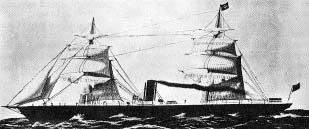
The Manhattan was a steamship
Eccles, Bertha Marie Jensen, [Autobiography], Utah Pioneer Biographies,
vol. 9, pp. 24-26, 28.
Letter from N. H. Felt - July 3, 1867
Felt, N.H, [Letter] Latter-day Saints’ Millennial Star 29:31,
(August 3, 1867.) P. 494-495.
On board steamship Manhattan, July 3, 1867.
N. H. Felt. [p.495]
Writings of Andrew Fillerup
Fillerup, Andrew Peter [Writings] in Hutchings Family, Newsletters
(Special Collections & Manuscripts, Mss Sc 7758), vol.1, no.1, p. 5
(Harold B. Lee Library, Brigham Young University, Provo, Utah)
Utah Lake is 4428 feet above sea level.
Utah lies between 37° and 42° N and 109° and 111° longitude.
We traveled 2095 miles at a cost of $2427.678. . . . [p.5]
Letter from A. N. Hill - July 4, 1867
Hill, A. N., et. al. [Letter], Latter-day Saints’ Millennial Star
29:30, (July 27, 1867) pp. 473-474.
Steamship Manhattan New York Harbor, July 4, 1867.
President F. D. Richards
A. N. Hill, President
Niels Wilhelmsen, Counselor
James Ure, Counselor
Francies Platt, Counselor
R. R. Anderson, Clerk [p.474]
Autobiography of Jens Iver Jensen
Jensen, Jens Iver, [Autobiography], Our Pioneer Heritage, comp.
By Kate B. Carter, vol. 10 (Salt Lake City: Daughters of Utah Pioneers,
1967) p. 74-75.
Autobiography of Johanna Kirstine Larsen Winters
Winters, Johanna Kirstine Larsen [Autobiography], Our Pioneer
Heritage comp. by Kate B. Carter, vol.11 (Salt Lake City: Daughters of
Utah Pioneers, 1968) pp. 60-61, 64.
Reminiscences of Charles Keilgaard Hansen
Hansen, Charles Keilgaard. Reminiscences (Ms 8891).
pp. 90-92, 94-96.
LDS Church Historical Department Archives
Journal of William Gibson
Gibson, William. Journals (Ms 901), vol. 2, pp. 73-74.
LDS Church Historical Department Archvies
Felt, Alma Elizabeth Mineer, Journal, An Enduring Legacy, vol.
7 (Salt Lake City: Daughters of Utah Pioneers, 1984) pp. 196-198, 200.
Minutes of the Monarch of the Sea
Harrison, E. L.T., "Minutes of the Monarch of the Sea Conference,
[Letter], Latter-day Saints’ Millennial Star 23:30 (July 27, 1861) pp.
475-76.
Letter of Elias L. T. Harrison - June 19, 1861
Harrison, Elias L. T., [Letter], Latter-day Saints’ Millennial
Star 23:30 (July 27, 1861) pp. 478-79.
Monarch of the Sea, New York, June 19, 1861.
President G. [George] Q. Cannon.
To W. R. Gardner, Esq., Commander, Monarch of the Sea.
Jabez Woodard,
H. O. Hansen,
N. Wilhelmsen,
Presidents of the Company.
E. L. T. Harrison, Secretary.
June 1861.
Elias L. T. Harrison.[p.479]
Diary of Carl Eric Lindholm
Lindhom, Carl Eric. [Diary], Our Pioneer Heritage comp. by Kate
B. Carter, vol. 12 (Salt Lake City: Daughters of Utah Pioneers, 1969) p.
478-479.
LDS Church Historical Department Archives
Autobiography of William Probert, Jr.
Probert, William, Jr., [Autobiography], In Biography of William
Riley and Hussler Ann Probert Stevens, comp. and ed. by Orvilla Allred
Stevens (privately printed, 1981) pp. 56- 57.
The Life of John and Barbara Staheli
Staheli, John. The life of John and Barbara Staheli, (Ms
7832), pp. 1-3; Acc. #19761.
LDS Church Historical Department Archives
History of Barbara Sophia Haberli Staheli
Walker, Elizabeth Staheli. History of Barbara Sophia Haberli
Staheli. (Ms. 8691, reel 3), pp. 1-3; Acc. # 35501.
LDS Church Historical Department Archives
Journal of Peter Nielsen
Nielsen, Peter. Journal (Ms 8221), pp. 354-57.
LDS Church Historical Department Archives
Breinholt, J. C. L. Autobiography (formerly in Msd 2050),
p. 10,12.
LDS Church Historical Department Archives
Autobiography of Richard Daniels Brown Jr.
Brown, Richard Daniels, Jr., [Autobiography], In Brown, Archie
Leon, 141 Years of Mormon Heritage: Rawsons, Browns, Angells - Pioneers
(privately printed, 1973) pp. 81- 83.
George Finlinson Family
Finlinson, George, George Finlinson Family, 1835-1974, comp. by
Angie F. Lyman (privately printed, 1974) pp. 14-19.
George did not write more in his diary but he went on to Salt Lake
and then on to Fillmore. . . .[p.19]
Autobiography of Nils C. Flygare
Flygare, Nils Christian, Autobiography. In Papers (Special
Collections & Manuscripts, MSS 1496, bx. 1, fd. 3, pp. 51-57).
(Harold B. Lee Library, Brigham Young University, Provo, Utah)
History of Caroline Martine Anderson
History of Caroline Martine Anderson, first wife of Charles Keilgaard
Hansen [letter, Caroline Martine Hansen to Charles K. Hansen, June 17,
1864, Wyoming, Nebraska] (Ms 8889). pp.1-2
LDS Church Historical Department Archives
Caroline Martine Hansen.
These letters were translated from Danish language to the English by
Edith Melgaard Cox of Fairview, Utah. [p.2]
Letter of Caroline Martine Hansen - April 18, 1864
Hansen, Caroline Mortine. [Letter] Our Pioneer Heritage comp.
by Kate B. Carter, vol. 16 (Salt Lake City: Daughters of Utah Pioneers,
1973), pp. 460-61.
Grimsby, England April 18, 1864
Caroline Mortine Hansen.[p.461]
Diary of Christian Hansen [Jensen]
Hansen, Christen [Jensen]. Diary (Ms 1795), pp. 12-13.
LDS Church Historical Department Archives
Autobiography of Nels August Nelson
Nelson, Nels August. Autobiography (formerly in Msd 2050),pp. 1.
LDS Church Historical Department Archives
Journal of Ove Christian Oveson
Oveson, Ove Christian. Journal (Ms 6221), pp. 22-23, 25.
LDS Church Archives
Reminiscences of Martha Olson Sprague
Sprague, Martha Olson, [Reminiscences], "Utah Pioneer Biographies,"
vol. 27, pp.51- 52.
Reminiscences of H. N. Hansen
An Account of a Mormon Family’s Conversion"
Hansen, H. N., "An Account of a Mormon Family’s Conversion to
the Religion of the Latter-day Saints and their Trip from Denmark to Utah,"
Annals of Iowa 41:1 (Summer 1971) pp 712-26.
Reminiscences of John Johnson [Johan Johanssen]
Johnson, John. [Johan Johanssen] Reminiscences (Ms 1779), fd.
4, pp. 4-8,12-13.
LDS Church Historical Department Archives
Autobiography of Andrew Christian Nielson
Nielson, Andrew Christian. Autobiography (Ms 2735 282),
pp. 4-6.
LDS Historical Department Archives
Autobiography of John Smith
Smith, John. Autobiography (MS 8305 3 #1), pp. 10-12.
LDS Church Archives
Ballard, Margaret McNeil, [Autobiography], (Mss A - 1- 074), pp.
2-4 (Utah State Historical Society)
Reminiscences of George Cunningham
Cunningham, George. Reminiscences. (Ms 7322 2), pp. 1-3,
5.
LDS Church Historical Department Archives
Family History of Mary Ann James Dangerfield
Dangerfield, Mary Ann James. Family History. (Ms 2050, reel
4, bx. 4, fd. 10, item #1), pp. 2-3.
LDS Church Historical Department Archives
Journal of James G. Willie
James G. Willie Emigrating Company. Journal. (Ms 1477), pp. 1-15.
LDS Church Historical Department Archives
Diary of John Linford
Linford, John. Diary. (Ms 3984, fd. 2); pp. 1-3.
LDS Church Historical Department Archives
The Sketch of Susanna Stone Lloyd
Lloyd, Susanna Stone. Sketches (Ms 11995), p. 1.
LDS Church Historical Department Archives
I, Susanna Stone Lloyd, being impressed to make a sketch of my
early life, will endeavor to do so. I was born of honest parents,
in the town of Bristol, England, December 24, 1830. My father was
William Stone, who was a master painter, born in London. My mother,
Diana Grant Stone, was born in Glostershire, England. My grandmother’s
maiden name was Sherman. She married a Mr. Hall. After becoming
a widow, she married my grandfather Grant, who came to America in the early
days. My Father’s people belonged to the Church of England, Mother’s
people to the Wesleyans. I attended the Wesleyan Sunday School.
I used to read the scriptures and wish that I had lived in the days of
Apostles and Prophets, not knowing then that the everlasting gospel had
been restored to the earth. When I heard it preached I hailed it
with joy. I joined the Church of Jesus Christ of Latter Day Saints
about the year 1848. This caused my heart to rejoice. I have
seen that the hand of the Lord has been over me for good from my earliest
childhood and I know that his Holy Spirit has been my constant guide and
companion. I never shall forget the many manifestations of the Lord’s
goodness and blessings unto me and mine. My parents, relatives and
friends did all in their power to keep me from coming to America, but I
had the spirit of gathering and the Lord opened my way and I came to Utah
in 1856 with the hand cart company. Brother Willey [James G. Willie]
was our captain, Millen Atwood was his councilor. We were almost
pioneers for we had to travel thru sunflowers and sage brush for many miles.
Diary of Peter Madsen
Madsen, Peter. Diary. (Ms 1451), (Danish mss.) And (English
translation) pp. 3-15,29
LDS Church Historical Department Archives
name tinware debt (price) s(shilling) d(pence)
Jensen [Jenson] " " 8 9
Jens Petersen [Peterson] " " 2 9
Wiklund " " 5 9
Sophie Pedersen " " 6 9
Niels Hansen [Hanson] " " 2 6
The foregoing expenses, 59 rigsdaler, 3 [-], and contributions, 39
rigsdaler, 4 [-], 14[-], are balanced as follows: 19 rigsdaler, 5 [-],
3, [-], which exchanged for English money amounts to 2 pounds, 5 shillings,
and a sixpence.
The three pounds that Jorgen Andersen received from Lars Madsen equals
$14.52 and the one pound from Ana Olsen equals $4.83.
Autobiography of Archibald McPhail
McPhail, Archibald. "Archibald McPhail Comes to Zion" in
Voices From the Past: Diaries, Journals and Autobiographies, comp. by Campus
Education Week Program (Provo, Utah: Brigham Young University, 1980) pp.
61-64.
"More Mormons"
[Newspaper article], Journal History (June 14,1856),
p. 1.
More Mormons
Autobiography of John Oborn
Oborn, John, [Autobiography] Heart Throbs of the West, Comp. by
Kate B. Carter, vol. 6 (Salt Lake City: Daughters of Utah Pioneers, 1945)
pp. 364-66.
Autobiography of Ann Jewell Rowley
Rowley, Ann Jewell, [Autobiography], in Jones, James Albert, Some
Early Pioneers of Huntington, Utah and Surrounding Area, (privately printed,
1980) p. 243.
Richard Rowley
Rowley, Richard. Richard Rowley, 1897 (Special Collections
& Manuscripts, MSS SC 2763), p. 1. (Harold B. Lee Library, Brigham
Young University, Provo, Utah)
A Biographical Sketch of the Life of Samuel Rowley
Rowley, Samuel. "A Biographical Sketch of the Life of Samuel
Rowley, son of William and Ann Jewel Rowley" (Special Collections &
Manuscripts, MSS SC 2764)," p.1-2. (Harold B. Lee Library, Brigham
Young University, Provo, Utah)
Faithful Stewards-the Life of James Gray Willie and Elizabeth Ann Pettit
BSmith, Marilyn Austin. Faithful stewards--the life of James
Gray Willie and Elizabeth Ann Pettit (Ms 9248), pp. 88-95.
LDS Church Historical Department Archvies
land . . . Doctor came on board off Staten Island and gave a certificate
of the good health of the passengers. The Custom House also came
and passed our luggage without any inspection. At sun down we landed
at the Castle Gardens, a large building appropriated for emigrants, where
we were visited by Elder Felt who kindly welcomed us."
Letter from Anna F. Tait - June 6, 1856
Tait, Anna F., [Letter], Latter-day Saints’ Millennial Star 18:30
(July 26, 1856) pp. 478- 479.
New York, ship Thornton, June 6, 1856.
Anna F. Tait. [p.479]
Willie, James G., [Letter], Journal History, June 14, 1856,
p. 3.
Letter from James G. Willie - June 11, 1856
Ship Thornton, at Sea off New York,
June 11, 1856
Chas. Collins, [-]
B. W. Ward, [-]
John W. [-]
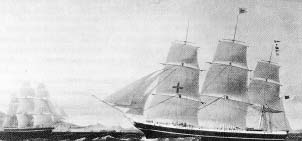
The Tuscorora crossed the Atlantic in 1857
Anderson, P.N., "P. N. Andersons Beretning," Morgenstjernen 3:20
(15 Oktober 1884) p.314. Translated from Danish by Gavin Christensen.
LDS Church Historical Department Archives
BAdams, Caroline Hansen, [Autobiography], Our Pioneer Heritage,
comp. By Kate B. Carter, vol. 12 (Salt Lake City: Daughters of Utah Pioneers,
1969) p. 472.
Autobiography of Lars Christian Christensen
Christensen, Lars Christian. A short sketch of my life (formerly
in Msd 2050), (typescript), (Ms 5831) pp. 4-6.
LDS Church Historical Department Archives
Diary of Matthias Cowley
Cowley, Matthias. Diary, pp. 64-82.
LDS Church Historical Department
Letter from Matthias Cowley - June 1, 1857
Cowley, Matthias. [Letter], Latter-day Saints' Millennial
Star 19:28 (July 11, 1857), pp. 445-47.
Ship Westmoreland, Philadelphia, June 1, 1857.
President O. [Orson] Pratt.
Matthias Cowley. [p.447]
Journal of Johann F. F. Dorius
Dorius, Johann F. F., [Journal] in Church Emigration Book (1855-1861)
pp. 3-7.
LDS Church Historical Department Archives
Reminiscences and Journal of John Frantzen
Frantzen, John. Reminiscences and Journal (Ms 8953), pp.
27-29, 39.
LDS Historical Department Archives
Reminiscences of Louis Garff
Garff, Louis. Reminiscences (Ms 1754), p. 58
LDS Historical Department Archives
Autobiography of Ola Nielson Liljenquist
Liljenquist, Ola Nielsen, [Autobiography] Tullidges Quarterly
Magazine 41 (July 1881) pp. 570-71.
Journal of Matthias Cowley Emigrating Company
Matthias Cowley Emigrating Company. Journal. (Ms 5479)
pp.1-18.
LDS Church Historical Department Archives
Isaac Soresen Journal
Sorensen, Isaac [Journal], (Special Collections and Archives,
920, So 68), pp. 31-33, (Utah State University).
Journal of Isaac Sorensen - Utah Historical Quarterly
The History of Isaac Sorensen: Selections from a Personal Journal", A. N. Sorensen, ed. Utah Historical Quarterly Volume 24 (1956), p. 52-53
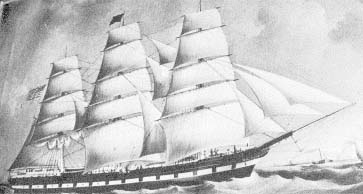
The William Tapscott made several LDS voyages
Journal of John James Fry
Fry, John James. Journal 1849-1860, pp. 1-2.
LDS Church Historical Department Archives
Journal of Henry Hobbs
Hobbs, Henry, 1835-1917. Journal, 1859 May-1860 Jul, pp.
13-65, 73-74, 89, 91-92.
LDS Church Historical Department Archives
Autobiography of Lars Christian Pedersen
Pedersen, Lars Christian, 1839-1920. Autobiographical sketch
[ca. 1919]. pp. 3-4.
LDS Church Historical Department Archives
Journal of James Kirkham
Kirkham, James, [Journal], In Kirkham, E. Kay, George (Wm.) Kirkham:
His Ancestors and Descendants to the Third Generation (privately printed,
1973) pp. 65-67.
We Sail
Journal of Thomas McIntyre
McIntyre, Thomas. Journal. 1833-1914. [LDS Church
Archives, Ms 1794, pp. 16-17, 67-68.
LDS Church Historical Department Archives
Reminiscences and diaries of Hans Olsen Magleby
Magleby, Hans Olsen. Reminiscences and diaries (Ms 1540),
vol. 2, pp. 56-61, 70. Typescript, translated from Danish.
LDS Church Historical Department Archives
April, 1859
May, 1859
June, 1859
September, 1859.
Letter from Robert F. Neslen et. al - May 13, 1859
Neslen, R[obert] F. [Letter] Latter-day Saints' Millennial Star
21:25 (June 18, 1859) pp. 400-401.
New York, May 13, 1859.
President Asa Calkin.
Sir,--As we are drawing to the conclusion of our voyage, we should
not be doing justice to our feelings, were we not to embrace this opportunity,
before we separate, of expressing, though briefly, those sentiments of
sincere regard and esteem which have been engendered within us towards
yourself, during our short intercourse while on our passage across the
Atlantic, and throughout which we have all been so happily blessed and
prospered.
We would humbly assure you that the pleasant and interesting time which
we have spent on board the William Tapscott will be long remembered by
us all, and mostly so on account of the many kindnesses and favors which
we have received from her worthy captain. The assiduous care and
kindly interest which you have universally displayed for our comfort and
welfare, your courteous urbanity, and gentlemanly bearing have all combined
to win our hearts and call forth the warmest feelings of a grateful people.
And wherever our respective lots may be cast in the future, our minds
will often revert to the present voyage and its happy associations; and
our heartfelt prayers shall ascend to heaven for the richest blessings
of our Father to be bestowed upon you that your life may be long,
prosperous, and happy, and your future, joy and peace.
Signed, in behalf of the seven hundred and twenty-six passengers, and
with their unanimous approval.
Robert F. Neslen
President of the Company of Emigrants
Henry H. Harris
George Rowley
Counselors
James Bond
Secretary [p.401]
Journal of Fanny Fry Simmons
Simons, Fanny Fry, An Enduring Legacy, Vol. 6 (Salt Lake City,
Daughters of Utah Pioneers, 1983) pp. 185-89.
Autobiography of Squire Thornton
Thornton, Squire. Autobiography (Mon A 1260) (Utah State
Historical Society), pp. 2,4.
Autobiography of Eda [Ido] Fredreca Kruger Tietjen [Titjen]
Tietjen, Eda Fredreca Kruger. Autobiography, ( Daughters
of the Utah Pioneers Museum Library, Salt Lake City), p. 1.
Astle, Francis. An Enduring Legacy Vol. 10 (Salt Lake City, Daughters of the Utah Pioneers, 1987),
pp.105-11.
Journal of C. [Christen] L. Christensen
Christensen, C. L., Heart Throbs of the West, Comp. by Kate B.
Carter, Vol. 9 (Salt Lake City: Daughters of Utah Pioneers, 1948), pp.1-3.
Diary of Niels Christian Christensen
Christiansen, Niels Christian, Diary, In Manuscript History
of the Scandinavian Mission, May 2, 1860, p. 3-8 (LR 9332, ser. 2, reel
6).
LDS Church Historical Department Archives
1860 (May 2)
A Short Sketch of Gottlieb Ence
Ence, Gottlieb. A short sketch of my life. 1840-1918
LDS Church Archives, Ms 8658, pp. 8-9,10; Acc. #35318.
Autobiography of Carl Johan Ellefsen Fjeld
Autobiography, In A Brief History
of the Fjeld-Fields Family, Comp. By Andrew Fjeld (Springville, Utah:
Art City Publishing, 1946) pp. 17-20.
Life Story of Mary Ann Stucki Hafen
Autobiography. (Daughters of Utah
Pioneers Museum Library, Salt Lake City), pp. 2-3.
Memories of George Isom
Memories, LDS Church Archives, Ms 8620, reel
5, item #2, pp. 5-12,14; Acc. #35069. Also LDS Church Archives, Ms
8040, pp. 9-18; Acc. #26732
Journals of Charles F. Jones
Jones, Charles F. Journals (Ms 1679), vol. 2 p.194, vol.
3 pp. 1-4.
LDS Church Historical Department Archives
Autobiography of Andrew Rasmussen
[Autobiography], In Sanderson, Ivan L., A Brief
History of Amasa Rasmussen, 1868-1965 (privately printed) pp. 8-9
Autobiography of Heinrich Reiser
Autobiography, (formerly in Msd 2050),
pp. 4-7 LDS Church Archives(Ms 8233)
Journal of John S. Stucki
Stucki, John S., Family History Journal of John S. Stucki (Salt
Lake City: Pyramid Press, 1932) pp. 40-41
The Latter-day Saints' Millennial Star 22:29 (July 21, 1860)
pp. 459- 460
Your friend and brother
Thomas Williams [p.460]